
AI image generators have multiplied faster than most creators can audit them. Marketing pages all promise the same thing: photorealistic, cinematic, brand-ready visuals from a single line of text. The only way to separate genuine capability from glossy demos is to put each tool through the same brief and look at what comes back.
This comparison runs a single editorial prompt through four of the most discussed AI image generators of 2026: Ideogram, Leonardo AI, Stable Diffusion, and Recraft AI. The prompt describes a futuristic freelance creator workspace at night, complete with hardware, ambient lighting, a holographic interface, and a rain-soaked city skyline. The brief is deliberately layered, because real production work rarely fits a one-line request.
All four tools generated outputs that could be reviewed side by side. The sections that follow break down each render against the same evaluation criteria, with a verdict on where each tool earns its place in a creator workflow.
How the Comparison Was Set Up
Every tool received the exact same prompt, the same 16:9 landscape ratio, and the same instruction to avoid readable text, logos, people, and watermarks. No prompt rewriting, weighting tricks, or platform-specific style modifiers were applied. The point was to measure how each model interprets a layered editorial brief out of the box, not how far a power user can push it with prompt engineering.
Generation speed across all four tested platforms was consistently quick. None of the renders required more than a short wait, which mirrors the broader 2026 trend toward near-real-time inference. Speed alone has stopped being a differentiator, so the comparison weighs composition, lighting, material realism, and prompt adherence instead.
The exact prompt used
| Create a realistic 16:9 landscape editorial image of a futuristic freelance creator’s workspace at night. A clean wooden desk has a tablet showing a half-finished digital illustration, a camera lens, a coffee cup, sticky notes, and soft LED lighting. In the background, a large window shows a rainy city skyline with subtle reflections on the glass. Add a small holographic AI assistant interface floating above the tablet, with abstract icons for image generation, editing, and color correction. The image should feel professional, cinematic, detailed, modern, and suitable for a tech blog cover. No readable text, no logos, no people, no watermark. |
Evaluation criteria
• Photorealism of materials, especially the wooden desk, glass, and ambient LED light.
• Composition and cinematic framing across the 16:9 canvas.
• Prompt adherence on the layered request: tablet illustration, camera lens, coffee cup, sticky notes, rainy skyline, holographic interface.
• Restraint on the no-text, no-logo, no-people, no-watermark constraints.
• Usability of the raw output as a tech blog cover without heavy post-production.
Ideogram: Output and Observations
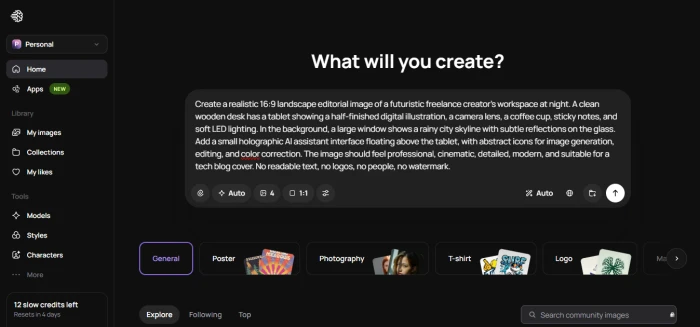
Ideogram is best known for its industry-leading text rendering. According to Tool Junction, Ideogram 3.0 renders embedded text with 90 to 95 percent accuracy, well ahead of most competitors. On this brief, however, the prompt explicitly rules out readable text, which means the comparison falls back on what Ideogram does outside its headline feature: photographic composition, lighting, and prompt adherence.
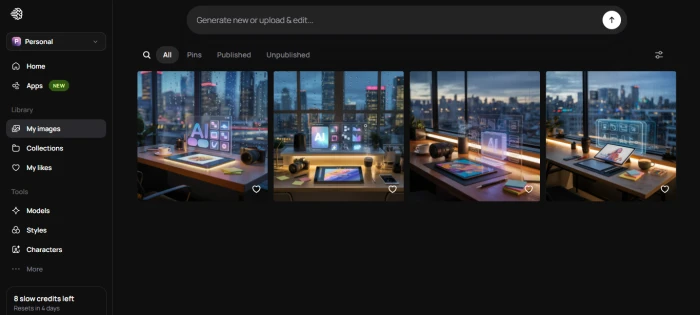
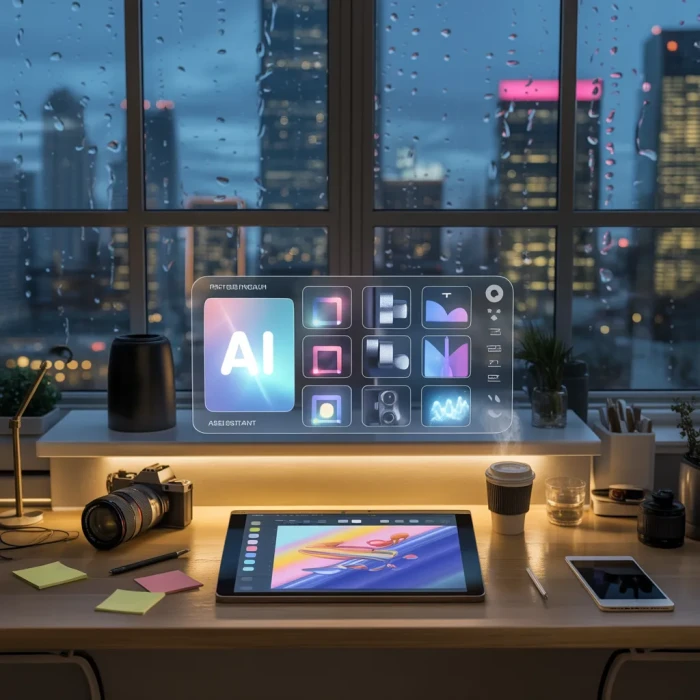
On the workspace render, Ideogram delivers a clean, balanced composition with strong attention to the foreground objects called out in the prompt. The wooden desk reads as physical and grain-accurate, the tablet illustration sits naturally rather than looking pasted in, and the LED lighting wraps around the scene with consistent warmth. The holographic interface, the part of the brief most likely to break a model, is treated as a soft translucent overlay rather than a hard sticker shape.
The rainy city background is rendered with restraint. The reflections on the glass behave like a real window rather than a stock photo composite. Where Ideogram occasionally trails the more cinematic models is in mood: the output feels editorial and tidy rather than dramatic.
Output:
Where Ideogram lands
• Reliable object placement, strong prompt adherence, and disciplined respect for the no-text instruction.
• Mood reads polished and editorial rather than moody or cinematic.
• Free tier covers 10 prompts per day, with paid plans starting at roughly $7 to $8 per month according to Cost Bench and Top 50 AI Tools, which makes it one of the more accessible options on this list.
Inside the Leonardo AI Render
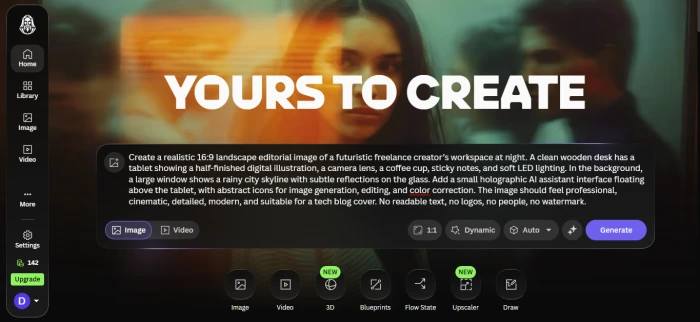
Leonardo AI runs on its Phoenix model family and has built much of its reputation on cinematic, concept-art style outputs. The free tier provides 150 tokens per day, with paid plans beginning at $12 per month according to Cost Bench. For a prompt that explicitly asks for a cinematic and professional tech blog cover, this is the tool with the closest stylistic match on paper.
The render leans into atmosphere. The rainy skyline through the window carries the kind of soft bokeh and color separation that usually requires manual color grading. LED lighting is read as a directional source rather than ambient glow, which gives the desk objects clearer shadow definition than the other tested models. The holographic interface above the tablet sits in the air convincingly, with a faint glow that does not bleed into surrounding pixels.
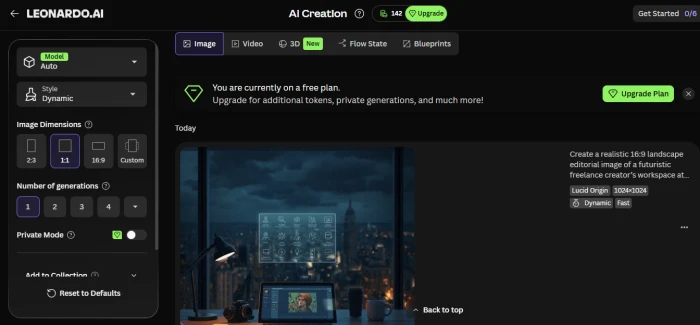
The trade-off is interpretation. Leonardo AI tends to add stylistic flourish even when not asked. Some elements of the prompt, such as the abstract icons inside the floating interface, can come through as decorative shapes rather than recognizable iconography. For a cover image where mood matters more than literal accuracy, that is often a feature rather than a flaw.
Output:
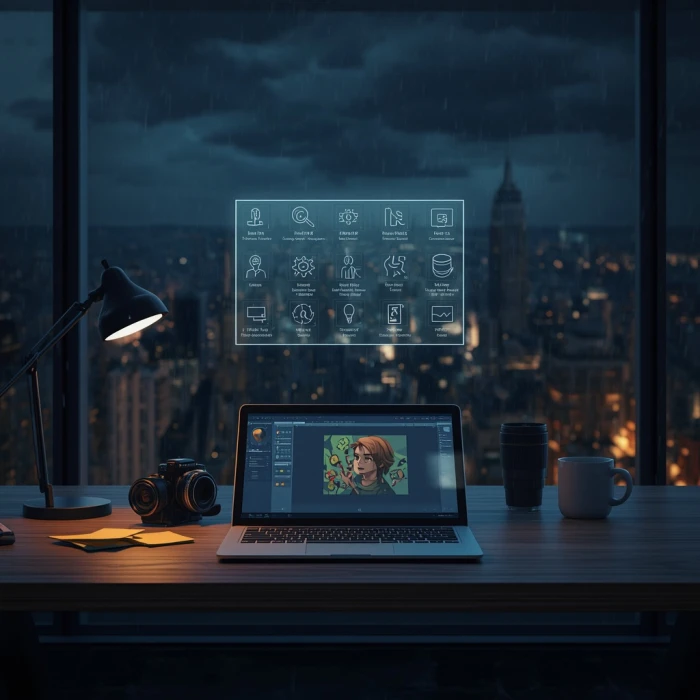
Where Leonardo AI lands
• Strongest cinematic mood of the four tested platforms, with believable lighting and atmosphere.
• Occasionally interprets abstract elements as decorative rather than literal, which suits cover art more than product visualization.
• Free 150 tokens per day go fast once advanced features like upscaling or higher resolution variations are enabled, as flagged by Flux Note.
Stable Diffusion
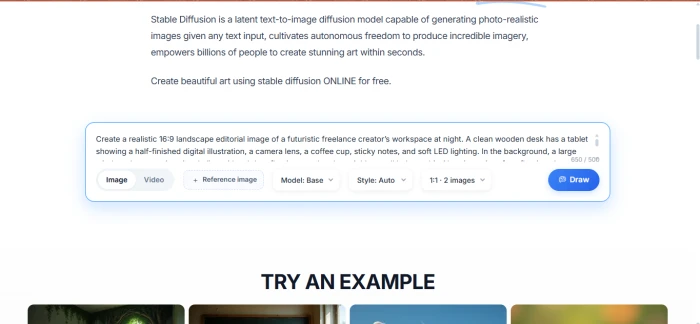
Stable Diffusion is the open-source pillar of the AI image generation ecosystem. The flagship public model, SDXL, runs locally on consumer GPUs or through hosted interfaces, and the broader family includes a deep library of community checkpoints such as Juggernaut XL and RealVisXL. Articsledge documents the evolution from SD 1.5 through SDXL and Stable Diffusion 3.5, with each generation expanding resolution and prompt adherence.
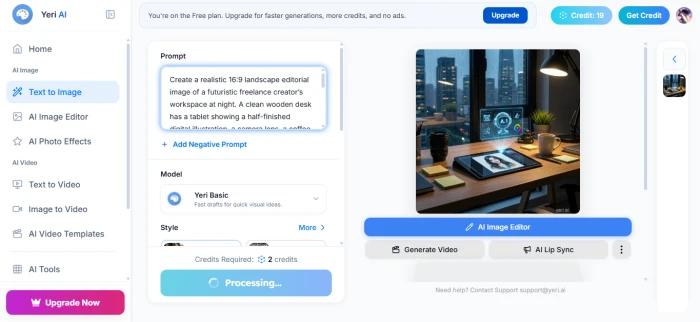
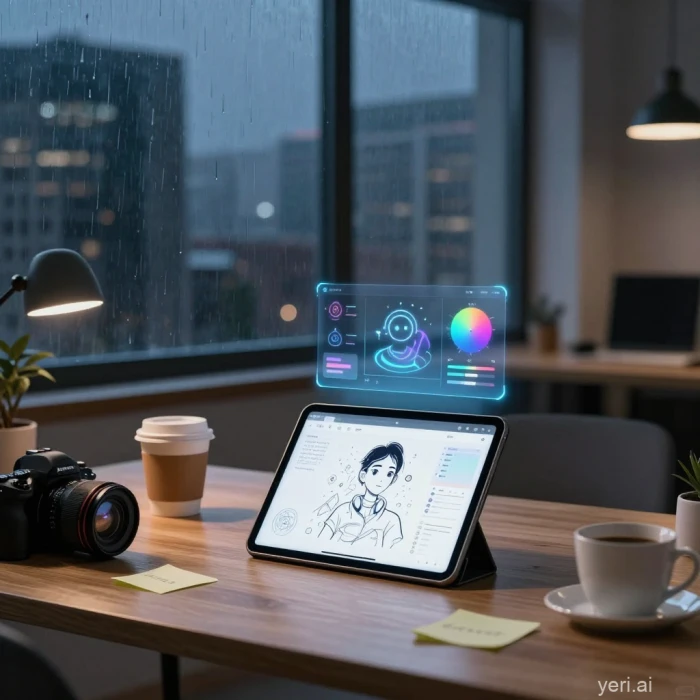
For this brief, the SDXL output sits between Ideogram and Leonardo AI in character. Photorealism on the desk materials and the camera lens is high, and the rainy window holds up to close inspection without obvious artifacts. The holographic interface is the weakest part of the composition: without a ControlNet pose or sketch guidance, the model places the hologram correctly but renders the abstract icons as soft geometric blobs rather than icon-like shapes.
The real story with Stable Diffusion is variability. The same prompt against a different community checkpoint or with a small style LoRA can swing the output from clinical product shot to full cinematic still. That openness is the platform’s strength and its overhead at the same time, because the quality ceiling rises with skill, but so does the setup time.
Output:
Where Stable Diffusion lands
• Highest ceiling for technical control through ControlNet, LoRA, and checkpoint swaps, as covered in the Image Tools AI SDXL guide.
• Out-of-the-box prompt adherence on layered briefs is solid but not the most cinematic without extra tuning.
• Cost depends on the interface: free locally with a capable GPU, or through paid hosted services that vary widely in price.
Recraft AI Tackles the Brief
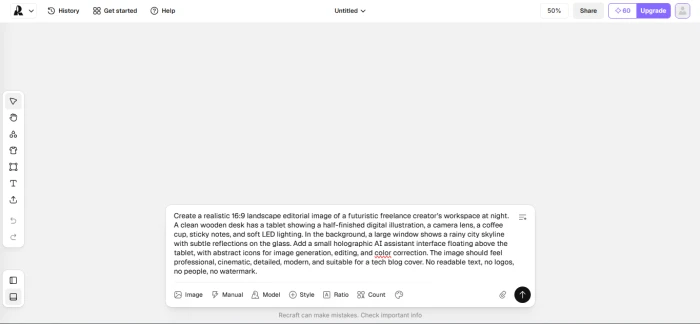
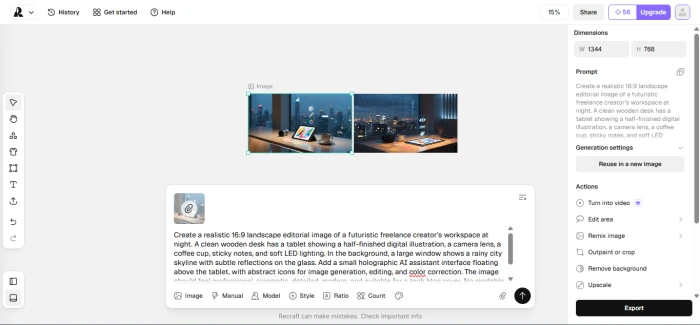
Recraft AI sits in a slightly different category. Its core differentiator is native vector generation, with the V3 and V4.1 models producing editable SVG output alongside raster images. Tools for Humans documents brand style training, infinite canvas workflows, and Figma plus Framer plugins, all aimed at design teams rather than general consumer use.
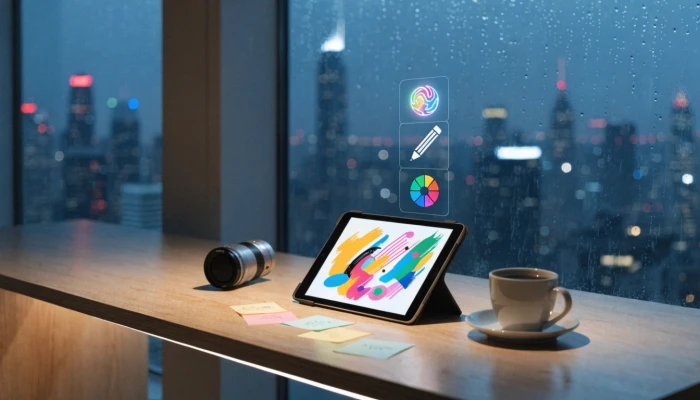
On a raster, photorealistic workspace prompt, Recraft AI plays slightly against type. The render comes back clean, well composed, and faithful to the object list, but with a polish that reads closer to high-end stock photography than full cinematic still. The materials are convincing, the holographic interface is restrained and tidy, and the no-text instruction is respected without slip-ups. The mood is corporate calm rather than rainy-night dramatic.
Where Recraft AI pulls ahead is in usability of the output for downstream design work. The composition leaves comfortable negative space for headlines and overlays, which matters for a tech blog cover that will be combined with a title bar in a CMS. According to SVG Genie and Tools for Humans, the free plan offers 30 daily credits, with paid private generation starting at around $20 per month.
Output:
Where Recraft AI lands
• Cleanest composition for downstream layout work, with strong respect for prompt constraints.
• Native vector and brand style features add value beyond a single render, especially for design teams.
• Free tier images are public and lack commercial rights, so any professional use requires the paid tier.
Side-by-Side at a Glance
The table below summarizes how each tool handled the editorial workspace brief. Rankings are qualitative, drawn from the rendered outputs and the platform behavior observed during the test.
| Tool | Photorealism | Cinematic Mood | Prompt Adherence | Free Access |
|---|---|---|---|---|
| Ideogram | Strong | Good | High | 10 prompts per day |
| Leonardo AI | Very Strong | Very Strong | Good | 150 tokens per day |
| Stable Diffusion | Variable by model | Strong with right checkpoint | High with controls | Free if run locally |
| Recraft AI | Clean and polished | Moderate | High | 30 credits per day |
Best Pick by Use Case
Cinematic blog covers and editorial headers
Leonardo AI is the strongest choice for moody, atmospheric covers where lighting and color carry the image. The Phoenix model interprets cinematic prompts with confidence, and the trade-off in literal accuracy on abstract elements is usually acceptable for hero artwork.
Product or workspace visualization with strict prompt fidelity
Ideogram earns this pick. The render keeps objects in the right places, holds the no-text constraint, and produces a polished editorial look without veering into stylization. At under $10 per month for the entry paid tier, it is also the most cost-efficient pick for high-volume publication work.
Brand-consistent assets and layout-ready images
Recraft AI is built for this lane. The clean composition, brand style training, and native vector output make it the most useful choice when the generated image is one piece of a larger design system. The higher price point and lack of free commercial rights are the cost of that specialization.
Full creative control and custom training
Stable Diffusion remains the answer when a workflow needs ControlNet, LoRA tuning, custom checkpoints, or local inference. The setup overhead is real, but the ceiling is the highest of any tool in this group for teams willing to invest in the stack.
Methodology Notes and Limitations
All four tested generations ran on the default settings of each platform’s free or trial tier, with no negative prompts, style references, or seed locking. Resolution was kept consistent at the 16:9 landscape preset offered by each tool. Outputs were judged on a single generation per platform to mirror what a creator would see on a first attempt, rather than the best of many tries.
One limitation applies. Stable Diffusion outputs depend heavily on the chosen checkpoint, so results from a different community model could shift the comparison meaningfully. The framework itself is repeatable: any reader running the same prompt should expect broadly similar character from each tool, with minor variation per generation.
Closing Take
No single AI image generator wins this brief outright. Leonardo AI delivers the most cinematic frame, Ideogram offers the cleanest prompt adherence at the lowest cost, Recraft AI produces the most layout-ready composition, and Stable Diffusion provides the highest ceiling for teams willing to tune their own stack.
For a publication producing tech blog covers on a steady cadence, the practical answer is a two-tool pairing: one cinematic generator for hero art and one disciplined generator for in-article visuals. The four names compared here cover every combination most creator teams will need in 2026.
Comments
Join the discussion and share your perspective.