
Yono Chomp (yonochomp.com) presents itself as a sixteen-category multi-niche digital publication covering automotive, business, education, entertainment, fashion, finance, general, health, life, online games, real estate, social media, sports, technology, top posts, and travel. The footer claims a 2026 copyright. The homepage uses a clean WordPress theme. The article thumbnails load properly. On first glance, nothing about the layout screams spam.
The structural inconsistencies, however, start surfacing within the first scroll. The archive widget lists only three active months. The Recent Comments box reads "No comments to show." The same author byline appears on every visible post, attached to an author profile URL whose slug does not match the displayed name. A guest post marketplace banner sits in the sidebar pointing to a third-party advertising domain. None of these are subjective impressions. They are observable facts on the live homepage.
This audit applies a six-layer domain reality check to separate functioning publications from monetized SEO surfaces.
Surface Presentation
The homepage runs the Warm Blog theme by Adore Themes on WordPress 6.9.4. Typography is readable. Spacing is consistent. Categories sit in a clean horizontal menu. Each post card carries a featured image, an estimated reading time, a category tag, an author name, and a publication date. Visually, the site reads as a legitimate small-to-mid publication rather than a thrown-together blog farm.
Archive Depth
Three Active Months Spread Across Roughly Three Years
The archive widget on the homepage lists exactly three months: May 2025, August 2023, and July 2023. There is no January 2024, no October 2024, no February 2025. Between late August 2023 and May 2025, there is no publishing record visible in the archive at all.
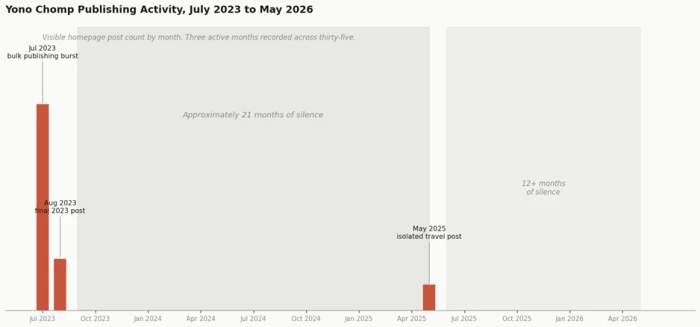
Figure 1. Visible publishing activity across thirty-five months. Two clusters in 2023, one isolated post in 2025.
| Active month | Visible homepage activity | Gap until next active month |
|---|---|---|
| July 2023 | Multiple posts: fashion, general, top post | Roughly 1 month |
| August 2023 | At least one online game post | Roughly 21 months |
| May 2025 | One travel post (Naarden) | 12+ months to present |
For a publication branded with sixteen categories, three active months across three years is the central red flag. A functioning multi-niche magazine typically shows continuous monthly activity, contributor cycles, and seasonal coverage trends. Yono Chomp shows none of those patterns. It shows a single 2023 content drop, a year-and-a-half of silence, and one isolated travel article in 2025.

Category Honesty
Sixteen Advertised, Five Populated
The header navigation advertises sixteen categories. The Categories widget in the sidebar, which on WordPress typically reflects only categories containing at least one post, lists five: Fashion, General, Online Game, Top Post, and Travel. The remaining eleven categories advertised in the main menu, automotive, business, education, entertainment, finance, health, life, real estate, social media, sports, and technology, do not appear in the sidebar at all.
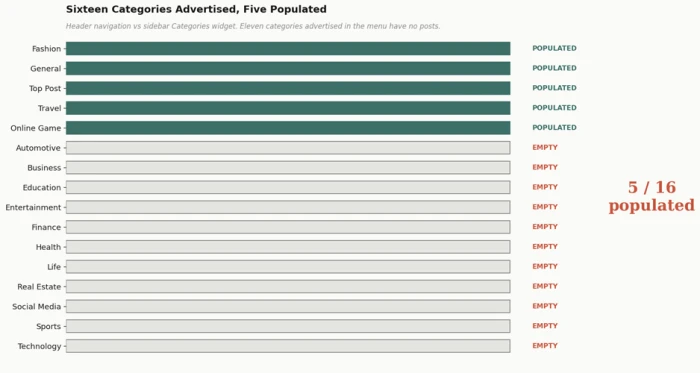
Figure 2. Header navigation versus sidebar Categories widget. Eleven advertised categories carry no posts.
This mismatch is structurally important. The header projects scope. The sidebar reveals reality. A reader landing on the homepage assumes coverage across sixteen topics. A reader who scrolls to the sidebar finds the publication has effectively published in five. The other assessment notes the same pattern, observing that several sections contain almost no meaningful activity and that many categories barely have posts.
Authorship Trail
One Display Name, One Mismatched URL Slug, Zero Bios
Every post visible on the homepage carries the same author byline: Roland. The author profile URL behind that byline is /author/brijesh/. The displayed name and the URL slug do not match. There is no visible "About the Author" box on the homepage cards, no editorial team page in the main navigation, and no contact information beyond an obfuscated email link in the sidebar.
One author across an entire sixteen-category publication is already a credibility signal. A mismatch between display name and author slug compounds it. Functioning publications generally maintain consistency between the byline a reader sees and the author archive URL, because both are tied to a real contributor record inside the CMS. A name-slug divergence suggests a placeholder identity rather than a genuine staff writer.
Monetization Signals
The Sidebar Banner Says What the Footer Will Not
The sidebar of yonochomp.com contains a banner image labeled "Guest Post Marketplace 2026" linking to an external third-party domain that routes to an Adoovy advertising endpoint. This banner is not hidden, not gated, not buried inside a privacy policy. It sits in the standard right-rail position above the Recent Posts widget on the homepage.
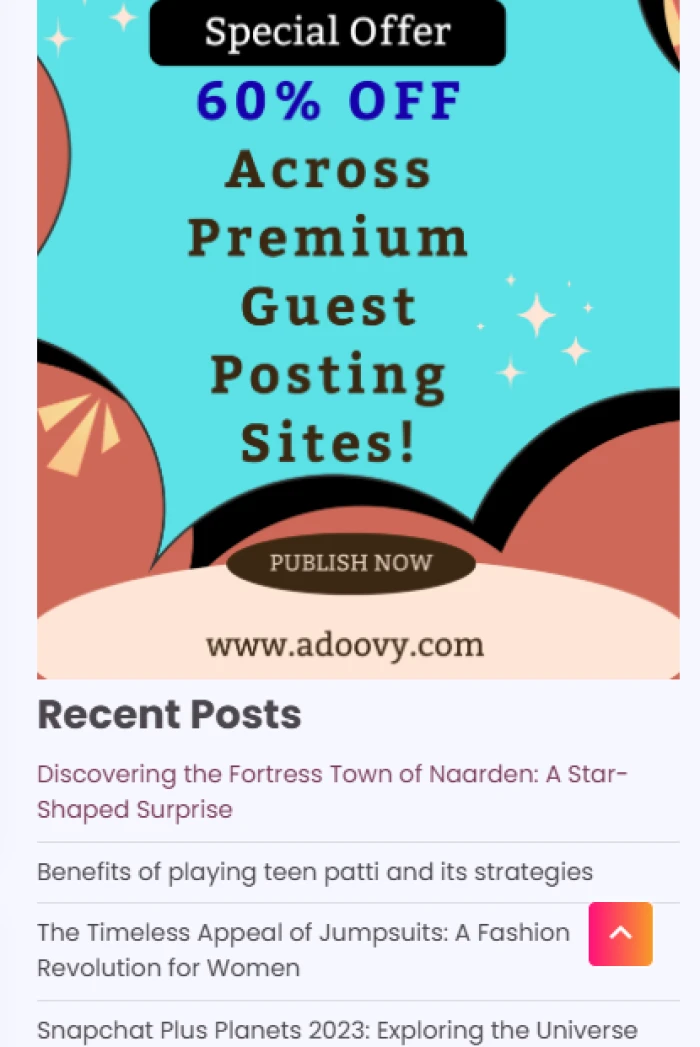
A guest post marketplace banner placed in the primary sidebar of a publication’s homepage is the clearest public signal that the domain is being offered as a paid backlink placement. It reframes the surrounding content from "publication" into "link inventory."
The other reviews reached the same conclusion through external evidence, noting that the site appears listed on guest posting and backlink marketplaces where domains are sold as SEO placements for link building campaigns. The on-site banner confirms that observation from the publication’s own homepage rather than from a third-party directory.
Content Fingerprint
The 2023 Drop Reads Like Template Filler
The July and August 2023 articles follow a near-identical structural template. Each opens with an "Introduction" heading, runs roughly four minutes of reading time, uses broad informational language, and closes with a short summary. Topic samples from the homepage feed include Snapchat Plus Planets 2023, jade stone earrings, Brooks walking shoes for women, jumpsuits, black patchwork sleeves, Amazon.de, ImmoScout24, Lotto24, and teen patti strategies.

The topical mix is the giveaway. A single contributor publishing fashion guides, German e-commerce explainers, German real estate apps, German lottery platforms, Indian card game strategies, and Snapchat UI explainers inside the same two-week window does not reflect a writer with a defined editorial beat. It reflects a keyword-driven content load designed to place indexed pages across as many search niches as possible inside a short time window.
The single 2025 travel article on the Dutch fortress town of Naarden is the only post that breaks the 2023 template. Its placement reads less like a return to active publishing and more like an isolated paid placement, which is consistent with the sidebar banner’s stated business model.
Reader Engagement
An Empty Comments Widget Across the Entire Site
The Recent Comments widget on the homepage displays the default WordPress message: "No comments to show." Across the visible posts, no comment counts appear above zero. There is no visible social share count, no newsletter signup module, no community section, and no contributor application page.
For a publication claiming sixteen subject categories and a 2023-to-2026 operational timeline, zero recorded reader interaction is functionally definitive. Real publications attract at least incidental comments, spam attempts, or social share activity over multi-year timelines. The absence of any engagement record suggests the site has never developed a meaningful human readership, only a crawl footprint.
Scorecard
Six-Layer Domain Reality Check
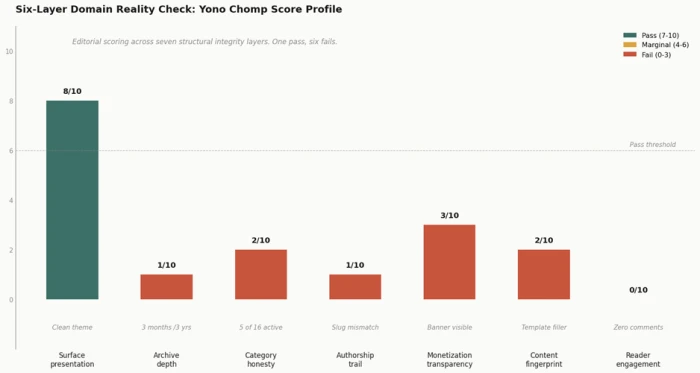
Figure 3. Editorial scoring across seven structural integrity layers. One pass, six fails.
| Layer | Finding | Rating |
|---|---|---|
| Surface presentation | Clean WordPress Warm Blog theme, readable typography, organized cards | Pass |
| Archive depth | Three active months across roughly three calendar years | Fail |
| Category honesty | Sixteen advertised in menu, five populated in sidebar widget | Fail |
| Authorship trail | Single byline "Roland," mismatched URL slug /author/brijesh/, no bios | Fail |
| Monetization signals | Visible guest post marketplace banner in primary sidebar | Fail |
| Content fingerprint | Template-formatted 2023 keyword load across unrelated niches | Fail |
| Reader engagement | Zero recorded comments site-wide, no community modules | Fail |
Editorial Verdict on Yono Chomp
Yono Chomp is best understood not as a struggling publication but as a successfully executed link inventory dressed in publication aesthetics. The Warm Blog theme creates a credible visual shell. The sixteen-category menu establishes topical surface area. The concentrated 2023 publishing burst populated the indexable pages. The lone 2025 travel post and the sidebar banner indicate the domain is now being maintained primarily as a paid placement asset rather than as an editorial product.
The site’s most honest moment is its own sidebar. The "Guest Post Marketplace 2026" banner discloses, in image form, what the content patterns confirm. The business model is not hidden inside opaque code or buried legal text. It is sitting next to the article feed.
For readers searching for genuine reporting or analysis in any of the advertised categories, Yono Chomp does not function as a primary source. The articles are surface-level rewrites of widely available beginner-level explainers, with no evidence of original research, interview access, or subject expertise.
For publishers or marketers evaluating Yono Chomp as a backlink target, the homepage already provides enough signal to make the call. The domain is a pure SEO asset. There is no working editorial operation around the placement, no audience to reach beyond crawlers, and no contributor structure that lends authority to a published byline. Anyone weighing a placement should treat the buy as a link-only transaction, not as content distribution.
The cleanest summary is the one the homepage delivers about itself. Sixteen categories, five populated. Three active months across three years. One author byline with a mismatched URL slug. Zero recorded comments. A guest post marketplace banner above the Recent Posts widget. The numbers are the review.
Comments
Join the discussion and share your perspective.