
Something strange is happening in the modern workplace. By 2026, artificial intelligence has become nearly universal at work, 87% of digital workers now use it, and three in four say it makes them more productive. Yet when you ask those same people whether their organization is actually performing better because of AI, only 13% say yes. Individuals feel faster; institutions can't find the gains on the balance sheet.
This gap is the central story of AI at work today, and it points to a fundamental shift in how we should think about the technology. The first wave of workplace AI was a collection of tools, chatbots you visited, prompts you typed, tabs you switched between. The next wave is the AI coworker: a system that understands your company's context, works across every application you already use, and helps each department get real work done rather than simply generating text on demand. Understanding the difference is the key to closing the gap.
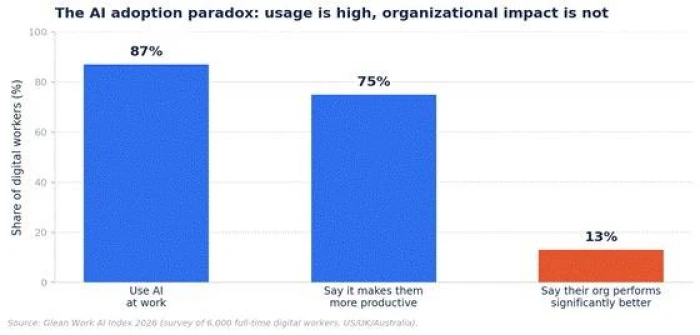
Figure 1 — Adoption is nearly universal, but organizational impact lags far behind.
From AI tool to AI coworker
A standalone AI tool is powerful but blind. It doesn't know who your customers are, where your policies live, what last quarter's numbers were, or which document is the current version. Every time you use it, you become the connective tissue, copying context in, checking the output, and pasting the result somewhere useful. An AI coworker flips that relationship. It plugs into your existing systems, is grounded in your company's own knowledge, and can take action across them, so it behaves less like a search box and more like a well-briefed colleague who already knows how your organization works.
That distinction matters because of where the productivity gains actually leak out. Glean's Work AI Index 2026, a survey of 6,000 full-time digital workers across the US, UK, and Australia, found that workers save roughly 11 hours a week through AI automation, more than a quarter of the workweek. But they also spend an average of 6.4 hours a week on what the researchers call "botsitting": feeding AI the context it's missing, checking its output, debugging its mistakes, re-running prompts, and cleaning up confident-but-wrong answers. That's more time than many workers spend actually producing work with AI. A related habit, "botshitting", shipping AI output without verifying it was admitted to by 69% of respondents.
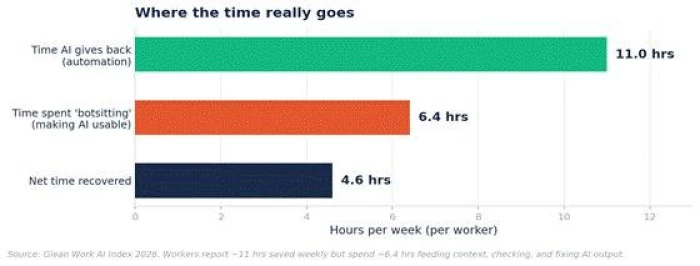
Figure 2 — The time AI gives back is partly clawed back by the hidden labor of making it usable.
The lesson isn't that AI doesn't work. It's that context is the bottleneck. When AI is grounded in real company knowledge and embedded in the flow of work, botsitting shrinks and the time savings survive. That is precisely what a true AI coworker is built to do, and it's why the benefits look different, and larger, when you examine them department by department.
What an AI coworker does for each department
AI's impact is not evenly distributed, and the highest-value use cases look completely different in Sales than they do in Legal. The figure below gathers reported improvements from across the recent 2025–2026 research to show the breadth of the opportunity; the sections that follow explain what's driving each number.
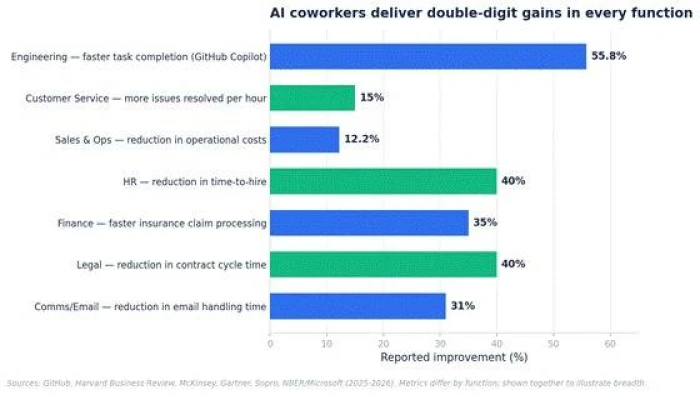
Figure 3 — Double-digit gains show up in every function, though the metric that matters differs by team.
Sales — more selling, less admin
Sales reps famously spend a minority of their week actually selling. An AI coworker attacks the rest: it drafts personalized outreach, summarizes every prior interaction with an account, preps briefing notes before a call, and keeps the CRM updated automatically. With AI-driven lead scoring, teams stop spraying and start prioritizing the accounts most likely to close. Across commercial functions, automated workflows cut operational costs by an average of 12.2%, and nearly two-thirds of businesses now run AI in at least two core areas, meaning the competitive baseline for outreach speed and personalization has already moved.
Marketing — from blank page to on-brand draft
Marketing was one of the earliest and fastest adopters: roughly 78% of marketing teams now use AI for content generation and customer segmentation. An AI coworker grounded in company knowledge goes beyond generic copy, it can pull the correct product positioning, reuse approved messaging, adapt a campaign for different segments, and repurpose a single asset across channels while staying on-brand. The result is less time staring at a blank page and more time on strategy, testing, and creative judgment that AI can't replicate.
Customer service — faster answers, happier agents
Support is where the economics are most dramatic. Roughly 66% of customer-service time is spent on non-customer-facing tasks, exactly the work AI is best at absorbing. Agents assisted by AI answer 13–15% more queries per hour, with the biggest gains going to the least experienced staff, effectively compressing months of ramp-up. Gartner projects conversational AI will cut global contact-center labor costs by $80 billion in 2026, and Salesforce reports that 66% of service organizations were running AI agents in 2026, up from 39% a year earlier. The winning pattern is hybrid: AI handles routine volume and drafts responses, while humans own the complex, emotional, and high-stakes conversations.
People & HR — reclaiming the human in human resources
HR teams drown in repetitive process work: screening résumés, answering the same policy questions, scheduling, and onboarding. An AI coworker can screen and shortlist candidates, answer employee questions instantly from the actual handbook, and draft job descriptions and onboarding plans, reportedly reducing time-to-hire by around 40%. The point isn't to remove people from people operations; it's to hand back the hours currently lost to administration so HR can focus on coaching, culture, and the judgment calls that define a good workplace.
Finance — from data entry to decision support
Finance teams are moving AI from back-office automation toward genuine decision support. In financial services, firms using AI for support and operations report 35% faster claim processing and a 28% improvement in fraud-detection response times. An AI coworker can reconcile figures, surface anomalies, summarize lengthy filings, and answer natural-language questions about internal data, turning finance from a function that reports what happened into one that explains why and recommends what to do next. As always, human review remains non-negotiable for anything touching the P&L.
Legal — the associate that never sleeps
Legal went from cautious to committed remarkably fast: 79% of legal professionals now use AI, and in-house corporate adoption of generative AI roughly doubled in a single year, from about 23% to 52%. Contract review and clause extraction lead the way, with AI reportedly cutting contract cycle times by up to 40% and reaching around 95% accuracy on review tasks versus roughly 80% for manual work. Generative AI could reduce legal-department costs by 20–30%, yet, tellingly, none of the AmLaw 100 firms anticipate reducing attorney headcount. The role is evolving, not disappearing: AI handles the meticulous grunt work, while human lawyers own judgment, strategy, and ethical oversight.
Engineering & IT — shipping and supporting faster
For engineering, the AI coworker is already deeply embedded. GitHub reports that Copilot users complete tasks about 55.8% faster, and by some measures AI assistants now write a substantial share of new code. Beyond writing code, an AI coworker helps engineers navigate unfamiliar codebases, debug faster, and cut the time spent hunting through documentation and past tickets. On the IT service side, it deflects routine requests, guides employees to the right internal resources, and frees specialists for the genuinely hard problems, the same context-grounded pattern that pays off everywhere else.
The same pattern, tuned for your world
What makes the AI-coworker model compelling is that the underlying idea grounding AI in your own knowledge and embedding it in daily work travels across every sector, not just the classic corporate departments. A hospital network, a manufacturer, a government agency, and a university all have the same core challenge: valuable knowledge trapped in siloed systems that people waste hours searching through.
Higher education is a vivid example. Universities juggle sprawling, disconnected systems across admissions, the registrar, finance, HR, IT, and research and students, faculty, and staff all pay the price in time. An AI coworker can give students instant, plain-language answers on deadlines and policies, lighten faculty admin loads like syllabus building, and help researchers move faster through grant data and literature. It's worth seeing how a purpose-built platform frames this: Glean's overview of AI for higher education maps these same department-level wins onto the campus, connecting siloed systems so every part of the institution can work smarter while IT keeps control of permissions and sensitive data.
The takeaway for any leader: don't ask "which industry is AI for?" Ask "where is our knowledge stuck, and which team loses the most time because of it?" That's where an AI coworker earns its keep first.
How the leaders capture the value
If 87% of workers use AI but only 13% of organizations see real gains, the interesting question is what that top group does differently. The research points to a consistent playbook, and notably, it has little to do with buying more AI seats or pushing employees to prompt more.
- Ground AI in enterprise context. The single biggest lever. When AI already knows your data, policies, and history, botsitting collapses and answers become trustworthy.
- Meet people in their existing tools. Value comes from AI embedded in the flow of work, not from one more tab to switch to.
- Teach verification, not just prompting. Train employees on when to use AI and how to check it, so speed doesn't turn into 'botshitting' and costly rework.
- Govern and protect. Enforce permissions and safeguard sensitive data so adoption scales responsibly across departments.
- Measure business outcomes, not activity. Track cycle time, cost per project, and customer results, not prompt counts. Nearly half of organizations still don't measure AI's impact at all.
As Dr. Rebecca Hinds, who leads Glean's Work AI Institute, puts it: adoption alone doesn't equal transformation. Organizations that win redesign how work gets done around AI rather than treating usage as a vanity metric.
The numbers at a glance
87% of digital workers use AI at work | 11 hrs saved per week through AI automation | 6.4 hrs per week lost to 'botsitting' |
13% of orgs perform significantly better | 55.8% faster task completion for developers | 40% shorter contract cycles in legal |
78% of marketing teams use AI for content | $80B projected 2026 contact-center savings | 35% faster claims processing in finance |
Sources: Glean Work AI Index 2026; GitHub; Gartner; McKinsey; Sopro; NBER/Microsoft (2025–2026).
The bottom line
AI at work has cleared the adoption hurdle. The next race is about integration, turning individual time savings into organizational advantage. The teams pulling ahead have stopped treating AI as a clever tool you visit and started treating it as a coworker you brief once and trust to work across your systems. When AI understands your context, lives in your workflow, and is verified and governed properly, every department from Sales and Support to HR, Finance, Legal, and Engineering doesn't just move faster. It works smarter. And the gains finally show up where they were always supposed to: in the results.
Comments
Join the discussion and share your perspective.