
The short answer
This comparison broke in 2026. Blackbox AI stopped publishing consumer plan prices and now sells as an enterprise inference platform, metered per token on an annual commit that starts with a sales conversation. ChatGPT still sells to individuals, from $0 up to $200 a month, with a ₹399 tier in India.
If you are one person deciding what to pay for this month, ChatGPT is the only one of the two still selling you something at a published price. The sections below show what changed and who Blackbox is built for now.
Ahrefs puts global monthly search demand for the phrase “blackbox ai” at roughly 3.25 million. Inside that traffic sits a narrower question that Google surfaces in its own People Also Ask box: is Blackbox AI better than ChatGPT?
Almost every article answering that question in 2026 describes a $10 coding subscription. That product is no longer on the Blackbox pricing page. What follows checks both vendors against their live pricing pages rather than against each other’s marketing, and the gap between those two things turns out to be the story.
Who Is Actually Asking This Question
Most English comparisons of these two tools read as though the audience sits in California. The search data disagrees.
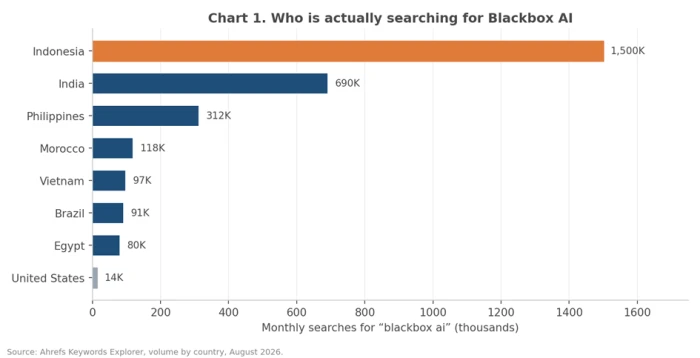
Indonesia alone produces 1.5 million monthly searches. India adds 690,000. The United States contributes 14,000, under half a percent of worldwide demand. Morocco, Vietnam, Brazil and Egypt each out-search the US by a wide margin.
The keyword data carries a second signal. Alongside developer queries, Ahrefs records 7,900 monthly Indian searches for “blackbox ai exam paper” and 4,300 for “blackbox ai chat”. Students make up a large share of this audience.
Hold both facts in mind, because the next section explains why they now sit awkwardly against what Blackbox actually sells.
What Every Other Comparison Gets Wrong
Search for these two products and you will find a consistent story: Blackbox is the budget coding assistant at $10 a month, ChatGPT is the pricier generalist at $20. Review sites, comparison pages and directory listings all repeat some version of it, with verification dates running from May to July 2026.
Open blackbox.ai/pricing today and none of it is there.
What the live pricing page says in August 2026
One tier, labelled Enterprise, priced Custom. Sold on annual committed spend through a purchase order, with the balance drawn down as teams consume tokens.
Metered per token rather than per seat. No platform fee, no credit-purchase fee, no per-seat charge.
The page answers its own question “When do I have to talk to sales?” with “From the start. The commit is the contract.” An engagement begins, in its words, with a conversation rather than a signup.
The company now describes itself as a high-trust platform for frontier inference. Its site headline sells reserved single-tenant capacity, zero data retention and routing across 300 or more models. The word student appears nowhere on it.
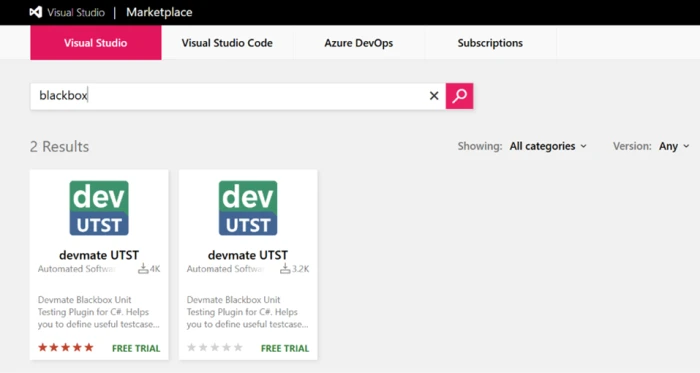
Self-serve account creation still exists at app.blackbox.ai, and the VS Code extension is still installable from the Marketplace. What has gone is the published price for an individual. That distinction runs through the rest of this comparison.
What Blackbox Sells Now
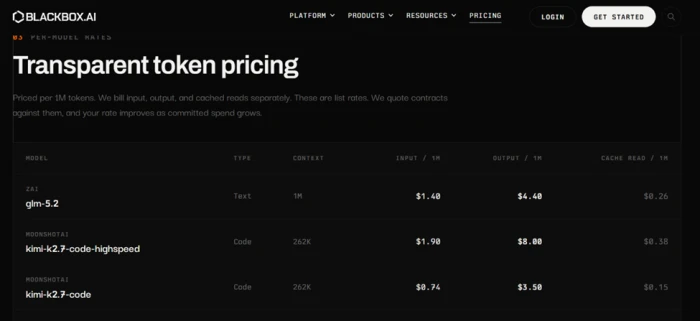
The replacement for plan pricing is a published rate card. Blackbox bills input, output and cached reads separately, quoted per million tokens, with contract rates improving as committed spend grows.
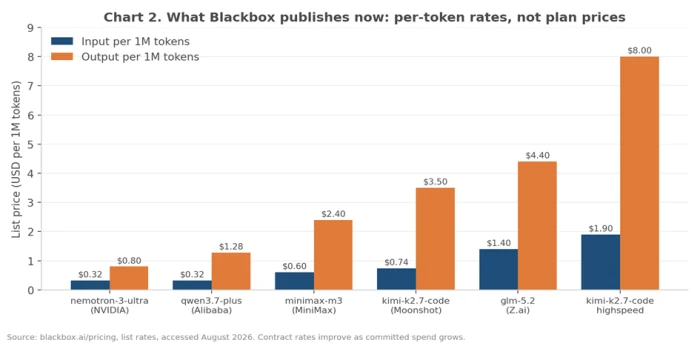
Nemotron 3 Ultra sits at the cheap end at $0.32 input and $0.80 output. Moonshot’s high-speed code model tops the published list at $1.90 input and $8.00 output. Blackbox quotes a blended rate of $0.44 per million tokens on Nemotron, and cites Artificial Analysis verifying it as the fastest provider of that model at 454 tokens per second in July 2026.
What the Enterprise tier includes
• A dedicated forward-deployed engineer, with implementation at no added cost
• Single-tenant deployment, data residency, and customer-managed keys
• Zero data retention on a contractual basis, backed by a DPA
• PII removed before prompts reach a closed model
• SAML SSO, SCIM and RBAC, plus audit logs
• Agents API for cloud coding agents, and multi-agent orchestration through Chairman LLM
The VS Code extension survives the repositioning with 4.2 million installs claimed, running inline completions, chat-driven edits shown as reviewable diffs, and a multi-agent command that dispatches the same task to several models at once. Team licensing for it now runs through an Enterprise agreement with SSO sign-in rather than individual keys.
One catch carries over from the old credit system into the new commit system. Unused committed spend expires at the end of the billing period. Blackbox sends alerts at 75 and 90 percent of the commit, and advises sizing to minimum rather than expected usage.
What ChatGPT Sells Now
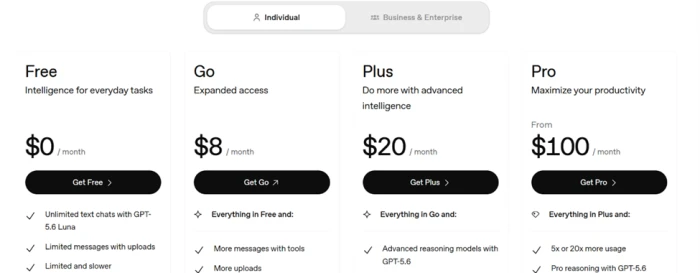
OpenAI went the opposite direction during the same period. It added rungs at the bottom of its ladder instead of removing them.
| Plan | Price per month | What the tier adds |
|---|---|---|
| Free | $0 | GPT-5.6 Luna default since 6 Aug 2026, uncapped text chats, ads shown in the US |
| Go | $8 | Roughly 10x the free tier for messages, image generation and file uploads |
| Plus | $20 | GPT-5.6 Sol, Deep Research, Codex, Agent Mode, Sora |
| Pro | $100 | Five times Plus usage limits plus the Pro model level |
| Pro | $200 | Twenty times Plus usage limits |
| Business | $20 to $25 per seat | Two seat minimum, SSO, admin controls, contractual no-training guarantee |
| Enterprise | Custom | SCIM, data residency, compliance logging, custom terms |
Verified against OpenAI’s ChatGPT pricing page in August 2026. Business dropped from $25 to $20 on annual billing on 2 April 2026. The $100 Pro tier launched on 9 April 2026.
Two dates matter for the audience in Chart 1. OpenAI launched Go in India first, in August 2025, at ₹399 a month payable through UPI, then took it global on 16 January 2026. Codex Mobile went free on every plan including Free on 14 May 2026. Both moves aimed at exactly the markets generating the search demand.
The Comparison That Actually Matters Now
Feature-by-feature tables assume both products are competing for the same buyer. That assumption expired.
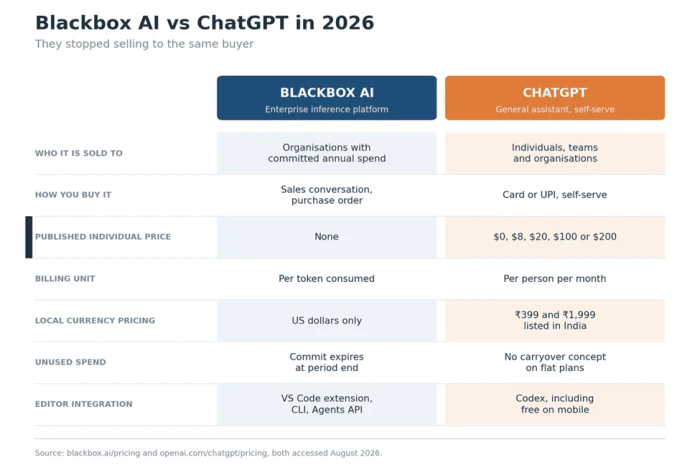
| Blackbox AI | ChatGPT | |
|---|---|---|
| Who it is sold to | Organisations with committed annual spend | Individuals, teams and organisations |
| How you buy it | Sales conversation, purchase order | Card or UPI, self-serve |
| Published individual price | None | $0, $8, $20, $100 or $200 |
| Billing unit | Per token consumed | Per person per month |
| Local currency pricing | US dollars only | ₹399 and ₹1,999 listed in India |
| Unused spend | Commit expires at period end | No carryover concept on flat plans |
| Editor integration | VS Code extension, CLI, Agents API | Codex, including free on mobile |
Compiled from both vendors’ live pricing pages, August 2026.
Read down the middle column and a pattern appears. Every row describes a buyer with a procurement process. Read the right column and it describes a person with a debit card.
If You Are One Person With A Budget
Chart 1 established that most people asking this question are in Indonesia, India, the Philippines or Morocco. Here is what the repositioning does to them.
ChatGPT Go at ₹399 remains the cheapest credible paid AI subscription either company offers, roughly a fifth of the Plus price, billed in rupees through a domestic payment rail. Blackbox has no published counterpart at any price, in any currency.
That does not make Blackbox unusable. The VS Code extension still installs, and account creation is still open. What it means is that you cannot see what you will be charged before you commit, and no tier is documented as free.
For students specifically
The 7,900 monthly searches for “blackbox ai exam paper” suggest a large group treating Blackbox as a study tool. That group is now looking at a product whose pricing page opens with a Talk to Sales button. ChatGPT’s free tier removed its message cap in August 2026, which makes it the safer default for anyone whose budget is zero and whose work is coursework.
What Reviewers Scored Them On
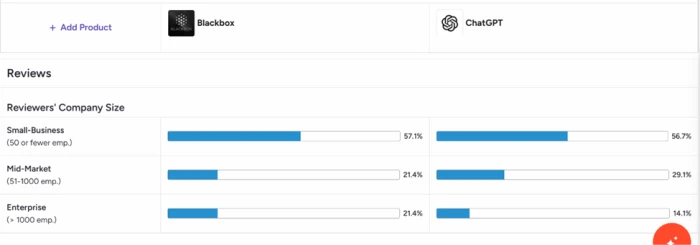
G2 publishes both products against a shared rubric, aggregated from user reviews.
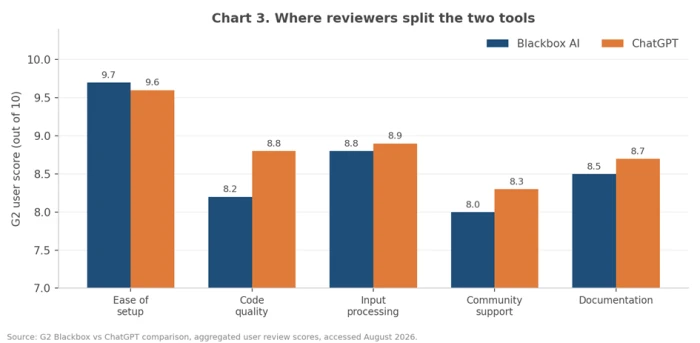
Blackbox edges ahead on ease of setup at 9.7 against 9.6, thin enough to ignore. The gap worth noting is code quality, where ChatGPT scores 8.8 against Blackbox at 8.2. ChatGPT also leads on documentation at 8.7 against 8.5 and community support at 8.3 against 8.0.
One caveat on this data: these reviews were written by users of the previous Blackbox product. Scores describing a $10 self-serve coding assistant tell you less about an enterprise inference platform sold on annual commits. Treat Chart 3 as history rather than as a current verdict.
The Benchmark Question
Blackbox published a HumanEval comparison claiming 85.36 percent on Python code completion against 82 percent for GPT-4, evaluated zero-shot for pass@1. It has since published a separate result, TB v2.1, citing 90 percent pass@1 using GPT-5.6 Sol paired with Opus 4.8.
Both numbers come from Blackbox about Blackbox. The GPT-4 baseline in the first has been superseded several times. The second measures a configuration routing to other vendors’ models, which makes it a claim about the routing layer rather than about a competing assistant.
The practical takeaway: no independent lab has published a head-to-head result for these two products as they exist in 2026. Any article quoting a precise accuracy percentage is repeating a vendor or estimating.
Where Each One Earns Its Money
Blackbox fits when
• You buy through procurement. Committed annual spend, purchase orders and a named engineer are the shape of this product now.
• Data control is a hard requirement. Contractual zero retention, PII stripping before closed models and single-tenant deployment are stronger commitments than any consumer AI plan offers.
• You want many model families on one bill. Routing across 300 or more models through one endpoint has no equivalent inside a ChatGPT subscription.
• Token metering suits your usage. Paying per token rather than per seat favours teams with uneven usage across a large headcount.
ChatGPT fits when
• You are buying for yourself. It publishes a price you can read and pay today.
• A human reads the output. Documentation, study notes and client writing are where the quality gap is widest.
• You need one login for several jobs. Research, images, voice and video sit inside the same subscription.
• Local pricing decides it. The ₹399 rung has no counterpart on the other side.
Your Code And Their Training Data
The repositioning flipped this section. Blackbox used to be the weaker option on data handling. It is now arguably the stronger one, provided you can afford the entry.
Blackbox states end-to-end encryption on every connection, zero data retention on a contractual basis backed by a DPA, and removal of personally identifiable information before prompts reach a closed model. Organisations that cannot route to a third party at all can run a single-tenant deployment of an open-weight model instead. Retention on routed traffic is suppressed through provider terms wherever the provider API supports it, which is a qualified commitment rather than an absolute one.
On the ChatGPT side, Business and Enterprise carry a contractual commitment that conversations are not used for training. Plus and Pro offer a user-controlled opt-out toggle, which is a setting rather than a guarantee. Business at $20 per seat annually with a two seat minimum costs the same per person as Plus while adding that commitment.
If you are pasting client code
A toggle you can switch off is weaker protection than a contract that says no. On either platform, price the team tier rather than the individual tier, then treat the difference as insurance.
If Neither One Fits
With Blackbox out of reach for individual buyers, the shortlist for a self-serve coding assistant matters more than it did.
| Tool | Best for | Main limitation |
|---|---|---|
| GitHub Copilot | Teams already living inside GitHub pull requests | Moved to usage-based credits, so cost is harder to forecast |
| Cursor | Developers willing to switch editors for a purpose-built agentic IDE | Requires abandoning your current editor |
| Claude | Long-context reasoning and terminal-based agent work | Fewer built-in media features than ChatGPT |
| Gemini | Buyers in markets with aggressive local pricing | Google launched AI Plus in India at ₹199 for six months, then ₹399 |
Compiled from published vendor pricing and positioning, August 2026.
So Which One Should You Pay For
The answer now depends on what kind of buyer you are rather than which model writes better code.
If you are an individual developer
ChatGPT Plus at $20, or Go at $8 if your coding volume is light. Blackbox no longer publishes a price you can act on alone. Install the VS Code extension if you want to test it, and expect a sales conversation before anything is settled.
If you are a student
Two free tiers cost nothing. ChatGPT’s free tier lost its message cap in August 2026, which makes it the stronger of the two for coursework. When you eventually pay, ₹399 for Go is the cheaper first purchase in India.
If you write, market or research
ChatGPT, without much debate. Blackbox has moved further away from this use case, not closer to it.
If you are buying for an engineering organisation
This is the scenario Blackbox is now built for, and the one where it is worth a conversation. Contractual zero retention, PII stripping, single-tenant deployment and per-token metering across a large headcount are genuine differentiators against a per-seat subscription. Get the commit sized against minimum usage rather than forecast usage, since unused balance expires.
Back to the question in the title
Blackbox AI is not better or worse than ChatGPT in 2026, because the two stopped competing for the same customer during the year. Blackbox went upmarket into enterprise inference. OpenAI went downmarket, adding an $8 tier and giving away Codex on mobile. For the 3.25 million people searching every month, most of them in markets where ₹399 is a real decision, that leaves one product still selling to them and one that stopped.
Comments
Join the discussion and share your perspective.