
Short answer: yes, you can sell AI-generated images online, and thousands of people already do. But "can you" and "should you expect it to be simple" are two different questions. Selling AI art legally and profitably depends on three things that most guides gloss over: whether you can own the image, whether the marketplace you're using actually allows it, and whether the economics make sense once you account for saturation and low per-sale payouts. This guide walks through all three with current law, real platform policies, and hard numbers.
The 30-second version You can legally sell AI images in most places, but a purely AI-generated image cannot be copyrighted in the U.S., so you usually can't stop others from copying it. |
| Platforms split sharply: Adobe Stock and Etsy allow it with disclosure; Shutterstock and Getty do not accept contributor-submitted AI. • The market is booming, but per-image payouts are small, success is a volume-and-niche game, not a get-rich-quick one. |
The Legal Question: Can You Even Own an AI Image?
This is the part that trips people up, so it's worth being precise. There are two separate legal issues: (a) is it legal to sell AI-generated images, and (b) can you own the copyright to them? The answer to the first is generally yes. The answer to the second, in the United States, is mostly no.
Copyright requires a human author
The U.S. Copyright Office has taken a consistent position: copyright protects works of human authorship. A work generated entirely by a machine from a text prompt has no human author in the legal sense, and therefore cannot be registered. This isn't a vague guideline, it has been tested repeatedly and upheld by the courts.
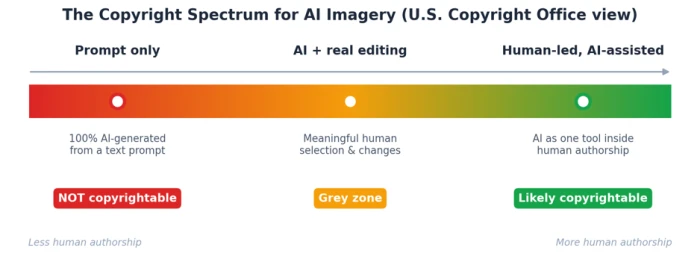
Figure 1 — Where an AI image falls on the copyright spectrum depends on how much human creative control shaped the final result.
The key rulings and decisions
| Case / Decision | Date | What it established |
|---|---|---|
| Zarya of the Dawn | Feb 2023 | USCO registered the comic's text and arrangement but denied copyright to the individual Midjourney-generated images. |
| Thaler v. Perlmutter (District Court) | Aug 2023 | Judge Howell: "Human authorship is a bedrock requirement of copyright." |
| USCO Report, Part 2 (Copyrightability) | Jan 2025 | Prompts alone, even detailed ones don't make output copyrightable. Human-authored elements can be. |
| Thaler v. Perlmutter (D.C. Circuit) | Mar 2025 | Appeals court affirmed: an AI machine cannot be an "author" under the Copyright Act of 1976. |
| Supreme Court declines Thaler appeal | Mar 2026 | SCOTUS refused to hear the case, leaving the human-authorship rule firmly in place. |
Source: U.S. Copyright Office; Thaler v. Perlmutter (D.C. Cir. 2025); CNBC; Harvard JSEL; Congress.gov (LSB10922).
The practical takeaway on ownership
If you sell a 100%-prompt-generated image, you generally cannot register a copyright on it which means if a competitor copies and resells it, you have little legal recourse. However, the Copyright Office has signalled a middle path: when a human contributes meaningful creative input, significant editing, compositing, retouching, arranging multiple elements, the human-authored contributions can be protected. In 2025 the Office registered "A Single Piece of American Cheese", where the applicant used iterative "inpainting" and selection, illustrating that human-directed editing shifts the analysis.
What this means for a seller Selling AI images is legal. Owning them exclusively usually is not unless you add substantial human creativity. Build a workflow around editing, compositing and curation if protection matters to you. Also note the flip side: an AI image can unintentionally reproduce copyrighted or trademarked material from its training data, and that liability can land on you as the seller. |
Where You Can Actually Sell
This is where most sellers get burned, uploading to the wrong platform and getting listings or accounts removed. Policies vary dramatically and have changed over time. Here's the current landscape, grouped by how they treat AI content.
Marketplace policy comparison
| Platform | AI images allowed? | Key requirement |
|---|---|---|
| Adobe Stock | Yes | Must label as "Generative AI"; no artist/brand/real-person names in prompts; releases for real people/property. |
| Etsy | Yes | Must disclose AI use in the listing; you must provide original creative input; list as "Designed by." |
| Freepik / Dreamstime | Yes | Accept AI with labeling and metadata; among the more AI-friendly stock sites. |
| Print-on-demand (Redbubble, Society6, Printful) | Mostly yes | Generally allowed with disclosure; enforcement and originality rules vary by site. |
| Shutterstock | No (contributor upload) | Bans contributor-submitted AI; only sells AI via its own in-house generator + Contributor Fund. |
| Getty Images / iStock | No | Bans AI-generated uploads over copyright/rights concerns; offers its own licensed generator instead. |
Source: Adobe Stock Contributor guidelines; Etsy Seller Handbook & Creativity Standards; Shutterstock Contributor FAQ; Getty Images statements (2022–2025).
The "allow" camp: Adobe Stock and Etsy
Adobe Stock was an early mover, it began accepting generative AI content in December 2022. The rules are strict but clear: you must check the "Created using generative AI tools" box, submit photo-realistic AI images as Photos and everything else as Illustrations, and keep prompts free of artist names, real people, fictional characters, brands and copyrighted references.
Etsy has permitted AI-assisted work under its Creativity Standards (in place since 2024) as long as you disclose AI use in the listing description and contribute genuine creative direction. Since June 2025 Etsy tightened its originality rule, items must be "based on a seller's original design," and the old carve-out for templated designs was removed. Enforcement is automated and can flag even compliant listings, so clear disclosure and documentation matter.
The "ban" camp: Shutterstock and Getty
Both refuse contributor-uploaded AI, but for a revealing reason: provable IP ownership. Shutterstock's Contributor Terms require you to prove you own the IP of everything you submit; because AI models are trained on many artists' works, Shutterstock argues that ownership "cannot be assigned to an individual." Getty banned AI uploads in 2022 citing "open questions" on copyright and unaddressed rights issues. Notably, both companies still sell AI imagery just through their own in-house, licensed generators that compensate contributors, rather than accepting outside AI uploads.
Rule of thumb Match your product to the platform. Selling on Adobe Stock, Etsy, Freepik or POD sites? AI is fine, just disclose and follow prompt rules. Targeting Shutterstock or Getty? Contributor AI uploads will be rejected. |
The Money: Market Size vs. Real Earnings
The opportunity is real and growing fast, but the per-image economics are humbling. Understanding both sides is what separates realistic sellers from disappointed ones.
A fast-growing market
The AI image generation market is expanding at double-digit — sometimes triple-digit — rates depending on how analysts scope it. Estimates vary widely (from a few hundred million to several billion dollars) because some measure only image-generator software while others include the broader tooling ecosystem. The direction, however, is unanimous: up and to the right.
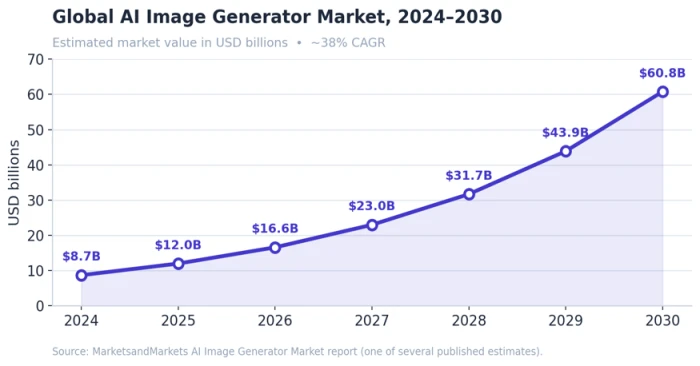
Figure 2 — One widely cited projection puts the AI image generator market on a path from ~$8.7B to ~$60B+ by 2030.
| Research firm | 2024/25 value | Forecast | CAGR |
|---|---|---|---|
| MarketsandMarkets | $8.7B (2024) | $60.8B by 2030 | 38.2% |
| Grand/MarkNtel | $9.1B (2024) | $63.3B by 2030 | 38.2% |
| Market.us | $9.1B (2025) | $272.8B by 2035 | 40.5% |
| SkyQuest | $3.16B (2025) | $30.0B by 2033 | 32.5% |
| Fortune Business Insights | $484M (2025) | $1.75B by 2034 | 17.4% |
Source: Compiled from MarketsandMarkets, MarkNtel, Market.us, SkyQuest and Fortune Business Insights (2025–2026). Figures differ due to differing market definitions.
What a single sale actually pays
Here's the reality check. On subscription-based stock platforms, one download often pays cents, not dollars. Adobe Stock pays a 33% royalty on images (35% on video). On a typical $29.99 / 10-download plan, that's about $0.99 per download, with a per-download floor of $0.33–$0.38. Shutterstock has a hard $0.10 minimum and resets contributors to the lowest tier every January 1.
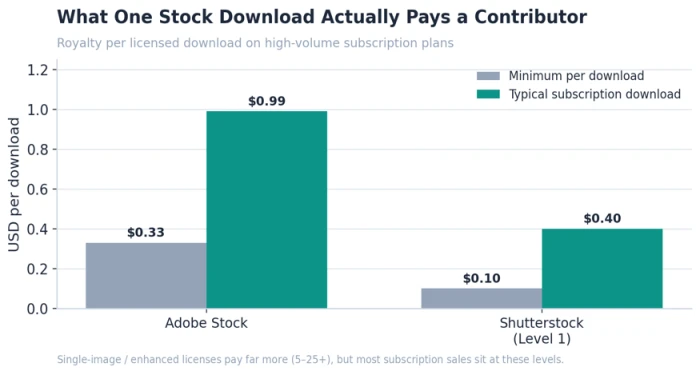
Figure 3 — Subscription downloads pay little per sale; the money comes from volume and the occasional high-value single/extended license.
| Channel | Typical payout per sale | Where the upside is |
|---|---|---|
| Stock (subscription download) | $0.10 – $0.99 | High volume across a large portfolio. |
| Stock (single / extended license) | $2.97 – $25+ | Occasional premium licenses lift the average. |
| Etsy digital art print | $3 – $15+ per sale | You set the price; strong niches & bundles scale. |
| Print-on-demand (poster/mug) | $2 – $10 margin | Repeat designs + trending niches compound. |
Source: Adobe Stock royalty documentation; PixTagger/AutoKeyWorder contributor analyses (2026); Etsy seller reports.
The honest economics Selling AI images is a volume-and-niche business. A handful of images on a saturated stock site will earn almost nothing. A focused portfolio of hundreds of well-keyworded assets, or a tight Etsy niche with your own pricing and branding, is where realistic income appears. Treat it like building a catalog, not flipping a switch. |
How to Do It Right: A Practical Checklist
If you've decided to move forward, this sequence keeps you legal, compliant, and positioned to actually earn.
1. Check your generator's license. Confirm your AI tool (Midjourney, Firefly, DALL·E, etc.) grants commercial-use rights for its outputs. Adobe Firefly is popular partly because it's trained on licensed/Adobe Stock content.
2. Add human authorship. Edit, composite, retouch or arrange. This both improves quality and strengthens any copyright claim on your contribution.
3. Pick the right platform. Adobe Stock, Etsy, Freepik and POD sites accept AI; Shutterstock and Getty reject contributor AI uploads.
4. Disclose and label. Tick the "generative AI" box on stock sites; state AI use plainly in Etsy descriptions. Non-disclosure is the fastest route to removal.
5. Clean your prompts and metadata. No artist names, real people, brands, or copyrighted characters. Strip identifying metadata where required and keyword accurately.
6. Avoid infringement. Don't generate recognizable logos, trademarked characters or real people's likenesses without rights, the liability is yours.
7. Play the long game. Build a niche, a catalog, and a brand. Volume plus differentiation beats spraying generic images across a saturated market.
The Bottom Line
So, can you actually sell AI-generated images online? Yes, and it's a legitimate, growing opportunity. But do it with your eyes open. Legally, you can sell them, yet a pure AI output isn't yours to own exclusively unless you add real human creativity. Practically, the platform you choose decides whether you're welcomed or removed. Financially, the market is expanding fast, but per-image payouts are small, so income comes from volume, niche focus, and building something more defensible than a folder of prompts.
The sellers who win treat AI as a starting point, not the finished product, pairing it with editing, curation, disclosure, and smart platform choices. Get those right, and "selling AI images" stops being a gamble and becomes a real, repeatable business.
Comments
Join the discussion and share your perspective.