
An AI chatbot pays off on high-volume, repetitive, low-risk questions like order status and password resets, where it answers in seconds at roughly $1.84 or less per contact. A human support agent pays off on complex, emotional, or high-stakes issues, where judgment and empathy decide the outcome. Above a few hundred conversations a month, a hybrid setup usually wins.
That is the short answer. The rest of this guide shows you how to reach it for your own numbers, using a decision framework and cost math you can apply to your actual ticket mix, plus the 2026 research that explains why the popular statistics seem to contradict each other.

The real question is not which is better
Ask most vendors whether you should use a chatbot or a human agent and you get a pitch, not an answer. The honest framing is narrower and more useful: which option resolves a given type of problem, at your volume, at your risk tolerance, for the lowest total cost without hurting the customer.
Treating this as all-or-nothing is where money leaks. Route every ticket to humans and your cost scales with headcount. Route everything to a bot and you pay later in churn and repeat contacts. Three levers decide the answer every time, and the whole guide hangs on them: the type of issue, the volume of that issue, and the cost of getting it wrong.
The three levers that decide payoff
Issue type. Is the question repetitive and rule-based, or does it need judgment, empathy, or a policy exception?
Volume. How many of this exact issue arrive each month? Automation only earns its build cost above a threshold.
Risk. What does a wrong answer or wrong action cost you in refunds, compliance exposure, or a lost high-value account?
What we are actually comparing (and why 2026 changed the answer)
Part of the confusion is that the word chatbot now covers three different things, and they do not pay off in the same places.
Rule-based bot, AI chatbot, and agentic AI
A rule-based chatbot follows scripted decision trees. It is cheap, predictable, and useful for triage, but it breaks the moment a customer phrases something it did not expect. An AI chatbot built on a large language model understands natural language, pulls answers from your knowledge base, and holds a conversation. An AI agent goes one step further: it takes action across your systems, processing a refund, updating an order, or rebooking an appointment, then hands off cleanly when it hits its limit.
The functional line is action, not fluency. As one 2026 industry breakdown put it, if an AI system only talks, it is a chatbot; if it can decide what to do next and take action across tools, it is an agent. For teams evaluating tools in this category, side-by-side breakdowns of AI chatbot platforms and their real capabilities help separate scripted widgets from genuine agents before any budget is committed.
What a human agent still brings
Humans read tone, ask the right follow-up when a request is vague, de-escalate an angry customer, and make judgment calls a script cannot encode. When someone types "nothing is showing on my screen," a bot offers a menu of guesses while a person asks the one clarifying question that unlocks the fix. That gap is the whole reason the human column still exists.
Why 2026 shifted the break-even
Two changes moved the line this year. First, agentic AI can now complete tasks rather than just deflect them, which raises how much a bot can safely own. Second, the industry stopped celebrating deflection and started measuring resolution, because a ticket the bot pushes away that comes back as a callback costs more than sending it straight to a person. That single reframe changes which option actually pays off, as the cost section shows next.
Head to head: the numbers that actually decide it
Start with the comparison in one view, then look at the two dimensions that need nuance.
| Dimension | AI chatbot | Human agent |
|---|---|---|
| Cost per contact | ~$0.50–$1.84 (self-service median) | ~$13.50 (assisted median) |
| Speed | Under 2 seconds, 24/7 | Minutes, plus queue and shifts |
| Availability | 168 hours a week, no premium | ~4.5 agents to cover one 24/7 seat |
| Best issues | Repetitive, rule-based, low risk | Complex, emotional, high-value |
| First-contact resolution | 55–70% (AI-native platforms) | Higher on complex, judgment-heavy cases |
| Empathy and judgment | Limited; misses sarcasm and nuance | Reads tone, adapts, de-escalates |
| Setup and ramp | $5k–$50k build, instant once live | $1k–$5k hire, 2–8 weeks to ramp |
| Main risk | Hallucination, dead ends, deflection | Cost scales with headcount |
Cost figures: Gartner median cost per contact. Resolution and setup ranges: aggregated 2026 industry benchmarks.
Cost per contact versus cost per resolution
The single most repeated number in this debate is Gartner's: a median of $1.84 for a self-service contact against $13.50 for an assisted one, a roughly seven-times gap. It is real, and it is also where most analyses stop and go wrong.
Cost per contact only tells the truth when the contact actually resolves. A cheap bot interaction that fails and forces a follow-up costs more end to end than the human contact you avoided. Email shows the same trap: a single reply looks cheap until it takes four messages to close one issue. The number that matters is cost per resolution, not cost per contact. This is why deflection rate is a vanity metric and containment, the share of contacts fully resolved without a human, is the one to run your business case on.
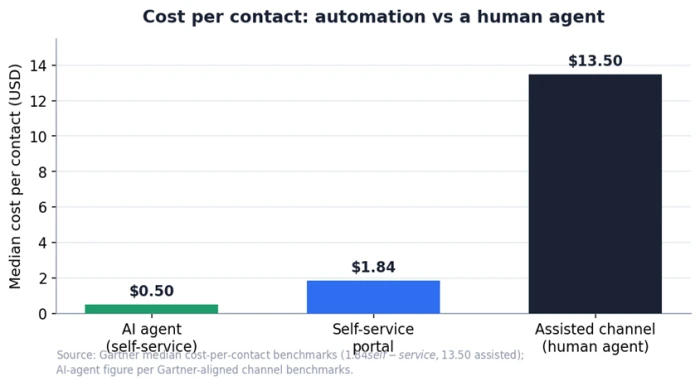
Chart 1: Gartner median cost per contact by channel. Automation is cheap per contact, but only resolution makes it cheap per outcome.
Speed and the 24/7 coverage math
For a customer asking about an order at 11pm on a Sunday, an instant answer beats any human response because there is no human awake to beat. Bots reply in under two seconds and cover all 168 hours of the week at the same unit cost. Covering that span with people takes roughly four and a half full-time agents per seat once you add nights, weekends, and holidays. Availability, though, is not resolution, which is exactly the catch the quality data exposes.
Resolution rates by issue type
Blended resolution numbers hide the real story. AI-native platforms reach 55 to 70% first-contact resolution, while traditional self-service fully resolves only about 14% of issues, according to Gartner. The spread within a single business is even sharper: returns are far more automatable than billing disputes, which need investigation and judgment. The lesson is to automate by issue type, not by a single company-wide target.
What the consumer data actually says
Here the headlines openly fight each other, and reconciling them is where most guides fall short.
| Statistic | Source | What it actually measures |
|---|---|---|
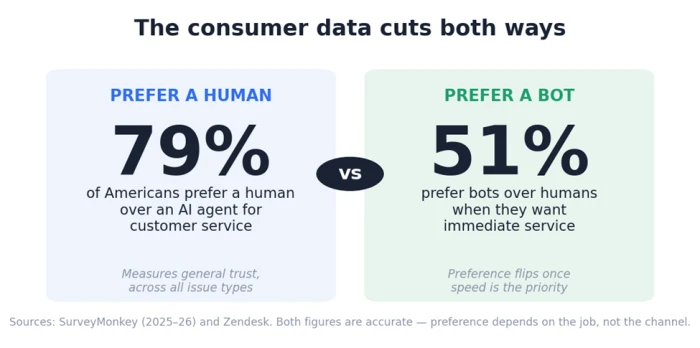
| 79% of Americans prefer a human over an AI agent | SurveyMonkey (2025–26) | General preference and trust, across all issue types |
| 84% believe human agents are more accurate | SurveyMonkey | Perceived accuracy, not measured accuracy |
| 51% prefer bots when they want immediate service | Zendesk | Preference shifts once speed is the priority |
| 68% prefer AI for simple status-style questions | Industry survey (2026) | Preference by issue type, not overall |
| 89% want the option to reach a human | SurveyMonkey | Demand for a fallback, not rejection of AI |
Why both numbers are true
People do not have a fixed loyalty to a channel. They want their problem solved quickly and completely. Ask about preference in the abstract and humans win on trust. Ask in the moment a customer wants a fast answer to a simple question and bots win on speed. The 89% who want a human available are not rejecting automation; they are asking for a safety net. Read together, the data points one way: match the channel to the job, and always leave a visible door to a person.
When an AI chatbot pays off
Reach for automation when all three levers point the same way: repetitive issue, real volume, low risk.
• High-volume, repetitive, low-risk questions. Order status, password resets, store hours, and policy lookups are the classic wins. Best-in-class ecommerce brands deflect 40 to 50% of contacts this way.
• When speed and round-the-clock coverage decide satisfaction. International customers and after-hours traffic get an instant answer instead of a queue.
• When you are scaling faster than you can hire. During a launch or seasonal spike, a bot absorbs the flood so the team is not buried in "where is my order."
When a human agent pays off
Flip every lever and the human column wins. Volume is low, complexity is high, and a mistake is expensive.
• Complex, multi-system, or ambiguous problems. A billing error that spans a refund, an account credit, and a subscription change needs someone who can connect the pieces and ask the missing question.
• Emotional and high-stakes moments. A customer panicking about a damaged order for tomorrow's event wants a person who gets it. An apology from a human lands differently than a canned line from a bot.
• Regulated or high-value decisions. Compliance nuance, sensitive disputes, and top-tier accounts are where a wrong automated action costs far more than a human hour.
When automation loses you money
Vendors rarely write this section, which is exactly why it matters. Automation backfires in three predictable ways.
Deflection theater
A bot tuned to push customers away rather than solve their problem optimizes for the wrong outcome. Consumers noticed early: many describe first-generation support bots as deflection dressed up as self-service. Chasing a 90% containment target usually means the bot is holding tickets it should escalate, and customers end up angrier than if they had waited for a person.
The context-loss tax
Handoffs are where hybrid setups quietly break. One 2026 analysis found AI lost context in 22% of handoffs, forcing customers to repeat themselves to the human who picks up. Repetition is a top frustration: Zendesk's 2026 research reports that 74% of consumers are annoyed when they must retell their story. A deflected ticket that still needs a human costs more than a ticket sent straight to one.
Risk costs that do not show on the invoice
Hallucination-related complaints are rare, around 0.34% of AI-handled tickets, but 71% of CX leaders rank them a top-three governance concern because each public incident is expensive. Agents that take actions add a second category of risk: a wrong action, not just a wrong answer. Security bodies now track prompt injection as a leading vulnerability for tool-using AI, and NIST published an Agentic AI Profile precisely because older risk tools were not built for software that acts on its own. Tight tool permissions and a human-in-the-loop gate keep these in check.
The metric that ties it together
Measure cost per resolution, not cost per contact or deflection rate. A contact resolved by a bot that later generates a callback has a higher true cost than the human interaction it replaced. Containment rate, the share of issues fully closed without a human, is the number your business case should run on.
The payoff decision framework
The next step is turning all of this into a rule you can apply to any ticket type. Plot issue complexity against volume and the answer falls out of the quadrant.
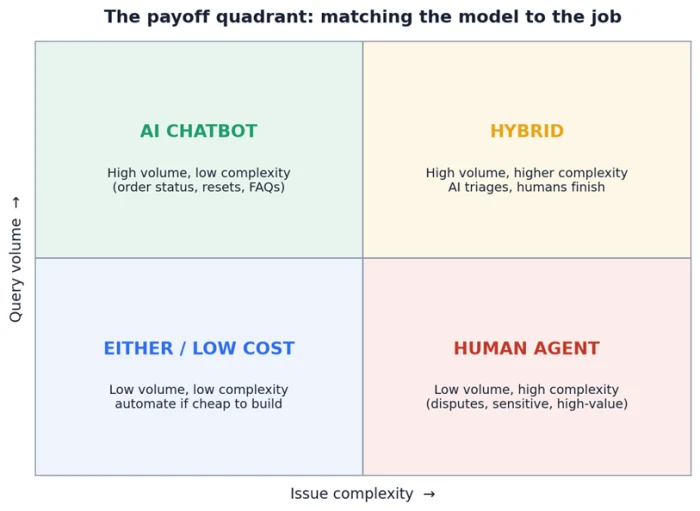
Framework 1: The payoff quadrant. Volume and complexity decide whether a chatbot, a human, or a hybrid setup wins.
The five-question automate test
Run any recurring issue through these questions. More "yes" answers on the first three mean automate; a "yes" on the last two means keep a human close.
1. Is the question repetitive and rule-based, with a clear correct answer?
2. Does it arrive often enough to justify a build (a few hundred a month or more)?
3. Can the bot access the data or system needed to fully resolve it, not just describe a fix?
4. Would a wrong answer be low-cost and easy to reverse?
5. Is the customer likely to be calm rather than upset or high-value?
The cost-per-resolution break-even model
Cost pages love a crossover formula but forget escalation drag. Here is a worked version that does not. Take a $20,000 bot build amortized over 12 months, about $1,667 a month, plus $0.60 per conversation, against $8 for a human conversation. The per-chat gap is $7.40, so the bot passes break-even at roughly 225 conversations a month ($1,667 divided by $7.40).
Now add reality. If the bot escalates 25% of those chats to a human, you still pay the human rate on that quarter, which pushes the true crossover higher and is exactly why hybrid math beats pure-bot math. Lower your build cost or raise your labor rate and the crossover drops below 200. Most teams above a few hundred monthly conversations are already past it.
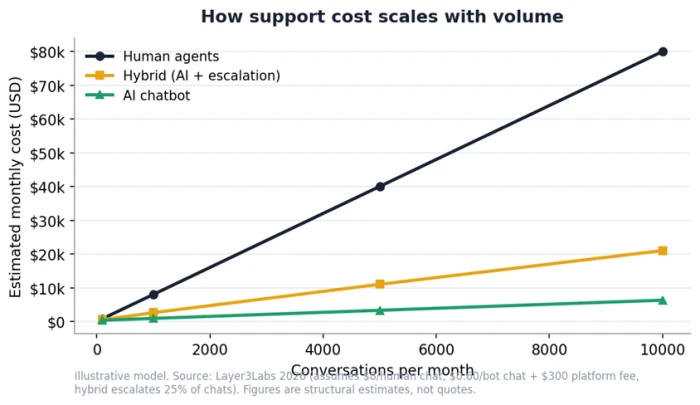
Chart 2: Monthly cost as volume scales. Human cost tracks headcount; bot cost stays nearly flat; hybrid sits between the two.
Why hybrid usually wins, and how to build it right
For most teams above a few hundred conversations a month, the answer is not one column or the other. It is a deliberate split: the bot clears routine volume cheaply, and humans take the cases that need judgment.
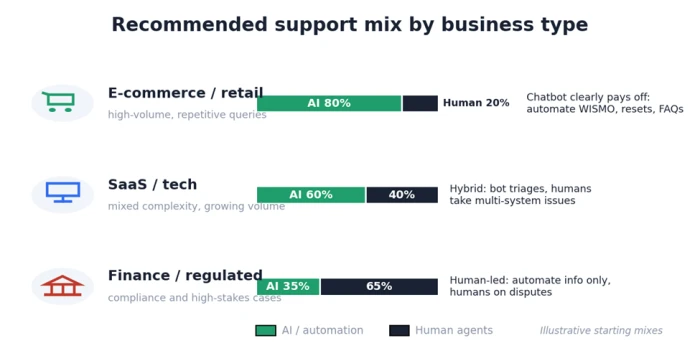
Start at 80/20 and let data move the line
A common starting point is the 80/20 rule: automation handles the routine 80% while humans own the 20% that needs a nuanced touch. Treat those numbers as a hypothesis, not a target. Audit your ticket mix first, automate the issues that pass the five-question test, and adjust monthly on the evidence.
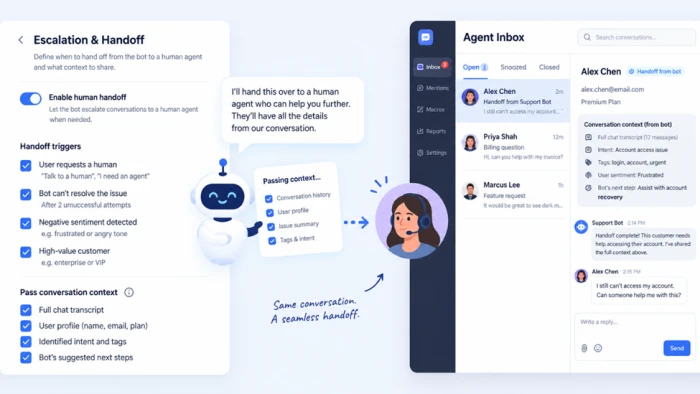
The clean-handoff checklist
Because context loss is the number one hybrid failure, the handoff is worth engineering carefully.
• Pass the full transcript and customer history to the human automatically, so nobody repeats themselves.
• Escalate on confidence and sentiment, not just on failed keyword matches, so upset customers reach a person fast.
• Keep a visible, one-click path to a human at every step, since 89% of consumers want that option.
• Scope the bot's tool permissions tightly and log every action it takes.
KPIs to watch
Track cost per resolution, first-contact resolution, containment (not deflection), escalation rate, and CSAT split by channel. Watching CSAT separately for AI and human interactions is what tells you whether the bot is solving problems or just closing tickets.
Payoff by business type
The framework holds everywhere, but where you land in the quadrant depends on your model.
SMB and early-stage
A basic AI chatbot runs roughly $50 to $500 a month, and first-year all-in cost lands around $1,500 to $8,000 once you count setup and training. A part-time human agent costs $18,000 to $28,000 a year, a full-timer $35,000 to $55,000 plus benefits. If a bot resolves 60 to 70% of your queries, it usually pays for itself within three to six months. Start by automating your top three repetitive questions.
E-commerce and high-volume retail
This is the clearest chatbot case. When one question like "where is my order" drives 40 to 60% of tickets, automating it removes a mountain of assisted contacts at about $11.66 saved each. A mid-sized brand deflecting 35% of 2,000 monthly tickets to self-service saves roughly $8,000 a month. The routine volume is exactly what bots do best.
SaaS and regulated industries
Here human and hybrid setups earn their cost. Decision-tree control can be preferable when there is regulatory risk, compliance exposure, or immature AI governance, because in those cases the effort to govern an autonomous agent may not pay off in the short term. Automate the informational tier, but keep humans on disputes, sensitive data, and anything with a compliance tail.
A 30/60/90-day path to the right mix
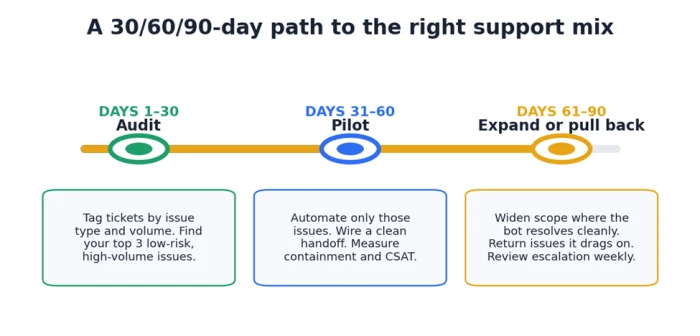
Turn the framework into a sequence instead of a big-bang switch.
• Days 1–30: audit. Pull your ticket data, tag it by issue type and volume, and calculate your current cost per resolution. Find the three highest-volume, lowest-risk issues.
• Days 31–60: pilot. Automate only those issues, wire up a clean human handoff, and set confidence thresholds conservatively. Measure containment and CSAT against your baseline.
• Days 61–90: expand or pull back. Where the bot resolves cleanly and CSAT holds, widen its scope. Where it deflects or drags, return that issue to humans. Review escalation rate weekly.
The rule that survives every scenario
Strip away the vendor noise and one rule holds across every business, volume, and budget in this guide: automate the issue, not the department. Map each recurring question by its complexity, its volume, and the cost of getting it wrong, then send it to whichever option resolves it cleanly for the least money. Measure cost per resolution weekly, keep a visible door to a human, and let the evidence move the line. The teams that win in 2026 are not the ones that picked a side. They are the ones that stopped asking which is better and started asking which pays off, for this exact problem, right now.
Conclusion
Neither option wins outright, and treating the choice as a contest is what costs teams money. The decision comes down to a single question asked one issue at a time: does this specific problem get resolved faster, cheaper, and cleanly by software or by a person?
For most teams, the honest answer looks like this:
· Reach for an AI chatbot when the issue is repetitive, rule-based, and low-risk, and when it arrives often enough to justify the build. Order status, password resets, and policy lookups are where automation earns its keep at roughly $1.84 or less per contact.
· Keep a human agent on anything complex, emotional, or expensive to get wrong. A billing dispute, a panicked customer, or a top-tier account is worth a human hour many times over.
· Run a hybrid setup once you clear a few hundred conversations a month, which most growing teams already have. Let the bot clear routine volume and route the rest to people, with a clean handoff so nobody repeats their story.
Two habits separate the teams that win from the ones that stall. First, they measure cost per resolution instead of cost per contact or deflection rate, because a deflected ticket that boomerangs into a callback is more expensive than the human interaction it replaced. Second, they keep a visible, one-click path to a person at every step, since 89% of consumers want that door to stay open even when they start with a bot.
Start small. Automate your three highest-volume, lowest-risk issues, watch containment and CSAT for 60 days, then expand where the numbers hold and pull back where they don't. The right mix is not a one-time decision you make on day one. It is a line you move every month as the evidence comes in.
Comments
Join the discussion and share your perspective.