
I kept seeing CheaterBuster AI pop up on my feed, in those short videos where someone types a name into a box and supposedly finds out whether their partner is secretly swiping on dating apps. The pitch is irresistible and a little scary: type a first name, a city and an age, and the tool hands you the truth. I run review sites for a living, so “too good to be true” is a reflex for me. I wanted to know for myself, so I ran the full flow end to end and wrote down exactly what happened at every step.
This is not a paid placement and it is not a hit piece. It is what I actually saw, what the tool can and cannot do, what other real users are reporting, and whether the CheaterBuster AI experience is worth your money. If you are here because you are worried about someone, I think you deserve a straight answer rather than hype.
Quick Verdict (For People in a Hurry)
| What I checked | My honest take |
|---|---|
| Does it actually find profiles? | Sometimes. It only surfaces public or searchable dating-app data. Hidden or private profiles stay invisible. |
| Is the AI as smart as it claims? | The “AI” framing is heavy marketing. Underneath it is a public-data and reverse-image search, not a secret backdoor into Tinder. |
| Is the price fair? | It feels steep for what you get, and the pricing only appears at the very end after a long emotional quiz. |
| Would I rely on the result? | No. I would treat a result as a lead to investigate, never as proof of cheating or proof of innocence. |
| Overall | A real, working tool wrapped in an anxiety-driven funnel. Useful in narrow cases, easy to over-trust. |
How I Tested It
To keep things clean I did not search for a real partner or anyone who had not agreed. I ran the flow using a neutral test identity, a first name (“Akshay”), an age and a city (Dehradun), so I could see every screen the funnel shows without putting a real person under a microscope. That is an important point I will come back to later, because the ethics of these tools matter as much as whether they work.
First Impressions: What CheaterBuster AI Promises On The Homepage
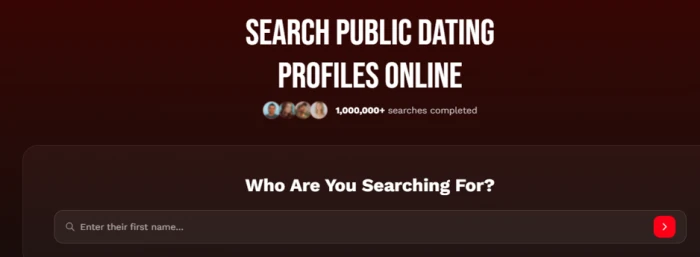
The landing page leads with a bold promise and a big social-proof number.
The homepage sets the tone straight away. A large headline invites you to search public dating profiles online, and right under it sits the familiar trust-signal move: a counter claiming more than a million searches completed, with a little cluster of faces next to it. It is clean, confident and built to convert. There is no mention of price here, no mention of how the data is gathered, just a single search box asking “Who Are You Searching For?”
From a marketing standpoint this is smart. From a buyer-beware standpoint, the absence of any “how it works” or pricing detail on the first screen is the first thing that made me slow down. Big numbers with no methodology are a pattern I have learned to question.
Step 1: It Starts By Asking For A First Name
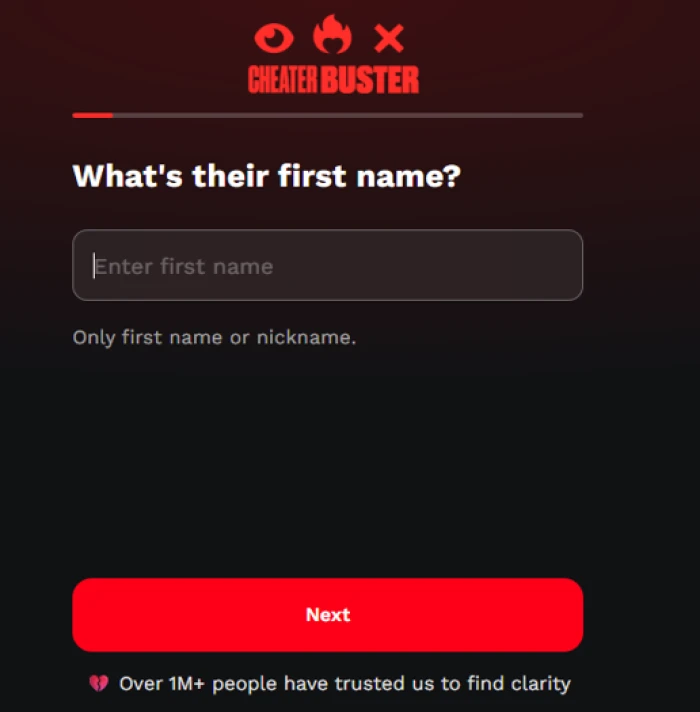
A single field, only a first name or nickname, with a reassuring trust line underneath.
The actual search begins as a step-by-step quiz. The first question only wants a first name or a nickname. Notice the line at the bottom, “Over 1M+ people have trusted us to find clarity.” That word “clarity” is doing a lot of quiet work. The whole funnel is written to speak to someone who is anxious and looking for relief, not to someone calmly comparing data tools.
Practically speaking, a first name alone is almost nothing to search on. Thousands of people share any given first name in a single city. This is the first sign that the quality of your eventual result depends entirely on how much more you are willing to feed it.
Step 2: The Age Question And The ±2 Year Trick
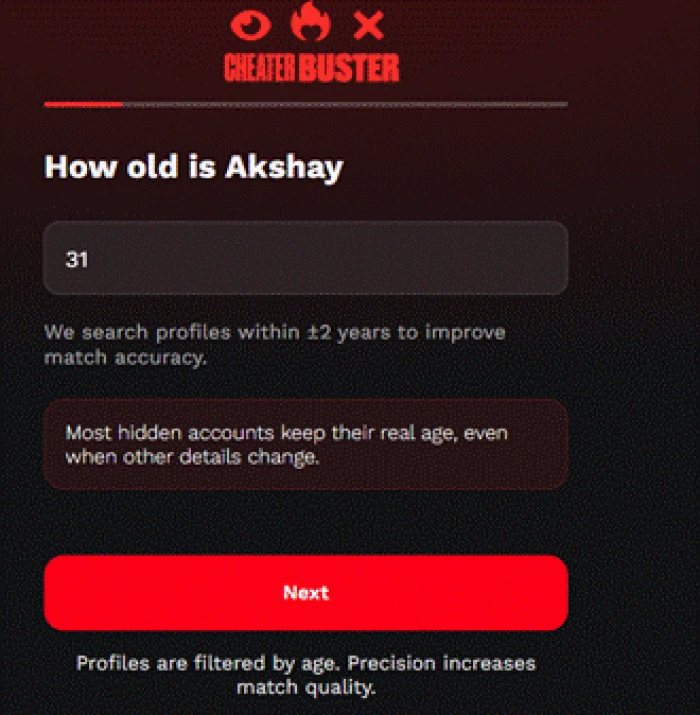
Age narrows the search, and the tool quietly widens its own net by two years each way.
Next it asks for an age. I entered 31. The tool explains it searches within a two-year range either side to improve match accuracy, and it adds a line suggesting that hidden accounts usually keep their real age even when other details change. There is a logic to that, but it is also a neat way to make a vague result feel precise. A “match” inside a five-year age band and a shared first name is not a smoking gun.
Step 3: Male Or Female
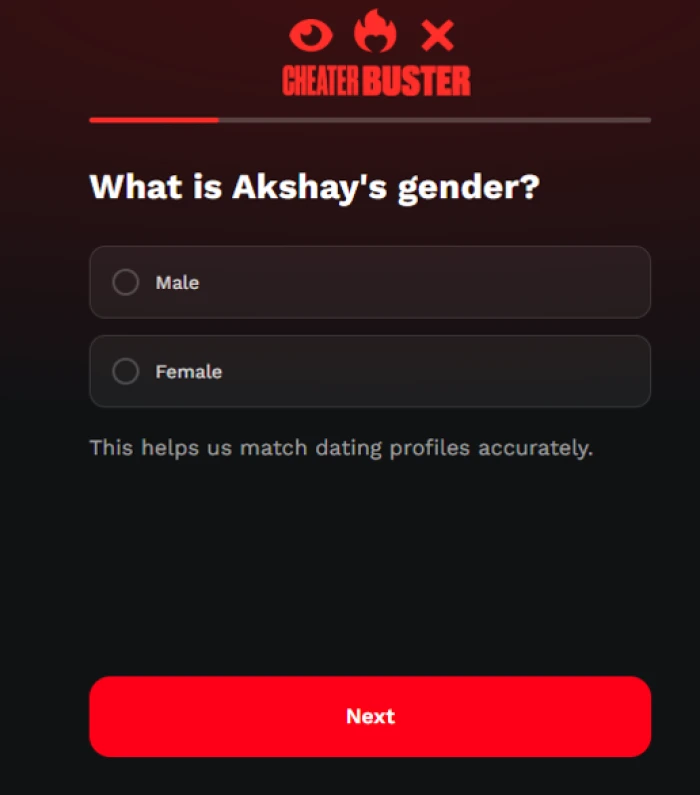
A simple binary gender question to filter dating-profile results.
The gender question is straightforward and helps filter the pool. Nothing controversial here, although it is worth noting the options are limited to two, which could reduce accuracy for anyone who does not fit neatly into that filter on the dating apps being scanned.
Step 4: “What’s Your Relationship With Them?”
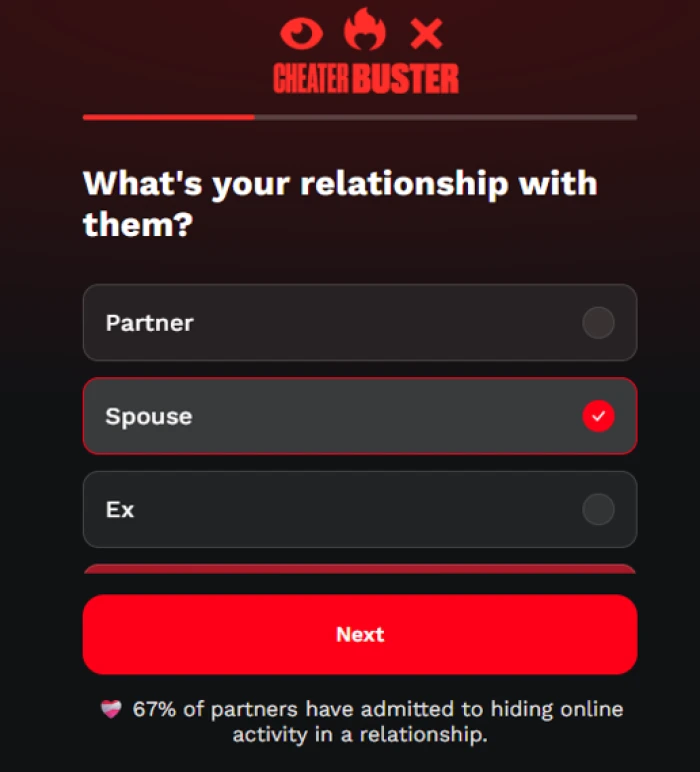
Partner, spouse or ex. The stat underneath is pure emotional priming.
Here the funnel stops being a search tool and starts being a persuasion engine. It asks whether the person is your partner, spouse or ex, and then drops a statistic claiming that 67% of partners have admitted to hiding online activity in a relationship. I could not find a credible source for that figure anywhere, and numbers like this are a classic conversion tactic. They raise your anxiety just before they ask for your money.
This is the moment I would tell a friend to take a breath. Nothing you have typed so far has found anything. You are being warmed up.
Step 5: The Suspicious Behaviour Checklist
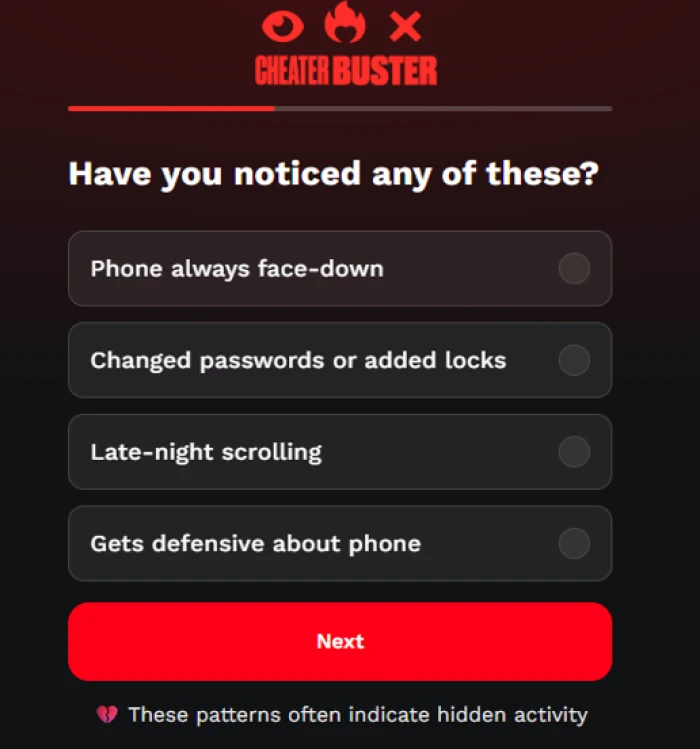
Phone face-down, changed passwords, late-night scrolling, defensive about the phone.
The checklist asks whether you have noticed behaviours like the phone always being face-down, changed passwords, late-night scrolling or getting defensive about the phone. The footer tells you these patterns often indicate hidden activity. Every one of these behaviours is also completely normal. People put phones face-down in meetings. People change passwords after a breach. Treating ordinary habits as evidence is exactly how suspicion turns into something unhealthy, and this screen leans into that hard.
None of these answers improve the search in any technical way. They exist to make the eventual report feel personalised and justified.
Step 6: Pinning A Location On The Map
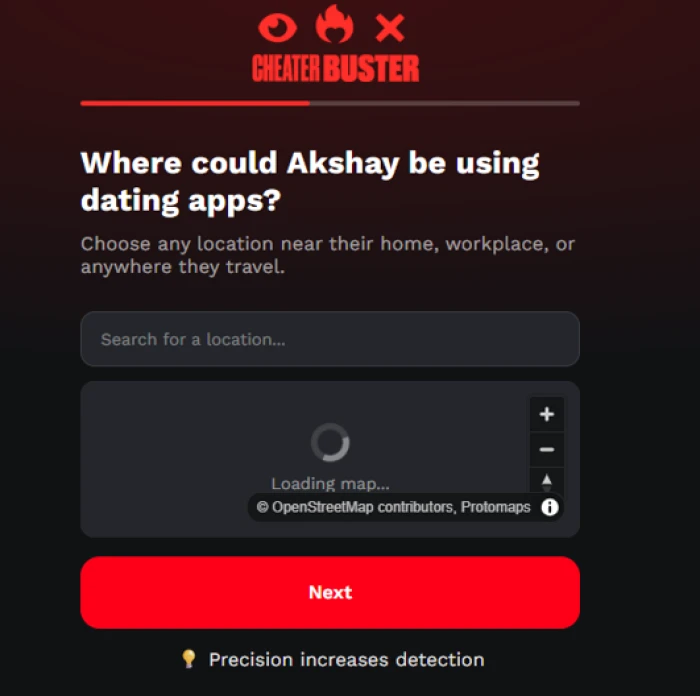
A map asks where the person might be using dating apps.
Now we get to a question that genuinely affects accuracy. Dating apps are location-based, so the tool asks where the person might be using them, near home, work or anywhere they travel. This is the single most useful input in the entire flow, because the underlying dating data is tied to the last place someone opened the app. A vague city will give vague results. This is where precision actually helps.
Step 7: “Does Akshay Travel Often?”
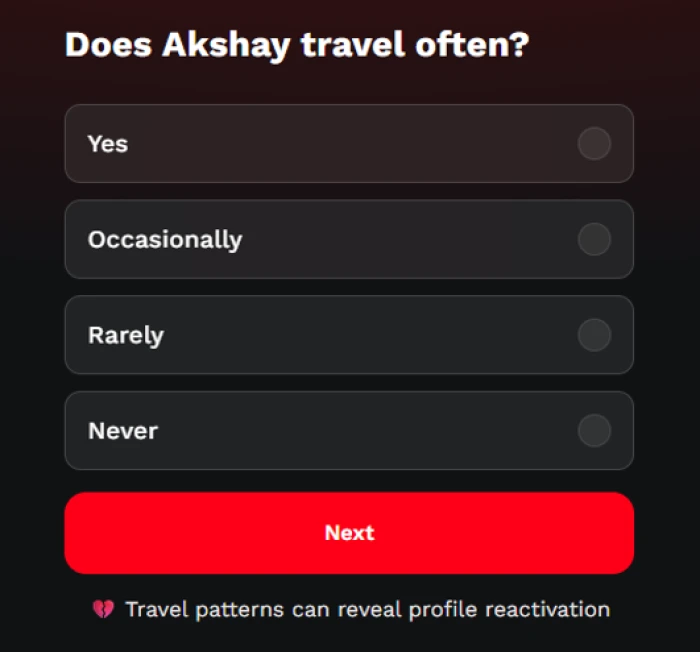
Yes, occasionally, rarely or never, framed as a clue to “profile reactivation.”
The travel question is dressed up with a line about travel patterns revealing profile reactivation. In reality this is more funnel colour than science. Whether someone travels does not give the tool any new data source to search. It simply makes the questionnaire feel thorough, which again builds your confidence in whatever comes at the end.
Step 8: When Do You Think They’re Most Active?
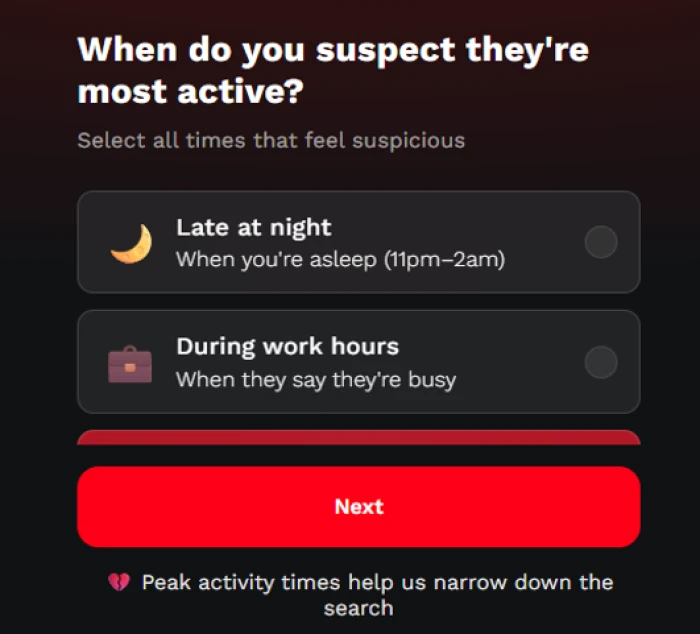
Late at night or during work hours, the hours chosen to feel accusatory.
You are asked to select the times that feel suspicious, with prompts like late at night while you are asleep, or during work hours when they say they are busy. The language is doing the work here. There is no technical way for the tool to search “only profiles active at 1am.” This is mood, not method. By now I had answered a long list of questions and still had zero results in hand.
Step 9: The Optional Face Photo Upload
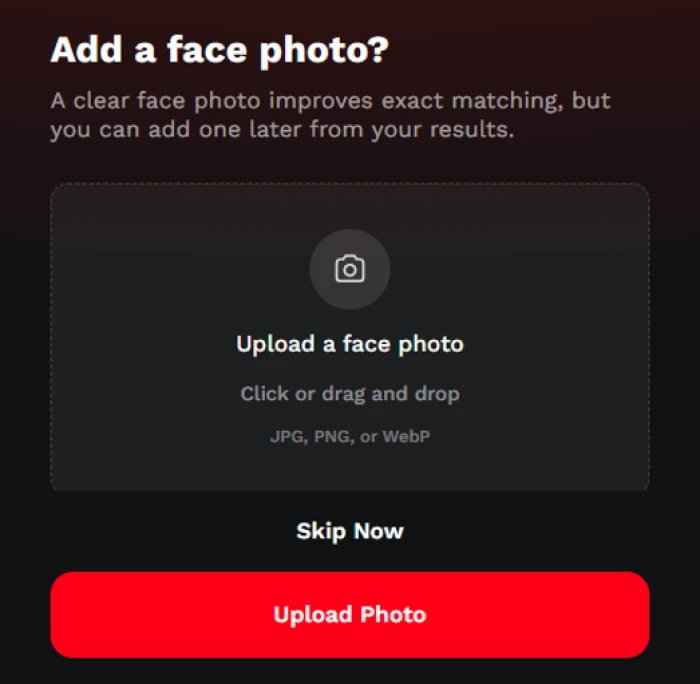
Upload a face photo for “exact matching,” or skip it for now.
This is where the “AI” claim actually touches something real. Uploading a clear face photo lets the tool attempt reverse-image matching against public profile pictures, which it brands as FaceTrace™ later on the pricing page. Reverse-image search is a genuine technique and it can work, but it is not magic and it is not exclusive to this product. Free tools like Google Images and TinEye do the same job. You can skip this step, and I did on the first pass to see how far a no-photo search would get.
One quiet concern: you are being asked to upload someone else’s face to a third-party service. Keep that in the back of your mind.
Step 10: Instagram And TikTok Handles
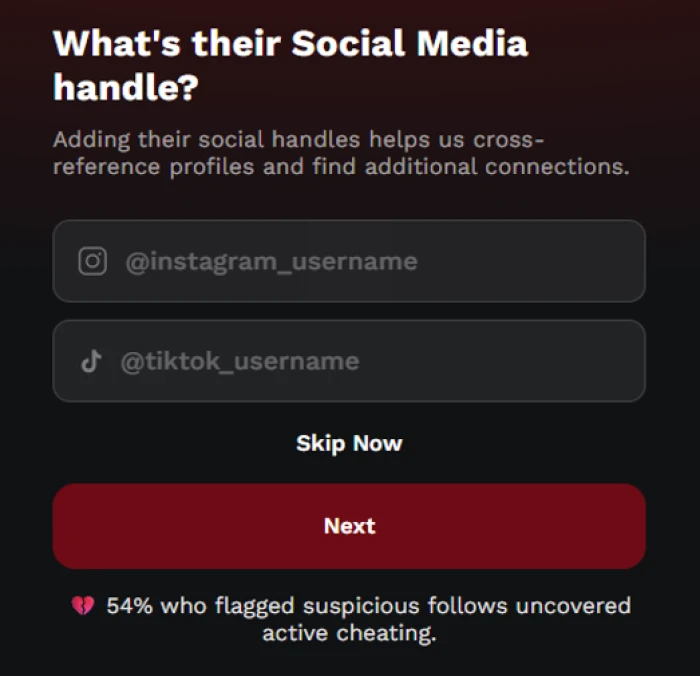
Optional social handles, with yet another anxiety statistic below the fold.
The tool then offers to cross-reference Instagram and TikTok handles to find additional connections, with another unsourced stat claiming 54% who flagged suspicious follows uncovered active cheating. Linking a public social handle is a reasonable way to confirm identity and match a face to a name. It is also, once again, something you can do yourself for free by simply opening the person’s public profile.
Step 11: The “Start Search” Screen
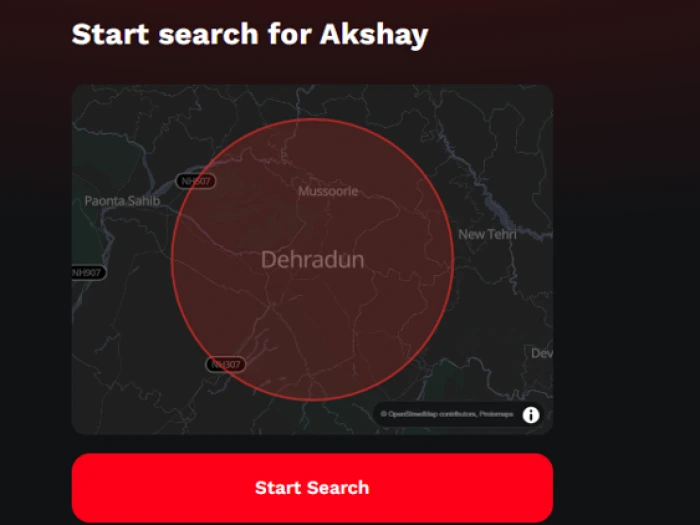
A dramatic red radius drops over the chosen city before the search “begins.”
After all those questions, the tool shows a map with a glowing red search radius over the city I picked and a single big button: Start Search. It is theatre, and it is effective theatre. The animation and the countdown that follows are designed to make it feel like a powerful engine is now combing through databases on your behalf. What is really happening is far more mundane, as I will explain in the next section.
Step 12: “Your Report Is Ready” And The Sign-In Wall
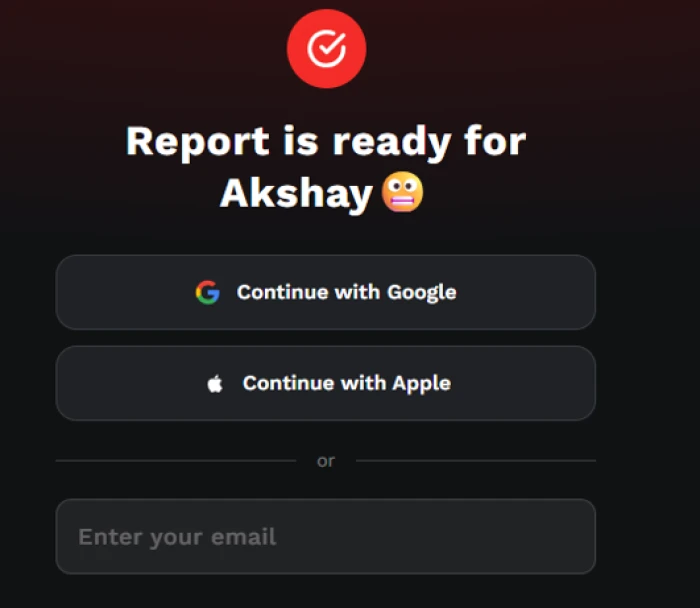
The report is “ready,” but first you must hand over an account.
Here is the first real catch. The tool announces the report is ready, then immediately blocks it behind a sign-up wall asking you to continue with Google, Apple or your email. You have invested five minutes and a lot of emotional energy, and now you must create an account to go further. This is a textbook commitment-and-consistency tactic. Having come this far, most people hand over their email without a second thought.
Step 13: The Paywall, Where The Real Cost Finally Shows Up
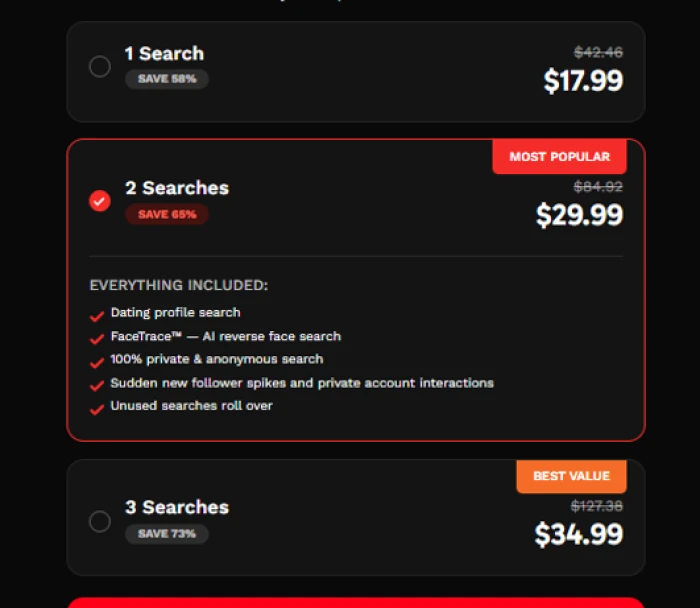
Pricing only appears at the very end, anchored with crossed-out “original” prices.
And here is the whole point of the funnel. Only now, after the quiz, the account and the dramatic search animation, does the price appear. The tiers I was shown were anchored against inflated “original” prices with large fake-looking discounts:
| Package | Shown price | “Original” price | Claimed saving |
|---|---|---|---|
| 1 Search | $17.99 | $42.46 | 58% |
| 2 Searches (“Most Popular”) | $29.99 | $84.92 | 65% |
| 3 Searches (“Best Value”) | $34.99 | $127.38 | 73% |
The middle tier is pre-selected for you and labelled Most Popular, and the bundle promises dating-profile search, the FaceTrace reverse face search, a private and anonymous search, alerts about follower spikes and private-account interactions, and unused searches that roll over. For context, the service this grew out of, Swipebuster, charged around five dollars for a search back in 2016, as Quartz reported at the time. The price has climbed a long way for what is still, at its core, a public-data lookup.
How CheaterBuster AI Actually Works Behind The Scenes
Once you strip away the animation, the mechanics are not mysterious. CheaterBuster began life in 2016 as Swipebuster and was later rebranded with the “AI” label, a timeline documented in overviews like this Blockchain.news profile of the service. The core function has always been the same: search dating-app data, primarily Tinder, using a name, age, gender and last-known location.
The crucial thing to understand is what it is not doing. It does not have a secret backdoor into Tinder’s database. Tinder’s private API is locked down. Independent write-ups, including this candid IndieHackers account from someone who tested it, reach the same conclusion: the tool works with publicly available and searchable data. If a dating profile is public, it may surface. If the profile is hidden, private, or set so only matches can see it, the tool simply cannot find it.
That single fact reframes everything. A “no profile found” result does not mean the person is not on a dating app. It means nothing public turned up for that one name, in that one area, on the apps it checks. Absence of evidence is not evidence of absence, and that is the most dangerous misreading this product invites.
What It Can And Cannot Do
| It genuinely can | It cannot |
|---|---|
| Search public, searchable dating-app data by name, age and area | Break into Tinder or read private accounts |
| Attempt reverse-image matching if you upload a clear photo | Find a profile set to private or hidden |
| Show a possible last-active area for a surfaced profile | Prove that someone is or is not cheating |
| Save you a little manual searching time | Read messages, texts or call logs |
| Cross-reference a public social handle | Guarantee the 97 to 99 percent accuracy it advertises |
So, Does CheaterBuster AI Actually Work? My Honest Answer
My honest answer is: it works in a narrow, limited sense, and it fails exactly where people most want it to succeed. If the person you are searching for has a genuinely public dating profile with accurate details, a well-fed search with a photo and a precise location has a real chance of surfacing it. That is the version of “works” the testimonials are built on.
But the homepage headline figure of 97 to 99 percent accuracy is not something I would take at face value. One independent accuracy estimate, flagged by rival service Social Catfish in the breakdown of “no match” results, put real-world accuracy closer to 89 percent even with perfect inputs, which means roughly one in nine searches can come back wrong or empty. And that is before you account for the huge blind spot of private profiles, which never show up at all.
Bottom line: treat any result as a lead, not a verdict. A hit tells you to have a real conversation. A miss tells you almost nothing. Basing a marriage-ending decision on either would be a serious mistake.
What Users Are Saying
I did not want this review to rest only on my own run, so I read through a large number of independent reviews and complaints. The picture is genuinely mixed, and it is worth seeing both sides.
The Positive Reviews
On CheaterBuster’s Trustpilot page, which sits around a middling score of roughly 3.1 out of 5 across a few hundred reviews, plenty of people say it delivered. There are heartfelt reviews from users who say it confirmed a suspicion quickly, surfaced a profile they already half-knew existed, or gave them the push to end a relationship that was not working. A hands-on walkthrough on Techpoint Africa also found the sign-up flow simple and the interface genuinely easy to use. When the inputs are good and the profile is public, the tool can do what it says.
The Negative Reviews And Red Flags
The complaints cluster around a few consistent themes, and they are the ones that would stop me from recommending it freely:
Billing surprises. Multiple reviewers report expecting a one-off charge and then seeing repeat or doubled charges, describing it as a subscription they did not realise they were signing up for.
Vague or inaccurate results. A recurring complaint is paying for a search that comes back thin, generic or simply wrong, including cases where a profile the user already knew existed returned nothing.
Trouble cancelling or getting support. Some users describe difficulty cancelling and slow or unhelpful responses when they tried to get a refund.
Overpromised accuracy. Claims near 100 percent are not realistic for any tool that depends on public data, and the gap between the promise and the experience is where most anger comes from.
To its credit, the company does appear to respond to a large share of negative reviews publicly. Whether those responses resolve anything is a separate question, but it is not a company that ignores its critics entirely.
Pros And Cons At A Glance
| Pros | Cons |
|---|---|
| Clean, easy, anonymous interface | Price only revealed after a long quiz and sign-up |
| Can surface genuinely public profiles | Cannot see private or hidden profiles at all |
| Reverse-image search is a real, useful feature | Advertised 97 to 99 percent accuracy looks inflated |
| No Tinder account needed to search | Reports of surprise or repeat billing |
| Responds to reviews publicly | Anxiety-driven funnel with unsourced statistics |
Is It Safe, Legal And Ethical To Use?
Searching publicly available information is generally legal in most places, and the data the tool touches is the same data a dating app exposes to anyone nearby. That was the uncomfortable point raised all the way back in 2016 when Swipebuster first appeared: it was not hacking anything, it was showing how exposed that public data already is.
The ethics are murkier than the legality. Uploading another person’s photo to a third-party service, building a secret dossier on a partner, and letting an app feed your suspicion with unsourced statistics are all things worth pausing over. If trust has eroded enough that you are running a search like this, a result from a website is unlikely to be the real fix. An honest conversation, and in serious cases a counsellor, will do more than any report.
What I Would Do Instead (Free And Low-Cost Options)
Reverse-image search yourself. Drop a profile photo into Google Images or TinEye and filter for social or dating sites. This is the same core technique, for free.
Check public profiles directly. Open the person’s public Instagram, TikTok or other handles. Much of what the tool “discovers” is simply public.
Use a broader people-search tool. If you genuinely need this, tools that search many platforms and public records at once cast a wider net than a single-name, single-app lookup.
Have the conversation. Not a tech fix, but the only one that addresses the real problem a search like this is really about.
Final Thoughts: Worth It, Or Not?
After running the whole thing myself, my view is that CheaterBuster AI is a real tool wrapped in an anxiety-selling funnel. It can surface public dating profiles, the reverse-image search is legitimate, and the interface is easy. But the “AI” branding oversells what is essentially a public-data lookup, the accuracy claims are inflated, the price is high and hidden until the last moment, and the questionnaire is engineered to make you more worried, not more informed.
If you understand those limits and treat a result as a starting point for a conversation, it can be one small input. If you are hoping it will hand you certainty about your relationship for thirty dollars, it will not, and believing that it has may cause more harm than the doubt that sent you there. Go in clear-eyed, or better still, talk to the person instead.
Comments
Join the discussion and share your perspective.