
Two names that sit one letter apart, two products with almost nothing in common. Here is how I sorted them out.
I review AI tools for a living, and one question reaches me more than almost any other. Readers want to know whether Poly.AI and PolyBuzz are the same thing.
It is a fair thing to ask. Search either name and the results blur together. I cover both products on this site under titles that look nearly identical, so I finally wrote down the explanation I keep giving.
The answer caught a few people off guard, and the reason behind it is a small piece of AI history that almost nobody bothers to explain.
Let me take you through it.
The short answer, before anything else
No. Poly.AI and PolyBuzz are not the same product. They come from two separate companies, and they solve different problems for audiences that would never overlap.
There is one wrinkle, and it causes most of the confusion. The app now called PolyBuzz used to go by the name Poly.AI. So depending on what you remember, the name you typed could point to either of two things. I will introduce both below, starting with the one most people have never heard of.
First, meet PolyAI, the enterprise voice company
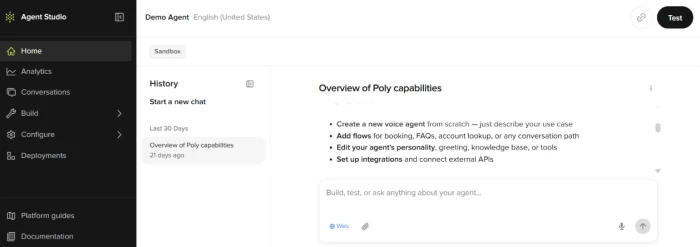
PolyAI is a London company that has operated since 2017. It builds voice agents that handle customer service phone calls for large organizations, the kind of automated voice you reach when you call a bank or a hotel chain. Its agents run on a proprietary model the company calls Raven, designed for live conversation rather than written text.
This is enterprise software with a heavy price tag. The company has raised more than $200 million, and its agents work inside call centers across banking, telecom, travel, and healthcare. For most of its history the platform was sold only through enterprise contracts. Earlier this year it added a self-serve version with a free trial, which is one reason its name began appearing in more searches. I put the platform through a hands-on test and scored it in our full PolyAI review. None of this touches anime characters or roleplay, which is where the other product enters the picture.
Now meet PolyBuzz, the AI character chat app
PolyBuzz lives in a different corner of the internet entirely. It is a character chat and roleplay app from Cloud Whale Interactive Technology LLC, a company registered in Delaware. Rather than answering support calls, it lets you talk to AI personalities for entertainment.
The scale is hard to overstate. I documented the full experience, including a live test of the character builder, in our PolyBuzz review. The app carries more than twenty million characters across anime, K-pop, fantasy, and romance, and it has passed ten million downloads on Google Play. You can chat with characters other people built or create your own, complete with an AI-generated avatar. Subscriptions run from $9.90 to $29.90 a month, with a separate coin system for extras such as voice chat and image generation.
It is rated for adults, and private adult conversations are permitted. That detail alone signals a different user than a bank shopping for a call-center tool.

What is running under the hood
PolyAI runs on a voice-first stack tuned for one hard problem: holding a natural phone conversation in real time. Speech comes in, gets transcribed, passes through PolyAI's own models for intent and dialogue, then returns as synthesized speech, all inside the sub-second window a caller expects before a pause turns awkward. The agents handle interruptions and mid-sentence corrections, the moments that snap an ordinary phone tree in half. The team also designs a separate voice persona for each client so the agent carries the brand instead of sounding like stock software, and the platform reaches across more than 100 languages. This is engineering descended from the founders' early academic work on efficient conversational models, and the pedigree shows on a live call.
PolyBuzz is built around the opposite goal: keep you scrolling and coming back.
Instead of one house model, it routes conversations across several third-party language models and tunes them for character roleplay. In my testing the app never revealed which model was answering a given character, and that opacity leaks into the experience as uneven quality from one character to the next. Access to the stronger models is partly a paid perk, folded into the higher membership tiers. Image generation runs on its own diffusion model in beta, billed through coins rather than the subscription.
The practical takeaway sits in two human moments. PolyAI's stack is engineered so a caller in a tense spot, a missed payment or a delayed flight, gets handled without friction. PolyBuzz's stack is engineered so a restless user at midnight taps for one more reply. Same family of technology, aimed at opposite needs.
The plot twist that explains everything
Here is the piece that links the two names, and it is the wrinkle I flagged in the short answer above.
The app known today as PolyBuzz did not always carry that name. Cloud Whale first launched it under the brand Poly.AI. In late 2024 the company rebranded the app to PolyBuzz, and the old name slipped off its app store listings.
Picture what that created.
A company in London had spent years building its reputation as PolyAI in the enterprise market. A separate company was running a consumer chat app under the nearly identical name Poly.AI. Two unrelated businesses sharing one name, with a search engine left to guess which was which.
The move to PolyBuzz cleared the collision for the company that changed. It did not erase the years of links and older articles that still call the chat app Poly.AI, which is why the question keeps landing in my inbox.
I want to be exact about one point, because rushed write-ups get it wrong constantly. The London enterprise company did not become PolyBuzz. It still runs under its own name. The rebrand touched only the consumer chat app. Confusing those two is the biggest error I see in coverage of this whole topic.
How to tell which one you are looking at
Once you know the backstory, separating them takes seconds. The giveaways sit in the web address and in the product itself.
| PolyAI | PolyBuzz | |
|---|---|---|
| Website | poly.ai | polybuzz.ai |
| Company | PolyAI Ltd (London) | Cloud Whale Interactive (Delaware) |
| What it does | Enterprise voice agents for customer calls | AI character chat and roleplay |
| Built for | Businesses with high call volumes | Adults who want AI companions and storytelling |
| Pricing | Custom enterprise quotes, plus a free trial | $9.90 to $29.90 a month, plus coins |
| The name | Always PolyAI | Was Poly.AI until late 2024 |
A simple rule covers most cases. If a page is selling call-center automation to businesses, you have landed on the London company. If it is showing you anime avatars and roleplay scenes, you have found the app that used to be Poly.AI.
Where your data goes, and who can read it
PolyAI sells into banks, insurers, telecoms, and hospital systems, so it lives by the security paperwork those buyers demand before signing. The platform holds SOC 2 certification, supports PCI DSS for handling card numbers spoken on a call, encrypts data in transit and at rest, and lets clients configure how long recordings are kept. Healthcare deployments can add the contractual cover regulated callers expect. None of this is decoration. It is audited, because a bank's compliance team will not approve a vendor without it.
PolyBuzz answers to no such buyer, and the contrast is sharp.
The app tells users their character chats are private and stored encrypted, unreadable even to staff and to the people who built the characters. That is the reassuring version. Reviewers who actually read the policy describe a looser reality, where the company's own terms permit collecting the text of chats, uploaded photos, and (on the mobile app) audio. The mobile version also tracks activity across other apps for advertising, and the consent screen on the site discloses data sharing with a long roster of ad partners. The word "private" carries more weight in the marketing than the policy backs up.
Age control is the part I would not wave past. PolyBuzz wears an 18+ rating and offers a Teen Mode, yet sign-up asks only for a birthdate, and a child clears that gate by typing a year that makes them an adult. Parental controls that let a guardian read the chats do not exist. For an app that allows adult roleplay, that is a thin door, and the parent-focused reviews I checked reach the same verdict: treat it as adults-only, and assume the filters will not hold against a determined minor.
Which one do you actually want?
By this point the choice usually answers itself, and it hinges on one question. Are you a business, or are you here for fun?
Run a contact center and want to automate inbound calls? The London platform is the one worth your time, and the review I linked earlier walks through its free trial and my testing so you can weigh the fit before any sales call.
Came looking for AI characters or roleplay instead? The app once called Poly.AI is now PolyBuzz, and the review I linked above breaks down its features, pricing, safety record, and the complaints real users raise. Read that before you subscribe.
If neither one is right for you
If you want an enterprise voice but PolyAI's six-figure contracts and multi-week build feel too heavy, lighter options exist. Cognigy, now owned by NICE, bolts voice and chat automation onto contact-center systems a company may already run. Replicant chases the same target as PolyAI, full automation of repetitive inbound calls, with a different delivery style. For a smaller team that needs to be live in days rather than months, developer-friendly platforms like Retell AI and Vapi offer self-serve pricing and free tiers, the reverse of PolyAI's sales-call-first approach.
The character-chat side carries more rivals than anyone could test in a week.
Character.AI is the usual first stop, with a library on PolyBuzz's scale and a name for tight moderation, which makes it the calmer choice for general roleplay and a frustrating one for anything explicit. Janitor AI takes the opposite stance: you supply your own model key and wire in something like GPT-4 or Claude, trading setup friction for control over quality. Talkie pushes hard on voice and animated scenes, while Candy AI spends its effort on sharper visuals than PolyBuzz currently ships. I put several of these side by side in our character-app comparisons, with the trade-offs laid out.
Choose by the constraint that actually binds you. Budget and rollout speed steer you toward the self-serve voice tools. Content limits and visual quality separate the chat apps faster than any feature checklist.
The bottom line
If you take one habit from all of this, let it be checking the web address before you trust a page. The two products sit on different domains, and that one glance is quicker than reading a full homepage to work out which company you have reached. Skip it and you could hand your card to an enterprise call-center platform when you wanted an AI companion, or the reverse.
The mix-up is mostly a matter of timing. PolyBuzz only dropped the Poly.AI name in late 2024, so search results and forum threads are still catching up, and the dead name will keep surfacing for a while. Give it another year and most of those stray references will thin out.
Until then, treat the two as what they are: strangers who shared a name for a season. Pick the product that fits your problem and open its review. The other one is not for you.
Comments
Join the discussion and share your perspective.