
You are one click from a signup form. It wants your email, your card, and maybe a folder of documents you would rather not hand to a stranger. The homepage says “AI-powered.” The reviews are glowing. And a small voice asks the only question that matters right now: is this AI tool legit?
Here is the fast answer. You can tell whether an AI tool is legitimate in about five minutes by checking five public things: whether a real company stands behind it, what its privacy policy says about training on your data, whether it is actively maintained, whether it is a real product or a thin shell over someone else’s model, and whether its reviews survive a skeptical read. Clear all five and you are almost certainly fine. Fail two and you have your answer.
That question has two halves that people tend to blur together. One is whether the tool is real and honest. The other is whether it will still be here next quarter. A tool can be completely genuine today and gone by the time your annual plan renews. This check covers both.
The verdict first: trust it, slow down, or walk away
Most guides make you read to the end for a conclusion. This one gives you the scoring rule up front, because the whole point is speed. As you run the five checks below, you are sorting the tool into one of three buckets.
| Verdict | What it means | What to do |
| Trust it | Clears all five checks. Real company, sane data policy, active development, genuine product, believable reviews. | Sign up. Keep the receipt and the plan terms. |
| Slow down | One clear miss, such as no visible security page or a suspiciously perfect review profile. | Ask the vendor directly. Get the answer in writing before you pay. |
| Walk away | Two or more misses, or a single hard red flag like a guaranteed-returns claim. | Don’t enter payment or sensitive data. Better options exist. |
The single fastest disqualifier
No named humans anywhere. If a product asking for your credit card has no findable founders, no registered company, and no traceable history, stop there. Everything else is a bonus check.
Why “is this AI tool legit?” became a real question
Vetting software used to be optional paranoia. Three shifts turned it into a basic habit.
Launching an “AI” product now takes a weekend
The barrier to shipping something that calls itself AI has collapsed to an API key and a landing page. That is wonderful for builders and terrible for buyers, because the same weekend-project speed produces both the next useful tool and the thin knock-off designed to grab a subscription before anyone notices it does nothing a free chatbot could not.
Regulators started fining fake AI claims
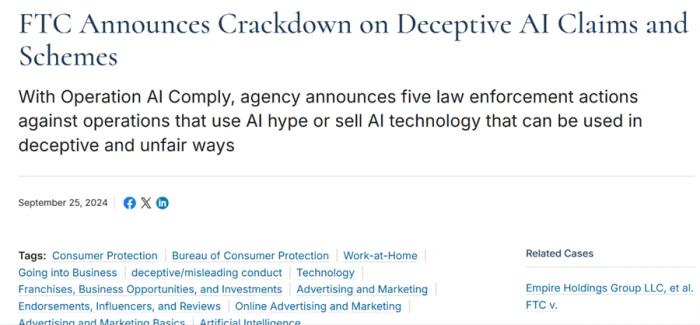
The exaggeration got large enough that agencies stepped in. In September 2024 the U.S. Federal Trade Commission launched Operation AI Comply, a sweep of enforcement actions against companies using AI claims to deceive. The headline case was DoNotPay, which marketed itself as “the world’s first robot lawyer.” The FTC said the company never tested whether its AI matched the work of a human attorney; DoNotPay settled for $193,000, with a final order in February 2025 barring the unproven claims and requiring it to notify past subscribers.
The securities regulator ran a parallel crackdown on what it calls “AI washing,” dressing up ordinary software in AI language to attract money. In March 2024 the SEC fined two investment advisers, Delphia and Global Predictions, a combined $400,000 for marketing AI capabilities they had not actually built. The pattern behind every one of these cases is the same: bold claims the underlying technology could not back up.
Even honest tools disappear
Durability is its own risk. Gartner projected that at least 30% of generative-AI projects would be abandoned after the proof-of-concept stage by the end of 2025, citing poor data quality, unclear business value, and escalating costs. And the collapse can reach the top: Builder.ai, a startup once valued above $1 billion, fell into insolvency in 2025 amid reporting that it leaned on human engineers for work it had marketed as automated. Scale is no guarantee of substance.
Against that backdrop, the reported cost of fraud keeps climbing, which is the environment any new tool now arrives into.
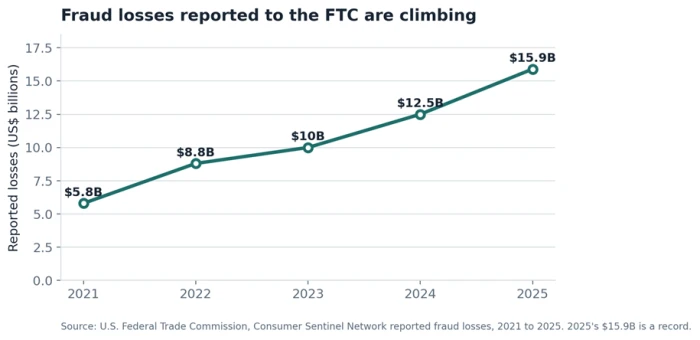
The next question is practical. If the risk is real, what exactly do you look at, and in what order? The five-minute check answers that.
The 5-minute check, minute by minute
Set a timer if it helps. Each step is one question you can answer from public information, plus the tell that a bad answer leaves behind.
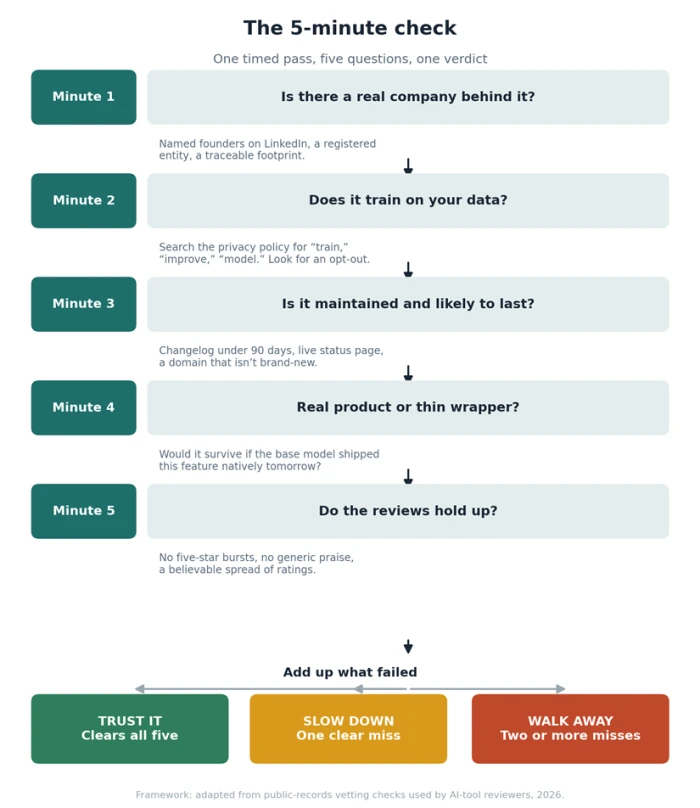
The five checks and how they resolve into a single verdict.
Minute 1: Is there a real company behind it?
Open the About or Team page. You are looking for named people you can find on LinkedIn, not stock photos or invented “AI avatar” headshots. Then confirm the company exists as a legal entity: a quick Secretary of State business search in the U.S., or a look at SEC EDGAR for a public company. Crunchbase fills in funding and investors.
None of this is disqualifying on its own. Plenty of good tools are bootstrapped and absent from Crunchbase. The bad answer: no findable founders, no registered entity, and no history, on a product that wants your card. If a founder’s photo shows up on unrelated sites, a reverse image search will expose it in seconds.
Minute 2: Does it train on your data?
This is the check that earns its keep. Open the privacy policy and terms, and use Ctrl+F for three words: “train,” “improve,” and “model.” Many consumer AI tools reserve the right to train on whatever you paste in unless you actively opt out. If you plan to feed the tool anything sensitive, that one clause outweighs every feature on the pricing page.
For business data, expect more: a Data Processing Agreement available on request, and a trust or security page listing certifications. On security specifically, ask for SOC 2 Type II, not just Type I. A Type I report says controls were designed on one date; Type II says they actually operated over at least six months. For anything touching customer data, Type II is the real bar, with ISO 27001 mattering for European and regulated contexts.
Copy-paste search inside the policy
In the privacy policy, search these exact terms one by one: train · improve · model · third party · retention · opt-out. Two minutes here tells you more than the entire marketing site.
Minute 3: Is it maintained and likely to survive?
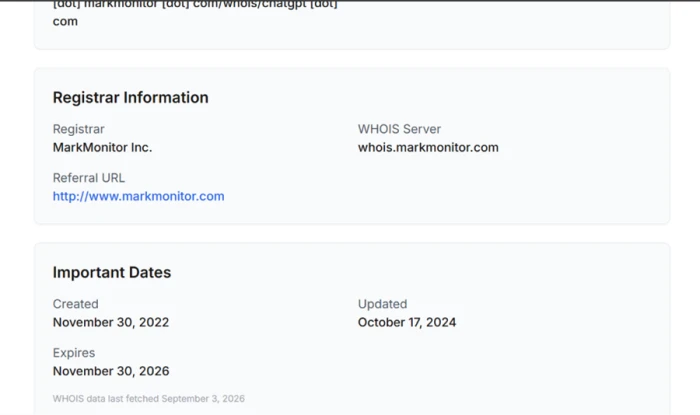
A genuine tool that gets abandoned in six months is still a bad bet, so check for a pulse. A changelog or release notes updated within the last 90 days, a public status page that shows real incident history rather than a permanent green light, and a domain that is not freshly registered (a WHOIS lookup on a site like who.is settles it in seconds).
Run a quick abandonment test. Warning signs: no product updates in 90-plus days, social accounts dormant for months, a domain near expiry, no reply to a pre-sales question, and for funded startups, no new round in over two years. One is noise. Three at once is a tool already drifting toward the graveyard.
That drift is worth picturing, because the way tools die is not what most people expect.
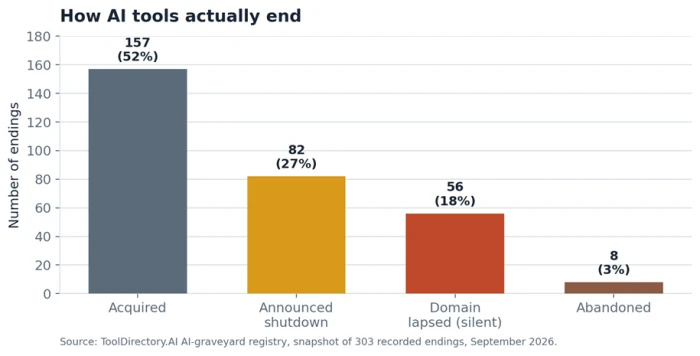
Acquisition, not a dramatic scam, is the single most common ending. But roughly one in five tools simply lets its domain lapse with no announcement at all. That is the quiet failure the maintenance check is designed to catch before you depend on the product.
Minute 4: Is it a real product or a thin wrapper?
A “wrapper” is a thin interface over someone else’s model, with no proprietary data and no defensibility of its own. Wrappers are not automatically scams, but they are fragile: when the base models improve, the gap they filled disappears. Four questions expose one fast.
· If OpenAI or Anthropic shipped this exact feature natively tomorrow, would the product still have a reason to exist?
· Does it get better the more you use it, accumulating your data, corrections, and workflows, or is every session a fresh prompt?
· What can it do that you could not get by pasting your own prompt straight into a general chatbot?
· Is there real engineering in the changelog, beyond interface tweaks?
If the only honest answer is “it has a nicer interface,” that is not a moat, and the durability risk is high.
Minute 5: Do the reviews hold up?
Assume, going in, that some of the reviews are paid or fake. The problem got large enough that the FTC’s rule banning fake and AI-generated reviews took effect in October 2024, carrying civil penalties of up to $51,744 per violation for knowing violators. You can screen for the obvious fakes in two minutes.
· Sort by most recent and look for bursts. A cluster of five-star reviews landing in a 24-to-48-hour window after long silence is the signature of a paid campaign.
· Distrust generic praise that names no specific feature or outcome. Real reviews describe the thing that actually helped.
· Check the reviewer. A brand-new account with one five-star review and no other activity is a tell.
· Read the rating spread. A 4.9 average across hundreds of reviews with essentially no low scores usually means negative reviews are being filtered, which is itself now illegal.
The legitimacy scorecard
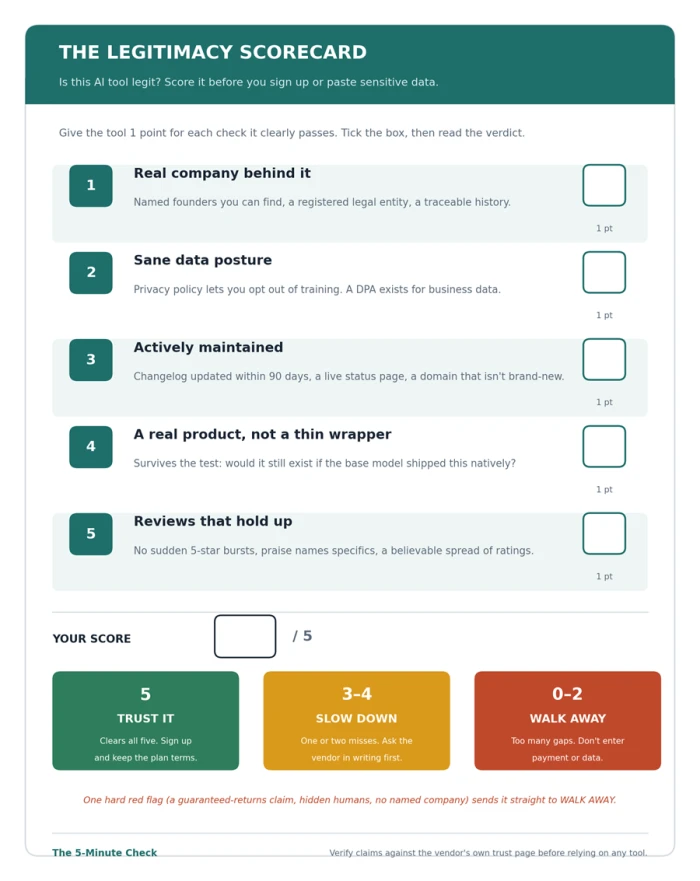
Turn the five checks into a score you can act on. Give one point for each check the tool clearly passes. The band it lands in is your verdict.
| Check | Passes if… | Point |
|---|---|---|
| Real company | Named founders, registered entity, traceable history | 1 |
| Data posture | Clear policy, opt-out of training, DPA for business data | 1 |
| Maintained | Changelog < 90 days, live status page, aged domain | 1 |
| Real product | Survives the four wrapper questions | 1 |
| Honest reviews | No bursts, specific praise, believable spread | 1 |
Scoring: 5 = trust it. 3–4 = slow down and ask. 0–2 = walk away. A single hard red flag, covered next, overrides the score and sends the tool straight to “walk away.”
Red flags versus what a legit tool does instead
These are the patterns regulators actually pursued in 2024 and 2025. Read them as stop signs, each paired with the honest version.
| Red flag | What a legitimate tool does instead |
|---|---|
| Vague “AI-powered” language with no detail on what the model does | Explains the capability plainly and can point to how it was tested |
| Guaranteed or extreme returns, like “an AI that builds you a million-dollar business” | Describes realistic outcomes and avoids income promises entirely |
| Autonomy claims with hidden humans in the loop | Discloses where humans are involved and what the system does alone |
| “Replaces your lawyer / doctor / accountant” with no evidence | Positions itself as an aid, not a licensed professional substitute |
| Pressure to pay now, refunds refused, negative reviews punished | Clear pricing, a real cancellation path, and reviews it does not filter |
One of these warrants slowing down. Two warrants walking away. The guaranteed-returns line is the most expensive phrase in the category, and the one investment-scam enforcement keeps circling back to.
Copy-paste checks you can run right now
Two of the fastest checks live outside the tool’s own website, and both are things you can literally copy and run.
The search strings
Paste these into a search engine, swapping in the tool’s name. The goal is to surface other people’s pain before it becomes yours.
· “[tool name] scam” and “[tool name] review”: read Reddit and forum threads over polished blog posts.
· “[tool name] shut down” or “[tool name] alternative”: a surge here is an early durability warning.
· “[tool name] refund”: a cluster of billing complaints tells you what the cancellation flow is actually like.
The stress-test prompts
If the tool has a chat interface, or if you paste its marketing claims into a general chatbot, these prompts pressure-test the story it tells about itself.
· “What model or models power this product, and which parts run on a third-party provider?”
· “Do you use my inputs to train or improve any model? Where in your policy does it say so?”
· “What happens to my data if the company shuts down, and can I export it?”
Evasive or contradictory answers are data. A legitimate tool can answer all three without flinching.
When “legit” still is not “safe for your data”
Passing the check means the tool is real and reasonably durable. It does not automatically mean it is the right home for sensitive or regulated information. Those are separate bars.
Before you paste anything confidential, demand these things in writing: an explicit statement that your inputs will not be used for model training, a Data Processing Agreement, and, depending on what you handle, SOC 2 Type II or ISO 27001, plus a Business Associate Agreement for anything covered by health-privacy rules. A tool can be perfectly legitimate for casual use and still fail this higher standard. Keep the two questions apart, and you will not talk yourself into oversharing just because a product looks trustworthy.
The half of the question almost no one checks
The scams get the headlines, and the checklist above catches most of them. But the enforcement actions, as loud as they are, cover only one half of “is this AI tool legit?”: the is-it-real half. The other half, will-it-last, is barely policed at all. No agency fines a tool for quietly letting its domain expire and taking your workflows down with it.
That is why the maintenance and wrapper checks matter as much as the scam checks, even though they feel less urgent in the moment. A guaranteed-returns pitch announces itself. A tool that is genuine, well-meaning, and out of runway looks exactly like a tool that will be around for years, right up until the login page stops loading. Five minutes of public-records reading is the cheapest insurance you can buy against both kinds of loss, and the only version of the check that treats “real” and “durable” as the two questions they actually are.
The Bottom Line
You do not need to become a security analyst to protect yourself. You need five minutes and a habit.
The whole check comes down to two questions asked in order. Is the tool real, meaning a findable company, a sane data policy, and reviews that survive a skeptical read? And will it last, meaning active development, a genuine product rather than a thin shell, and no signs of a project drifting toward its own domain-expiry date? A tool that answers both is worth your card. A tool that fails either one is worth a second look before you commit.
Weigh that against the cost of skipping it. On one side, five minutes of reading public pages you can reach for free. On the other, a subscription you fight to cancel, a folder of data fed into a model you never agreed to, or a workflow built on a product that quietly goes dark. The math is not close.
So the next time a signup form is sitting in front of you and that small voice asks whether the tool is legit, do not guess and do not trust the marketing. Run the check, add up the score, and let the verdict make the call. Trust it, slow down, or walk away. Five minutes now is the cheapest decision you will make all week.
Comments
Join the discussion and share your perspective.