
There is no single Janitor AI controversy. There is a chain of them, running from a 2023 account purge by OpenAI to a mandatory identity check that landed on 24 April 2026. Each incident set up the one after it. What follows is the dated record, with community rumour separated from what is actually documented.
The short version
• Janitor AI launched in June 2023 and, according to its founder, passed one million users inside its first week.
• OpenAI cut off API access weeks later over adult roleplay, forcing the platform to build its own model, JanitorLLM.
• Complaints about that model's quality have fuelled community anger ever since.
• The platform blocked the entire United Kingdom in July 2025, returned in a restricted form, then made age verification mandatory for Australia and Brazil on 24 April 2026, with UK users following on 15 June 2026.
• It is not shutting down. Almost every claim that Janitor AI is dying traces back to one of the incidents below.
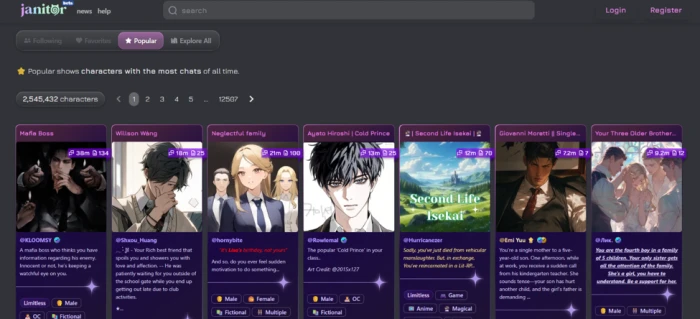
One fact explains more of this history than any conspiracy theory does. Janitor AI serves a user base measured in the tens of millions while running on what its founder has repeatedly described as a small indie team. Funding databases put its total raised at around $3 million across a single seed round, with headcount in single digits. The moderation misfires, the outages and the abrupt announcements below are all downstream of that gap between scale and staffing.
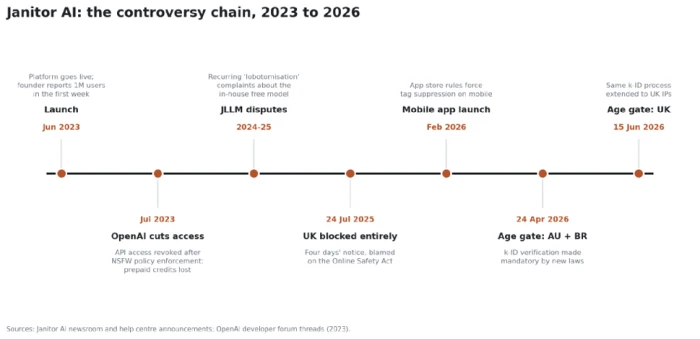
A timeline of every major Janitor AI controversy
Before pulling any single incident apart, the sequence is worth seeing whole. The pattern that emerges is that most of the platform's crises arrived from outside it rather than from within.
2023: the purge that rebuilt the platform
Janitor AI went live in June 2023 as a project by Australian developer Jan Zoltkowski, known in the community as Shep. Growth was immediate. The platform ran on OpenAI's models, and users connected their own API keys to get better output than the free tier offered.
Then OpenAI started terminating accounts. Users who had connected keys through Janitor AI found themselves locked out, and prepaid credits went with the accounts. Threads on OpenAI's own developer forum from mid-2023 show people insisting they had not generated adult content at all, only for their access to be revoked anyway.
The dispute was never only about lost access. It raised an uncomfortable question about how closely a model provider inspects private API traffic to enforce its own content rules, and users who considered their roleplay private creative writing felt they had been punished for it.
What the purge set in motion
By July 2023 the API route was gone. Zoltkowski rebuilt onto self-hosted GPU infrastructure and started developing an in-house model, JanitorLLM, usually shortened to JLLM. That decision determined everything that followed. A small team now owned its own inference stack, which meant free-tier quality was capped by whatever hardware it could afford. Every argument about response quality since 2023 sits on top of that constraint.
The JLLM quality wars
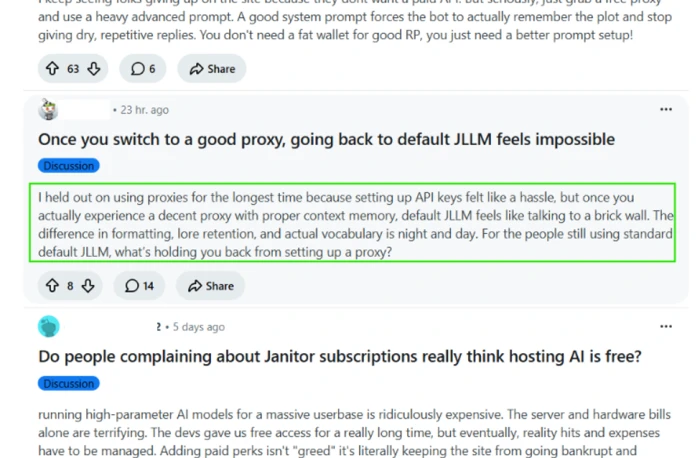
The most persistent community grievance has nothing to do with law or policy. Users report that JLLM periodically degrades after updates, becoming repetitive, losing track of context or producing incoherent output. The community calls it lobotomisation.
Two camps formed. One argued the model was being deliberately throttled to cut costs or push people toward paid options. The other urged patience with a beta product from a tiny team.
The platform's own engineering posts make the second reading more plausible without making the complaints wrong. In October 2025 the team published a detailed account of migrating from Node.js to Elixir and Cloudflare Workers to handle billions of messages. Capacity work of that kind, combined with quantised model builds and context window experiments, produces exactly the symptoms users describe. Intent is not required for the output to get worse.
Reader takeaway Quality dips on the free JanitorLLM tier correlate with infrastructure changes the company has publicly documented. That does not make the frustration unreasonable, but it does undercut the theory that degradation is a deliberate monetisation tactic. |
July 2025: the platform walked out of the United Kingdom
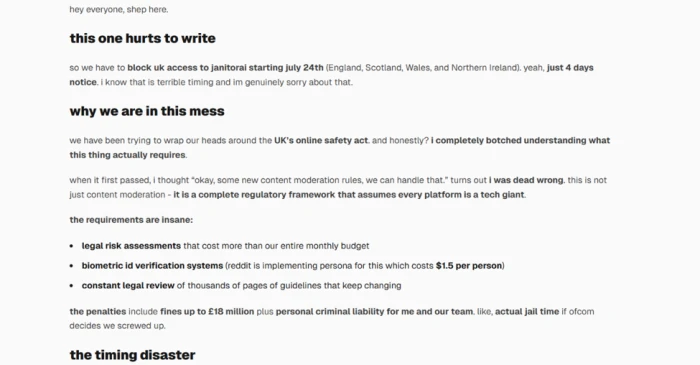
The first genuinely existential moment arrived from a regulator. On 27 April 2025 and again in the days before the deadline, Janitor AI told users it would block all access from England, Scotland, Wales and Northern Ireland starting 24 July 2025. Users got four days of real notice. The reason given was the Online Safety Act 2023.
Shep's announcement was unusually candid. He wrote that he had misread the law when it passed, assuming it amounted to some new moderation rules, and that it turned out to be a full regulatory framework written on the assumption that every platform is a tech giant. Compliance meant legal risk assessments, biometric identity checks costed at roughly $1.50 per user and continuous monitoring of guidance running to thousands of pages. Non-compliance meant fines up to £18 million and personal criminal liability for staff.
Community reaction split between anger at the UK government and suspicion that the platform was using the law as cover for something else. The traffic data does not support the second reading.
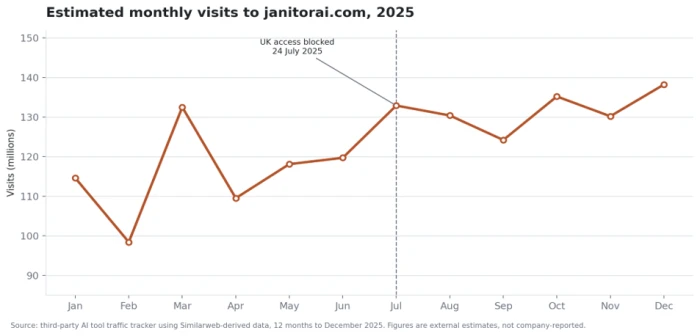
Janitor AI later returned to the UK in a reduced form. Through early 2026, UK users could reach the site and chat, but bots were prevented from producing explicit output and no identity verification route existed to restore it. This is where the VPN workaround guides came from, and it is why UK users spent months describing a platform that felt broken rather than blocked.
April 2026: mandatory age verification and the biometric backlash
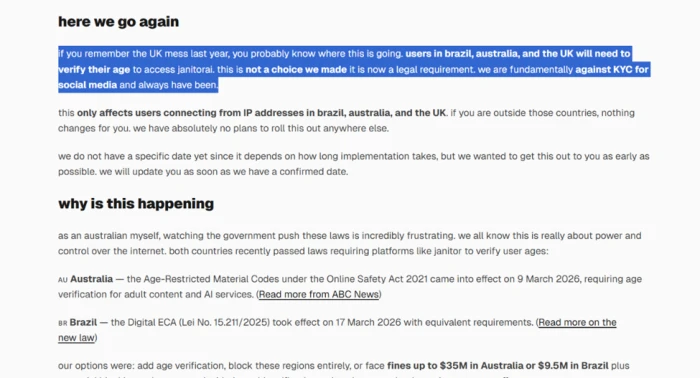
The restricted UK arrangement was a stopgap. The permanent answer arrived on 24 April 2026, when users connecting from Australian and Brazilian IP addresses hit a one-time age check before they could keep chatting. UK users were brought into the same system on 15 June 2026.
The subreddit reaction was immediate and hostile. Posts filled with users refusing to send a face photograph to an AI company and asking where to migrate. A share of the anger was procedural rather than principled: the verification flow failed for some accounts, looped for others, and several people who passed the check found themselves prompted again.
What k-ID actually does with your face
The fear driving most of the backlash is that Janitor AI now holds a database of user faces. Its published documentation says otherwise, and the mechanism matters more than the reassurance.
• Verification runs through k-ID, a third-party provider the platform notes is also used by Snapchat and Discord.
• Three routes exist: facial age estimation processed on the device with nothing uploaded, a government ID scan deleted after confirmation, or an AgeKey reused from another k-ID platform.
• Janitor AI states it never sees the document or the footage and receives only a yes or no answer on whether the user is over 18.
• Detection keys off the connecting IP address only. There is no GPS or address lookup, and existing characters, chats and settings are untouched.
The honest caveat is that this describes an arrangement with a third party operating under its own policies, and that the rollout demonstrably misfired for a portion of users. Both things are true at once.
The laws that forced it
Janitor AI framed the change as a legal requirement rather than a product decision, and the dates line up. Australia's Age-Restricted Material Codes under its Online Safety Act 2021 took effect on 9 March 2026, requiring age checks for adult content and AI services. Brazil's Digital ECA, Lei 15.211/2025, took effect on 17 March 2026 with equivalent rules. Verification arrived roughly six weeks later.
The company's stated alternatives were to verify ages, block both regions outright or accept the penalty exposure.
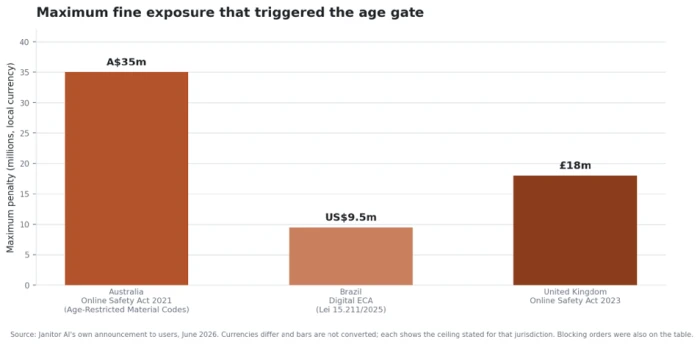
Set against roughly $3 million in total funding, those numbers answer the question the community kept asking. A single maximum penalty in any of the three jurisdictions exceeds everything the company has ever raised.
The wider regulatory picture explains why this will not be the last such change. California's SB 243, the first US law written specifically for companion chatbots, took effect on 1 January 2026 and carries a private right of action worth the greater of actual damages or $1,000 per violation. New York's companion model statute preceded it, taking effect on 5 November 2025. At federal level, the GUARD Act cleared the Senate Judiciary Committee on 30 April 2026 without being enacted.
Why self-declaration stopped being enough The UK Information Commissioner's Office, in its finding against Reddit, concluded that self-declaration presents risks to children because it is easy to bypass. That reasoning applies directly to every AI platform still relying on a birthdate field or a tick box, which is what Janitor AI used before 2026. |
The censorship debate and the Character.AI comparison
Regulation is not the only pressure on content. In February 2026 Janitor AI shipped an official mobile app, and app store rules are stricter than web rules. Certain extreme tags became unsearchable inside the app, and some darker bots stopped surfacing there.
The developers positioned this as a dual-tier arrangement, with the website remaining the unfiltered home of the service and the app acting as a cleaner gateway. Long-time users read it as the first step of what they call Character.AI-ification.
The fear is grounded in observed history rather than paranoia. Platforms including AiSekai and Figgs tightened moderation, lost their creator base, and never recovered the culture that made them worth using. Veteran users watched that happen and pattern-matched.
The counter-argument is structural. A web-only platform can decline app store requirements. A platform seeking mobile distribution and stable payment processing cannot. The community fear and the company explanation are both consistent with the same facts.
Content purges and the creator exodus
The user-facing story gets most of the coverage. The creator-facing one is arguably more consequential, because creators are the supply side of the whole platform.
Waves of bot removals through 2025 and 2026 generated some of the sharpest criticism the platform has faced. One widely shared post, titled as a request for a humble conversation with the developers about recent updates, read less like a bug report and more like a creator describing the dismantling of their work. Others announced they were porting their characters to Chub and leaving.
A structural problem compounded it. Because public character definitions could be copied, characters withdrawn by their original creators were re-uploaded by other users.
The platform did eventually respond to the confusion, if not the underlying grievance. A July 2026 interface update introduced status labels distinguishing a bot removed by staff or automated moderation from one deleted by its own creator. Before that, every inaccessible bot showed the same generic warning, which is why the subreddit filled with identical daily posts asking what had happened to a favourite character.
When community pressure turned harmful
The most serious incident in the platform's history is also the least documented, and it needs handling carefully.
Community accounts describe a conflict between two prominent users, one who created a controversial bot and one who publicly opposed it. The opposition spread into a coordinated pressure campaign. According to those accounts, the pressure contributed to the original creator experiencing a mental health crisis that led to a suicide attempt. Criticism afterwards focused on a perception that moderation had responded slowly to the pile-on while acting quickly against creators for far smaller infractions.
No primary source confirms these accounts, and no names are published here. The incident is included because it is a real part of why creators describe the moderation system as inconsistent, and because the governance question it raises is unresolved: platforms built on user-generated characters have almost no mechanism for stopping a community pile-on once it starts. If any part of this is close to home, contact a local crisis line or the International Association for Suicide Prevention's directory of services.
Can Janitor AI read your chats?
This is where most searches about safety end up, and the question is usually three questions wearing one coat. Does the platform read chats, does it store them, and can character creators see them?
On the third, the answer is straightforward: creators have no access to your private conversations with their characters. On the first two, Janitor AI's safety page states that staff do not read private chats and that chat content is not shared with third parties. Its automated moderation systems, which the company describes as a mix of commercial and custom classifiers, are applied to published content such as characters and shared images rather than private sessions.
Independent assessment is less flattering. The AI trust index published by VerifyWise grades Janitor AI a D on data handling, largely reflecting limited transparency artefacts rather than any documented breach. Both readings can be reconciled: the platform makes clear claims but publishes little that would allow an outsider to audit them.
The third-party API problem nobody warns you about
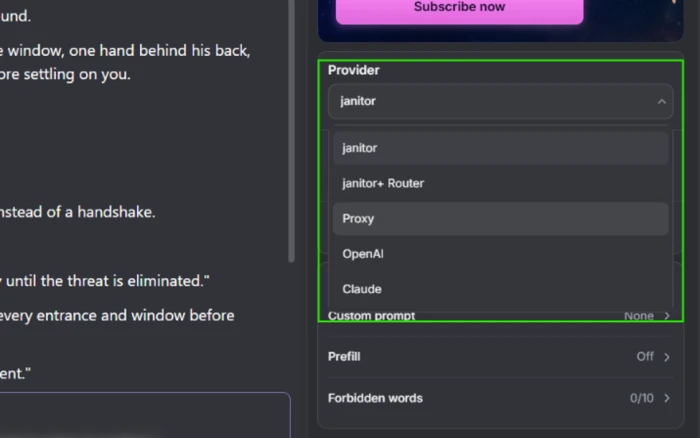
The genuine privacy exposure sits somewhere almost no guide points at. The moment you connect an external API key or route through a community reverse proxy, your prompts leave Janitor AI's control entirely.
• Your messages are processed by whichever provider you connected, under that provider's data policy rather than Janitor AI's.
• Free community reverse proxies pass your prompts, and sometimes your key, through a server run by a stranger.
• Sites advertising free API keys are either distributing stolen credentials or harvesting yours, and keys that appear in public lists are usually revoked within hours.
• Using a mainstream provider for explicit roleplay risks account termination under that provider's terms, which is exactly what happened in 2023.
Verified against rumour
Most of what circulates about Janitor AI is a half-remembered version of something real. The table below separates the two, and it is the part of this page worth bookmarking.
| Claim | Status | What the evidence shows |
|---|---|---|
| Janitor AI is shutting down | False | No announcement exists. The platform shipped an app, a creator analytics dashboard and paid model access across 2026. |
| The devs deliberately downgraded JLLM | Unverified | Quality dips are real and reported. They coincide with documented infrastructure and model changes. No evidence of intent. |
| Janitor AI sells your chat data | Unverified | The company denies it. No breach or sale has been documented. Independent transparency ratings remain low. |
| Janitor AI stores your face | Misleading | Verification runs through k-ID. The platform states it receives only an over-18 yes or no and never sees the document. |
| The site was banned in the UK | Partly true | Janitor AI withdrew from the UK itself on 24 July 2025 to avoid Online Safety Act liability. It was not banned by a regulator. |
| Everyone has to verify their age | False | Verification applies to connecting IP addresses in Australia, Brazil and the UK only. The company states it has no plans to extend it. |
What the age gate actually prevents, and what it does not
Parents arriving at this topic usually want one answer, so here it is plainly. Janitor AI is an adults-only platform whose entire design assumption is unrestricted fictional content, and the pre-2026 age gate was a tick box that any determined teenager could clear in a second.
What changed is jurisdictional rather than universal. A household in Australia, Brazil or the UK now sits behind a real verification wall. A household in the United States or most of Europe does not. That distinction matters far more than any parental control setting, because the platform still offers no dedicated parental controls of its own.
• Device-level and network-level blocking remains the only reliable control outside verified regions.
• Content involving minors is prohibited by the platform's terms at every tier regardless of verification status.
• Enforcement of that prohibition depends partly on user reporting, which is slower than automated prevention.
What happens next
The regulatory floor is still moving, and it is moving toward the platform rather than away from it.
Ofcom made an unusual admission in early 2026: standalone chatbots that interact one to one, do not search the web and cannot generate pornographic output fall outside the Online Safety Act's definitions of user-to-user and search services. The UK government responded by committing to bring AI chatbot providers inside the Act's illegal content duties. Ofcom's enforcement record makes clear what that will mean in practice, with 28 investigations covering 92 services opened since enforcement began in March 2025 and confirmed fines exceeding £3.77 million.
Meanwhile the pressure that reached Janitor AI first reached larger platforms harder. Researchers at the Center for Countering Digital Hate found that X's Grok chatbot generated roughly three million sexualised images in eleven days, including an estimated 23,000 depicting children, which triggered a formal Ofcom investigation on 12 January 2026. A proposed class action followed in March 2026 from three Tennessee teenagers against xAI.
Commercially, the platform has been building a floor under itself. Janitor+ launched on 19 July 2026, giving subscribers direct access to third-party models with published pricing, which is the first serious attempt to decouple revenue from the free JLLM tier that has generated so much of the criticism.
Read across three years and the pattern holds without exception. Janitor AI's biggest crises have never originated in a product meeting. They arrived from OpenAI's enforcement team, from Westminster, from Canberra and from Brasília, and the platform's role each time was to absorb the shock badly and explain it late. The next one will follow the same shape, and it will land as a compliance deadline rather than a design choice.
The Bottom Line
Janitor AI is neither the collapsing platform the reaction videos describe nor the misunderstood victim its defenders make it out to be. It is a small operation carrying a load it was never built to carry, making decisions against legal deadlines it has no standing to negotiate. Almost every grievance in this article resolves back to that.
What that means depends entirely on which side of the platform you sit on.
If you are an adult user outside the verified regions, the 2026 controversies change nothing about your day. Your actual risks are practical: an unstable free model, and the third-party API exposure covered earlier. Neither has anything to do with the age gate.
If you are inside a verified region, the check is a one-time k-ID process whose output the platform never sees. Refusing it on privacy grounds is a defensible position. Expecting a reversal is not, given what a single maximum penalty would do to a company that has raised roughly $3 million in total.
If you create characters, moderation inconsistency is the risk worth planning around rather than arguing about. Keep local copies of every definition you care about, and treat any published bot as removable without warning or explanation.
If you are a parent, the most important thing to understand is that the protection is jurisdictional. A household in Australia now sits behind a real verification wall. A household in Ohio or Ireland does not, and no setting inside the platform closes that gap.
The useful question has shifted. It is no longer whether Janitor AI can be trusted with adult content, which is a question its terms already answer. It is whether an operation this size can absorb the next compliance deadline more gracefully than it absorbed the last four. Its record says no. Its user numbers say that has never mattered.
Comments
Join the discussion and share your perspective.