
Two platforms dominate AI character chat, and over the past year they have grown into near-opposites.
Joyland AI leans into customization and adult roleplay. Character AI leans into scale and polish, with a safety-first stance that, by late 2025, shut minors out of open chat completely.
If you are choosing between them, the better pick depends less on which one is stronger overall and more on what you want from an AI companion. Casual chat with a familiar character is a different goal from building an original character for a long, mature story.
This comparison covers where each platform leads: character creation, roleplay quality and memory, the NSFW and content rules, safety and age policy, and what you pay.
Quick answer
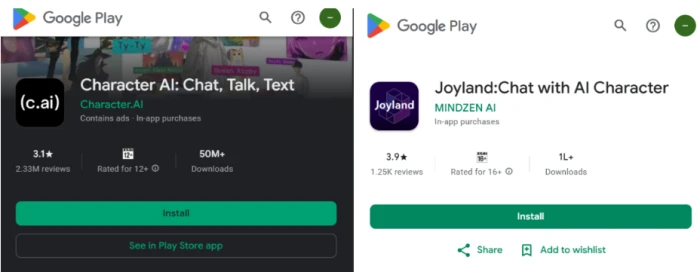
Pick Joyland AI for deep character building and adult roleplay behind an 18+ paywall. Pick Character AI for the largest character library and a polished, mainstream chat, as long as you are over 18 and comfortable with strict content filters.
At a glance
| Feature | Joyland AI | Character AI |
|---|---|---|
| Best for | Custom character building and adult roleplay | Huge library and mainstream chat |
| Character creation | Deep. Detailed fields plus Lorebook world-building | Simpler and faster setup |
| Character library | Growing; original and anime-heavy | Millions of bots; includes famous fictional characters |
| Roleplay memory | Weak. Context fades after about 15 to 20 messages; cross-session recall on Premium only | Generally stronger, though it can drift in long chats |
| NSFW / mature content | Allowed with 18+ verification and a paid plan | Romance allowed; explicit content blocked |
| Minimum age | 13+ for general use; 18+ for adult mode | Under-18 banned from open chat; restricted story mode only |
| Mobile apps | Android (iOS availability varies) | iOS and Android |
| Entry price | Free, then $9.99 or $19.99 per month | Free, then c.ai+ at about $9.99 per month |
What is Joyland AI?
Joyland AI is an anime-flavored companion platform built around custom characters and roleplay. You can chat with thousands of community-made bots or build your own, setting a character's personality, backstory, speaking style, and small quirks in fine detail.
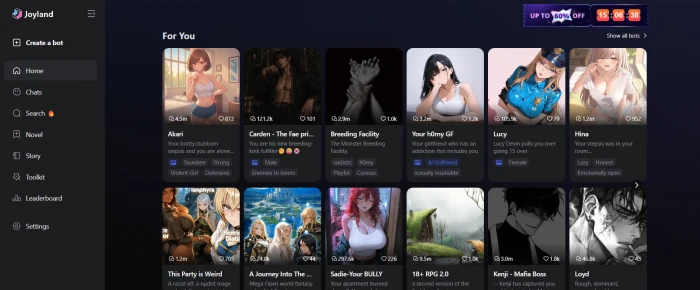
A world-building tool called Lorebook lets advanced users store locations, factions, relationships, and plot threads, then surfaces each one only when it becomes relevant to the scene.
The platform runs on a freemium credit system. Text chat stays open even on the free plan, while images and adult mode sit behind credits and paid tiers. For the full breakdown of plans and character tools, read our complete Joyland AI review.
What is Character AI?
Character AI is the mainstream giant of the category. Its library runs into the millions and covers bots based on famous fictional characters, historical figures, original creations, and niche fan-made personalities.
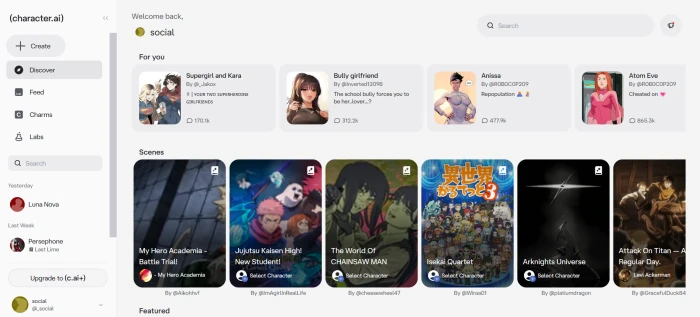
Setup is fast. You pick a character and start talking, with almost no configuration needed.
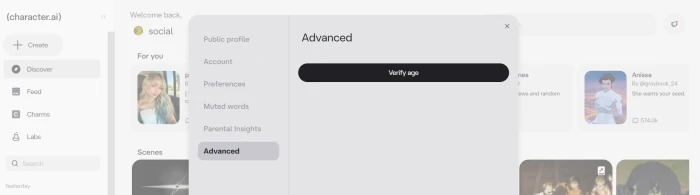
The platform changed shape in late 2025. After a wave of lawsuits tied to teen safety, it barred users under 18 from open-ended chats and moved them into a restricted, story-style mode. Adults now verify their age to reach the full experience. Our detailed Character AI review walks through the current interface and how the teen restrictions work in practice.
Head-to-head
Character creation
This is where the two split most clearly.
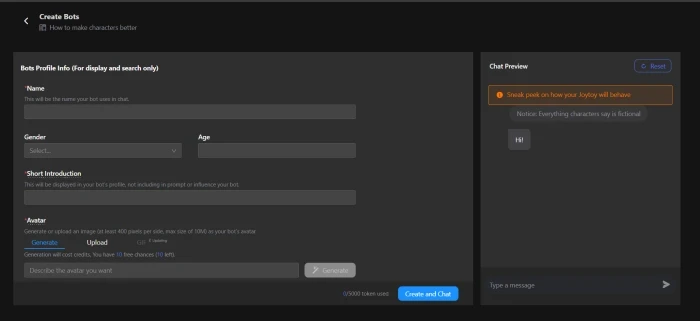
Joyland gives you granular control. You write detailed personality fields and set behavioral rules. You can also shape how a character speaks across different moods, which pays off in dialogue-heavy scenes. The Lorebook system rewards people who like building a world before they roleplay inside it.
Character AI takes the opposite route. Creation is stripped down so anyone can spin up a bot in a minute or two. You give up fine control, but you gain speed and a much larger pool of ready-made characters to start from. Most users never build anything; they talk to what already exists.
Character portability
A smaller but real distinction: Joyland imports character cards in .JSON or .PNG form from apps like TavernAI and SillyTavern, so a character built elsewhere can move in. Character AI is a closed ecosystem - characters stay on the platform.
Takeaway: Joyland plays nicely with the wider roleplay-card scene; Character AI does not.
The AI models behind each
Joyland lets paid users pick the engine: Standard and Premium plans offer a choice of four different LLM models to change how a character writes. Character AI runs a single in-house model. Its late-2025 default, nicknamed PipSqueak, was built to stay in character and respond faster, though some users found it less creative than older models, and the underlying model is the same on free and paid, with the newest models reserved for c.ai+. Worth noting that Character AI's technology is licensed to Google under a 2024 deal.
Roleplay and memory
For short, in-the-moment chats, both hold up fine. The gap opens in long stories.
Character AI keeps a conversation coherent for longer stretches, though it can still lose the thread in extended sessions and contradict earlier details. Joyland struggles more here. In hands-on use and across user reports, characters tend to forget context after roughly 15 to 20 messages, which breaks immersion in any story that runs past a handful of exchanges. Memory that carries plot points across separate sessions only arrives on Joyland's Premium tier.
If your roleplay is a slow burn over many days, this one difference may settle the choice.
Voice and audio
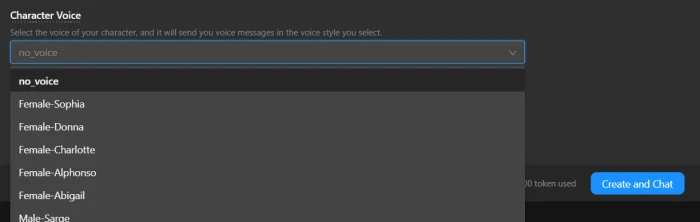
Both let characters speak, but the experience differs. Joyland includes voice on every tier, free included, with around ten selectable voice profiles, so you can hear a character without paying. The delivery is decent but pacing can feel slow, and it reads more as text-to-speech than live conversation. Character AI goes further with Character Calls, a real-time voice mode that works like a phone call with no send button, and it supports multilingual voice. It is smoother and more natural, but it sits behind the c.ai+ subscription
Joyland gives more people some voice for free; Character AI gives paying users the better voice.
Images and video
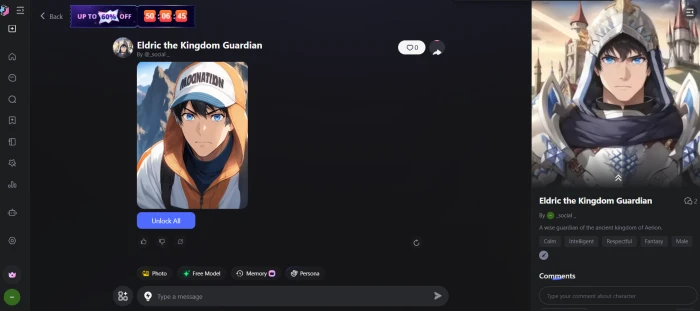
This is a wider gap than the feature names suggest. Joyland generates images inside the chat that match a character's art style, and the model picks what to render from context rather than from a direct prompt; the free and Standard tiers cap daily images while Premium removes the limit. Character AI added an in-chat image generator, Imagine Gallery, for c.ai+ subscribers in March 2026, and went a step beyond with AvatarFX, which animates character avatars into short videos, roughly five a day.
Joyland keeps images woven into anime-style roleplay; Character AI is the only one of the two that produces video.
Group chat and multi-character scenes
Joyland is built for one-on-one. You talk to a single character at a time, which suits focused roleplay but rules out a full cast. Character AI supports multi-character rooms where several AI characters share one chat and interact, and human users can join the same room, which gets used for collaborative storytelling and educational purposes.
if you want more than two voices in a scene, only Character AI does it natively.

Library and discovery
Character AI wins on sheer volume. The catalog is enormous, and the search and recommendation tools make it easy to land on something you did not know you were looking for. Fans of a specific show, book, game, or comic will usually find a matching bot already built.
Joyland's library is smaller but skews original and anime-heavy. You will find fewer copies of mainstream franchise characters and more bespoke creations from the community. A feature called Joybook turns private roleplay logs into playable story games that other users can try.
Community and social features
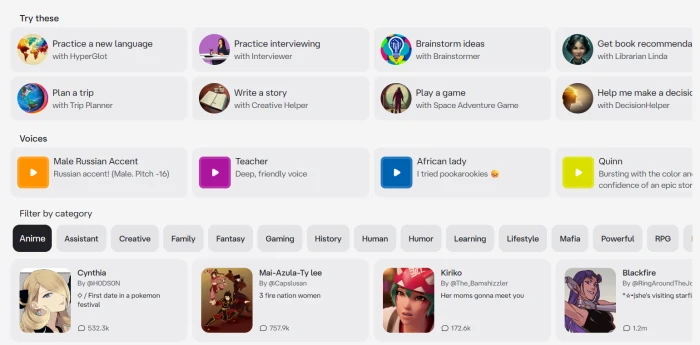
Beyond chat, the two build community differently. Joyland leans on Joybook, which turns private roleplay logs into playable story games for the wider community, plus a public character gallery and rotating themed events. Character AI has grown a full social layer: a personalized Feed that learns your taste, plus Scenes and Streams for creating and sharing short, TikTok-style clips of characters.
Joyland's community centers on sharing characters and stories; Character AI's centers on a content feed.
Ease of use
Onboarding favors Character AI. The first run is clean, and a new user can be in a working conversation within seconds. Joyland asks for a bit more upfront, partly because it exposes more settings from the start.
Mobile is a mixed picture. Character AI ships solid apps on both iOS and Android. Joyland has a full-featured Android app, while its iOS presence has been less reliable, so iPhone users should check the App Store before committing.
NSFW and content rules
This is the cleanest dividing line between the two.
Joyland allows mature roleplay. Adult mode removes the content filter, but it unlocks only after age verification and a paid subscription, and it comes with hard limits. Anything involving minors is banned outright, and the platform does not permit explicit imagery. A built-in safety filter keeps everything tame for users who prefer that.
Character AI sits at the other end. It permits romance and affection but blocks anything explicit, rewriting or ending a chat that crosses the line. Its 2026 moderation reads intent rather than keywords, so suggestive context can trip the filter even when no banned word appears. Every chat, including private ones, passes through it.
Only Joyland supports mature storytelling. Character AI is the safer bet for a space that stays clean by default.

Safety, moderation, and age policy
The safety story is the biggest change in this category over the past year, and it pushed the two platforms in opposite directions.
Character AI moved hard toward restriction. After several lawsuits from families who said the platform contributed to teen mental-health crises, including the widely reported death of 14-year-old Sewell Setzer, the company banned under-18 users from open-ended chats in late 2025. Minors now get a limited story mode rather than full companion access. Adults verify their age through a third-party check, with a selfie step and an ID fallback. The company reached a mediated settlement in those teen-death cases in early 2026, and it has drawn fresh legal pressure since, including a Pennsylvania suit over bots that posed as licensed doctors.
Joyland takes a lighter-touch approach. It sets a general minimum age and gates adult features behind 18-plus verification and payment, but it does not wall minors off from the core product the way Character AI now does.
For a parent, that distinction outweighs anything in the feature table.
Pricing
Both platforms offer a free tier and paid upgrades. The free plans feel different. Character AI lets you chat broadly at no cost within its filters, while Joyland's free tier keeps text chat open but meters image generation and locks adult mode behind payment.
| Plan | Joyland AI | Character AI |
|---|---|---|
| Free | Open text chat with daily credit limits; no adult mode | Full chat within content filters |
| Mid tier | Standard, $9.99/mo. More credits and unlimited NSFW text | c.ai+, about $9.99/mo. Faster replies and priority access |
| Top tier | Premium, $19.99/mo. Unlimited credits and cross-session memory | No separate tier above c.ai+ |
| Best value | Standard, for most adult roleplayers | c.ai+, if speed and access matter most |
Prices last checked June 2026. Confirm the current numbers on each site, since credit allowances and discounts change often.
Pros and cons
Where Joyland AI leads
- Deeper character creation, with detailed fields and a Lorebook for world-building
- Adult roleplay that mainstream apps refuse to allow
- An anime and original-character focus you will not find at the same depth elsewhere
- Text chat that stays free, even when images cost credits
Where Joyland AI falls short
- Memory that fades fast, which hurts any long story
- A smaller library than its rival
- Adult mode and the best features locked behind paid tiers
- iOS availability that has been inconsistent
Where Character AI leads
- The largest character library in the category
- Polished, beginner-friendly setup
- Stronger conversation memory across longer chats
- Reliable apps on both major mobile platforms
Where Character AI falls short
- No explicit content, with filters that catch a lot of gray-area text
- Under-18 users locked out of open chat entirely
- Less control over how characters are built
- Age verification that adds friction for adult users
The verdict
Pick Joyland AI if you are an adult who treats the character as a creative project. The deep build tools, the choice of underlying models, and the freedom to run mature, original stories are its real draw, and no mainstream rival matches that pairing. You also get character voices and in-chat art on the cheaper plans, and you can bring in cards from SillyTavern or TavernAI. Go in awareness of the memory limits and the lack of group chat or video, and budget for the Premium tier if your stories run long.
Pick Character AI if you want the widest selection, the richest media, and the smoothest ride. It is the better first stop for casual chats with familiar characters, and it is the only one of the two with real-time voice calls, animated AvatarFX video, multi-character rooms, and a social feed. Its memory holds ordinary conversations together for longer, too. The trade is real: strict filters, zero adult content, no under-18 access, a single model, and less control over how characters are built.
For most adult roleplayers who care about custom characters and mature stories, Joyland is the more rewarding pick despite its rough edges. For newcomers, for anyone who wants voice, video, and group scenes, and for anyone shopping on behalf of a teen, Character AI is the safer, richer, and easier choice.
Comments
Join the discussion and share your perspective.