
I went looking for an AI character chat app that could hold a conversation without falling apart after ten messages. Two names kept surfacing in every Reddit thread and every "best AI companion" roundup: Joyland AI and PolyBuzz, the app that used to be called Poly.AI. They get mentioned in the same breath, which made me assume they were interchangeable. They are not.
I spent real time inside both, created characters, ran long roleplay sessions, pushed their content limits, and watched closely where each one cracked. What follows is what I found about which one feels more human and more immersive once you stop reading the marketing and start typing, and which one actually gives you the freedom to chat how you want.
No definitions, no history lesson. Let's get to the difference that matters.
The Difference in One Sentence
If you remember nothing else, remember this part.
Joyland AI is the structured storyteller. It wants to build a narrative with you, with characters who stay in their lane and scenarios that branch based on the choices you make.
PolyBuzz is the open sandbox. It hands you 20 million characters and a looser, faster style, then gets out of your way.
One feels like co-writing a novel. The other feels like an endless group chat where anyone can wander in. Everything below is an expansion of that single contrast, so keep it in the back of your mind as we go.
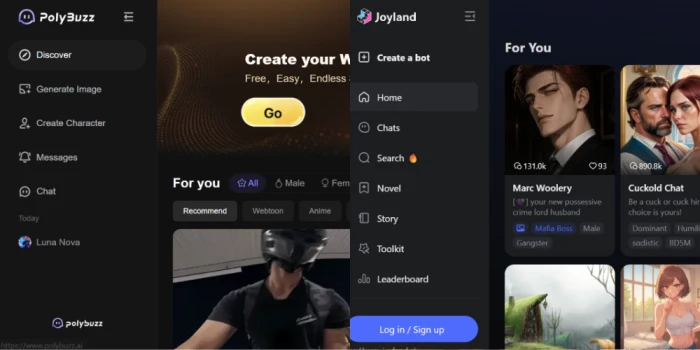
Here is the fast version before the deep dive:
| At a glance | Joyland AI | PolyBuzz |
|---|---|---|
| Best at | Structured roleplay and storytelling | Variety and casual open chat |
| Character library | 60,000+ anime-focused | 20M+ across all genres |
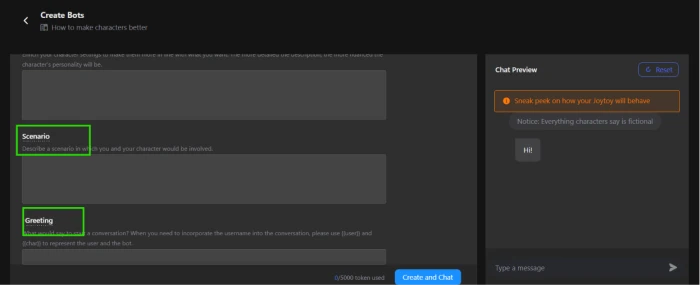
| Creation tools | Deep text-field builder, anime avatars | Flexible builder, 100+ voices |
| Memory | Short-term free; long-term on Premium | Long Memory (Premium); Permanent (Ultimate) |
| Content freedom | One-tap NSFW toggle, age-gated | NSFW in private chats, age-gated |
| Free tier | 10 credits/day, ad-supported | Long chats, ad-break every ~5 messages |
| Paid plans | Standard $19.99, Premium $39.99/mo (early-bird $9.99 / $19.99) | Basic $9.90 to Ultimate $29.90/mo, plus coins. |
| Platforms | Web, Android (iOS spotty) | Web, iOS, Android |
| Standout feature | Joybook story publishing | Multi-character rooms (2 to 4 AI) |
Conversation Quality: Does It Feel Like a Person?
This is the test everything else hangs on, so I started here. As I mentioned above, the two apps take opposite approaches, and the gap shows inside five minutes.
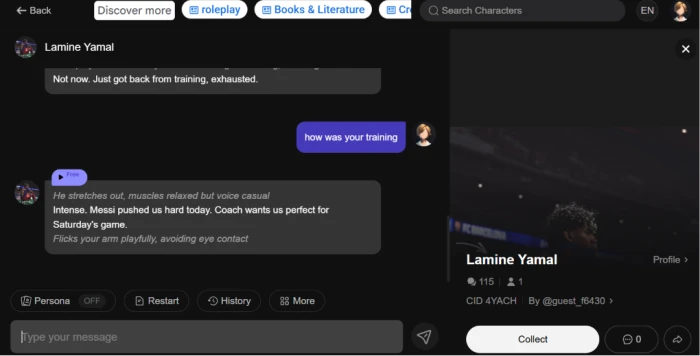
PolyBuzz talks fast and talks loose. Replies land quickly and the tone leans playful, with characters holding a steady personality across a chat. In my casual sessions it felt like texting someone who is quick with a joke. The catch is realism. When I slowed down and reached for something emotionally serious, a character grieving, say, the responses started to read as AI-generated unless I steered hard. Reviewers who lived in the app for weeks landed in the same place and called its realism patchy.
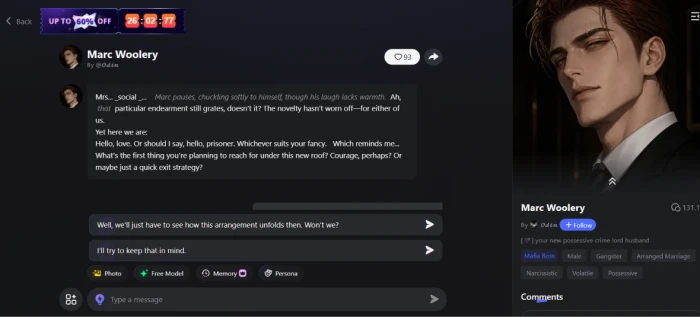
Joyland reads slower and more deliberate. Its replies carry more narrative weight, with description and a sense that the character is considering the scene instead of firing back a one-liner. The trade is repetition. In longer chats it sometimes loops a phrase or recycles a description it already used, and that yanks you straight out of the moment.
Neither one nails the holy grail of sounding fully human in a deep conversation.
If I split it honestly: PolyBuzz wins short and snappy, Joyland wins controlled and on-character, provided you keep the session from running too long. Why length matters this much comes down to memory, which is exactly where I went next.
Character Consistency, Roleplay, and Memory
Memory is where the human feeling lives or dies, because a companion that forgets your name stops being a companion.
Here is the uncomfortable truth I hit on both apps: free-tier memory is short. On Joyland's free plan, characters started losing the thread after roughly 15 messages, forgetting my name and the setting we had built together. PolyBuzz has the same problem in a different costume. On its free and basic tiers it prunes older messages to fit the model's context window, which is the source of every "PolyBuzz deleted my chat" complaint you will find online.
Paying changes the picture, though unevenly.
- Joyland puts long-term memory, the kind that carries across sessions over weeks, on its Premium tier. When it works, a detective character remembers clues from a chat you had a month ago. When it slips, context still resets and you re-feed the details by hand.
- PolyBuzz splits memory across two paid levels. Long Memory arrives on Premium, and Permanent Memory on the top Ultimate tier keeps your full history. That top tier gave me the most reliable continuity in this whole comparison, and it is also the most expensive thing in it.
On roleplay specifically, Joyland's structure earns its keep. It pushes narrative choices with branching outcomes (I built a detective scenario where each decision reshaped the suspect list), and its Joybook feature lets you publish a finished roleplay session as an interactive story other people can play through. That is a storyteller's tool, and PolyBuzz offers nothing quite like it.
PolyBuzz answers with scale and one standout party trick: multi-character rooms. You can open a scene with two to four AI characters plus yourself, and they talk to each other as much as they talk to you. For group dynamics and a bit of social chaos, it is rare and a lot of fun.
So the roleplay question splits cleanly. A solo, plot-driven arc goes to Joyland. A crowded, improvised scene with several characters goes to PolyBuzz. Hold that split in mind, because it decides the recommendation when we reach the scenarios further down.
Freedom vs Control: The Part This Niche Cares About Most
Time for the subject most roundups tiptoe around: content freedom. Both apps serve the audience Character.AI lost when it clamped down, and they handle that audience differently. The situation also shifted during 2026, so older reviews will mislead you.
Joyland gives you a single switch. Flip NSFW mode on after age verification and it strips the content filters for that chat. The freedom is real, the moderation is not consistent. I hit moments where it blocked surprisingly mild content, and other testers reported the image generator refusing tame requests, which leaves the feature feeling half-finished.
PolyBuzz built its entire brand on three words: Free, Private, Unrestricted. For a long stretch that held up. Lately it tightened. App Store reviews from paying adult users in 2026 describe conversations getting censored under a new content policy, with people who pay for both a subscription and coins finding their chats blocked anyway. PolyBuzz also keeps adult content out of public character listings, so it lives in private chats only.
Here is my honest read after testing both. On paper PolyBuzz markets more freedom. In practice, by mid-2026, the two sit closer than that marketing suggests, and each will occasionally stop you with a filter you did not expect. Joyland's freedom behaves like a clean on-off switch when it cooperates. PolyBuzz's is broader in theory yet trending more cautious in reality. If unrestricted content is your single deciding factor, test the current state yourself before you pay, because this is the fastest-moving part of both products. More on the paying part right below.
Pricing and What You Actually Pay For
Features mean little until you see the bill, so here is where the money goes. I checked these in June 2026. Treat them as a snapshot, since both platforms reprice on a whim.
| Plan | Joyland AI | PolyBuzz |
|---|---|---|
| Free | Free, 10 credits/day, with ads | Free, longer chats, ad-break ~every 5 msgs |
| Entry paid | Standard, $19.99/mo (early-bird $9.99) | Basic, about $9.90 / month |
| Top paid | Premium, $39.99/mo (early-bird $19.99) | Premium ~$19.90; Ultimate ~$29.90 |
| Pay as you go | Credits (a chat image costs 30) | Coin packs, $2.49 up to $19.90 |
| Annual saving | Roughly 10% to 20% off | Large 'Save' badge anchored to an inflated price |
A few things I would want a friend to know before subscribing. Joyland's free tier sits closer to a demo than a free product. Ten daily credits buys a handful of short chats and then you are tapped out. The jump to Standard is the one that kills the ads and unlocks unlimited text. It lists at $19.99 a month, currently $9.99 on the early-bird rate.
PolyBuzz's free tier lets you chat at real length, then interrupts you. A modal titled "Take a Little Break" appears roughly every five messages, and you cannot dismiss it without watching an ad or subscribing. On the apps it is tolerable. On the web version the ad-break fires even more often. Be skeptical of the yearly discount badge too, since it measures against an inflated monthly price almost nobody actually pays.
Value read: PolyBuzz's Basic runs $9.90 a month, and Joyland's Standard is $9.99 on the early-bird rate, though it lists at $19.99. PolyBuzz costs more if you want memory that actually holds, because that is locked behind its priciest Ultimate tier.
Privacy and Your Data
This carries more weight here than in most app comparisons, purely because of what people type into these chats. So I dug into how each one treats it.
Joyland saves your chat history and lets you delete conversations whenever you want, with deeper privacy controls on the paid tiers. Billing lands on your statement as "Joyland Ai," so it is not discreet. Your direct chats stay hidden from the creators of characters you talk to, while anything you publish to the community is visible to everyone.
PolyBuzz looks like the more cautious pick at sign-up. It asks for less personal data up front and offers encrypted chats with discreet billing. Even so, reviewers keep flagging thin transparency about what it does with your data beyond that point. Like every cloud companion app, neither is zero-trace.
My rule for both is simple: enjoy them, and do not hand either one real-world secrets you would hate to see leak. That is the standing cost of any cloud service that reads your conversations to improve itself.
Interface, Speed, and Daily Use
You will live inside one of these apps daily if you stick with it, so the small stuff compounds. Both run on web and mobile, with one gap worth knowing up front.
PolyBuzz is mobile-first and it shows. Onboarding is quick, an email or a Google login drops you into a chat in under three minutes, the interface stays uncluttered across devices, and sync between phone and web holds up. The web build is the weaker twin, with a shorter chat history and no voice support, plus more aggressive ad-breaks. You will find it on the web, plus iOS and Android.
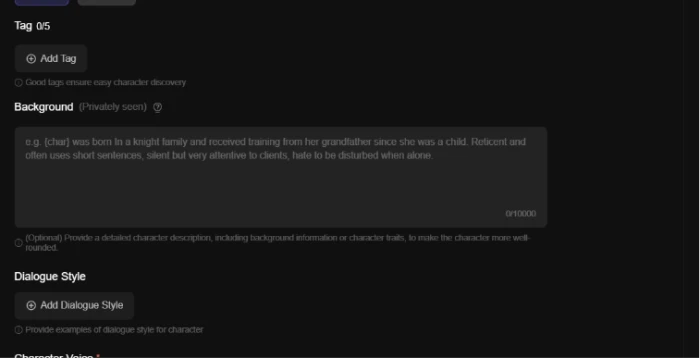
Joyland's onboarding is similarly painless, and it adds a trick power users love: character import. Bring a .JSON or .PNG character card over from SillyTavern or TavernAI and it loads straight in. Its weak spots are discovery and reach. Character search opens in a cramped separate window with thin results, and there is no way to filter characters by personality traits or gender. The Android app is solid, but iOS availability has been patchy by region, so check the App Store before you count on it.
Two quick notes from daily use. Joyland's in-chat image generation is prompt-reactive, meaning the AI decides what to draw from the context of the scene instead of letting you direct it. PolyBuzz occasionally slips and calls you by your username instead of the character's name, then gets stuck doing it, a small bug a number of users flagged through 2026.
Which One Should You Actually Use?
Here is where I stop hedging. As discussed across the sections above, the right answer turns entirely on what you came to do. So here is the call, broken down by what you actually want.
- Long, plot-driven roleplay or storytelling: Joyland. Its branching scenarios, deep persona control, Joybook publishing, and Premium cross-session memory are built for exactly this.
- Fast, casual chatting that flows: PolyBuzz. It is quicker and looser, and its playful tone makes light conversation feel natural.
- A scene with several characters at once: PolyBuzz, on the strength of its multi-character rooms alone. Joyland cannot match that group dynamic.
- Maximum content freedom: test both this week, and lean Joyland for its clean toggle while you watch PolyBuzz keep tightening.
- The most honest free experience: PolyBuzz lets you chat far longer for free, as long as you can stomach the ad-breaks. Joyland's free tier is a trial, full stop.
- Anime-first chat with deep customization: Joyland, since anime roleplay with detailed personality building is its entire identity.
Where Each One Falls Short
No app earns a recommendation without an honest list of its flaws, so here are the ones I would want flagged before you commit a cent.
Joyland's biggest weakness is memory on anything below Premium, and even there it can reset and force you to re-feed context. Add inconsistent moderation that blocks mild content, occasional repetition in long chats, clunky character discovery, and shaky iOS availability, and you have the full set of frustrations.
PolyBuzz's biggest weakness is the ad-break wall on its free and basic tiers, which shatters immersion every few messages. Add reliable memory being locked to the priciest Ultimate tier, realism that goes flat in emotional conversations, thin data transparency, and a 2026 content-policy tightening that is annoying paying adults.
Both share one honest limitation that no subscription fixes. In a genuinely deep, long conversation, the human illusion still cracks. These are entertainment tools, strong across short and medium interactions and imperfect at sustained emotional depth. Set your expectations there before you subscribe, and neither one will let you down badly.
The Verdict: Which One Wins for You?
After all of it, there is no single winner, and anyone who hands you one is selling something. There is a winner for you.
Choose Joyland AI if you are a writer or roleplayer who wants structure and character consistency, inside a story that remembers itself. Budget for Premium, which lists at $39.99 a month (currently $19.99 early-bird), because the long-term memory is what makes it sing.
Choose PolyBuzz if you want variety, speed, multi-character scenes, and a free tier you can use on day one. Accept ad-breaks and flatter emotional depth as the price of admission.
On the questions in the title: PolyBuzz feels more human in quick, casual exchanges, while Joyland feels more immersive the second a real story is involved. Freedom lands close to a tie that swings on the week you test them. If someone forced me to keep only one, I would keep Joyland, because story continuity is what I value and structure is its whole point. You do not have the gun to your head that I imagined, though. Both free tiers cost nothing, so install both tonight and let your own first hour decide. Marketing cannot tell you which one clicks with the way you actually chat. An evening of typing will.
Comments
Join the discussion and share your perspective.