
You typed "PolyAI vs Character AI" into a search bar expecting two rivals. They aren't. One is a piece of software a bank buys to answer its phone lines. The other is an app where someone roleplays with a fictional character at midnight. The only thing they truly share is four letters and a spot in your search results.
PolyAI (poly.ai) builds voice agents that handle customer calls for banks, hotels, and utilities. Character AI (character.ai) is where 20 million people a month talk to AI personalities for company, roleplay, and storytelling. A contact center director and a teenager writing fan fiction would never shop for the same tool, yet both get funneled toward this comparison.
So the useful question isn't which one is better. It's which one you actually need, what it costs in 2026, and why these two keep landing on the same page in the first place.
Quick Verdict
Short answer first, because the two tools rarely compete for the same buyer.
| If you need | Pick |
|---|---|
| Automated customer support over the phone | PolyAI |
| An AI companion to talk to daily | Character AI |
| Voice agents for a contact center | PolyAI |
| Roleplay, storytelling, and character chat | Character AI |
| Enterprise compliance (HIPAA, SOC 2, PCI) | PolyAI |
| A free tool you can try in 30 seconds | Character AI |
| Multilingual call handling at scale | PolyAI |
| Creative writing partners and fandom characters | Character AI |
PolyAI wins anything involving a business answering customers. Character AI wins anything involving a person looking for conversation, play, or creativity. If your decision is genuinely between these two, you have probably already picked, you just need confirmation.
PolyAI vs Character AI at a Glance
The comparison table below lays out the core attributes. Read it top to bottom and the split in purpose becomes obvious.
| Attribute | PolyAI | Character AI |
|---|---|---|
| Primary purpose | Enterprise voice AI for customer service | Consumer AI companions and roleplay |
| Who it serves | Large companies and contact centers | Individual users, ages 13+ |
| Pricing | Custom quote, reportedly six figures per year | Free tier; c.ai+ at $4.99/month |
| Voice AI | Core strength, lifelike phone agents | Voice calls available, preset voices |
| Integrations | CRM, telephony, Salesforce, Genesys | None, closed consumer app |
| Security | SOC 2, HIPAA, GDPR, PCI DSS standard | Standard consumer privacy, no enterprise certs |
| Customization | Full dialog design via Agent Studio and ADK | Character creation with personality fields |
| Public API | Yes, developer ADK | No public API |
| Best users | Banks, hotels, healthcare, utilities, retail | Writers, roleplayers, students, casual chatters |
What Is PolyAI?
PolyAI builds voice agents that answer inbound phone calls for large organizations. Founded in 2017 by a team out of Cambridge University's dialog systems group, the company set out to solve one narrow problem extremely well: making an automated phone agent that does not sound like a phone tree from 2009.
The platform runs on a proprietary model the company calls Raven, trained on more than a billion enterprise conversations. That training base is the moat. A general chatbot can hold a conversation, but handling a frustrated customer disputing a charge in their second language, with the right compliance guardrails, is a different engineering problem.
PolyAI serves regulated, call-heavy industries. Banking and financial services use it for account questions and authentication. Hotels and casinos use it for reservations. Healthcare providers use it for patient scheduling. Utilities lean on it during outages when call volume spikes. Restaurants like Fogo de Chão have publicly credited it with adding millions in incremental revenue from a single voice agent.
Main features
- Lifelike voice agents that handle interruptions, accents, and emotional cues without sounding robotic
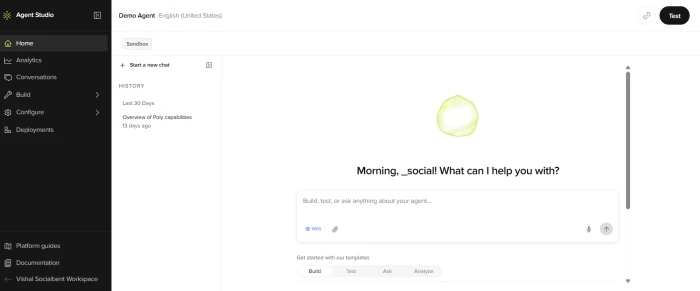
- Agent Studio, a no-code builder for non-technical teams, plus an Agent Development Kit (ADK) for engineers
- Built-in compliance: SOC 2, HIPAA, GDPR, and PCI DSS as default rather than add-ons
- Multilingual handling, including disputes resolved in a customer's local language
- Analyst Agents that let operations teams query call data in plain language
During a review of the platform's published case studies, one pattern stands out. The numbers companies report are operational: a 50%-plus reduction in calls needing a human agent, double-digit CSAT gains from day one, and seasonal hiring cut by enough to save a retailer over a million dollars. This is software sold on cost deflection, not delight, and the deployment numbers behind those claims get a closer look in this PolyAI review.
What Is Character AI?
Character AI is a consumer app for talking to AI characters. It launched in 2022, built by two former Google engineers who had worked on the LaMDA language model, and it grew into one of the most-used consumer AI products on the internet. As of 2026 it hosts more than 10 million user-created characters and draws around 20 million monthly users, many of whom spend over an hour a day inside the app.
The pull is simple. You pick a character, a historical figure, an original creation, a tutor, a fictional persona, and you talk to it. The character stays in voice across long sessions, which is what separates an engaging roleplay from a generic chatbot exchange.
Character creation
Creating a character takes a few minutes. During testing, building a custom character meant filling in a name, a greeting, a short description, and a longer definition block that shapes personality and speech patterns. No coding, no setup. A teenager can spin up a believable character between classes, which is precisely why the library grew to eight figures.
Roleplay and community
Roleplay is the heartbeat of the platform. Users write collaborative stories with characters, run interview practice, learn languages, or simply keep company. A 2025 Stories feature added guided interactive narratives. A Model Picker lets users choose engines tuned for speed or depth. The community discovers and remixes each other's characters, which keeps the catalog fresh without the company writing a single one.

One change shaped the 2026 experience more than any feature: monetization. Full-screen ads now run mid-conversation for free users. Swipe regenerations consume a virtual currency called Charms once you hit a daily cap. The underlying model is identical on free and paid, so the $4.99 subscription buys speed and the removal of friction, not smarter responses, a trade-off this Character AI review weighs in full alongside the safety filters and the ad backlash.
PolyAI vs Character AI Feature Comparison
This is where the gap stops being a summary and becomes specific. Each area below compares the same capability across both tools.
AI quality and conversation
PolyAI optimizes for accuracy under pressure. Its agents are measured on containment, the share of calls resolved without a human, and on staying compliant while doing it. Reviewers repeatedly rank its voice realism as the best in the enterprise market. Character consistency matters less than getting the customer's intent right on the first pass.
Character AI optimizes for personality. A good Character AI conversation remembers who the character is supposed to be over hundreds of messages and keeps the tone intact. Context retention is strong for a consumer app, though long sessions can drift. The two products are tuned for opposite definitions of quality: one for correctness, the other for immersion.
Voice features
Voice is PolyAI's entire reason to exist. Its agents run live phone conversations, manage barge-in when a caller interrupts, and adapt to accents in real time. Customers have described the result as indistinguishable from one of their own staff.
Character AI offers voice calls too, but with preset voices rather than custom-tuned brand voices. It is a feature inside a chat app, not the foundation the product is built on. Pleasant for a roleplay session, not built to handle a payment dispute.
Customization
PolyAI customization happens at the dialog design level. Teams script flows, set guardrails, define brand voice, and wire the agent into business logic through Agent Studio or the ADK. The output is a tailored agent that behaves consistently across every call.
Character AI customization is character-level. You shape a persona's traits, greetings, and conversation style through form fields. Powerful for creating a believable companion, with no concept of business workflows or backend logic behind it.
Integrations
| Integration area | Where it lands |
|---|---|
| CRM systems (Salesforce, etc.) | PolyAI integrates; Character AI does not |
| Telephony and contact center stacks | PolyAI integrates; Character AI does not |
| Public API for developers | PolyAI offers an ADK; Character AI has none |
| Standalone consumer use, no setup | Character AI wins; PolyAI requires a sales process |
Character AI is a closed app by design. It connects to nothing because it does not need to. PolyAI is the opposite, an enterprise tool that is only useful once it is wired into a company's existing systems.
Security and compliance
PolyAI ships with SOC 2, HIPAA, GDPR, and PCI DSS support as standard, because its customers handle health records and payment data over the phone. Every agent decision is logged for auditability.
Character AI applies standard consumer privacy practices and a strict safe-for-work content policy that the paid tier does not lift. It carries no enterprise compliance certifications, which is appropriate for what it is and disqualifying for regulated business use.
Scale
PolyAI is built to absorb millions of customer calls, with the heaviest load during outages and seasonal peaks. Character AI scales to millions of individual users running personal conversations. Both operate at scale; they just count different things.
Pricing Comparison
Pricing is the cleanest illustration of how far apart these products sit. One hides its price behind a sales team; the other charges less than a streaming subscription.
| Plan | PolyAI | Character AI |
|---|---|---|
| Free tier | None | Yes, unlimited messages with ads |
| Entry price | Custom quote | $4.99 / month (c.ai+) |
| Annual option | Annual enterprise contract | About $59.99 / year |
| Reported starting cost | Around $150,000 / year | $0 to start |
| Billing model | Per-minute plus contract | Flat subscription |
| Hidden costs | Telephony fees, CRM integration, engineering | Charms for extra swipes on free tier |
PolyAI does not publish rates. Third-party estimates and market reports put enterprise contracts at roughly $150,000 a year and up, with per-minute usage billed on top, plus telephony and integration costs that sit outside the platform fee. There is no self-serve signup and no free trial.
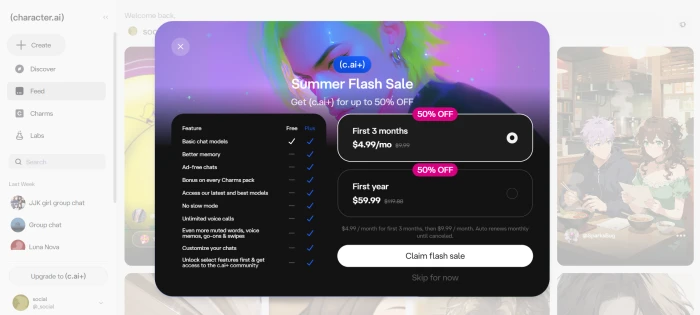
Character AI keeps it transparent. The core product is free with unlimited messages, though 2026 added mid-chat ads and a swipe currency that nudge heavy users toward paying. The c.ai+ plan runs $4.99 a month or about $59.99 a year, and it buys faster responses, no ads, and priority access during peak hours. The AI model is the same on both tiers.
Real-World Use Cases
Features matter less than the job you are hiring the tool to do. Here is how each platform performs across four common scenarios.
Customer support
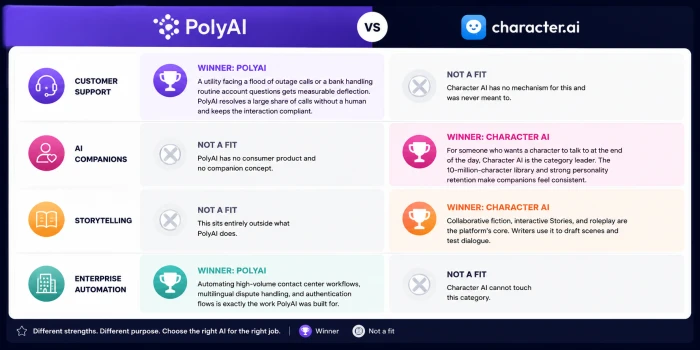
Winner: PolyAI. A utility facing a flood of outage calls or a bank handling routine account questions gets measurable deflection. PolyAI resolves a large share of calls without a human and keeps the interaction compliant. Character AI has no mechanism for this and was never meant to.
AI companions
Winner: Character AI. For someone who wants a character to talk to at the end of the day, Character AI is the category leader. The 10-million-character library and strong personality retention make companions feel consistent. PolyAI has no consumer product and no companion concept.
Storytelling
Winner: Character AI. Collaborative fiction, interactive Stories, and roleplay are the platform's core. Writers use it to draft scenes and test dialogue. This sits entirely outside what PolyAI does.
Enterprise automation
Winner: PolyAI. Automating high-volume contact center workflows, multilingual dispute handling, and authentication flows is exactly the work PolyAI was built for. Character AI cannot touch this category.
Pros and Cons
PolyAI
| Pros | Cons |
|---|---|
| Best-in-class voice realism | Reportedly starts around $150K per year |
| Strong containment, real cost deflection | No public pricing or free trial |
| Enterprise compliance built in | Requires a sales and scoping process |
| Deep CRM and telephony integration | Overkill for small businesses |
| Multilingual at scale | Implementation needs internal engineering |
Character AI
| Pros | Cons |
|---|---|
| Generous free tier, unlimited messages | Full-screen ads on the free tier in 2026 |
| 10M+ characters, huge variety | Strict content filters frustrate some users |
| Strong personality consistency | No API, no integrations, no enterprise use |
| Fast to start, no setup | Swipe currency adds friction for free users |
| Cheap upgrade at $4.99/month | Paid tier improves speed, not capability |
Personal Rating
Seven categories, scored out of 10, based on how well each product serves its actual target buyer, not how they compare head-to-head on features neither one was built for
| Category | PolyAI | Character AI | Winner |
|---|---|---|---|
| Voice & conversation quality | 9/10 | 7/10 | PolyAI |
| Ease of getting started | 3/10 | 10/10 | Character AI |
| Customization depth | 9/10 | 6/10 | PolyAI |
| Value for money | 6/10 | 9/10 | Character AI |
| Enterprise & compliance fit | 10/10 | 2/10 | PolyAI |
| Content & character variety | 4/10 | 9/10 | Character AI |
| Day-to-day user experience | 8/10 | 7/10 | Tie |
| Overall | 49/70 | 50/70 | - |
The totals land nearly even and that is the point. Neither tool is objectively better. They are built for completely different buyers, and the categories where each one dominates make that split obvious.
PolyAI scores highest on enterprise fit, voice quality, and customization depth, everything a contact center director cares about. Character AI leads on ease of entry, content variety, and value, everything a casual user or creative writer cares about. If you find yourself in the column that scores higher for your priorities, you already have your answer.
Scores reflect fit within each product's intended purpose, not raw capability. A low score in a category the product was never built for is expected, not a flaw.
Best Alternatives
If neither fits, the alternatives split along the same line: enterprise voice on one side, consumer companions on the other.
Alternatives to PolyAI (enterprise voice and CX)
- Kore.ai, a broad conversational AI platform aimed at enterprise automation
- Cognigy, strong in contact center orchestration and omnichannel flows
- Yellow.ai, a customer experience automation suite with voice and chat
Alternatives to Character AI (companions and roleplay)
- Replika, focused squarely on the AI companion relationship
- Chai, a lighter roleplay-first app with a large bot catalog
- Janitor AI, popular for less-restricted character roleplay
Picking from the right column is the real decision. Comparing a PolyAI alternative against a Character AI alternative repeats the same category error this whole article is built to fix.
Why This Comparison Is Harder Than It Looks
Most articles on this matchup treat it as a normal feature face-off. It is not, and the confusion runs deeper than purpose.
There is a genuine naming collision. The enterprise platform at poly.ai is a customer-service voice company. Separately, a consumer roleplay app once called Poly.AI rebranded to PolyBuzz and competes directly with Character AI for the same companion-and-roleplay audience. Search results blur the two PolyAIs together, which is how a customer-service vendor ends up in a roleplay comparison in the first place.
This guide covers the enterprise PolyAI at poly.ai. If your search started because you saw a roleplay app advertised as beating Character AI, you were likely looking at PolyBuzz, a different product with a shared history and a confusingly similar name.
So the honest framing is this. One PolyAI answers business phone calls. Another product that used to carry the name now chases the companion market under a new brand. Character AI sits firmly in that companion market. Knowing which PolyAI you mean settles most of the question before any feature gets compared, and that clarity is the thing nearly every competing article skips.
Match the tool to the job. A contact center leader and a teenager writing fan fiction are not shopping in the same store, and no single winner serves them both.
The Bottom Line:
There is no shared winner here because there is no shared buyer. The choice makes itself once you know what you are actually doing.
Pick PolyAI if you run a contact center or a customer-facing phone line and you need calls answered, resolved, and logged for compliance. It is expensive, it requires a sales process, and it is the wrong tool for a small business. For a bank, hospital, hotel, or utility handling thousands of calls a week, it earns the cost back in deflection.
Pick Character AI if you want something to talk to. Roleplay, storytelling, a companion at the end of the day, a study partner. It is free to start, it costs $4.99 a month if the ads and swipe limits start to bite, and the paid tier buys speed rather than a smarter model.
If you are still unsure which one you mean, that is the naming collision doing its work. Confirm whether you are looking at the enterprise poly.ai or the rebranded PolyBuzz roleplay app, and the answer stops being a comparison and starts being obvious.
Comments
Join the discussion and share your perspective.