
I did not plan to spend a month talking to chatbots. It started with a question a friend threw at me. If PolyBuzz and Janitor AI both let you chat with AI characters, why would anyone pick the one that looks harder to use? I went looking for an answer and ended up testing both for thirty days.
What I found is that these two apps look like rivals but barely play the same sport.
One hands you a finished toy. The other hands you a toolkit with a wiring diagram tucked inside the box. This piece walks through how that gap shows up at each step of real use, from the first ten minutes to voice, group scenes, reliability and the crowds behind each app, and it ends with the one I still keep open today.
Meet the two contenders
Before judging which app respects your time, it helps to know what each one is trying to be.
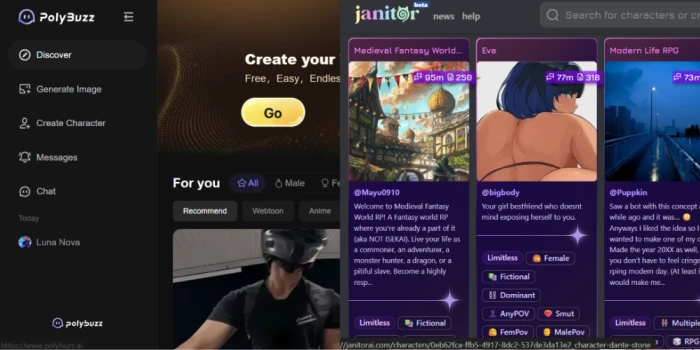
PolyBuzz is the friendlier face of the two. It started life as Poly.AI and rebranded to PolyBuzz in late 2024, and it is run by a US company called Cloud Whale Interactive Technology. The pitch is a library of more than 20 million characters you can chat with by text or voice, plus AI image generation inside the conversation. It lives on the web and as native apps on iPhone and Android, which is why it pulls roughly 42 million visits a month and keeps the average user around for more than an hour a day.

Janitor AI comes at the same idea from the opposite direction. Jan Zoltkowski launched it in June 2023, and it crossed a million users in its first week. It runs entirely in the browser as an installable web app, with no official entry in either mobile store. By 2026 it draws somewhere between 113 and 149 million visits a month from a community that builds and shares its own characters.
Here is the split that explains everything else.
PolyBuzz runs its own AI behind the scenes, so you open it and start talking. Janitor AI ships a small built-in model called JanitorLLM, but most regular users bypass it and connect an outside model instead. That single design choice, covered in the next section, decides how your first ten minutes go.
| The basics | PolyBuzz | Janitor AI |
|---|---|---|
| Launched | Poly.AI in 2023, became PolyBuzz late 2024 | June 2023 |
| Maker | Cloud Whale Interactive (US) | Jan Zoltkowski and a small team |
| Where it runs | Web app, plus native iOS and Android | Browser only (installable web app) |
| Runs its own AI? | Yes, an undisclosed model | A small built-in model, but most users connect outside models |
| Library size | 20 million plus characters | Hundreds of thousands of community bots |
| The vibe | Open and chat | Build and tinker |
Getting started: the first ten minutes
As I mentioned above, one app is built to be opened and the other to be assembled. Nowhere is that clearer than at signup.
PolyBuzz took me about forty seconds. I installed the app, picked a character from the feed, and was chatting before I finished my coffee.
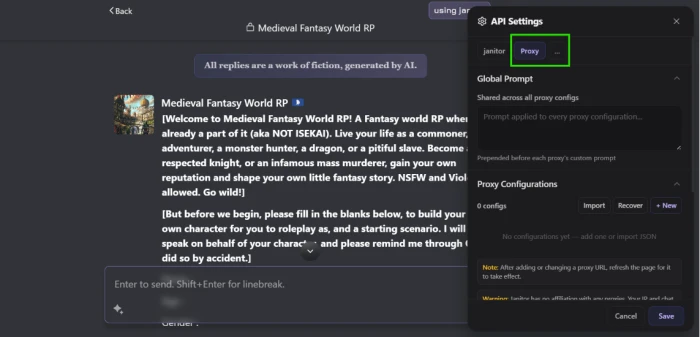
Janitor AI asked more of me. Creating the account is quick, but the built-in JanitorLLM model sits behind a queue and throttles hard, so any serious session pushes you toward connecting an external model through what the platform calls a proxy. That is where the famous setup friction begins.
- Make a second account with a model provider such as OpenRouter.
- Generate an API key and copy it without any stray spaces.
- Paste it into Janitor AI under Settings > API > Proxy, then pick a model name.
- Save, refresh the whole page, and send a test message.
None of those steps is hard on its own. Stacked together on a first attempt, they eat twenty to thirty minutes, and a single missed page refresh produces the dreaded network error that fills the platform's help forums.
The payoff is choice. A free OpenRouter route running DeepSeek gives you about 50 messages a day, and a Google Gemini Flash key can stretch that to roughly 250. There is also a catch I will return to in the safety section: since late 2025, any adult content on Janitor requires uploading a government ID.
How big the worlds are
Once you are inside, the next question is who you get to talk to, and how you find them.
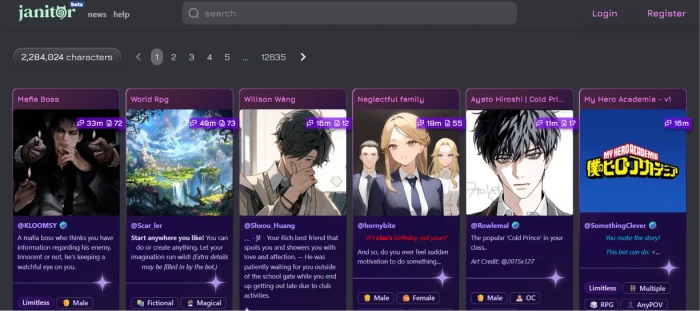
PolyBuzz wins on sheer volume. Its library passes 20 million characters drawn from anime, film, games and original creations by other users, and the app surfaces them in a scrolling feed you flick through like short videos. You can filter the lineup by gender or open it in full and browse. The cost of that abundance is uneven quality, since plenty of those bots are thin personas that run dry after a handful of messages.
Janitor AI carries fewer characters, counted in the hundreds of thousands, yet its catalog leans toward depth over breadth. Its creators tend to write longer, sharper personas, and adult characters sit openly in the mix behind the age check I will cover later. Browsing is plainer than PolyBuzz's feed, closer to a forum than a video app.
Numbers aside, a library is only as good as the tools that let you add to it, which is where the two apps split again.

Building a character of your own
Both apps let you build characters. The ceiling on that building sits in two different places.
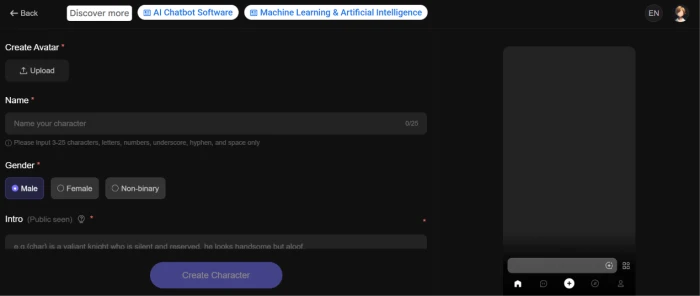
PolyBuzz keeps creation friendly. You tap the plus button, name your character, write a short personality and intro, pick a voice, and drop in an avatar you either upload or generate inside the app. It also imports character cards by JSON, including ones exported from older roleplay apps like Character.AI and TavernAI, so a persona you built elsewhere can move in without a rewrite.
Janitor AI treats character building as a craft. Beyond the basic profile, creators work with a permanent Lore layer that stores personality, backstory, speech patterns and key relationships that never expire between sessions, plus Scripts and a system prompt the community calls the jailbreak that shapes how the model behaves. The learning curve is real, and the payoff is bots that hold their personality across chats that run for hundreds of messages.
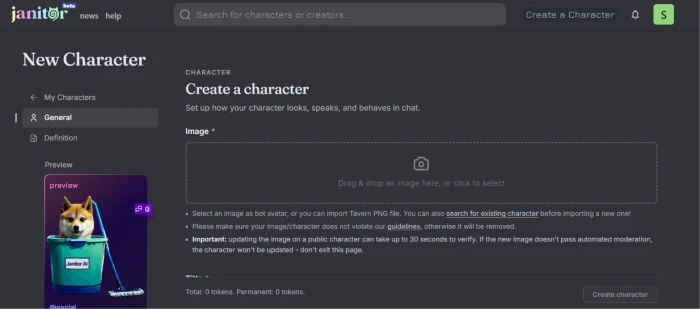
That Lore layer is also the backbone of how each app remembers you, which is the next thing worth measuring.
Chat quality and memory
A big library means nothing if the characters forget who they are by message thirty.
PolyBuzz does not say which language model powers it. On the free model the writing is serviceable and a little flat. Pay for Premium and you unlock its Passion and Tale models, which produce warmer, more story-coherent replies.
Memory is tiered the same way. Free and basic plans hold only about thirty messages of context before older lines get pruned. Premium adds a longer memory window, while the top Ultimate plan keeps a permanent history. The complaint you see across forums about PolyBuzz silently deleting chats traces straight back to that context limit on the cheaper tiers.
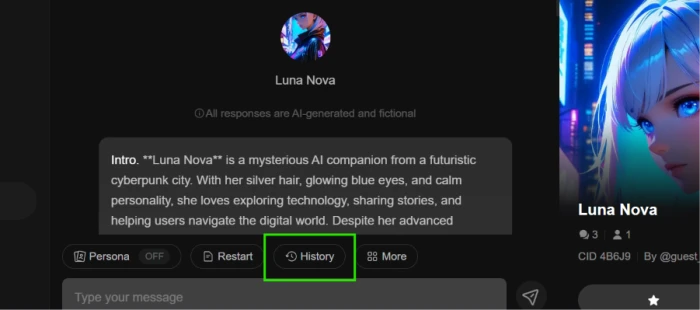
Janitor AI hands the quality question to you. Because you choose the model, the ceiling is high. A DeepSeek connection costs a few dollars and rivals GPT-4 for roleplay, while the free JanitorLLM feels closer to a demo. Its memory rests on the Lore layer from the previous section paired with a temporary context window, so long sessions still drift once that window fills, though power users tame the problem with temperature and context-length settings the casual apps never expose.
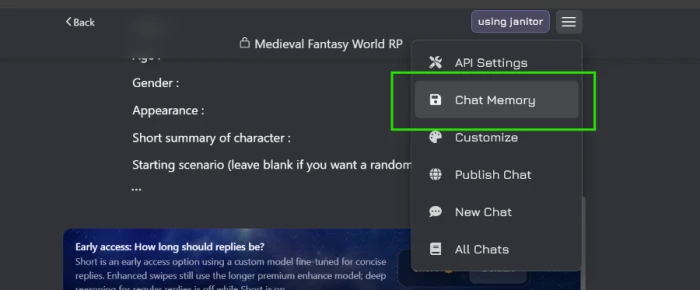
All of this writing quality, on both sides, gets richer the moment you add a voice and a face to it.
Voice, images and other senses
Text is where both apps live, but PolyBuzz reaches past it in ways Janitor AI mostly does not.
PolyBuzz speaks. Its voice synthesis adds lip-sync and a touch of emotional inflection, and you can hold a hands-free voice conversation, though free accounts get a daily cap that the paid tiers lift. It also draws. A built-in image generator produces character portraits in anime or realistic styles inside the chat, free on the web version, with Premium granting 30 avatar generations a day. The output is a reference portrait rather than a photo studio, so do not expect cinema, yet it adds a visual layer most rivals skip.
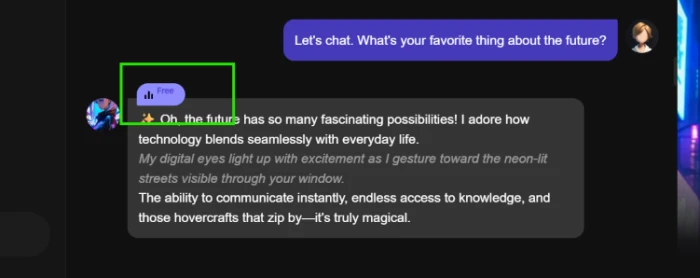
Janitor AI stays closer to the page. Text-to-speech exists and improved through 2026, and you can assign a voice to a custom character by hand, but there is no native image generation at all. If seeing your character matters to you, PolyBuzz answers that and Janitor sends you hunting for a separate tool.
Sound and pictures are one kind of richness. Having more than one character in the room is another.
Talking to a whole room
Most AI chat happens one human to one bot. PolyBuzz breaks that frame.
PolyBuzz runs group rooms where two to four AI characters share the same conversation and react to each other, which turns a private chat into something closer to an improvised scene with a small cast. It is the kind of feature you do not know you wanted until a side character interrupts your love interest mid-sentence.
Janitor AI centers on the single character. Its depth pours into one persona at a time rather than a roomful, and any group dynamics you want have to be written into a single bot's Lore rather than spun up as separate cast members. Two philosophies, and your taste in stories decides which one fits.
How you reach all of this, on a phone or at a desk, shapes the day-to-day as much as the features do.
Phone or browser
The device you use changes which app feels natural.
PolyBuzz was built for the phone. It ships real apps on iOS and Android, has passed tens of millions of installs, and sits near the top of the Entertainment charts, so the feed and the voice button feel native in your hand, push notifications included.
Janitor AI has no official app in either store. It runs as a website you can save to your home screen, and any listing claiming to be the Janitor AI app is unofficial and worth avoiding. On a laptop, where you are already juggling API keys and settings, the browser home suits it. On a phone in a waiting room, it is clumsier than a tap-and-talk app.
Browser or app, both still depend on servers staying up, and that is where Janitor AI earns its most common complaint.
When the servers wobble
Type 'is Janitor AI down' into a search bar and the volume of results tells the story.
Janitor AI stumbles, mostly at peak hours. US evenings and weekend nights are the worst windows, when its free built-in model gets overwhelmed and responses crawl or fail. Outages tend to last 15 to 60 minutes and get posted to the official Discord and the r/JanitorAI_Official subreddit, which act as an unofficial status page since the platform offers no live one. There is a cure, and it loops back to the setup from earlier: routing through your own API key skips the shared queue and steadies response times, which is the main reason heavy users bother with a proxy at all.
PolyBuzz is the steadier of the two. Running its own infrastructure behind native apps, it rarely makes users hunt for a status update, and when something does break the fix is usually a restart on their end rather than a key swap on yours. Stability is one of the quieter advantages of letting a company run the whole stack for you.
Reliability and reach cost money to build, which brings the comparison to price.
The money question
This is where the friendly app and the fiddly one trade places.
PolyBuzz is free to download, and that free tier is where its reputation takes a hit. A 'Take a Little Break' ad modal interrupts roughly every five messages, the daily login coins you earn expire after thirty days, and buying more coins runs from $2.49 for 1,000 up to $19.90 for 20,000, so the spending never fully stops. Paid plans on the US App Store start at $9.90 a month and climb to $29.90 for the top Ultimate tier, with the full breakdown in the table below. The pricing is flat, with no per-message charge once you subscribe.
Janitor AI flips the model. The platform itself charges nothing, and in June 2026 it launched its first-ever subscription, Janitor+, at $12.99 a month. Rather than unlocking the built-in model (free chats are already unlimited), it widens the context window fivefold, prioritises your messages for faster replies, and hands you a monthly allowance of swipes on its top models, no API to manage. The hidden cost lives in the bring-your-own-key route most active users prefer. A free DeepSeek key covers light use. A $5 prepaid balance lasts many users for months, while premium models such as Claude or GPT-4 can run $15 to $50 a month under heavy load.
| Cost element | PolyBuzz | Janitor AI |
|---|---|---|
| Platform fee | Free to start | Free, always |
| The free-tier catch | Ad break about every 5 messages, capped memory | Built-in model throttled; good models need API setup |
| Entry paid tier | Standard $9.90 / month | Janitor+ $12.99 / month |
| Higher tiers | Premium $19.90, Ultimate $29.90 / month | Bring-your-own-key external APIs |
| Cheapest good setup | Standard at $9.90 / month | About $5 prepaid DeepSeek, lasts months |
Note: all figures are current as of 29 June 2026 and may change at any time.
Read the table and a pattern jumps out. PolyBuzz costs more to make pleasant. Janitor AI costs more to make powerful.
NSFW and safety, the part most reviews rush
Both apps are rated for adults, and both handle that fact differently enough to change which one suits you.
PolyBuzz markets itself as private and permissive, with reality sitting somewhere short of that. Public adult content is banned outright and policed by a mix of AI screening and human moderators. Private chats loosen the filters without ever switching them off, and users regularly report the filter tightening from one month to the next. On privacy, the company says other users cannot read your conversations, but its policy stays quiet on whether your chats train the model. Account deletion is honored in about three days, and a Teen Mode filter exists for younger users.
Janitor AI allows deeper adult content, and it charges a privacy toll for the privilege. Since late 2025, unlocking that content means submitting a government ID to a third-party verification provider, a change that pushed a chunk of long-time users toward other platforms. New laws in Brazil and Australia added mandatory age checks in those regions from March 2026. Your conversations sit on Janitor's servers, and one more warning is worth stating plainly: some community proxies can read the messages that pass through them, so sticking to official keys is the safer path.
Safety policy is set by the company, but the daily texture of each app is set by the people using it.
The crowds around them
An app like this is partly its users, and the two crowds feel different.
Janitor AI grew a builder culture. Its Reddit and Discord overflow with people trading character cards, jailbreak prompts, error fixes and proxy guides, and that community effectively runs front-line support whenever the servers wobble. If you like tinkering alongside other tinkerers, you will find your people there.
PolyBuzz has a large audience rather than a workshop. Its Discord mostly carries announcements and downtime notices, and most users show up to chat rather than to build and publish. The crowd skews young, and the energy is closer to a busy app than a maker community.
All of these differences, stacked together, finally answer the question the title asked.
Which one is worth your time
After thirty days, my answer stopped being about features and became about temperament.
Pick PolyBuzz if
- You want to be chatting within a minute, with nothing to configure.
- You use a phone and care about voice replies and in-chat images.
- You like group scenes with more than one character at once.
- A flat monthly price suits you more than per-message math.
Pick Janitor AI if
- You want to choose the underlying model and tune its quality.
- You enjoy deep character building with Lore and accept a setup session.
- You will trade some reliability for fewer content limits.
- You want a builder community to learn from.
For me, the split was physical. PolyBuzz lived on my phone for idle minutes in a queue or on the bus. Janitor AI stayed open on my laptop for the long, involved sessions where the model quality earned back every minute of its setup.
If someone forced me to keep one, I would keep Janitor AI, because once the proxy was running I stopped noticing the plumbing and started noticing the writing. If that same person had never touched an AI chat app before, I would point them at PolyBuzz without hesitation and let them graduate to the harder tool when the easy one started to feel small.
Comments
Join the discussion and share your perspective.