
The software industry cannot agree on what an “open API” is. Wikipedia says plainly that there is no universally accepted definition of the term, and that it gets used for at least three different ideas at once. If the opposite of a word is that blurry, the word itself tends to get sloppy too. That is exactly what has happened to “proprietary API.” Most explainers treat it as a synonym for “private” or “internal,” which quietly hides the thing that actually matters to your budget and your architecture.
This guide fixes that. It defines proprietary APIs on two separate axes, plots real interfaces onto them, walks through what courts and regulators have actually decided, and ends with a scorecard you can run before you write a single line of integration code. If you build on other companies’ platforms, or you run one, this is the framing that keeps you out of trouble.
What is a proprietary API?
Quick definition
A proprietary API is an application programming interface whose design, specification, and terms of use are owned and controlled by a single vendor. That company decides how it works, what it costs, who may call it, and whether it keeps existing. “Proprietary” describes control of the interface, not whether the public can reach it.
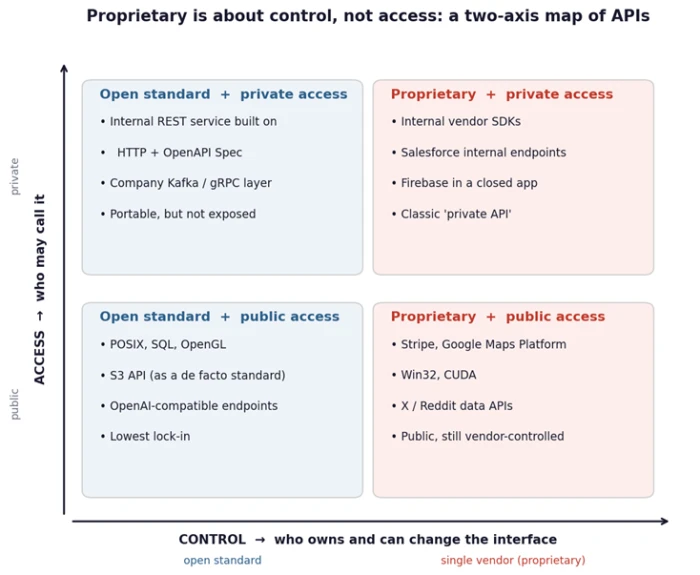
That last sentence is the whole game. A proprietary API can be wide open to the public, like Stripe or Google Maps Platform, and it is still proprietary because one vendor sets the rules. A private internal service can be built entirely on open standards and carry almost no lock-in, even though nobody outside the company can touch it. Control and access are different questions, and conflating them is the mistake that runs through nearly every article ranking for this term.
The two axes: who controls the interface vs who can call it
Picture a simple map. The horizontal axis is control: at one end a single vendor owns the interface, at the other an open standard governs it through a committee or public process. The vertical axis is access: at one end the API is private and reachable only by insiders, at the other it is public and open to any developer who registers. Every API sits somewhere on that grid, and the two coordinates predict very different things. Control predicts your switching cost. Access predicts your onboarding effort.
Proprietary is not the same as private
Read the current top search results and you will see the terms melt together. One popular explainer describes a private API as one where a developer must be granted permission because the data and functionality are “proprietary to the company.” Another states that internal APIs are “often proprietary” and used only inside an organization’s network. Both sentences are true in the narrow cases they describe, and both encourage a false equation: private equals proprietary.
It falls apart the moment you test it against reality:
- A public API can be fully proprietary. Stripe is documented, open to any developer, and completely controlled by Stripe.
- A private API can run on open standards. An internal microservice speaking HTTP with an OpenAPI description is portable even though it is invisible to outsiders.
Access is about who is allowed in. Proprietary is about who holds the keys to the design. Keep them apart and the rest of this topic gets much easier.
“Open API” has three meanings, and “OpenAPI” is a fourth
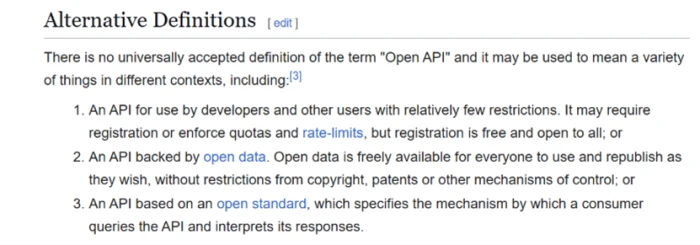
Part of the confusion is downstream of the opposite term. “Open API” is used to mean an API with few access restrictions, an API backed by open data, or an API built on an open standard. Those are three distinct claims. On top of that sits the OpenAPI Specification, the Swagger-derived format for describing REST APIs, which has nothing to do with whether an API is open at all. As one industry primer notes, a private API can follow the OpenAPI Specification without being public, and plenty of public APIs predate the spec and ignore it. When someone calls an API “open,” ask which of the four things they mean before you draw any conclusions about lock-in.
Proprietary API vs open API: what’s the difference?
The cleanest way to see the difference is to stop treating “open” as one thing. There are three meaningfully different alternatives to a proprietary interface, and they carry very different switching costs.
| Category | Who governs it | Can others reimplement it? | Typical switching cost | Examples |
|---|---|---|---|---|
| Proprietary | One vendor | Only with permission, or at legal risk | High | Stripe, Win32, CUDA |
| Open standard | Committee / public body | Yes, by design | Low | SQL, HTTP, POSIX, OpenGL, OpenCL |
| Unofficial standard | Vendor origin, wide adoption | Yes, through compatible clones | Medium | Amazon S3 API, OpenAI Chat Completions |
| Open source | Public license on the code | Depends on the license | Low to medium | Open-source SDKs and servers |
Open standard APIs
An open standard is governed in the open, and anyone can build a conforming implementation. SQL, HTTP, and POSIX are the classic examples; OpenGL and its compute cousin OpenCL are graphics and GPU equivalents. The upside is freedom to move. The tradeoff is speed. As GPU developers found with OpenCL, a committee-based standard has to reach consensus among many stakeholders, which produces slower development cycles than a single vendor can achieve alone. Standards buy portability at the price of velocity.
Unofficial standards: proprietary roots, ecosystem adoption
The interesting cases live in between. Amazon’s S3 object storage API was never ratified by any standards body, yet it became the default interface for object storage, and vendors from Cloudflare R2 to Backblaze B2, Wasabi, and the open-source MinIO all speak it. That widespread cloning is what lets teams treat storage as portable and swap providers by changing an endpoint.
The same story is unfolding in AI. OpenAI never formally defined its API as a standard, but its Chat Completions format became the default interface for large language models, and providers including Mistral, Together AI, Fireworks, and Groq expose OpenAI-compatible endpoints. An unofficial standard like this lowers lock-in because alternatives exist, but control has not moved. The vendor that created it can still change the specification, and everyone else races to keep up.
Callout: “compatible” is not “standard”
OpenAI-compatible usually means request-shape compatible, not behavior compatible. Providers optimize for different capabilities, so tool calling, reasoning-token accounting, streaming, and error handling still diverge under real workloads. Compatibility gets you started; it does not guarantee a clean migration. Plan for the glue code.
Open source is not open standard
One more distinction saves a lot of grief. A vendor can open-source its client SDK while keeping the API and the service behind it firmly proprietary. The reverse happens too: an open standard can exist with only closed implementations. Open source is a statement about the code’s license; open standard is a statement about who governs the interface. Treat them as separate checkboxes.
Real-world examples of proprietary APIs
With the definitions settled, the examples organize themselves. What follows is a spread across the categories, sorted by how much a switch would hurt.
| API | Owner | Access | Open alternative / pattern | Lock-in |
|---|---|---|---|---|
| Win32 API | Microsoft | Public | POSIX (different OS) | High |
| CUDA | NVIDIA | Public | OpenCL, SYCL / oneAPI | High |
| Amazon S3 API | AWS | Public | S3-compatible stores (R2, B2, MinIO) | Low–Med |
| Stripe API | Stripe | Public | No true drop-in equivalent | Med–High |
| Google Maps Platform | Public | OpenStreetMap-based APIs | Medium | |
| Firebase / Firestore | Public | Vanilla Postgres + auth (rewrite) | High | |
| X (Twitter) API | X Corp | Public | Other social platforms | High |
| Reddit Data API | Public | None equivalent | High | |
| OpenAI Chat Completions | OpenAI | Public | OpenAI-compatible providers | Low–Med |
Compiled from Microsoft Learn, NVIDIA/Intel documentation, AWS, Stripe, and reporting cited throughout this article.
Operating systems, hardware, and cloud
The Windows API is proprietary and public: any developer can target it, and Microsoft owns every decision about it. NVIDIA’s CUDA works the same way in compute. CUDA is a proprietary framework tuned for NVIDIA hardware, and benchmarks in 2026 still show it delivering a sizeable performance advantage over the open OpenCL standard on identical silicon. That performance gap is the lock-in mechanism; the open alternative exists, but choosing it costs speed.
Cloud shows both faces. AWS-native services and backend-as-a-service platforms such as Firebase couple your data and workflows tightly to one vendor, so leaving means a rewrite. Object storage went the other way because the S3 API became portable. When you can, prefer the layer that has a widely shared standard.
SaaS and product APIs
Stripe, Salesforce, and Google Maps Platform are proprietary despite being public, well documented, and pleasant to use. Good documentation is not openness. These interfaces are single-vendor-controlled, and the quality of the developer experience is part of what makes the eventual switching cost so high.
How proprietary APIs are controlled: terms, pricing, and IP
A vendor’s control is not abstract. It runs through four concrete levers, and knowing which one is in play tells you where your risk sits.
| Legal / commercial lever | What it protects | Practical effect on you |
|---|---|---|
| Terms of service / license | Allowed uses, access rights | Access can be narrowed or revoked on notice |
| Copyright | Expressive parts of code | Limited by fair use (see Google v. Oracle) |
| Patents | Novel methods / techniques | Can block independent reimplementation |
| Trade secret + anti-reverse-engineering | Undisclosed internals | Contract often does more work than copyright |
Framework based on U.S. Copyright Office materials and standard software-licensing practice.
Terms of service are the everyday lever
Copyright litigation is rare; a terms-of-service change is Tuesday. Rate limits, permitted uses, revocation clauses, and notice periods are where proprietary control is actually exercised. Before you build, read those clauses the way you would read a lease, because functionally that is what they are.
Are APIs copyrightable? What Google v. Oracle decided (and didn’t)
This is the question that hovers over every proprietary interface, and the answer is more subtle than the headlines suggested. The dispute ran for more than a decade. Oracle sued in 2010, the district court and the Federal Circuit split repeatedly on whether Java’s API was copyrightable and whether Google’s use was fair, and the case reached the Supreme Court in 2021.
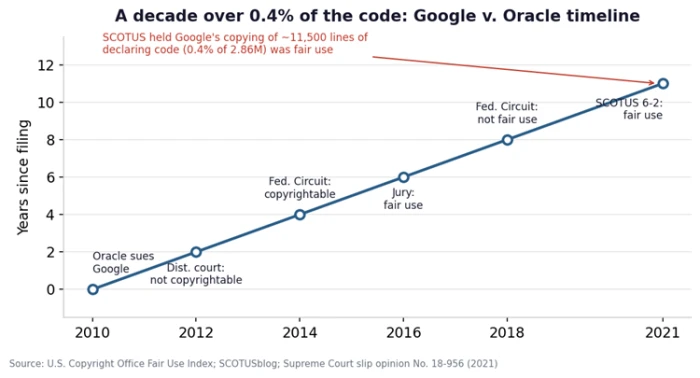
On April 5, 2021, in a 6-2 opinion written by Justice Breyer, the Court held that Google’s copying of roughly 11,500 lines of Java’s declaring code was fair use. The number matters: the Court noted those lines were about 0.4 percent of the 2.86 million lines in the Java SE platform, and that Google copied only what developers already knew how to use. The key point: the Court assumed for argument that the code was copyrightable and declined to decide that question, resting the outcome on fair use instead. So the precedent is real but narrow. Reimplementing the shape of a familiar interface can be fair use; it is not a blanket license to copy whatever you like.
Reimplementing an interface vs copying implementation code
Google copied declaring code, the method names and structure developers call, and wrote its own implementation underneath. That distinction did a lot of work. Cloning the surface of an API so existing code keeps working is legally very different from lifting the vendor’s underlying implementation. This is not legal advice; get counsel for a specific plan.
Sources: Supreme Court slip opinion No. 18-956 (2021); U.S. Copyright Office Fair Use Index; SCOTUSblog; EFF.
Patents, trade secrets, and contract
Copyright is only one lever, and often not the strongest. Patents can block an independent reimplementation of a technique even when no code is copied. Trade-secret protection and anti-reverse-engineering clauses in a license can restrict what copyright alone would allow. In practice the contract you clicked through governs more of your day-to-day risk than any court ruling.
Why companies build proprietary APIs (and when it’s the right call)
None of this makes proprietary APIs a mistake. There are good reasons to own an interface outright, and pretending otherwise would be dishonest.
- Speed and differentiation. Standards move at committee pace. A vendor can ship a new capability the day it is ready, which is how CUDA stayed ahead of OpenCL for years.
- Monetization. Sometimes the API is the product. Controlling access is what makes a platform business model work.
- Security and compliance. For confidential data or regulated transactions, a closed, vendor-controlled interface can be the responsible choice.
The costs are just as real, and they show up later: shrinking developer trust, a thinner ecosystem, and, increasingly, regulatory attention. The next section is what those costs look like when they arrive all at once.
The risks of depending on a proprietary API: case studies
Two recent episodes turned abstract lock-in into concrete numbers, and both happened to public APIs that thousands of businesses had treated as permanent.
Unilateral repricing: Reddit, 2023
In April 2023 Reddit announced new API pricing of 12,000 dollars per 50 million calls. For the popular third-party client Apollo, whose developer Christian Selig said the app made about 7 billion requests a month, that math worked out to roughly 20 million dollars a year, far beyond what the app earned. Apollo shut down on June 30, 2023, other clients followed, and thousands of subreddits went dark in protest. The interface had not changed; the price had, and that was enough to end a business.
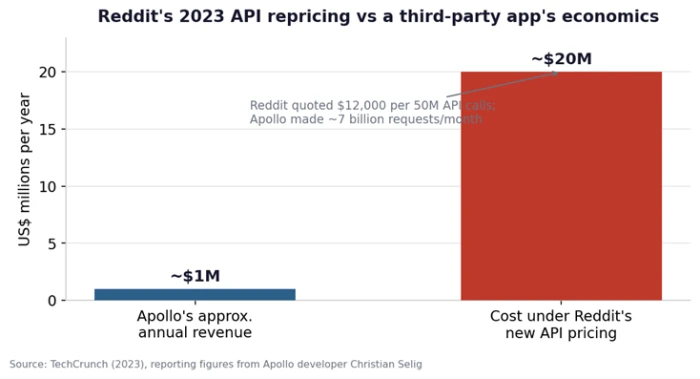
Source: TechCrunch (June 2023), reporting figures from Apollo developer Christian Selig.
Access revocation with almost no notice: X, 2023
Twitter, now X, gave developers about seven days’ notice before shutting down long-standing free API tiers in early 2023, then raised prices sharply on the rest. Third-party clients that had existed for over a decade disappeared. One veteran developer’s takeaway, quoted by TechCrunch, was blunt: spread your revenue across many baskets rather than pinning it to an API someone else controls. That is the entire risk in one sentence.

Deprecation, sunsetting, and lock-in
Even without a pricing shock, proprietary APIs change versions and retire endpoints on the owner’s schedule. Switching cost is the sum of everything you would have to rebuild: integration code, exported data, credential flows, staff familiarity, and, in the AI era, any fine-tuned model weights that live only on the provider. Add those up honestly before you commit.
The proprietary API lock-in scorecard
Here is a compact way to make that estimate repeatable. Score each factor from 0 (portable and safe) to 3 (deeply locked in). A total near 0 means you can leave easily; a high total means design an exit before you build.
| Factor | 0 – portable | 3 – locked in |
|---|---|---|
| Published spec | Fully documented, stable | Undocumented, shifting |
| Competing implementations | Several exist | None |
| Deprecation policy | Long, clear notice | Unpredictable, no guarantee |
| Pricing history | Stable, predictable | Sudden large hikes |
| Data export | One-click, standard format | No real export path |
| Credential portability | Standard auth | Bespoke, non-transferable |
| Fine-tuned / custom assets | None or portable | Locked to provider |
| Contractual notice period | Generous | Days, or none |
Original framework. Interpretation: 0–6 low risk, 7–15 moderate (isolate behind an adapter), 16–24 high (build an exit plan first).
Regulation is changing the rules for the biggest platforms
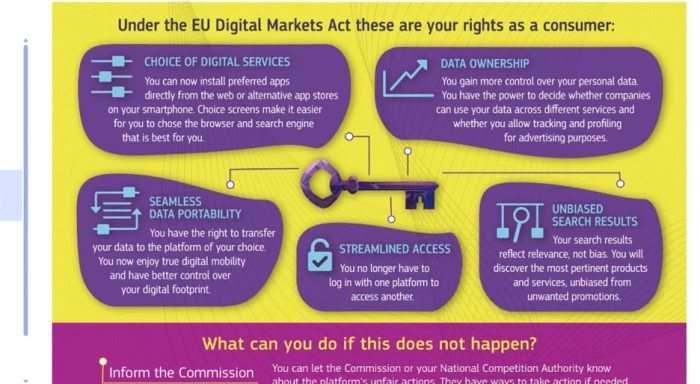
For dominant platforms, “proprietary” no longer means untouchable. The European Union’s Digital Markets Act requires designated gatekeepers, under Article 6(7), to give third parties access to the same operating-system hardware and software features the gatekeeper’s own services use. In other words, some interfaces that companies treated as private are now, by law, obligations.
What has actually happened so far
Enforcement is slow and contested. A July 2026 Court of Justice ruling dismissed Apple’s challenge to its gatekeeper designation for the App Store and iOS, confirming it stays subject to the DMA. Yet a Free Software Foundation Europe report found that, as of March 22, 2026, none of 56 formal interoperability requests had produced a working solution from Apple. Concrete gains have appeared, including data-transfer mechanisms and, in iOS 26.3, proximity pairing for non-Apple accessories, but the pace shows how hard it is to pry open a proprietary platform even with a law behind you.
For developers outside the EU, the effect is spillover. Interfaces built under these mandates often ship worldwide, and other regulators are watching whether forced interoperability improves outcomes. It is a trend worth tracking if your product depends on a gatekeeper’s platform.
Proprietary APIs in the AI era
AI has made this topic urgent because the interface that runs your product now often belongs to someone else. The dynamics are the same, but the lock-in has moved to new places.
The strongest lock-in is no longer the endpoint
Because the OpenAI Chat Completions format became a widely shared standard, swapping providers can be as small as changing a base URL and a model string. The endpoint, in other words, is barely a lock-in anymore. What holds you now sits deeper: fine-tuned model weights that exist only on one provider, proprietary tool-calling formats, custom agent-orchestration languages, and platform-specific memory APIs. Fine-tuning is the strongest form of this, since the trained weights do not transfer, which is why teams that value portability fine-tune open models they can run anywhere.
Agents as API consumers
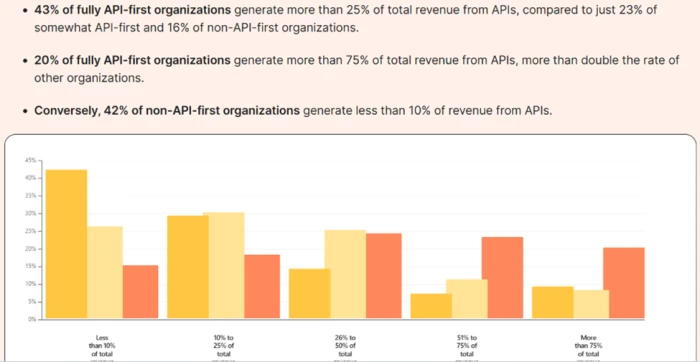
The consumer of your API is increasingly a machine. Postman’s 2025 State of the API report, which surveyed more than 5,700 developers, found that nearly one in four (24.3 percent) were already designing APIs with AI agents in mind, and that unauthorized or excessive automated calls had become developers’ top security concern. The report also noted a gap around the Model Context Protocol: awareness was high, near 70 percent, but regular use sat around 10 percent, even as agents were already calling APIs with or without it. When your callers are autonomous, interface stability and clear terms stop being nice-to-haves.
Isolate the vendor behind an adapter
The architectural fix for medium-risk dependencies is old and reliable: keep everything provider-specific in one place. If only one module knows your vendor’s SDK, swapping providers touches one file instead of your whole codebase. The S3 and OpenAI-compatible worlds make this concrete, because a portable client often needs only a different endpoint.
# One place that knows about the provider
client = OpenAI(
base_url=CONFIG.endpoint, # swap provider here
api_key=CONFIG.key,
)
# business logic never names a vendor or a model string
Illustrative pattern, consistent with OpenAI-compatible client usage documented by Modular and provider SDKs.
How to evaluate a proprietary API before you integrate
Pull the threads together and the consumer checklist writes itself. Run this before committing, not after the repricing email lands.
- Check the spec and the field. Is the interface documented and stable, and does more than one implementation exist? A widely shared standard is safer than a sole-source API.
- Read the terms like a lease. Find the revocation clause, the notice period, and the rate limits before you design around them.
- Score the lock-in. Use the scorecard above. Anything in the moderate band gets an adapter; anything high gets an exit plan first.
- Write the exit on day one. Estimate the migration cost, confirm a data-export path, and name a fallback provider while you still have leverage.
How to design a proprietary API responsibly
If you are the vendor, the same evidence points to a short discipline. Owning an interface is fine; surprising the people who depend on it is what turns a proprietary API into a liability.
- Publish the spec, version deliberately, and commit to a real deprecation policy with long notice.
- Price predictably and give generous warning. The Reddit and X episodes are what happens when you do the opposite.
- Decide what to standardize and what to keep proprietary: adopt or expose standards on commoditized layers, and reserve proprietary control for the parts that genuinely differentiate you.
That last decision is the one that separates a durable platform from a brittle one. The layers where you have a real edge are worth owning outright; the layers where you do not are where a widely shared standard wins you goodwill and costs you nothing. Get that split right and “proprietary” stops being a warning label and becomes a deliberate choice, for you and for everyone building on top of you.
Comments
Join the discussion and share your perspective.