
A few months ago I caught myself pasting a chunk of a contract into an AI tool to ask what one clause meant. My client's name was in it. Their fee was in it. I hit enter before I'd thought about it for even a second, because the box felt like a private notebook and the AI felt like a helpful colleague who'd never repeat what I said.
That pause afterward, the small "wait, where did that just go" feeling, is what this article is about. I'm not here to scare you off AI. I use it every day. I'm here to walk you through what actually happens to what you type, what's genuinely risky to share, and the simple rules I now follow so I never get that sinking feeling again.
So, should you worry about sharing sensitive information with AI? The honest answer isn't a flat yes or no. It depends on what you share and on how these systems actually handle it, which is almost never the way it feels. Let me show you the gap between the two.
Why AI Feels Completely Private (Even When It Isn't)
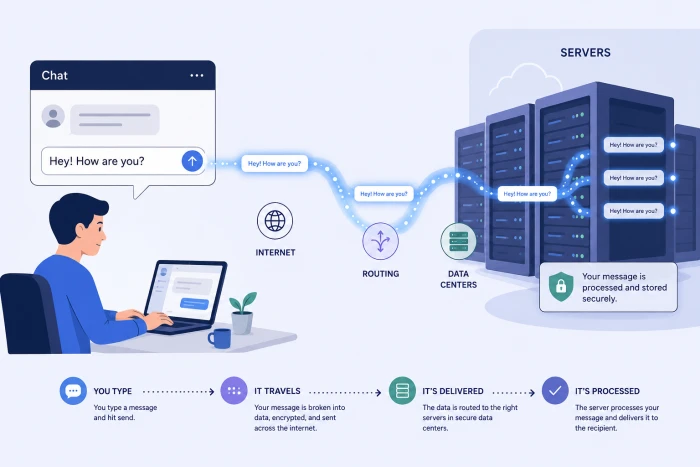
Start with the feeling, because the feeling is the whole problem. AI tools are designed to feel like a one-on-one conversation. There's no visible person on the other end. Your message slides up the screen and seems to vanish. The thing answers you warmly, like an assistant who exists only to help.
Your brain does the rest. It runs a quiet shortcut: if it feels private, it must be private. That shortcut is fine for a diary app that lives on your phone. It's wrong for a system that sends your words across the internet to be processed on machines you'll never see. The interface earns your trust faster than the technology behind it has earned it.
What Actually Happens to What You Type
Here's the part most people never picture. When you send a message to an AI tool, your text doesn't stay between you and a screen. It travels to large computing systems that read it as data and generate a reply. Modern platforms wrap that process in real privacy and security protections, and that matters, but the underlying reality is worth saying plainly:
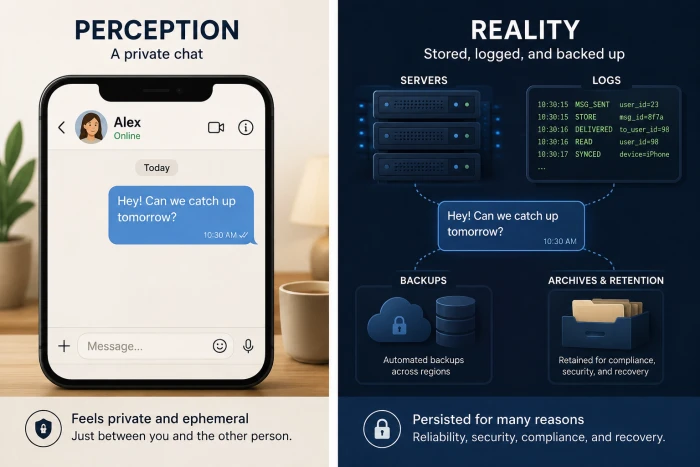
- Your inputs may be stored temporarily so the system can operate and respond.
- Some conversations may be reviewed by people for safety, debugging, or to improve the model.
- Everything runs through digital infrastructure, logs, and backups, not a private human memory.
- No online system can promise the absolute secrecy of an offline notebook locked in a drawer.
And one detail that reframes everything: AI doesn't understand privacy the way you do. It isn't keeping a secret because it has no concept of one. It processes your text statistically and moves on. So the question was never "will the AI tell anyone." The question is "where does this data go, and who could reach it later."
What Actually Counts as Sensitive Information
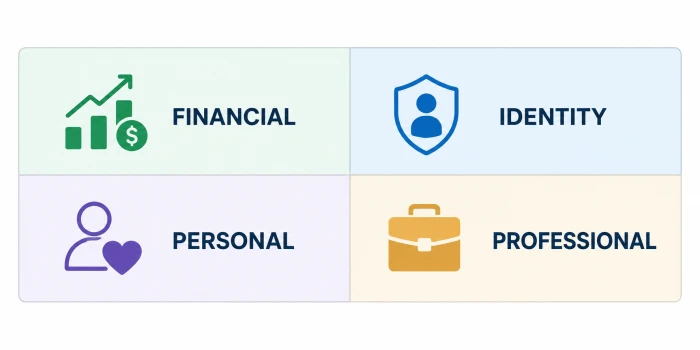
Most people picture sensitive data as passwords and nothing else. The category is much wider, and the things that slip out by accident are usually the ones that do the damage. Here's what I treat as off-limits, grouped by type.
Financial details
Bank account numbers, card details, OTPs, and transaction codes. Anything that touches money or grants access to it.
Identity data
Government IDs, passport numbers, and national identification details. These are the building blocks someone needs to pretend to be you.
Private personal data
Your full home address, medical reports, and the confidential corners of your personal life. The stuff you'd never hand to a stranger.
Work and professional data
Company secrets, internal documents, and client information, which is exactly the line I almost crossed with that contract. This one catches careful people off guard because it doesn't feel personal, but it isn't yours to expose.
The Real Risks Behind Oversharing
Even when an AI platform is secure, the risk doesn't disappear. It moves. It shifts to what happens once your data exists somewhere it didn't before, and to the people who go looking for it.
Financial fraud. Exposed financial credentials can be used for unauthorized access to your accounts. That's the most direct line from a careless paste to an emptied balance.
Identity theft. On their own, a name or a birth date seems harmless. Combined, personal identifiers let someone impersonate you convincingly enough to open accounts in your name.
Permanent digital exposure. Once data enters a system it may be stored, cached, or logged, and it may sit in backups for a long time. There's no reliable way to truly unsend it. That's the part that kept me up after the contract.
Targeted scams. Scammers don't need everything. A few real personal details are enough to build a message so specific and believable that you act before you doubt it.
Work and legal fallout. Sharing confidential work data can trigger policy violations, legal trouble, and a loss of trust that follows you. People have lost jobs over a single careless upload.
The Misconception That Causes the Most Damage
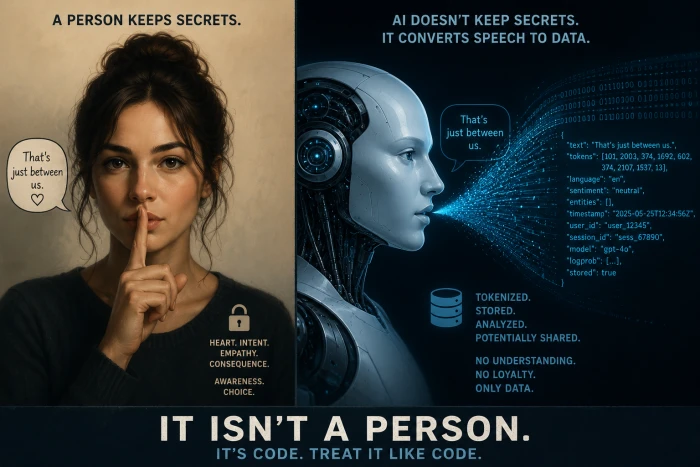
Almost every oversharing mistake traces back to one belief: that AI is like a trusted human who keeps your secrets. It's an easy belief to hold because the tool talks like a person. But it isn't one.
AI has no intent, no loyalty, and nothing to betray. It doesn't decide to protect your secret or leak it, because it has no concept of either. It just processes patterns. Your privacy doesn't rest on the AI choosing to be trustworthy. It rests on how the system is built and on what you chose to type into it. The danger isn't betrayal by a confidant. It's exposure through machinery.
The One Rule That Covers Almost Everything
If you remember nothing else from this, remember this single test. It has stopped me more times than any detailed policy ever could.
If you wouldn't post it publicly online, don't share it with AI.
And if you want it even shorter: if it could harm you when exposed, don't type it. That's it. Two sentences that replace an entire privacy manual.
What's Actually Safe to Share
I don't want to leave you nervous, because used well, AI is one of the most useful tools I've ever had. The line is simple. Strip out anything that identifies you or anyone else, and you're on safe ground. Here's where I use it without a second thought:
- Learning a concept or asking it to explain something I don't understand.
- General questions that have nothing to do with my private details.
- Help with writing, rephrasing, or structuring something.
- Coding assistance and debugging.
- Talking through a problem in the abstract, with names and specifics removed.
The pattern across all of these is the same. Safe use means no identifying or sensitive details attached. The moment you'd be uncomfortable seeing it on a billboard, that's your signal to stop.
A Practical Guide to Using AI Safely
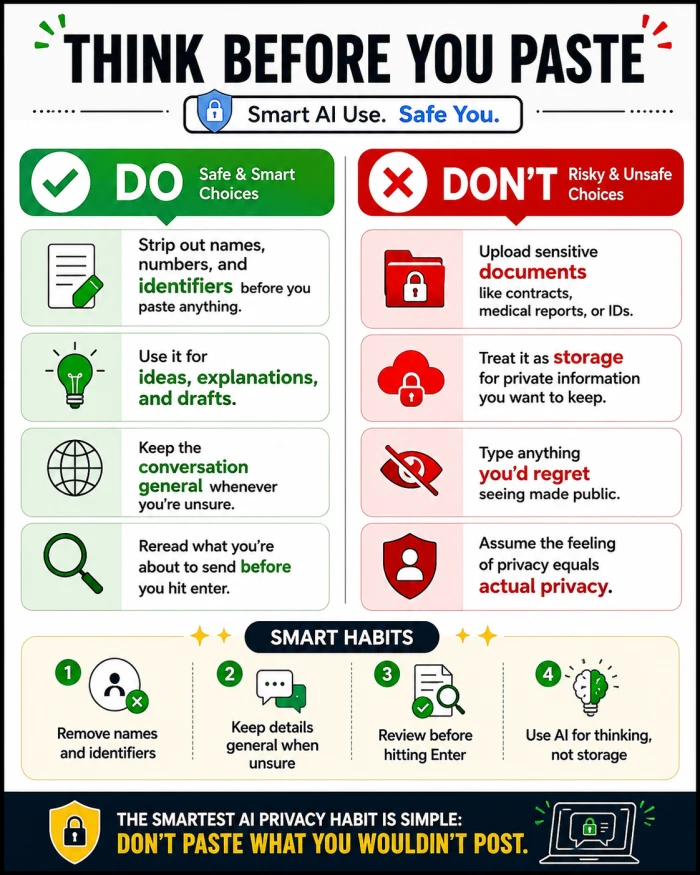
Theory is easy to nod along to and forget. So here's the do-and-don't version I actually keep in my head.
| Do | Don't |
|---|---|
| Strip out names, numbers, and identifiers before you paste anything. | Upload sensitive documents like contracts, medical reports, or IDs. |
| Use it for ideas, explanations, and drafts. | Treat it as storage for private information you want to keep. |
| Keep the conversation general whenever you're unsure. | Type anything you'd regret seeing made public. |
| Reread what you're about to send before you hit enter. | Assume the feeling of privacy equals actual privacy. |
The mental model that ties it together: AI is a thinking assistant, not a private vault. Lean on it for thought. Don't store your secrets in it.
Why This Matters More Now Than It Used To
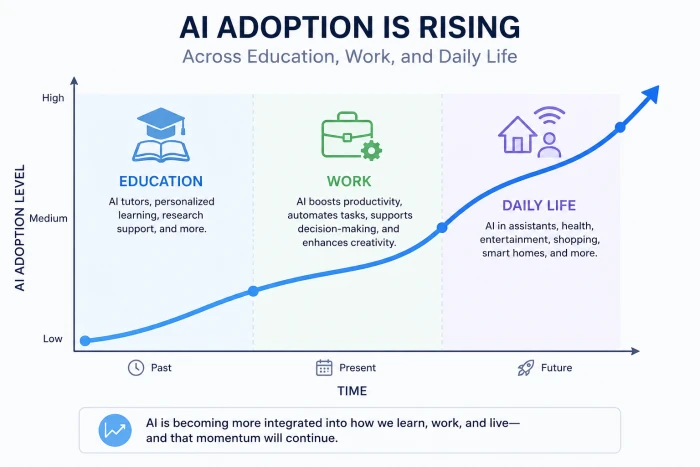
When only a handful of people used AI, a careless paste was a rare event. That's no longer the situation. AI has moved into classrooms, offices, customer service, and the small daily decisions of ordinary life. The volume of personal data flowing into these tools is climbing fast.
More usage means more convenience, and convenience is exactly where mistakes hide. The faster something becomes a habit, the less you think before doing it. That's why knowing what's safe to share has quietly become part of basic digital literacy, the same way locking your phone or spotting a phishing email did. It isn't an advanced skill anymore. It's a baseline one.
The Thing Worth Remembering
AI is one of the most capable tools you'll ever use, and it isn't a safe place to keep your secrets. Both of those are true at once, and holding both is the whole skill.
The risk was never really the technology. It's the gap between how private it feels and how private it is, and that gap closes the second you decide to read what you're about to send. Use AI freely for learning and getting things done. Just stop treating the chat box like a vault, because it was never built to be one.
Comments
Join the discussion and share your perspective.