
Summary
AI tools sell access in three main ways: subscriptions (flat monthly fee), credits (pre-paid pool consumed per action), and pay-per-use (metered tokens or API calls). In May 2026, the standard consumer tier across ChatGPT, Claude, Perplexity, and Google AI sits at $20/month. Power-user plans cluster at $100. Enterprise tiers reach $250+. API token prices range from $0.10 to $30 per million tokens depending on model. The right pricing model depends on one variable: how predictable and heavy your usage is.
The Three Main AI Pricing Models
Almost every AI tool on the market in 2026 uses one of four pricing structures. The first three are pure forms; the fourth is a hybrid that combines them. Understanding the difference is the foundation for picking a tool you won’t over- or under-pay for.
| Model | How It Works | Best For | Watch Out For |
|---|---|---|---|
| Subscription | Flat monthly or annual fee for unlimited or capped usage | Predictable daily users, individuals, small teams | Paying for unused capacity; usage caps and rate limits |
| Credit-Based | Pre-pay for a pool of credits consumed by each action | Image, video, audio tools; bursty usage patterns | Credits often expire monthly; opaque per-action costs |
| Pay-Per-Use (API) | Billed per token, image, or call - no minimum fee | Developers, very high or very low volume | Costs scale linearly; surprise bills without monitoring |
| Hybrid | Subscription base + metered overages or extra credits | Teams with predictable base + occasional spikes | Two pricing rules to track at once |
Table 1. The four AI pricing models compared on how they work, who they suit, and what to watch out for.
Subscription Pricing
A subscription charges a flat fee - usually monthly or annually - in exchange for access to a service, often with usage caps, message limits, or rate limits. This is the dominant model for consumer AI assistants. ChatGPT Plus, Claude Pro, Perplexity Pro, Google AI Pro, and firmcritics all follow this pattern.
What you pay for
• A specific tier of model access (e.g., GPT-5.4 instead of free GPT-5).
• A daily, weekly, or per-window message quota.
• Premium features such as document analysis, web search, code assistant, projects, and team workspaces.
Strengths
• Predictable monthly bill - no surprises.
• Simplest to budget for an individual or small team.
• Annual billing often saves 15–20% (e.g., Claude Pro at $17/month annual vs $20 monthly).
Weaknesses
• You pay for capacity you may not use - a $20 plan used twice a month is $10 per query.
• Hard usage caps stop your work mid-task; many plans reset only every 5 to 8 hours.
• No direct way to top up except by upgrading to the next tier.
Pricing pattern: In May 2026, the standard tier across ChatGPT, Claude, Google AI Pro, and Perplexity has converged at $20/month. The cheapest entry tiers are Google AI Plus at $7.99/month and ChatGPT Go at $8/month.
Credit-Based Pricing
Credit pricing pre-pays for a pool of generation units. Each action - an image, a video second, a transcription minute - consumes a defined number of credits. Once the pool runs out, you either wait for the monthly reset or buy a top-up. This is the dominant model for creative AI tools: Midjourney, Runway, ElevenLabs, Adobe Firefly, and most image and video generators.
What you pay for
• A monthly allowance of compute or "GPU time" (e.g., Midjourney Standard: 15 fast GPU hours).
• A specific number of credits per output (e.g., Runway: 625 credits = 25 seconds of Gen-4.5 video or ~78 images).
• Often a tier within a subscription - credits and subscriptions are not mutually exclusive.
Strengths
• Naturally suits bursty work where you produce a lot in a few sessions and nothing in others.
• Encourages efficient prompting because each generation has a visible cost.
• Top-ups are usually one-click without changing tier.
Weaknesses
• Most credits expire at the end of the billing cycle. Unused capacity is lost.
• Per-action cost is opaque - a longer or higher-resolution output silently costs more.
• Estimating monthly usage is hard until you have run for a few cycles.
Pricing pattern: Midjourney Standard ($30/month) gives ~15 fast GPU hours and unlimited Relax mode - effectively about $0.033 per image in fast mode and zero in relax mode. Runway’s free tier offers 125 one-time credits (≈25 images); paid plans start at $15/month.
Pay-Per-Use (API) Pricing
Pay-per-use is the developer model. You pay only for what you consume - typically priced per million tokens of input and output - with no monthly minimum. This is how every major model provider charges API customers: OpenAI, Anthropic, Google, xAI, DeepSeek, and Mistral all bill this way.
How tokens work
A token is roughly three-quarters of a word. One million tokens equals about 750,000 words. Input tokens (your prompt and any context) are billed at one rate; output tokens (what the model returns) are usually billed 5–6 times higher. A typical chat message is 100–500 tokens; a long document analysis can be tens or hundreds of thousands.
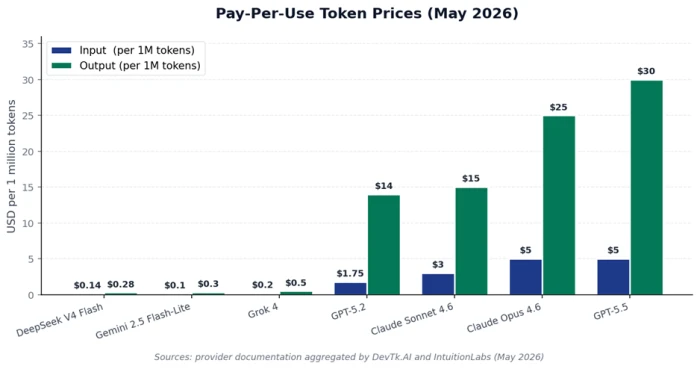
Figure 1. Pay-per-use input and output prices for major models in May 2026 (USD per 1 million tokens).
Strengths
• Zero monthly minimum - if you don’t use the API, you don’t pay.
• Linear cost scaling: 10x usage = 10x bill, predictable for cost modelling.
• Optimisations are available: prompt caching can save up to 90%, batch jobs save 50%.
Weaknesses
• Heavy or careless usage produces large bills with no built-in cap.
• Frontier-model output tokens are expensive: GPT-5.5 at $30 and Claude Opus 4.6 at $25 per million.
• Long-context surcharges apply: Claude doubles its rate once input exceeds 200,000 tokens.
Pricing pattern: In May 2026 token prices span more than 200x: Gemini 2.5 Flash-Lite costs $0.10 per million input tokens, while GPT-5.5 and Claude Opus 4.6 cost $5. Output rates range from $0.28 (DeepSeek V4 Flash) to $30 (GPT-5.5).
Hybrid Models
Most production AI products in 2026 are hybrids. A subscription gets you a base allowance; usage above that is metered as overage credits or API tokens. Examples include ChatGPT Business with credit-based access to advanced features, Claude Team with seat fees plus extra-usage bundles, and Adobe Creative Cloud with bundled generative credits on top of the standard subscription.
Hybrids are popular because they cap predictable costs while allowing burst usage. Read the small print: many hybrid plans buy down the per-unit overage rate, so heavy users effectively get a discount even on metered usage.
AI Pricing Across Major Tools (2026)
The chart below maps the full range of consumer-facing AI subscriptions in May 2026. Notice the clusters: a $7–20 entry-and-standard band covers most users, $100 is the power-user line, and $200+ tiers are aimed at heavy professionals and small enterprises.
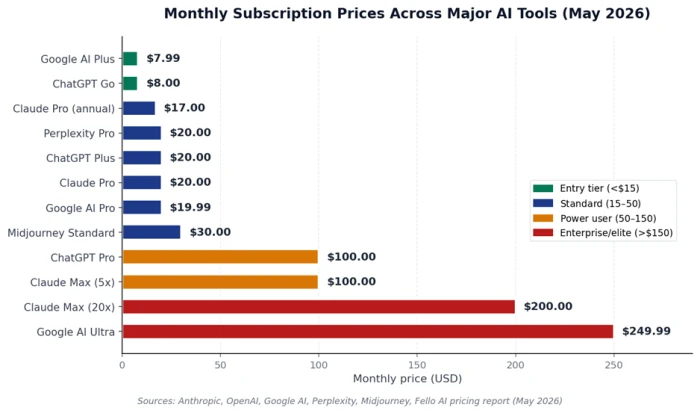
Figure 2. Monthly subscription prices for major AI tools, color-coded by tier.
| Tool / Plan | Monthly | Annual | What you get |
|---|---|---|---|
| ChatGPT Free | $0 | - | Basic GPT-5 access, capped messages |
| ChatGPT Go | $8 | - | Entry tier, higher limits than Free |
| ChatGPT Plus | $20 | $240 | GPT-5.4, image generation, advanced voice |
| ChatGPT Pro | $100 | - | 5x usage of Plus, priority access |
| Claude Pro | $20 | $200 ($17/mo) | Claude Opus 4.6/4.7, projects, Code |
| Claude Max (5x) | $100 | - | Heavy users; 5x Pro usage |
| Claude Max (20x) | $200 | - | Power coders; 20x Pro usage |
| Google AI Plus | $7.99 | - | Cheapest entry into Gemini ecosystem |
| Google AI Pro | $19.99 | - | Gemini 3.1 Pro, 5 TB storage |
| Google AI Ultra | $249.99 | - | Deep Think, Veo 3.1, 30 TB storage |
| Perplexity Pro | $20 | $200 ($16.67/mo) | 300+ deep research queries/day |
| Midjourney Standard | $30 | $288 ($24/mo) | 15 fast GPU hrs + unlimited Relax |
| RedeepSeek Professional | $18 | - | Unlimited messages, docs, code, 50+ langs |
Table 2. Major AI subscription plans in May 2026 with monthly, annual, and what each tier includes.
Cost Comparison: A Worked Example
Pricing structure matters more than headline rates. Three users running the same task on the same model can pay very different amounts depending on which model they pick. The chart below estimates monthly cost for three usage profiles, using Claude Sonnet 4.6-class pricing as the reference.
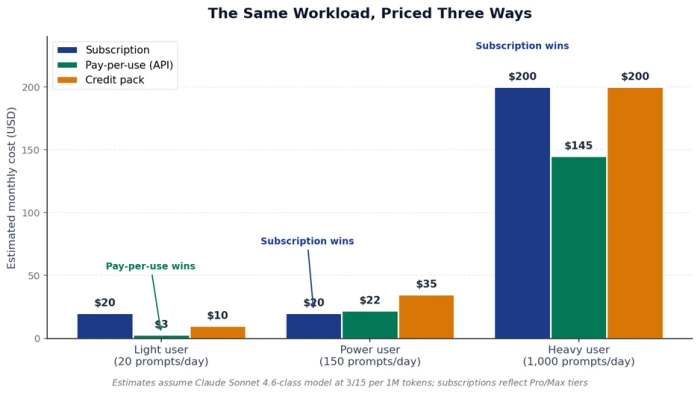
Figure 3. The same workload billed under each pricing model. The winner changes with usage volume.
Light user (about 20 prompts a day)
Estimated API cost: $3/month. Estimated subscription: $20. Pay-per-use is roughly 7x cheaper because most of a $20 subscription pays for capacity the user never touches. Stay on API or use a free tier.
Power user (about 150 prompts a day)
Estimated API cost: $22/month. Subscription: $20. The two converge. Subscription wins by a small margin and removes the bill-anxiety of metered usage. This is why $20 is the most common AI plan.
Heavy user (about 1,000 prompts a day, including long documents)
Estimated API cost: $145/month. Subscription (Claude Max 20x): $200. API is cheaper on raw cost but lacks unlimited access; many heavy users still prefer the $200 subscription for its predictable bill, priority routing, and absence of surprise overages.
How to Choose the Right Model
The choice is driven almost entirely by usage pattern. Two questions answer it for most people: Is my use predictable and daily, or bursty and occasional? And how much do I run through in a typical day? The decision tree below maps the answers to the right pricing model.
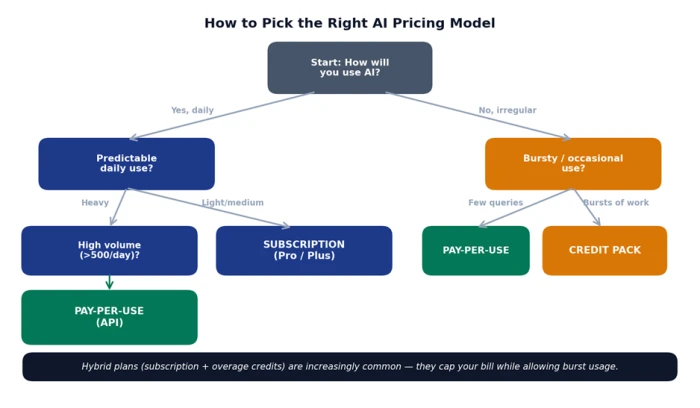
Figure 4. A decision flow for picking subscription, credits, or pay-per-use based on usage pattern.
Rule of thumb: If a $20 monthly subscription would cost you more than five times the equivalent API bill, switch to API. If your API bill exceeds the price of the next subscription tier two months in a row, switch to subscription.
Hidden Costs to Watch For
Headline pricing rarely tells the full story. Eight common surcharges can quietly add 20–50% to a monthly bill. Check each item in the table below before committing to a plan.
| Hidden cost | What to check before paying |
|---|---|
| Credit expiration | Most credits expire monthly. Confirm the rollover policy before pre-paying. |
| Cache and batch tiers | Some APIs charge 50–90% less for cached prompts or non-urgent batch jobs. |
| Long-context surcharges | Anthropic doubles the per-token rate above 200K input tokens; check thresholds. |
| Output vs input asymmetry | Output tokens often cost 5–6x more than input. Verbose models cost more. |
| Per-seat minimums | Team plans often start at 5 seats. A 2-person team pays for 5. |
| Annual lock-in | Annual plans usually do not refund if you cancel. Forecast 12 months of use first. |
| Third-party tool exclusions | Some subscription quotas no longer cover third-party harnesses (e.g. Anthropic, April 2026). |
| Currency and tax | Most prices are USD pre-tax. Add 5–20% for local taxes and FX fees. |
Table 3. The eight hidden costs most often overlooked when comparing AI pricing.
Conclusion
AI pricing in 2026 is no longer one model: it is a market with subscriptions for predictable users, credits for bursty creative work, pay-per-use for developers and very heavy users, and hybrids for everyone in between. The right choice depends on usage pattern, not brand. Map your typical week to the decision flow, check the hidden cost table, and let the maths choose the model.
Comments
Join the discussion and share your perspective.