
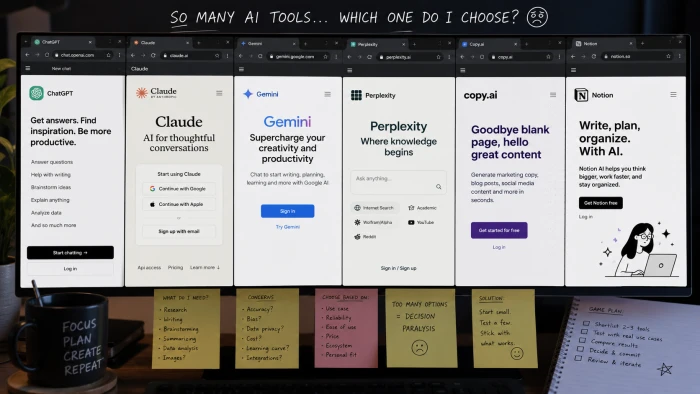
A few months ago I set out to choose an AI writing assistant for my own work. I did what most people do. I opened a dozen browser tabs, read through reviews, watched a couple of walkthrough videos, and built a shortlist of the tools everyone seemed to love.
Then I started using them.
The gap hit me almost at once. A tool that one reviewer called flawless kept slipping fake statistics into my drafts. Another that scored 9 out of 10 across half the internet collapsed the moment I asked t to follow a specific format. The reviews and the reality were describing two different products.
That mismatch is what pushed me to write this. After testing more tools than I planned to, and reading far too many reviews along the way, I kept hitting the same blind spots. So I want to lay out what an honest AI tool review should include, drawn from what I picked up the slow and frustrating way.
First, a definition, because the word honest carries the whole article. An honest review is reproducible, meaning you could run the same prompt and land close to what the reviewer described. It discloses where the reviewer's money and free access came from. And it shows the failures sitting right next to the wins. Every section below traces back to those ideas.
Why Most AI Tool Reviews Fall Short
Once I knew what to look for, the weak reviews became easy to spot.
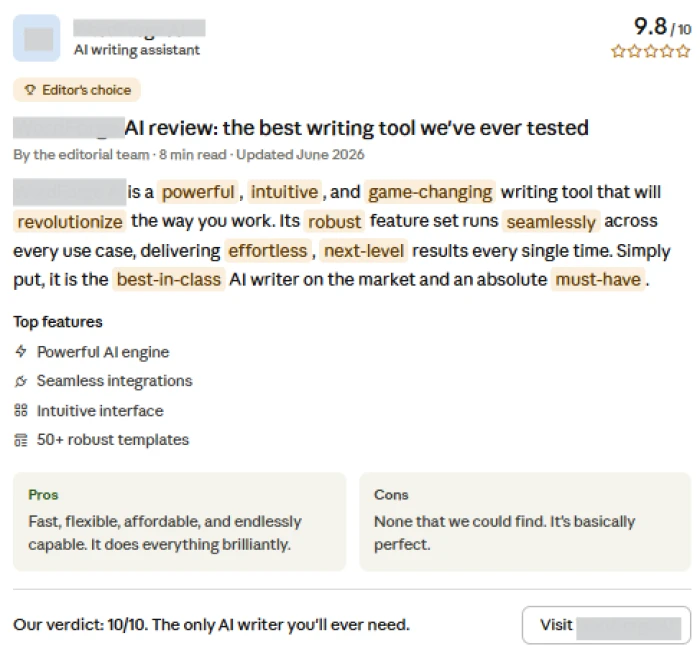
Most of them describe features instead of behavior. They tell you a tool supports long-form content or offers 50 templates, without ever showing the thing doing real work. A feature list is a spec sheet. It is not a review.
The second tell is the language.
Reviews lean on words lifted straight off the product's own marketing page. When every tool is powerful and intuitive, those words stop carrying meaning, and you are reading copy rather than judgment.
Then there is the missing half of the story. I rarely saw a review admit where a tool struggled. No failed prompts, no awkward outputs. A review with zero criticism is either lucky or quietly selling you something.
I will come back to that last point near the end, because the reason behind it matters more than the symptom.
Evidence Over Claims: Real Prompts, Real Outputs
This is the part that separates a review from a polished ad, so it gets the most space here.
Testing is the foundation, but testing on its own proves nothing to a reader. If I tell you I used a tool for two weeks and it writes great emails, you have to take my word for it. You cannot check it. You cannot compare it against anything. You are reading a testimonial dressed up as a review.
What changes the whole picture is showing the work. An honest review puts the actual prompt on the page and the actual output beside it, so you can judge the quality with your own eyes instead of trusting an adjective.
Here is the difference in practice.
A typical review says, “It writes excellent marketing emails.”
An honest version shows it.
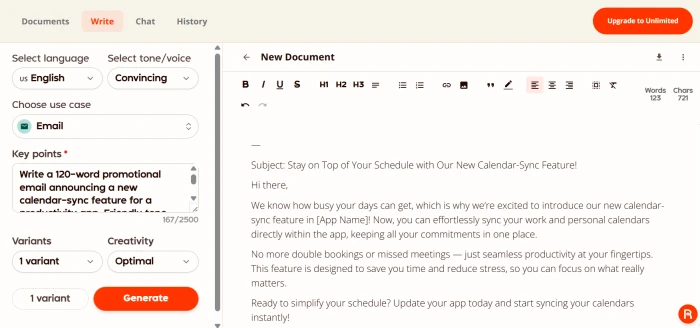
Prompt I used: Write a 120-word promotional email announcing a new calendar-sync feature for a productivity app. Friendly tone, aimed at busy professionals, one clear call to action.
Output (excerpt): “Subject: Stay on Top of Your Schedule with Our New Calendar-Sync Feature!
Hi there,
We know how busy your days can get, which is why we’re excited to introduce our new calendar-sync feature in [App Name]! Now, you can effortlessly sync your work and personal calendars directly within the app, keeping all your commitments in one place...”
Then it adds a line of honest observation. The email read cleanly but stayed generic, and the tone only matched my brief on the second attempt.
That one pairing of prompt and output tells you more than ten paragraphs of praise. You see both the ceiling and the floor of what the tool can produce.
Good testing also reaches past the best case. A review that shows only the tool's finest moment is cherry-picking. I want the average result too, the kind you get on an ordinary Tuesday when you are not crafting the perfect prompt. And I want to see what happens when it breaks. The failures get their own section shortly, because they earn it.
What Users Beyond the Reviewer Are Saying
After I started trusting my own testing, the next problem showed up. My experience is still one person's experience.
I might use a tool in a way that hides its worst habits, or trip over a bug almost nobody else hits. One reviewer, however careful, cannot speak for thousands of paying users.
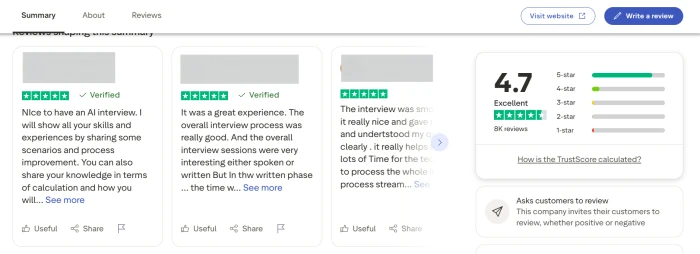
So an honest review looks outward. It pulls in what real people report on places like G2, Reddit, Trustpilot, and the tool's own community forum. Not the polished testimonials, the unfiltered ones.
What I learned to track was patterns, not individual outbursts. A single furious one-star review means little. Forty users describing the same billing trap, or the same feature that broke after an update, means a great deal. Praise works the same way. When the same strength surfaces again and again across hundreds of reviews, that is a signal worth trusting.
There is a time dimension most reviews ignore. AI tools shift quickly, and a glowing write-up from last year can describe a product that no longer exists. I started checking whether recent reviews still lined up with the older ones, or whether the mood had quietly soured after a price hike or a downgraded model.
Where the Tool Breaks: Failures and Edge Cases
Every tool looks competent in a demo. The demo is engineered to make it look competent. The real measure is what happens at the edges, and this is the section I now read first in any review.
The most common failure with AI tools is the confident wrong answer. The tool hands you a fabricated citation or a statistic that exists nowhere, delivered in the same assured voice as the material that happens to be correct. An honest review shows at least one of these moments rather than pretending they never occur.
Consistency is the next problem.
I would run the same prompt twice and get one strong answer and one mediocre one. A review built around a single flawless output is hiding that variance from you.
Prompt sensitivity is the third trap, and a sneaky one. Some tools fall apart the instant you phrase a request a little differently. A small wording change should not turn a sharp output into nonsense, and an honest reviewer pokes at exactly that weakness.
I want to watch a reviewer try to break the thing on purpose. Feed it a messy, self-contradicting prompt. Push it past its context window until it forgets the start of the conversation. How a tool fails tells you far more about living with it than how it shines.
Does It Save You Effort, or Just Impress You?
Somewhere in this process my main question changed. I stopped asking whether a tool could produce something impressive and started asking whether it made my work lighter.
Those are not the same thing.
A tool can spin up a dazzling first draft and still cost you an hour of cleanup, because the output needs heavy rewriting or the interface fights you at every turn. An honest review measures the effort wrapped around the output, not the output by itself.
So I look for a handful of practical answers. How much editing does a typical result need before you can ship it? And how does the tool hold up inside a real workflow instead of a clean demo, including how it behaves when the service is slow or busy? Those answers decide whether you keep the tool once the novelty wears off.
Price belongs in the same conversation, and it is messier than most reviews let on. The headline plan is rarely the plan you end up paying for. Free tiers throttle you, and the features you want most tend to sit one tier up. Usage caps and message limits quietly shape what you can get done, while the cheaper model behind a basic plan often behaves nothing like the flagship shown in the screenshots. A review that quotes only the starting price leaves out the part that lands on your card.
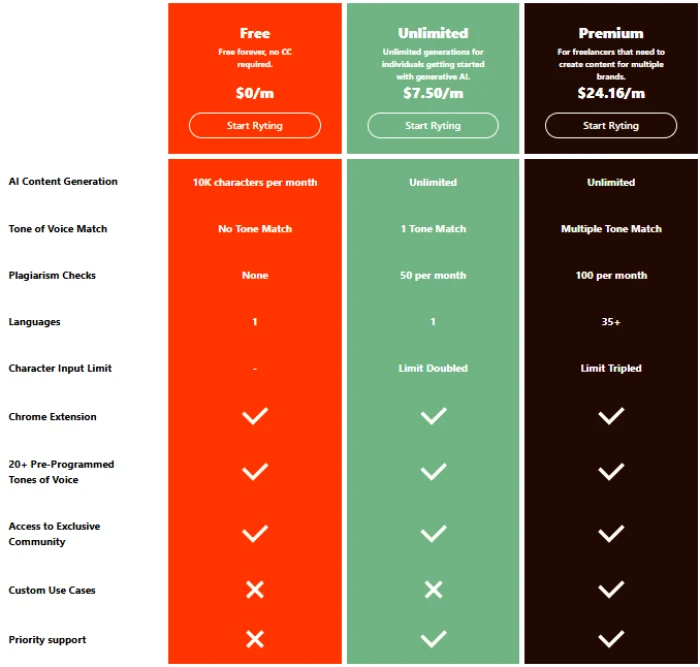
Value is also relative. A tool is only good measured against whatever you would use instead, so the strongest reviews put it head to head with a competitor on an identical task. As I noted earlier about showing real outputs, a side-by-side on the same prompt beats two separate paragraphs of praise.
The Trust Layer: Privacy and Hidden Incentives
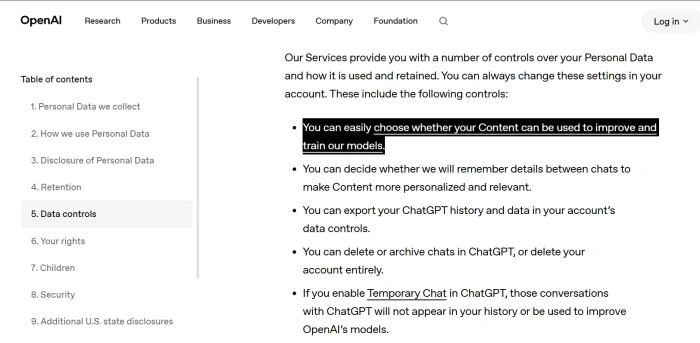
There is one element I almost never saw covered, and it might be the most important of all. What does the tool do with everything you type into it?
You are handing these tools your drafts and, sometimes, your company's internal information. Whether that text gets stored or fed into training for the next version of the model is a real question with real consequences, and a review that skips it skips the part that could land a reader in trouble at work. An honest review at least opens the privacy policy and reports what it found.
The second piece of the trust layer is the one I promised at the start I would return to.
Most reviews are not dishonest because the writer is lying. They come out incomplete because of incentives. Affiliate links pay the reviewer when you sign up, which creates a quiet tug toward recommending. Free premium access shapes the experience in ways a paying customer, the person footing the bill, never gets to feel.
None of that makes a reviewer corrupt. It makes them human. What sets an honest review apart is plain disclosure. Tell me how you got access. Tell me whether a link earns you a commission or a slot was paid for. Once the incentives sit out in the open, I can read with the right pinch of salt, and that beats a hollow claim of total neutrality.
The Checklist I Run Before Trusting Any Review
Compress everything down to a single gut check, and this is the list I now hold up against any AI tool review before I believe a word of it.
- Testing that is shown on the page, not merely claimed
- The exact prompts used, with the real outputs sitting beside them
- Average and failure results, not only the prettiest one
- What users beyond the reviewer report, and whether that has shifted over time
- The tool's failure modes, including where it invents facts and how often it contradicts itself
- The real effort around the output, including editing time and speed
- Honest pricing, with the tier you will end up needing and the caps attached to it
- What the tool does with the data you feed it
- Plain disclosure of how the reviewer got access and what they earn from your signup
I never found a single perfect review, and at some point I stopped hunting for one. What changed was how I read them. The tools will keep shifting every few months, so the sharpest thing you can own is the set of questions you bring to them.
Comments
Join the discussion and share your perspective.