
A vendor sends you a quote. Ninety dollars per seat per month, forty seats, twelve-month commitment. The demo was clean and the sales engineer knew your industry. Somewhere behind your enthusiasm sits a suspicion you cannot quite shake: that behind the branded interface is an API key and a paragraph of instructions you could have written yourself.
That suspicion is often correct. It is also usually the wrong thing to act on.
The word wrapper describes where value sits inside a product. Almost all software wraps something lower down, so the useful question is never whether a product calls someone else's model. The question is whether the layer between you and that model costs less than the work it removes.
What follows answers that with numbers rather than opinions: a definition that survives contact with a sales call, a method for pricing the markup you are being charged, a short test to run before you sign, and an honest account of the cases where the right answer is to cancel and use something you already pay for.
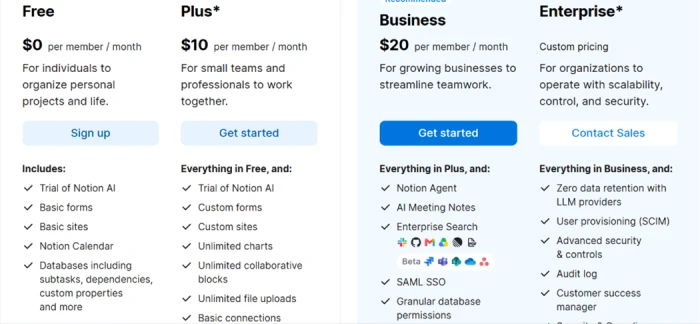
What an LLM wrapper actually is
An LLM wrapper is the software layer between a user and a foundation model, turning a raw API into something a person or a business process can use. At minimum it converts a request into a provider-specific call and converts the answer back. In production it also decides which model receives the request, what context travels with it, which tools it may call, how much it may spend, what happens after an error, and what the user finally sees.
That list is why two products running on the same model can behave like different species. One streams a clean answer in two seconds, keeps a project memory, shows its sources and recovers from a provider outage. The other loses your conversation state and quietly triples its own token bill on silent retries. The intelligence is shared. The behaviour is not.
Three different things people mean by the term
Search the phrase and the results split three ways, which is part of why the topic stays muddy.
• A code library. Packages such as llm_wrapper on PyPI normalise calls across OpenAI, Anthropic and locally hosted models so a developer writes one function instead of four.
• A commercial product. An application built on someone else's model and sold as a subscription. This is what buyers mean, and what the rest of this article is about.
• A research method. A 2024 arXiv paper titled LLM-wrapper describes black-box adaptation of vision-language models. Nobody is going to invoice you for it.
Thin, thick, and the long stretch in between
Product people usually sort wrappers into thin and thick. A thin wrapper adds little beyond the API call and can be rebuilt over a weekend. A thick one carries real engineering, integrations, accumulated data and brand on top of the model, and is hard to copy. The boundary is not binary, which is exactly where buyers get into trouble, because the same word covers a hobby project and a company doing hundreds of millions in revenue.
A spectrum is more useful than a label.
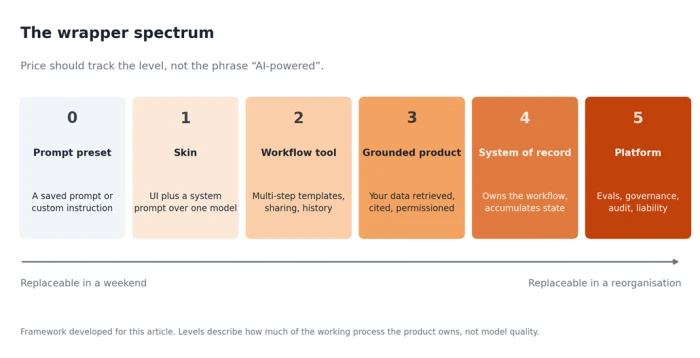
Six levels of wrapper depth. The level, not the marketing, should set the price.
Most disappointing purchases are a level 1 product charging level 4 money. Most underrated purchases are level 3 tools bought by teams who assumed the model was doing all the work and the software was decoration.
Wrapper, agent, or aggregator?
Vendors use these words as if they were rival categories. They are not.
| Term | What it means | Typical example |
|---|---|---|
| Wrapper | The application layer built around a model | Nearly every AI product you can buy |
| Agent | A wrapper whose model chooses actions across multiple steps | Coding assistants, ticket resolution bots |
| Aggregator | A wrapper that routes requests across many models | OpenRouter and multi-model chat clients |
| Fine-tune | A modified model rather than a layer around one | Uncommon outside well-funded vendors |
An agent is a kind of wrapper, not an alternative to one. If a vendor answers “we are not a wrapper, we are agentic,” you have learned something about their marketing rather than their architecture.
Why “just a wrapper” became an insult
In February 2026, Google's head of global startup organization Darren Mowry told TechCrunch's Equity podcast that wrapping, in his words, “very thin intellectual property” around Gemini or GPT-5 signals a company is not differentiating itself, and that founders now need deep, wide moats that are either horizontally differentiated or specific to a vertical market. He named Cursor and Harvey AI as wrappers that built genuine depth.
The forum version of the argument goes nowhere. Every SaaS product is a wrapper around a database, runs the standard rebuttal, so the criticism is meaningless. True enough, and useless to a buyer. What matters is whether the thing you are renting would survive its supplier having a good quarter.
The one thing the critics get right
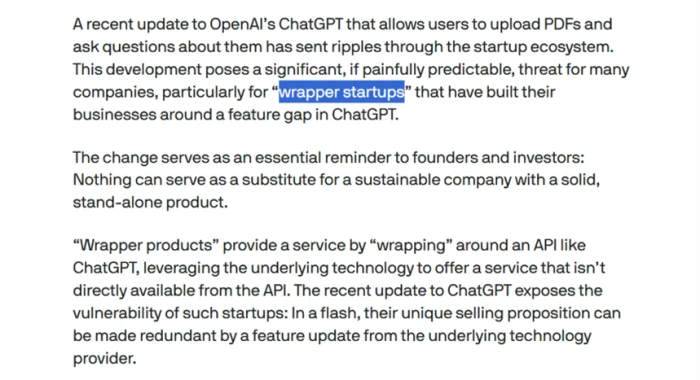
November 2023. OpenAI shipped PDF uploads in ChatGPT. A cluster of startups whose entire proposition was “chat with your documents” woke up to find their selling point had become a free feature of the platform they were built on. TechCrunch's write-up at the time made the point without much sympathy: nothing substitutes for a business that stands on its own.
Turn that into a buying question. Which single upstream release would make this vendor redundant? If you can answer in one sentence, you have found the risk you are actually underwriting.
What the layer legitimately buys you
Before pricing anything, it helps to know what a good wrapper does that a raw model cannot. Six things come up repeatedly.
• Your data. Retrieval over your contracts, tickets, codebase or claims history, with citations you can actually check.
• Multi-step work with gates. Real processes carry approvals, handoffs, rollbacks and audit trails. A single prompt carries none of them.
• Integration depth. Living inside the CRM, the code editor or the records system rather than sitting beside it in another browser tab.
• Evaluation and guardrails. Regression tests against known answers, plus sensible refusals when the evidence is thin.
• Permissions and audit. Who asked, what was retrieved, which model version answered, who approved the output.
• Liability transfer. An uptime commitment and somebody to call when the system breaks at 2am.
Stack those against the price and most buying decisions resolve quickly. Here is where the common categories tend to land.
| Category | What you are usually sold | Honest verdict |
|---|---|---|
| Generic AI writer | A prompt library over a frontier model | Rarely worth a separate subscription. Your existing chat plan covers it |
| Meeting notes | Capture, speaker labels, CRM sync | Often worth it. The recording pipeline is real engineering |
| AI outbound / SDR | Sequences and personalisation over the same outbound stack | The most common markup trap. Price it hard |
| Contract review | Clause libraries, redlining, playbook enforcement | Worth it where your playbook is encoded, not where it only summarises |
| Coding assistants | Repo context, diffs, agent loops, evaluations | Usually worth it. Heavy token burn means a low effective markup |
| Support deflection | Grounded answers over your help centre plus routing | Worth it if resolution rate is measured and written into the contract |
| Regulated documentation | Domain data, compliance posture, audit trail | Worth it. The compliance surface alone exceeds the licence fee |
| Internal knowledge search | Permissioned retrieval across your systems | Worth it at scale. Rarely worth it below fifty seats |
How to tell what you are buying
The next step is verification, and none of it needs an engineer.
Four tests you can run in an afternoon
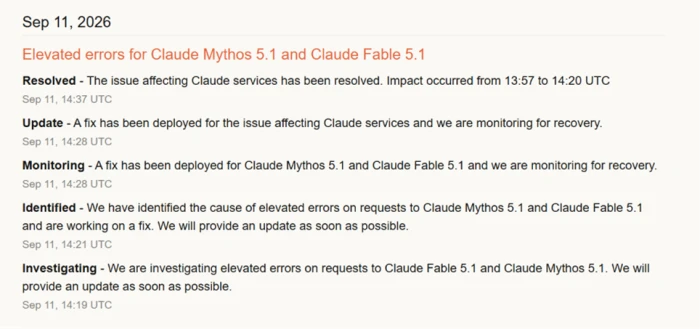
1. The outage test. Watch what happens to the “proprietary enterprise AI” when OpenAI or Anthropic has a public incident. Software that fails in the same minute is passing your queries straight through.
2. The consistency test. Run the same prompt five times in fresh sessions. Materially different findings each time means the system is guessing rather than reasoning over a fixed set of evidence.
3. The known-answer test. Ask something you already know from a recent internal document, then compare the output line by line against the source.
4. The no-good-answer test. Ask something your data cannot support. A credible product says the evidence is not there. A thin one invents a confident answer.
Four questions for the demo call
| Ask this | A good answer sounds like | Walk away if |
|---|---|---|
| Which models do you use, and why those? | Names the providers and explains the routing logic | They call it proprietary and change the subject |
| What happens when that model is deprecated? | A tested migration path plus advance change notices | Nobody on the call has considered it |
| What of ours is retained, and for how long? | Specific retention periods and a written training opt-out | Warm reassurance with nothing contractual behind it |
| Can you run this on our messy input now? | They agree, and the output survives the encounter | Only the rehearsed sample data works |
There is more negotiating room in that conversation than most buyers use. The FTC's Operation AI Comply, launched in September 2024, has produced more than a dozen cases against companies that exaggerated or fabricated AI capabilities, and recent actions apply the same substantiation standard to business-to-business marketing as to consumer advertising. The practical move is simple. If a capability matters to your decision, get it written into the contract rather than left in the deck.
What should this layer actually cost?
The wrapper markup multiple
Divide what you pay per month by the raw API cost of doing the same work. Call it the wrapper markup multiple. Estimating the denominator takes about ten minutes: count the tasks your team runs per month, estimate the tokens each one consumes, then price them at a current published rate.
A worked example, using invented numbers for an illustrative vendor rather than a real product.
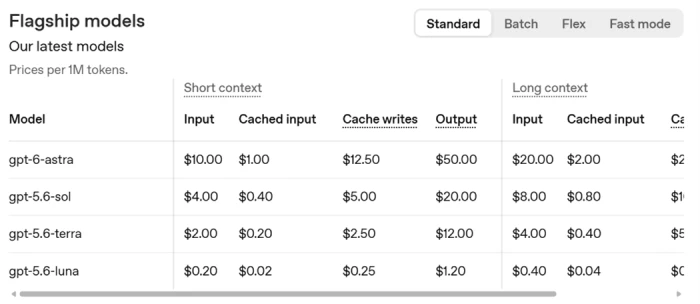
Forty seats at $90 a month is $3,600. Each user runs roughly 40 drafting tasks a month at about 3,000 input tokens and 900 output tokens per task. At GPT-4o mini's published rate of $0.15 per million input tokens and $0.60 per million output tokens, the month's inference costs a little under $2. The multiple lands somewhere near 2,000x.
That number shocks people, and it should not. Inference is almost never the real cost of an AI product. The multiple does not deliver a verdict on its own. It tells you what question to ask next, because an extreme multiple means you are paying for everything except the model, and you had better be able to name what that is.
| Spectrum level | Multiple that needs no explaining | What you are actually buying |
|---|---|---|
| Level 0 to 1 | Under 50x | Convenience, and not much else |
| Level 2 | 50x to 500x | Templates, history, collaboration |
| Level 3 | 500x to 2,000x | Retrieval, permissions, citations |
| Level 4 to 5 | Above 2,000x | Workflow ownership, governance, liability |
If the multiple sits well above the band for the level, you are either paying for a roadmap that has not shipped or subsidising a sales team.
Why your vendor's margin is your problem
Wrapper economics behave nothing like the SaaS economics your procurement templates were built around. An ICONIQ survey of roughly 300 AI startups, reported in January 2026, put AI product gross margins at 41% in 2024, 45% in 2025 and a projected 52% in 2026. Narrow it to the application layer, where the tools you actually buy live, and the figures were 33%, 38% and a projected 45%. Traditional software runs at 80% to 90%.
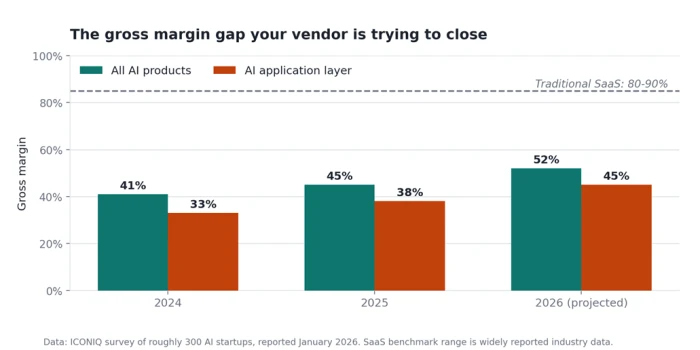
Gross margins for AI products against the traditional software benchmark.
Translate that onto your own risk register. A vendor operating at 38% gross margin has two levers when growth slows. Charge you more, or give you less. Both land on your budget. Once you start reading a pricing page for margin stress, the tells become obvious. Credit systems that obscure unit cost. Seat minimums. Fair-use language that defines nothing.
Do not lock in a long contract at today's prices
The input cost underneath every wrapper is collapsing faster than any other line item in enterprise software.
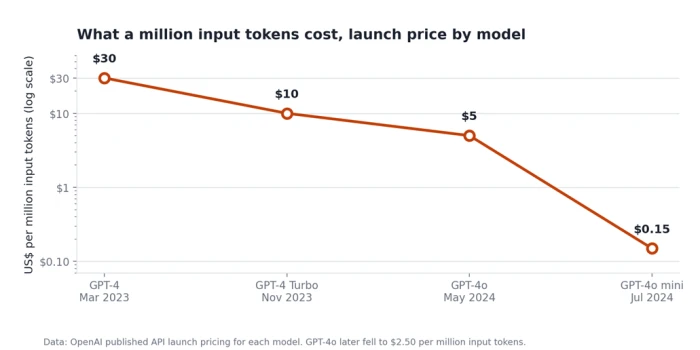
Launch price per million input tokens for successive OpenAI flagship models.
Epoch AI, which tracks the price of reaching fixed capability milestones, measures declines ranging from 9x to 900x per year depending on the benchmark, with the steepest drops concentrated in the most recent period. Signing a three-year seat price today is a bet against the most deflationary input in modern software.
The fix is contractual rather than technical. Prefer annual terms over multi-year ones. Add a price review clause tied to published model pricing. Where usage-based billing is on offer, take it with a ceiling attached.
The seven-question wrapper value test
Score each question from 0 to 2, then add up the total.
1. Does it use data the model cannot reach on its own?
2. Does it replace a multi-step process rather than a single prompt?
3. Does it live inside a tool your team already works in every day?
4. Does it measurably improve with your usage over time?
5. Would a saved prompt in a plan you already pay for get you most of the way there? Score 2 if the answer is no.
6. Could one upstream feature release make it redundant? Score 2 if the answer is no.
7. Can you export your data and leave inside a week?
11 to 14 Pay, and spend your negotiating energy on term length rather than list price.
7 to 10 Negotiate hard. Ask for usage pricing or a shorter commitment.
4 to 6 Replace it with a well-written prompt and a shared document.
0 to 3 Walk.
Should you just build it yourself?
The instinct is understandable, and the evidence is less flattering than most engineering teams expect. MIT's NANDA initiative published “The GenAI Divide: State of AI in Business 2025”, built on an analysis of 300 public deployments, alongside roughly 150 leader interviews and a survey of 350 employees. The widely quoted headline is that about 95% of pilots produced no measurable impact on profit and loss.
Read that number carefully, because most people quoting it do not. It measures the absence of measurement as much as the presence of failure. Very few pilots in 2024 and 2025 recorded a baseline before deployment, so there was nothing to compare the result against. The more useful finding sits underneath the headline: deployments involving external vendors succeeded roughly twice as often as internal builds.
Four costs in-house teams routinely underestimate: building an evaluation set worth trusting, maintaining the system through model deprecations, passing security review, and owning the on-call rota afterwards. Token cost is rarely the expensive part. The cost of a wrong answer reaching a customer is.
Build when the workflow is narrow and stable and a wrong answer costs almost nothing. Buy when the machinery around the model is the actual product.
Signing, renewing, and leaving
Gartner predicted in June 2025 that more than 40% of agentic AI projects would be cancelled by the end of 2027 on escalating costs, unclear business value or inadequate risk controls. The same analysis estimated that of the thousands of vendors claiming agentic capability, only around 130 were building anything that deserved the label. The full Gartner forecast is worth reading before any renewal conversation.
Those odds should shape the paperwork. Four clauses are worth arguing over.
• Price protection. A cap on renewal increases, ideally referenced to published model rates.
• Data use. Written confirmation that your inputs are not used for training, with retention periods named in days.
• Export. A machine-readable export of your data and configuration on demand, not on request.
• Model change notice. Advance notification when the underlying model or version changes, because your outputs will change with it.
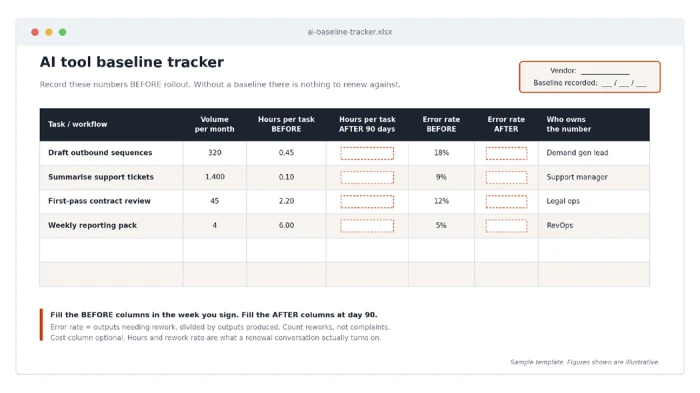
Then record a baseline before rollout. Hours spent on the task today, and the error rate you currently live with. It takes an afternoon, and it is the single thing that separates a renewal conversation you win from one where you are guessing.
The sharpest question to carry into that renewal has nothing to do with the word wrapper. Ask instead whether the product would still be worth the money if the model underneath it became twice as capable and half as expensive next quarter. For a level 1 skin, the answer is no, because the improvement flows to everyone including the free tier, and whatever edge you bought evaporates with it.
The Bottom Line
Most wrappers are worth paying for. Far fewer are worth the contract length attached to them. That gap is where buyers quietly lose money every year, and closing it requires no technical opinion at all.
Four moves, in order:
- Place the product on the spectrum first. Level sets your expectation before the price does. A level 2 tool priced like a level 4 platform has already told you how the negotiation will go.
- Run the markup multiple. It will be large. The number matters less than whether you can name, out loud, what the premium buys beyond the model.
- Score the seven questions before the demo fades. Enthusiasm decays faster than a commitment does.
- Spend your leverage on term and exit, not list price. A 10% discount on a three-year lock is a worse deal than full price on twelve months.
One last signal worth reading. Vendors who deserve your money tend to be relaxed about a short first term, because they expect to earn the renewal on results. The ones who push hardest for a multi-year lock are telling you, fairly clearly, what they think their own odds are.
Comments
Join the discussion and share your perspective.