
Two products sit side by side in a buyer's browser tabs. They do the same core things. One costs less. The buyer chooses the pricier one, renews for three years, and recommends it to four colleagues. The cheaper product quietly loses that same buyer inside ninety days. If features and price settled everything, this would never happen.
It happens every day.
This is the uncomfortable truth behind modern SaaS. The checklist of capabilities and the number on the pricing page have become table stakes. They get you considered. They do not get you kept. The products people stay with do something harder to copy. They solve a problem that actually hurts, they make the first ten minutes feel effortless, they earn trust before they ask for loyalty, and they keep getting better while the customer sleeps.
What follows is a walk through the qualities that separate the products people keep from the ones they abandon. We start where every strong product starts, with the problem, then build up through experience, trust, customer success, ecosystem, and the feedback loop that keeps the whole thing alive. Each section leans on the one before it, so read them in order.

Why Features and Pricing Stopped Winning Deals
For most of software history, a longer feature list was a genuine advantage. Building anything took specialized engineers, months of work, and expensive infrastructure. That moat is mostly gone. Cloud platforms, open-source libraries, AI-assisted coding, and cheap infrastructure now let a small team ship in weeks what used to take a year.
The result is feature parity.
Look at any crowded category and the top handful of products offer roughly the same capabilities. When everyone can tick the same boxes, the checklist stops being a differentiator. Customers stop comparing feature grids and start comparing how the products feel to live with.
There is a deeper problem with competing on features: most of them never get used. Pendo studied anonymized usage across hundreds of products and found that 80% of features in the average software product are rarely or never touched. Public cloud companies spent an estimated $29.5 billion building capabilities that mostly sit idle. Every feature you ship to look competitive is a feature you now have to maintain, document, and explain.
Price follows the same pattern. Undercutting a rival buys attention, not loyalty. A cheaper tool that wastes an hour a week costs more than an expensive one that saves five. Buyers who have been burned understand this, which is why the lowest bid rarely wins the renewal.
Slack is the clearest case. When it launched it competed against email and a handful of existing chat tools that already did team messaging. Slack won because signing in felt good, search returned the right message the first time, the tone had personality, and the whole thing felt fast. Those are not line items on a feature sheet.
A few products that won on something other than features or price, and what each one actually competed on:
| Product | What it actually competed on | The lesson |
|---|---|---|
| Slack | The feel of daily use, and search that returned the right message | A better experience beats a longer feature list |
| Superhuman | Raw speed, and a measured path to product-market fit | Solve one job better than anyone else |
| Notion | Flexibility that bends to each team's way of working | Let customers shape the tool to fit them |
| Canva | Professional design made usable by people who are not designers | Remove the skill barrier and the market widens |
| Zoom | Call quality and reliability when the network is under load | Performance is a trust signal |
| Shopify | Growing with merchants at every stage of their business | Never make a customer outgrow you |
Every product in that table earns its place through something the next section is built on, a real problem solved for a real person. That is where we go next.
Great Products Start With a Problem That Hurts
If features are not the differentiator, the obvious question is what to build instead. The answer arrives before a single line of code: a problem painful enough that people will change their habits to make it go away.
Product-market fit is the name for the moment the problem and the solution click. It is easy to feel and hard to measure, so most teams argue about it in meetings rather than measuring it. Rahul Vohra, who founded the email client Superhuman, found a way to put a number on it.
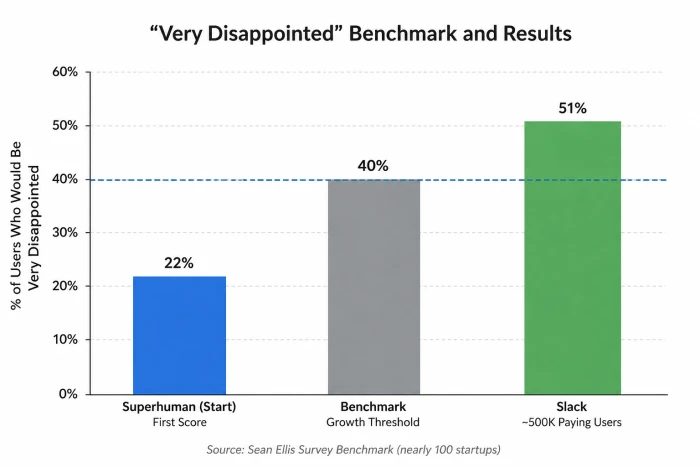
Vohra borrowed a survey question from Sean Ellis, an early growth leader at Dropbox and Eventbrite: how would you feel if you could no longer use this product? Ellis benchmarked nearly a hundred startups and found a clean threshold. When more than 40% of users answered "very disappointed," the company almost always grew. Below that line, growth was a grind.
Superhuman's first score was 22%. Instead of guessing, the team segmented the responses, found the users who loved the product most, learned what those people valued, and rebuilt the roadmap around them. The score climbed past 40% and kept going. For contrast, Slack scored 51% on the same survey when it had around half a million paying users, which shows how high that bar sits.
The lesson underneath the numbers is focus. When you know exactly whose problem you solve, you stop building for everyone. That discipline is the antidote to feature bloat, the slow pile-up of capabilities that impress no one and confuse everyone. Remember the 80% of features that go unused from the last section. Most of them exist because a team said yes to a request without asking whether it served the core job.
A quick gut check before you build anything new:
- Which specific user asked for this, and how many of them share the need?
- Does it help someone finish the core job faster, or does it add a new job?
- What will you remove or simplify to make room for it?
- If nobody used it after launch, would you even notice?
The Experience Is the Product
Solving the right problem gets someone to sign up. The experience decides whether they come back on Tuesday. The most fragile moment in the entire relationship is the first session.
The numbers here are brutal. Across SaaS products, the average activation rate, the share of new users who reach the product's core value, sits near 37%. Almost two-thirds of the people who sign up never see the thing they came for. Users who take no meaningful action in their first three days have roughly a 90% chance of churning, according to Intercom's data. Amplitude, looking across more than 2,600 companies, found that over 98% of new users churn within two weeks when they never hit a value milestone.
Time-to-value captures this. Customers who reach their first real win within fourteen days retain at 80% or higher a year later. Customers who take longer than thirty days retain at 35 to 50%. One onboarding variable swings retention by more than forty points.
Good onboarding skips the guided tour. The job is to move the user down the shortest possible path to one genuine outcome, and nothing else. Every extra step leaks users. Surveys put abandonment at 72% when signup demands too many steps, and each additional form field drops completion by five to seven percent. The instinct to show off everything the product can do is the fastest way to lose the person before they see any of it.
The craft is in reducing what the brain has to process. A clear visual hierarchy tells the eye where to go. Consistent patterns mean a button behaves the same way on every screen. Mobile layouts that hold up respect the person checking in from a phone between meetings. None of this shows up on a feature comparison, and all of it decides who stays.
Experience carries the product. The person deciding whether to return is reacting to how it felt to use, long before they tally up what it can do. We will come back to why measuring this matters when we reach the metrics section.
Trust Is the Feature Nobody Sees
A smooth first week means nothing if the product goes down during a customer's biggest moment. Experience gets people through the door. Trust keeps them from leaving the first time something breaks.
Trust in SaaS stays invisible until it fails. Uptime, encryption, sensible authentication, regular backups, and clear data handling are things customers never thank you for and never forgive you for losing. A single outage during a product launch or a payroll run can undo a year of goodwill.
As customers grow, the questions get sharper. Enterprise buyers ask about SOC 2 reports, data residency, single sign-on, and audit logs before they ask about features. Meeting that bar early signals that you plan to be around for the long haul.
The counterintuitive part is that trust grows most during failure. Every product breaks eventually. What separates the trusted ones is how they behave when it happens. A public status page and an honest post-mortem beat silence every time. Customers remember being told the truth far longer than they remember the downtime itself.
Move From Support to Customer Success
Trust keeps a customer from leaving. It does not, on its own, make them successful. That is a different job, and the products that grow treat it as one.
Support and customer success get confused, and they are not the same discipline. Support is reactive. It waits for a ticket, then solves the problem. Customer success is proactive. It watches for the customer who has not logged in for two weeks and reaches out before that person decides to cancel.
The economics reward the proactive side. Bain's research found that lifting retention by five points raises profits by 25 to 95%. Gainsight's data shows companies with mature customer success functions post 28% higher net retention. Selling to an existing customer succeeds 60 to 70% of the time, against 5 to 20% for a brand-new prospect. Keeping a customer is cheaper than replacing one by a wide margin.
Proactive success shows up as a handful of concrete things. Documentation that answers the question before someone has to ask it. Educational content that turns a casual user into a power user. A community where customers help each other and, in doing so, quietly sell the product for you. Product webinars and office hours that give people a reason to go deeper. HubSpot Academy and Canva's design school built large audiences this way, teaching skills that happen to require the product.
This is where the trust from the previous section pays off. Customers only lean on your education and your community once they believe you are on their side.

No Product Wins Alone
No customer uses your product in a vacuum. It sits inside a stack of a dozen other tools, and how well it plays with them shapes daily reality more than any single feature does.
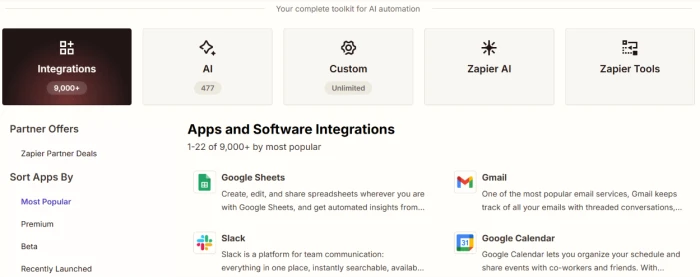
Integrations turn a standalone app into part of someone's workflow. When your tool pushes updates into Slack, syncs with Google Workspace, connects through Zapier, or handles payments through Stripe, it stops being one more tab and becomes infrastructure. The more embedded it gets, the harder it is to rip out. That is the healthy kind of switching cost we mentioned earlier, the kind earned by usefulness rather than lock-in.
Slack understood this early. Its app directory turned a chat tool into a hub where hundreds of other products live inside the same window. Salesforce did the same with AppExchange. Each platform grew more valuable because other companies built on top of it.
The same logic applies over time. A customer who signs up as a team of three should never have to leave when they become a team of three hundred. That means designing for scale from the start, with an API for the workflows you did not anticipate, permission controls for a growing org chart, real automation for repetitive work, and performance that holds as data piles up. Products that force customers to outgrow them are handing competitors a warm lead.
Listen, Measure, and Keep Improving
Everything so far describes a product at one moment in time. Great SaaS is never finished. The products that stay great treat customer feedback as a permanent input, not an annual survey.
That takes a real system for listening. Customer interviews that dig into why, not just what. Feature requests tracked and weighed against the core job from the earlier section. Product analytics and session recordings that show where people get stuck. Beta releases that test an idea before a full launch. Release notes that tell customers you heard them. Companies that act on feedback grow faster, by one estimate 4.6 times the rate of those that ignore it, and yet roughly 95% of feedback goes unread.
Listening produces signals. Metrics tell you whether the signals are working. The trap is drowning in dashboards, so here are the numbers that actually move decisions and what each one is telling you.
| Metric | What it actually tells you |
|---|---|
| MRR / ARR | Whether the business is growing month over month and year over year |
| Churn rate | How fast customers leak out the bottom. SaaS averages 5 to 7% a month |
| Net revenue retention | Whether existing customers grow in value before any new sales land |
| CAC | What each new customer costs to win, and whether that pace is affordable |
| LTV | What a customer is worth across their whole lifetime, the real ceiling on CAC |
| Activation rate | Whether new users reach value, the leak from the experience section |
| Feature adoption | Which capabilities earn their keep, and which join the unused 80% |
| NPS / CSAT | How customers feel, and how likely they are to send you the next one |
Read together, these stop being a scoreboard and start working as a diagnosis. High activation lifts retention. Retention lifts lifetime value. Once lifetime value comfortably clears the cost of winning a customer, you can afford to grow. One weak number upstream quietly poisons the ones below it.

The Mistakes That Quietly Kill Good Products
Most of these mistakes are the shadow side of the qualities above. They rarely kill a product loudly. They bleed it slowly.
- Building features nobody asked for, feeding the unused 80% from the start.
- Onboarding that shows off the product instead of getting the user to one quick win.
- Navigation that needs a manual, when good design is supposed to need none.
- Slow, reactive support that treats a cancellation as a surprise.
- Thin documentation that pushes every question straight into the support queue.
- Ignoring feedback, then wondering why the roadmap keeps missing.
- Pouring everything into acquisition while retention quietly erodes underneath.
- Pricing so tangled that buyers need a spreadsheet before they can say yes.
Any one of these is survivable. Stacked together, they explain most of the products that shipped good features at a fair price and still had no customers left after two years.
Where Great SaaS Goes Next
The bar for a great product keeps rising, and the next shift is already here. AI is moving from a feature bolted onto the sidebar to the way the product works.
The useful version of this goes well beyond a chatbot in the corner. Picture a copilot that drafts the report, an agent that finishes the multi-step task while the user does something else, personalized interfaces that adapt to how each person works, and analytics that flag churn before it happens. Vertical SaaS, tools built deeply for one industry rather than broadly for everyone, is winning because it understands a specific customer's job better than any generalist can. Usage-based pricing is spreading because it ties what a customer pays to the value they get, a fairer deal than a flat seat license for software they barely open.
The thread running through every one of these trends is the same. A copilot that drafts a bad report is worse than no copilot. An agent that acts without the user's trust is a liability, not a feature. The teams that win the next decade will treat AI the way the best products already treat everything else, as a way to get a specific customer to a specific outcome faster. The ones chasing it for the press release will end up in the same graveyard as the products that had every feature and the lowest price.
Comments
Join the discussion and share your perspective.