

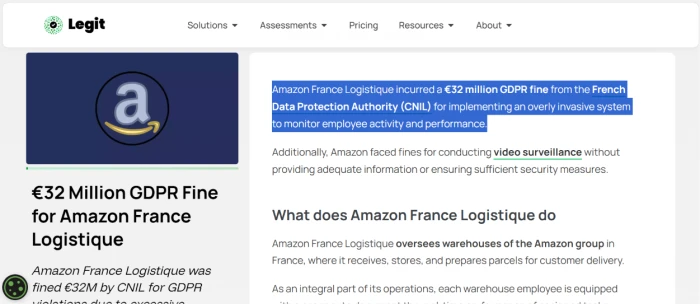
In January 2024, France's data protection regulator fined Amazon's warehouse subsidiary 32 million euros. The trigger was not a hacked server. It was a handheld barcode scanner.
Every warehouse worker carried one. It logged how fast they scanned each item and how long the device sat idle between scans. A pause longer than ten minutes raised a flag. One indicator, nicknamed the "stow machine gun," fired if a worker scanned an item in under 1.25 seconds. The regulator, the CNIL, found workers kept under near-constant pressure, forced to justify almost any gap in activity, with the data held for 31 days. That level of detail, it ruled, went past what the business needed.
I keep coming back to that case because it holds the whole argument in one story. Amazon had a real reason to track warehouse throughput, and nobody serious disputes that. What tipped it over the line was the absence of limits: no ceiling on how precise the tracking got, no cap on how long records lived, no restraint on how much of a worker's day fell under the lens.
That tension runs through this whole piece. Monitoring at work is now normal, and a good share of it is defensible. The useful question is no longer "should employers monitor" but "where does monitoring stop." I want to make the case that clear limits are what separate oversight that protects a company from surveillance that quietly corrodes it.
What Workplace Monitoring Actually Involves
It helps to pin down what the word covers, because it stretches from records almost every employee accepts to methods many find hard to stomach. Here is the range as it stood across 2024 and 2025.
| Category | What it captures | How intrusive |
|---|---|---|
| Attendance and access | Badge swipes; login and logout times | Low |
| Communication | Email and chat logs, messaging history | Medium |
| Activity | Websites visited, apps used, active versus idle time | Medium |
| Screen and keystroke | Screenshots, screen recording, keystroke logging | High |
| Location | GPS on vehicles or devices | High |
| Biometric and video | Facial recognition, fingerprint access, camera feeds | High |
| AI analytics | Productivity scoring, behavior and sentiment analysis | High |
A 2023 analysis by StandOut CV of 50 popular monitoring tools found that 96% offered time tracking and 86% offered real-time activity monitoring, while 78% could capture screenshots and 40% could log keystrokes. The invasive end is not a fringe capability. It ships in most products by default.
The line that matters runs between reasonable oversight and continuous surveillance. Oversight checks outcomes and steps in when something looks wrong. Surveillance watches every second regardless. A login timestamp tells a manager whether someone started their shift. A keystroke logger that captures every word typed, including a private message drafted on a break, tells them something else. The first supports the work. The second follows the person.
| Reasonable oversight | Continuous surveillance |
|---|---|
| Aggregated or sampled data | Every action, in real time |
| Tied to a stated purpose | Collected in case it proves useful |
| Scope known to employees | Scope hidden or left vague |
| Measures results | Measures presence and motion |
I will come back to the gap between those two columns, because most of the failures later in this piece come from sliding rightward without noticing.
Why Companies Watch in the First Place
It would be easy to treat all of this as control for its own sake. The reasons are usually more grounded than that.
Security tends to sit at the top. Insider threats and data leaks are a genuine worry, and in one 2024 report cited across industry surveys, 71% of organizations said they were concerned about insider risk. The common motives look like this:
- Protecting sensitive data and intellectual property from leaks, whether accidental or deliberate.
- Meeting legal and regulatory duties in fields like finance and healthcare, where certain records must be kept and certain conduct prevented.
- Keeping remote and hybrid teams coordinated once managers can no longer glance across a room.
- Catching security incidents early, before a small anomaly turns into a breach.
The remote shift poured fuel on all of it. Gartner reported in 2022 that the share of large employers tracking workers had doubled since the pandemic began, reaching 60%, with a projection it would climb to around 70% by 2025. When a manager cannot see who is at their desk, tooling fills the gap.
None of this makes monitoring sinister by itself. A company that logs who opened a patient database is behaving responsibly. The trouble starts when the same instinct keeps expanding with no natural stopping point, which is what the next two sections are about.
Where It Starts to Cost People
Watch people closely enough and something shifts in how they feel about the work. The evidence on this is consistent and, frankly, uncomfortable.
The stress of being watched
Constant observation carries a cost that shows up before any data is ever misused. More than half of monitored employees have told the American Management Association they feel tense or stressed at work. In ExpressVPN's 2025 survey of US workers, a third of those already being monitored said they worry constantly about being watched. A 2024 peer-reviewed study of 3,508 Canadian workers, published in Social Currents, traced how surveillance drives psychological distress through several linked mechanisms. It raises the pressure of the job. It makes people feel their privacy has been breached. And it wears down their sense of control over their own work.
The slide into micromanagement
Detailed tracking tempts managers to manage the wrong thing. A 2024 Forbes Advisor survey, run by OnePoll with 1,000 remote and hybrid US employees between February 13 and 23, found that 31% of monitored workers felt micromanaged, reading every click as scrutiny. Once a dashboard shows idle minutes, idle minutes become the target, and the harder question of whether the work is actually getting done falls away. That was the core of the CNIL's objection to Amazon's scanners, described at the start of this piece.
The privacy nobody signed up for
Then there is what monitoring sweeps up by accident. Two-thirds of workers in that Forbes Advisor study said at least one part of their online activity would embarrass them if their employer saw it, and the most common worry, named by 37%, was private messages with friends or partners. Screen recording and keystroke logging do not politely skip the personal. They capture the bank login typed at lunch, the message to a doctor, a half-written resignation letter, a search made in a private moment. Anything collected this broadly also has to be stored, turning an HR tool into a security liability of its own.
Workers push back
People notice, and a fair number quietly fight back. In the Forbes Advisor survey, a quarter of monitored workers admitted to pretending to be online while doing something else. Microsoft gave this behavior a name in its 2022 Work Trend Index: "productivity theater," the work of looking busy. I will pick that thread up next, because it points straight at why heavy monitoring so often fails on its own terms.
Where It Starts to Cost the Business
Here is the part that should give any executive pause. The costs above land on employees first, but they do not stay there. They travel up into the numbers leaders care about.
Trust and turnover
Start with retention. In that 2024 Forbes Advisor survey, 27% of monitored workers said they would be at least somewhat likely to quit over it. ExpressVPN's 2025 figures ran harder: 49% of US workers said they would consider leaving if surveillance increased, and 24% said they would accept a pay cut of up to 25% to avoid being monitored. In the UK, ExpressVPN's 2024 survey found 51% would rather quit than face constant surveillance. Another 35% already felt their employer did not trust them, and 14% said they felt dehumanized. One survey of remote employers found more than two-thirds had already lost staff who did not want to be monitored.
The productivity paradox
Now the twist. Heavier monitoring is usually sold as a productivity move, yet the evidence for that payoff is thin. Microsoft's 2022 Work Trend Index, drawn from 20,000 people across 11 countries, found that 87% of employees felt productive while 85% of leaders doubted their teams were. Microsoft named the gap "productivity paranoia." The reflex response, reaching for tracking software, measures motion rather than results, which breeds the theater from the last section. People spend energy proving they are busy instead of working.
Mouse jigglers exist for a reason.
The slower damage
Some costs never surface on a dashboard at all:
- Innovation needs a degree of slack and psychological safety, both of which shrink under a microscope.
- Collaboration suffers once people grow careful about what they say in monitored channels.
- Employer reputation takes a hit that outlasts any single quarter and makes hiring harder.
- Managers who lean on surveillance often stop building the judgment to lead without it.
Put together, the case for maximal monitoring looks weak. A tool sold to raise output can lower it, while quietly raising the legal exposure I turn to next.
The Legal and Regulatory Picture
Law is where a vague sense of "too much" grows teeth, and the ground is uneven. Rules differ sharply by country and region, so what follows are principles, not advice for any one place. Anyone drafting a policy should check local law or take counsel.
Even so, a common set of expectations shows up again and again in regulation:
- Transparency and notice. People should know that monitoring happens and what it covers.
- Purpose limitation. Data gathered for security should not quietly become a performance-review tool.
- Data minimization. Collect the least that meets the stated aim, not the most the software allows.
- Proportionality. The intrusion has to match the size of the problem being solved.
- Retention limits. Records should not live indefinitely.
- Security. Whatever is collected has to be protected, because it becomes a target.
The Amazon case maps almost cleanly onto these. The CNIL did not object to warehouse tracking in principle. It found three things wrong at once. The second-by-second precision was ruled disproportionate. Retaining every detail for 31 days breached data minimization. And the workers, along with visitors to the warehouses, were never properly informed.
Regulators are also getting more specific. Ontario, through its Working for Workers Act of 2022, became the first jurisdiction in North America to require employers with 25 or more staff to keep a written policy stating whether and how they monitor electronically. The direction of travel is toward disclosure, not away from it.
Why Clear Limits Matter
Everything so far points to one conclusion, and it is the claim in this article's title. Almost none of the harm in this piece traces back to monitoring as such. It traces back to monitoring with no boundary.
A limit is just a decision made in advance about where watching stops. Set one and the same tool behaves differently. Amazon's scanners, with a cap on retention and precision, would have drawn no fine. The Forbes Advisor respondents who felt micromanaged were reacting to the missing edge, the sense that scrutiny could reach anywhere at any time.
Clear limits do two things that open-ended monitoring cannot.
The first is fairness. When people know the scope ahead of time, monitoring stops feeling like a trap and starts feeling like a rule that applies to everyone evenly. Both the ExpressVPN and Forbes data show acceptance rising once workers understand what is happening and why.
The second is accountability, running both ways. A stated limit is something a company can be held to, and something an employee can point to. It turns a discretionary practice into a policy with edges.
So what actually needs a limit? A short set of questions every monitoring program should be able to answer out loud:
| Question | Why it matters |
|---|---|
| What is monitored? | Names the scope so it cannot quietly expand |
| When does it happen? | Separates work time from personal time |
| Who can see the data? | Prevents casual or unauthorized access |
| How long is it kept? | Stops indefinite retention |
| Why is it collected? | Ties every data point to a real purpose |
| How are people told? | Keeps the whole thing visible |
Answer those honestly and most of the harm described earlier never appears. The next section turns them into everyday practice.
What Responsible Monitoring Looks Like
Turning limits into habits does not take much. It takes discipline about a few things and restraint about the rest.
Write it down, in plain language
A policy nobody can find is not a policy. In research compiled by ActivTrak, two-thirds of employees said they had never received formal monitoring guidelines at all. State what is tracked and why in words a new hire can follow, then put it somewhere they will actually see.
Collect the minimum, not the maximum
Default settings lean toward capturing everything, so turn that around. If aggregated weekly activity answers the question, there is no case for logging every keystroke. That was the CNIL's exact point about Amazon: weekly summaries would have served the stated purpose, which made the second-by-second capture indefensible.
Measure outcomes, not motion
This is the single change that pays off most. Judge people by what they deliver, not by how long their status dot stayed green. It kills productivity theater at the root, and as Microsoft's researchers argued, it is simply a better way to run hybrid work.
Fence off personal time and space
Monitoring that follows someone into their evening, their private messages, or a bathroom break has lost the plot. Keep it to work, on work systems, during work hours.
Lock down access and delete on a schedule
Restrict who can view collected data, and set retention short enough that old records stop being a liability. Data you no longer hold cannot leak.
Tell people, then keep telling them
Disclosure is not a single email. The UK's regulator has warned employers against relying on one buried notice. Keep the practice visible enough that nobody is ever caught off guard by it.

Do these six things and monitoring stays in the "oversight" column from earlier. One force, though, is straining every one of them at once, and it has earned its own section.
How AI Is Changing the Equation
The monitoring described so far mostly records what happened. AI monitoring tries to interpret it, and more and more to predict it. That is a different proposition.
Adoption is already wide. A February 2025 survey of US employers found 61% using AI-powered analytics to measure productivity or behavior, and 67% collecting biometric data such as fingerprints or facial scans. Tools now claim to score productivity, flag "disengagement," read sentiment from messages, and in some cases infer emotion from a face on camera.
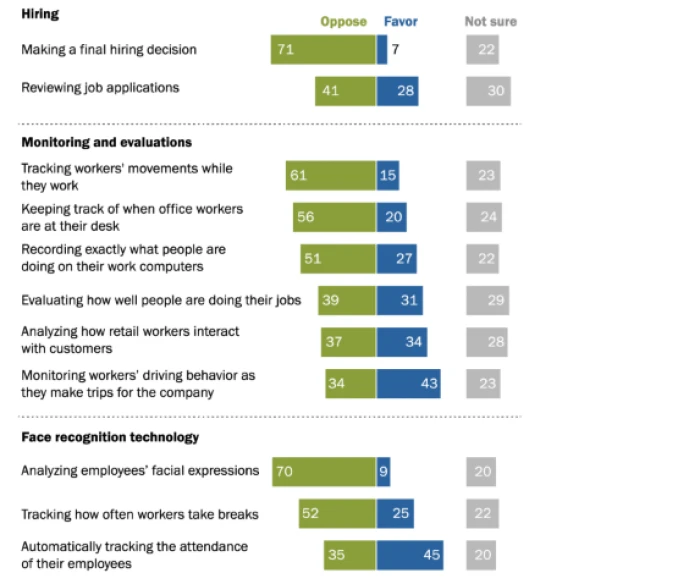
The public is not comfortable with any of it. The Pew Research Center's 2023 survey of 11,004 US adults found that 81% thought workers would feel inappropriately watched if employers used AI to monitor them. Two-thirds expected the collected data to be misused, and 61% opposed AI tracking workers' movements.
Two problems make AI monitoring riskier than the analog kind.
The first is bias and false positives. An algorithm scoring productivity or flagging "risky" behavior learns from patterns that can bake in existing inequities, and it makes its mistakes at scale. A human misreading one worker is a bad day. A model misreading thousands is a policy.
The second is the interpretation problem. Counting keystrokes is crude but honest. Claiming to read an employee's emotional state from their face is a leap the underlying science does not support, and acting on that claim can do real harm.
None of this means AI has no place at work. It means the limits from the previous sections matter more, not less. Automated judgments need a human in the loop. Biometric data needs tight governance. And honesty about what a model can and cannot actually tell you is what separates a useful signal from an automated injustice.
Building Trust Instead of Reaching for Surveillance
Step back from the tooling and a question appears that monitoring rarely asks: what problem are we actually trying to solve? Usually it is some version of "are people doing good work?" Surveillance is a poor way to answer that. Better ways exist.
The research keeps landing on the same alternative. Microsoft's work on productivity paranoia concluded that the answer lay in clearer priorities and steady feedback rather than more tracking, so people know what matters and managers can see progress without a wall of keystroke data. Give someone a clear goal and the room to reach it, and you get the thing surveillance is chasing without the corrosion it causes.
A few shifts do most of the work:
- Manage toward outcomes and let people own how they get there.
- Build regular, honest feedback loops in place of ambient observation.
- Offer flexibility as a signal of trust, then notice how often it is repaid.
- Treat a privacy-respecting culture as a hiring advantage, because for a growing share of candidates it already is.
There is a self-fulfilling quality to all of this. The numbers earlier showed that when monitoring reads as distrust, people disengage and some walk. The reverse holds too. In one 2025 industry analysis, when workers were trusted with their own monitoring data, 47% used it to improve their own performance. Trust people visibly, and most rise to it.
Finding the Balance
Security and privacy get set against each other constantly, as though more of one demands less of the other. The cases in this piece suggest that framing is simply wrong. Amazon did not become safer by tracking scans to the second. It collected a fine and a bruised reputation. The companies shedding staff over surveillance are not buying safety with the loss. They are paying twice.
The balance point is not a compromise where everyone gives something up. It is the plain recognition that proportionate, transparent monitoring serves the business better than the maximal kind and protects the people inside it at the same time. A badge system that logs entry, a written policy that says so in plain terms, a retention window measured in weeks, an access list short enough to name by hand: none of this describes a company that has sacrificed its security. It describes one that worked out where oversight ends and surveillance begins, and chose to stop at the line.
That line is a choice every organization makes, whether it admits to making it or not. The ones that make it on purpose, and write it down, are the ones whose employees will still trust them a year from now.
Comments
Join the discussion and share your perspective.