
What ElevenLabs Does
ElevenLabs turns written text into spoken audio, and it has spent the last two years expanding sideways into everything else a creator might need on the same timeline. The account you sign up for covers speech generation, speech to text, sound effects, voice design, music, and image and video work. All of it draws down a single credit balance rather than separate quotas per product.
The company positions itself as an audio research lab first and a creator tool second, and the product reflects that. Voice cloning sits alongside automatic dubbing across dozens of languages, and above both of those runs a conversational agent stack that has little to do with the plain text box most people arrive for. Developers get the same models through an API with its own subscription structure, which is a genuine source of confusion for buyers who assume one plan covers both surfaces.
Individual plans run from a free tier up through Starter at $6 a month, Creator at $22, Pro at $99 and Scale at $299, with Business and Enterprise options above that.
What Happened When We Tested It
We opened a free ElevenLabs account with no card on file and treated the starting credit balance as a fixed budget. After every generation we went back to the balance panel and recorded what had been deducted. The session ran about ten minutes of active work and touched five different products, which turned out to be enough to expose where the credit model gets expensive and where the free tier quietly stops being useful.
Signup and the opening balance
Test 01 . Account setup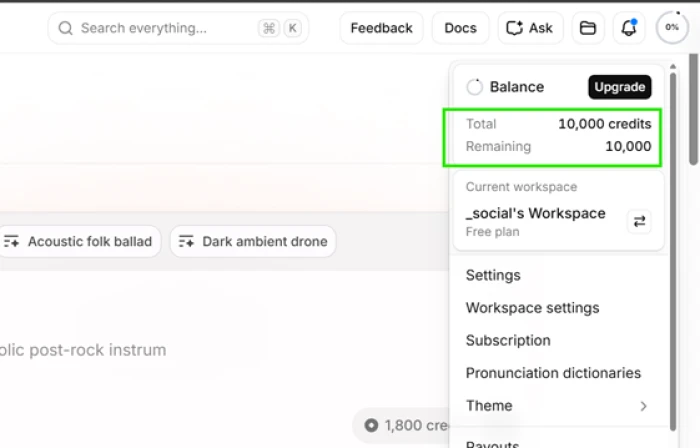
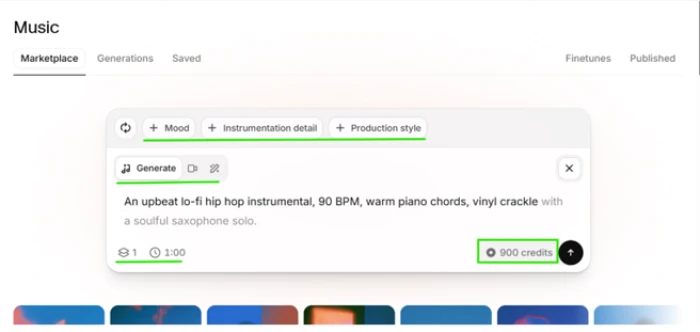
Music generation quotes its price first
Test 02 . Music"An upbeat lo-fi hip hop track with warm piano chords and vinyl crackle"
Post-generation controls go further than expected
Test 03 . Export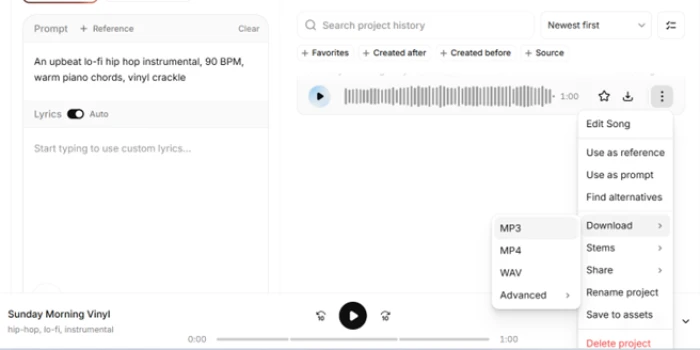
Where the free tier actually stops
Test 04 . Licensing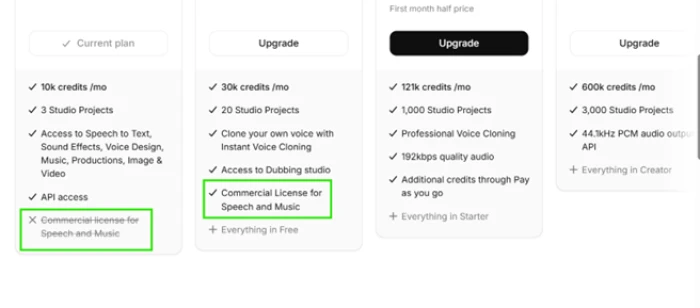
The voice library is bigger than it is browsable
Test 05 . Voice selection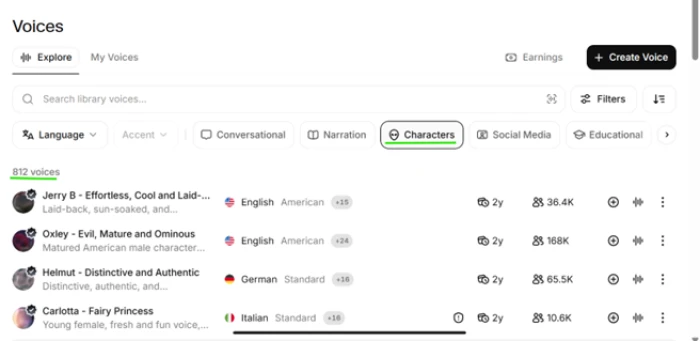
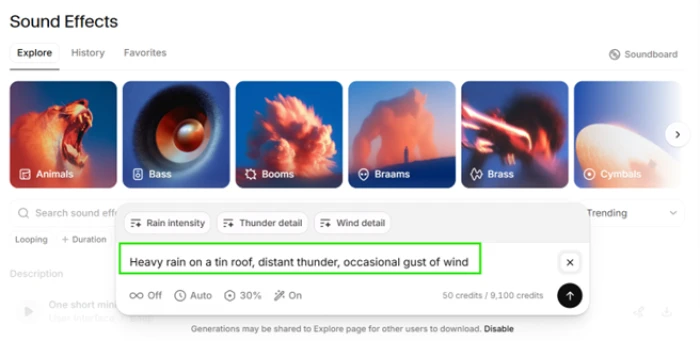
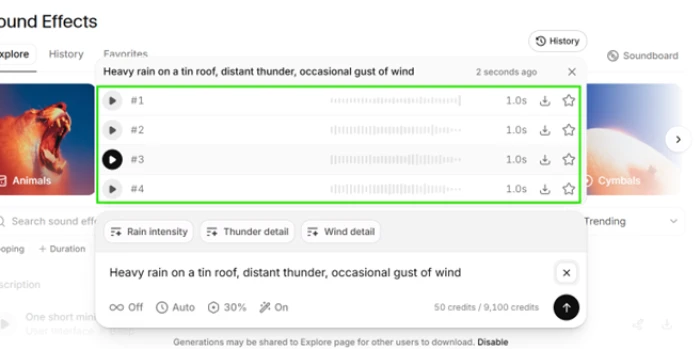
Sound effects return four takes at once
Test 06 . Sound effects"Heavy rain on a tin roof with distant thunder and occasional wind gusts"
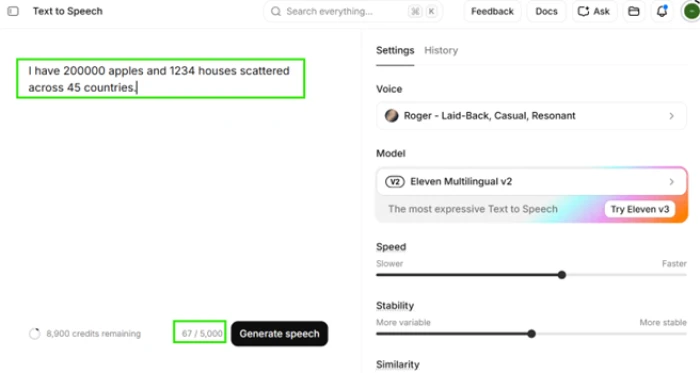
Long numbers read back correctly
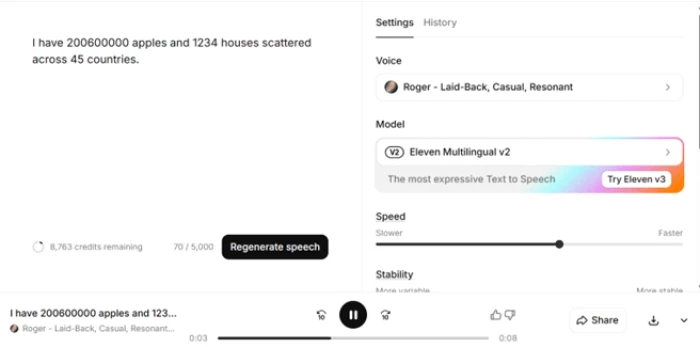
Test 07 . Pronunciation"I have 200000 apples and 1234 houses scattered across 45 countries"
A guardrail catches the wrong model before it charges you
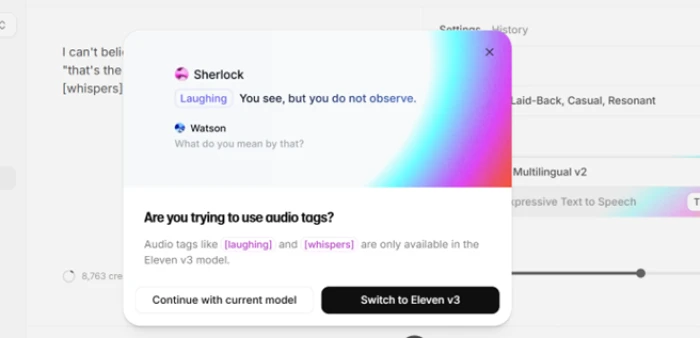
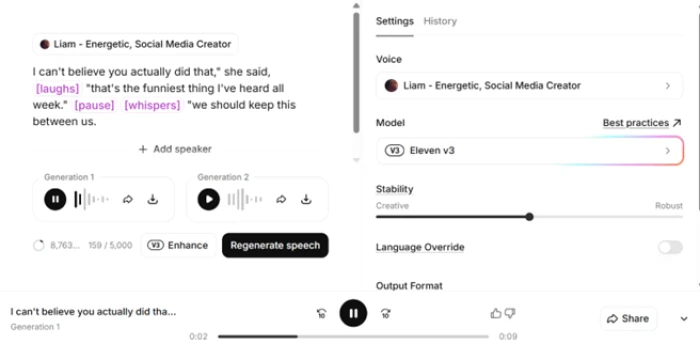
Test 08 . Audio tagsScript containing [laughs] and [whispers] tags, run first on Multilingual v2
Currency and decimals in one line
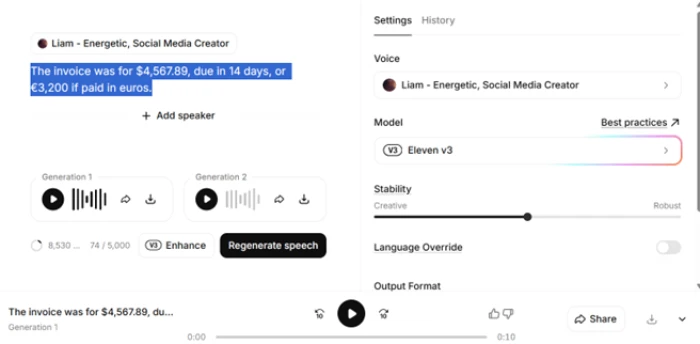
Test 09 . Mixed formats"The invoice was for $4,567.89, due in 14 days, or €3,200 if paid in euros."
The usage dashboard closes the loop
Test 10 . Cost reporting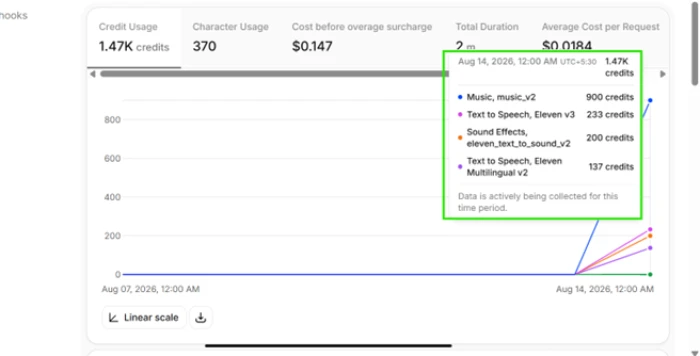
Three consecutive number tests returned correct audio on the first take, the hardest of them a single line combining a dollar decimal with a euro amount. The model mismatch popup then caught tagged text headed for the wrong engine before any credits moved. For anyone producing invoice reads, financial scripts or IVR prompts, that combination removes the two most expensive failure modes: a wrong number nobody catches, and a paid generation that was never going to work.
All four rain clips ran exactly one second. The prompt asked for sustained rain with rolling thunder and described weather over time, and what came back were short bursts with no loopable bed anywhere in the set. For a single door slam or impact cue that is fine. For background ambience under a two-minute video it means either stitching one-second fragments together in an editor or going elsewhere, and there was no visible control to ask for anything longer.
10-Point Feature Review
Pros and Cons
- Numbers survive the read: long integers, decimals and foreign currency come back correct without a retry
- Mistakes get caught early: a warning fires when tagged text is pointed at a model that cannot render it
- Cost preview before you commit: the prompt screen shows what a run will consume rather than reporting it afterwards
- Stems on music exports: generated tracks come back as separated layers, not just a flattened file
- Consumption is itemised: the dashboard attributes spend to individual products and models
- Emotional direction actually lands: bracket cues for laughter and whispering render audibly on the newest model
- Ambience prompts return fragments: sustained weather described in detail came back as one-second bursts
- Voice browsing does not scale down: a single category filter still leaves hundreds of candidates to audition
- Expressive tags are model-locked: bracket cues only work on one engine, so scripts are not portable between models
- Unexplained enhancement: the Enhance control sits beside regenerate with no indication of what it alters
Pricing Breakdown
| Feature | Free$0/mo | Starter$6/mo | Creator$22/moMost Popular | Pro$99/mo | Scale$299/mo |
|---|---|---|---|---|---|
| Monthly credits | 10,000 | 30,000 | 121,000 | 600,000 | 1,800,000 |
| Commercial license | ✗ | ✓ | ✓ | ✓ | ✓ |
| Instant Voice Cloning | ✗ | ✓ | ✓ | ✓ | ✓ |
| Professional Voice Cloning | ✗ | ✗ | ✓ | ✓ | ✓ |
| Studio projects | 3 | 20 | 1,000 | 3,000 | 9,000 |
| Workspace seats | 1 | 1 | 1 | 1 | 3 |
| Extra minutes | ~$0.36 | ~$0.20 | ~$0.18 | ~$0.17 | ~$0.17 |
The tier math: Creator advertises at half price for the first month, so the real decision lands on the second invoice when it doubles. Starter is the cheapest route to a commercial license, and what separates it from Creator is volume plus professional cloning rather than any restriction on what you may publish. Annual billing across every paid tier works out to two months free, which drops the effective Starter rate to $5. The part a table cannot show is that one balance covers every product, so a minute of generated music competes directly with your speech budget instead of drawing on a separate quota. Overage rates fall as you climb, which makes the free plan the most expensive place to exceed your allowance. We also checked the in-app subscription screen against the public pricing page on the same day, and the two agreed on every price and credit allowance.
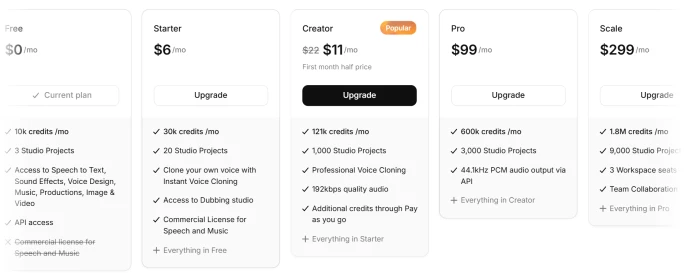
Pricing verified August 14, 2026. Tiers in this category shift without much warning, so confirm current terms on the official pricing page before you subscribe.
ElevenLabs vs the Top 3 Alternatives
| 11ElevenLabs | MMurf AI | LLOVO | SSpeechify Studio | |
|---|---|---|---|---|
| Entry paid plan | $6 per month | $19 per month billed annually | $24 per month billed annually | $100 per year |
| What the meter counts | Credits per character | Voice generation minutes | Voice generation hours | Credits per second |
| Step-up plan | $99 per month | $66 per month billed annually | $75 per month billed annually | $300 per year |
| Best For | Drawing speech and generative audio from one balance | Timeline editing for narrated training and explainer video | Bundling voiceover with video editing and subtitles | Occasional voiceover work budgeted yearly |
How to choose between them: The meter is the decision, not the sticker price. ElevenLabs charges by character, which rewards short scripts and punishes long-form narration where a single audiobook chapter can swallow a month. Murf and LOVO both charge by finished audio duration, so a wordy script costs the same as a sparse one and revisions hurt more than volume does. Speechify Studio bills annually, which suits people whose voiceover work arrives in bursts rather than weekly. If your output is mostly speech and mostly long, the per-character model is the one to model carefully before committing.
Discussion
Join the discussion and share your perspective.