Frosting AI is a Stable Diffusion-based web image generator with proper power-user controls: positive and negative prompt support (validated in Test 03 below with both prompts captured verbatim), batch generation up to 16x, ControlNet for layout and pose control, inpainting on higher tiers, reference image input, image upscaling, and experimental video generation. The platform routes generation requests across multiple Stable Diffusion checkpoints (SDXL, Pony, Juggernaut) and supports anime, photorealistic, and furry art styles. The free tier offers 100 daily generations; paid tiers scale from Planet at $7/month to Galaxy at $120 to $125/month. The test session below validates the image generation engine on a photorealistic business executive prompt, but the first-hand UX experience contradicted published reviews calling the interface "user-friendly", the interface presents a real learning curve for new users.
Frosting AI is a browser-based AI image generator powered by Stable Diffusion that converts text prompts into high-resolution images across anime, photorealistic, and furry styles. The platform's core differentiator versus simpler text-to-image alternatives is the depth of generation control: positive and negative prompts (validated in Test 03 below with the verbatim prompts captured), batch generation up to 16x, reference image input, ControlNet for layout and pose control, inpainting on higher tiers, image upscaling, and experimental video generation. The platform routes generation requests across a mix of Stable Diffusion base, SDXL, and community-tuned models (Pony, Juggernaut, and similar) picked by content type.
The audience profile from independent traffic analytics: 88 to 90% male, mostly 18 to 24, US-led, with over two-thirds of traffic arriving direct rather than via search, indicating a loyal returning user base rather than discovery-driven SEO. However, the platform's traffic trajectory is concerning: 411,000 monthly visits in December 2025 declined to 235,800 in March 2026, a 43% drop in three months that suggests competitive pressure or product friction issues. The hands-on test session below validates the image generation works and the advanced prompt controls function as designed, but surfaces a real interface usability concern that contradicts the "user-friendly" framing in some published reviews.
!
First-Hand UX Finding: Interface Confusion
Published 2026 third-party reviews frame Frosting AI's interface as "user-friendly" and "straightforward." The first-hand experience during the test session contradicts this framing. The interface is confusing and difficult to navigate, with controls and options presented in ways that are not immediately understandable for new users. This is editorial daylight specific to this review, the published consensus describes a friction-free experience that does not match the actual session. For prospective subscribers, plan to spend time learning the interface before committing to a paid tier. Power-user features like negative prompts, ControlNet, and batch generation are valuable but require navigation through an interface that earns its learning curve honestly.
What Happened When We Tested It
02 . Four tests across UX, discovery, and generation
The test session ran on a Frosting AI account in June 2026 and exercised the dashboard pre and post login, the Multiverse community discovery surface, the image generation workflow with the most stringent power-user prompts (combining a detailed positive prompt with a 200+ word negative prompt for maximum quality control), and evaluated the generated output inline. The session also yielded a first-hand UX finding that contradicts published reviewer consensus, surfaced above in Section 01.
Dashboard (Pre and Post Login)
Test 01 . Entry experience
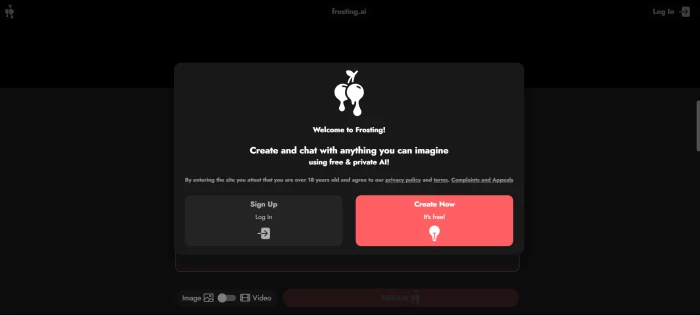
The Frosting AI pre-login dashboard.The post-login dashboard with authenticated tool surfaces.
What this shows: The pre-login marketing surface emphasises the Stable Diffusion underpinnings and tier pricing visibility. The post-login authenticated dashboard exposes the tool set: image generation, Multiverse community discovery, account credits, and configuration. The visual design is clean but the navigation labelling and control placement create the friction noted in the editorial finding above. The credit balance is immediately visible (useful for free tier users tracking their 100 daily generations), but several controls and feature paths require exploration before becoming legible to a new user.
Multiverse Community Discovery
Test 02 . Community surface
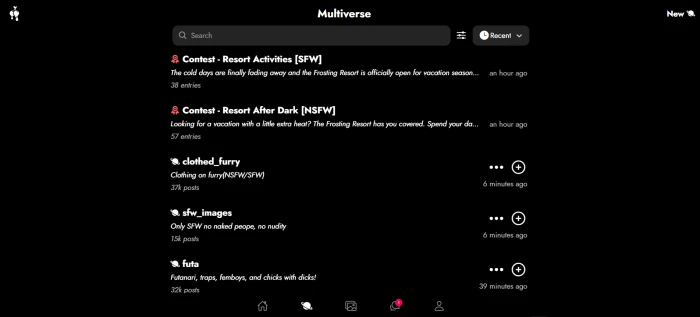
The Multiverse dashboard, community surface for browsing user-generated images.
What this shows: The Multiverse surface functions as community discovery, browsing images generated by other users, examining the prompts used, and saving inspiration for personal generation. While the platform's community features, such as sharing and contest participation, are functional, they remain relatively standard and lack advanced engagement options. The discovery layer is useful for prompt reference and style ideas but does not match the social depth of platforms with stronger community engagement (Civitai for Stable Diffusion power users, for example). Privacy controls work reliably, generated content is private by default and only surfaces to Multiverse when the user explicitly shares.
Image Generation with Positive and Negative Prompts
Test 03 . Power-user prompt control
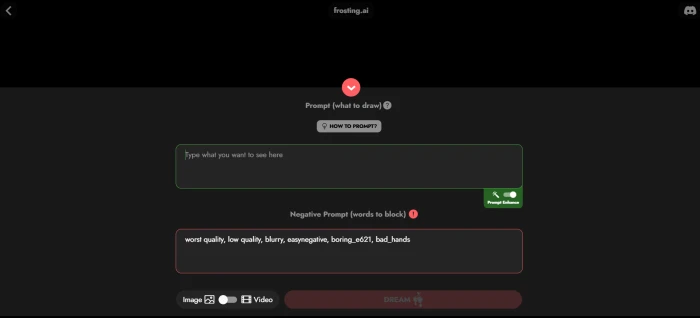
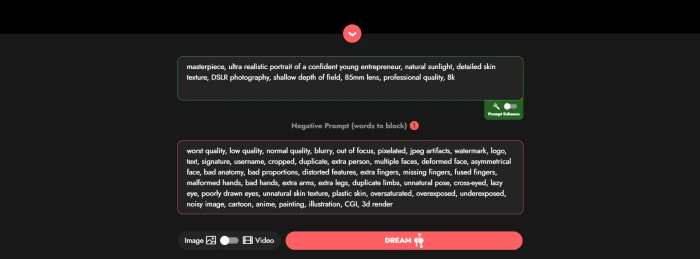
The image generation interface, model selection and aspect ratio controls visible.The prompt input fields with positive prompt entered and the extensive negative prompt below.
Positive Prompt · Business Executive Portrait
masterpiece, ultra realistic portrait of a successful business executive standing in a modern glass office, city skyline in the background, natural window lighting, sharp focus, professional photography, detailed skin texture, 85mm lens, photorealistic, 8k
Negative Prompt · Quality Exclusions
worst quality, low quality, normal quality, blurry, out of focus, pixelated, jpeg artifacts, watermark, logo, text, signature, username, cropped, duplicate, extra person, multiple faces, deformed face, asymmetrical face, bad anatomy, bad proportions, distorted features, extra fingers, missing fingers, fused fingers, malformed hands, bad hands, extra arms, extra legs, duplicate limbs, unnatural pose, cross-eyed, lazy eye, poorly drawn eyes, unnatural skin texture, plastic skin, oversaturated, overexposed, underexposed, noisy image, cartoon, anime, painting, illustration, CGI, 3d render
What this confirms: The dual prompt control system (positive + negative) is a power-user feature that puts Frosting AI ahead of consumer-grade alternatives that only accept positive prompts. The 200+ word negative prompt used in this test attempts to exclude every common Stable Diffusion artifact (bad anatomy, deformed faces, extra fingers, watermarks, painting style when photorealism is requested). This is the structural reason Stable Diffusion power users prefer platforms that expose negative prompts, the control over what should NOT appear is as important as what should. The interface for entering both prompts is visible and functional, though the navigation to reach this surface contributes to the UX friction documented above.
Generated Image Result
Test 04 . Output evaluation
Frosting AI produced this output from the dual prompt configuration above:
Generated by Frosting AI · Stable Diffusion checkpoint · June 2026
What this confirms: The output captures the requested business executive portrait, the modern glass office backdrop, the natural window lighting direction, and the overall photorealistic style direction. The composition is solid and the lighting matches the prompt brief. Quality lands in the "good but not great" band that multiple reviewers describe for end-user output, the result is usable for stock-style imagery, marketing concept work, or social media visuals, but does not match what dedicated Pro Midjourney or fine-tuned local Stable Diffusion setups produce. The extensive negative prompt successfully excluded most common artifacts; faces and hands carry the typical Stable Diffusion limitations even with strong negative prompting. For users producing photorealistic business or product imagery at scale, the platform delivers acceptable quality at $7 to $25/month versus dedicated premium alternatives.
How this review was put together. First-hand testing on a Frosting AI account covered the pre and post-login dashboards, the Multiverse community discovery surface, the image generation interface with verbatim positive and negative prompts captured in Test 03 above (both prompts displayed inline), and the resulting generated image displayed inline in Test 04 above. The interface usability finding flagged in the Section 01 callout is a first-hand UX observation that contradicts the "user-friendly" framing in some published reviews, this is editorial daylight specific to this review. Pricing tiers, traffic data, audience demographics, model checkpoint composition, and competitive positioning cross-reference multiple third-party sources including AI tools review platforms, independent traffic analytics (Similarweb-based), software pricing breakdowns, and community discussion across r/StableDiffusion and AI art subreddits.
10-Point Feature Review
03 . What the Stable Diffusion platform actually delivers
Feature Scores at a Glance
Stable Diffusion Output
7.5
Positive + Negative Prompts
7.5
Advanced Features (ControlNet)
7.5
Pricing Range ($7 to $125)
7.5
Free Tier (100 daily credits)
7.5
Generation Speed (10 to 30s)
7.5
Privacy Controls
7.5
Output Quality Consistency
6.0
Interface Usability
5.5
Platform Growth Trajectory
5.0
Feature-by-feature breakdownScored on a 10-point scale
01
Stable Diffusion image generation VALIDATED
The image generation engine produced an acceptable photorealistic business executive portrait from the verbatim prompt configuration tested in Test 04 above. Multiple Stable Diffusion checkpoints power the platform: a mix of Stable Diffusion base, SDXL, and community-tuned models (Pony, Juggernaut, and similar) picked by content type. Output quality lands in the "good but not great" band: solid for marketing concept imagery, stock-style portraits, and social content, but trailing dedicated premium alternatives for fine artistic work.
MODELS: SDXL, Pony, Juggernaut mixQUALITY: Good but not great
7.5
GOOD
02
Positive and negative prompt support POWER-USER FEATURE
Full positive and negative prompt control (validated in Test 03 above with both prompts captured verbatim). The 200+ word negative prompt tested attempts to exclude every common Stable Diffusion artifact (bad anatomy, deformed faces, watermarks, painting style when photorealism is requested). This is the structural feature that puts Frosting AI ahead of consumer-grade alternatives that only accept positive prompts, the control over what should NOT appear in the output is as important as what should for serious image generation.
POSITIVE: StandardNEGATIVE: Full support
7.5
GOOD
03
Advanced features stack CONTROLNET + BATCH
The platform supports a fairly deep stack of advanced features: batch generation, reference image input, ControlNet, inpainting, and experimental video generation. None of that is buried behind an enterprise pricing tier. Batch generation up to 16x is useful for A/B testing marketing visuals. Reference image input guides the AI toward a specific visual direction. ControlNet provides layout, pose, and composition control. Inpainting (Galaxy tier) modifies specific image regions without regenerating the whole image.
BATCH: Up to 16xCONTROL: ControlNet + reference
7.5
GOOD
04
Pricing range and tier structure $7 TO $125
Five tiers from Free (100 daily credits) to Galaxy ($120 to $125/month with maximum features and fastest processing). Planet at $7/month provides 500 daily credits, Star at $25/month delivers 1,500 daily credits plus style customisation, Nebula sits between with a one-day trial available. The $7 Planet entry tier is among the most affordable in the Stable Diffusion web platform category. The wide pricing range serves casual creators through power users without forcing enterprise commitments.
RANGE: Free to $125/moENTRY: $7/mo Planet
7.5
GOOD
05
Free tier (100 daily credits) GENEROUS
100 daily image generations on the free tier. This is genuinely usable for casual creators producing personal images, evaluating the platform before committing, or generating small batches of concept imagery. Compared to alternatives that gate basic generation behind paid tiers (GetImg AI retired its free tier post-2.0 overhaul, for example), Frosting AI's daily allotment is competitive. Free tier does carry basic-quality settings restrictions but provides genuine generation utility.
DAILY: 100 generationsRESET: Per day
7.5
GOOD
06
Generation speed 10 TO 30 SECONDS
Image generation typically completes within 10 to 30 seconds based on multiple third-party benchmarks. This is efficient for Stable Diffusion-based generation, faster than self-hosted setups on consumer hardware and competitive with other cloud Stable Diffusion platforms. Higher paid tiers (Nebula, Galaxy) offer priority processing for faster generation during peak times.
SPEED: 10 to 30s typicalPRIORITY: Paid tiers
7.5
GOOD
07
Privacy and content controls PRIVATE BY DEFAULT
Privacy controls work reliably, ensuring user-generated content is private by default and providing peace of mind for users. Generated content does not surface to the Multiverse community discovery unless the user explicitly chooses to share. The platform uses secure cloud servers with encryption and auto-deletes images after a period. For users concerned about generated content visibility, the default-private posture is the right design choice.
DEFAULT: Private contentAUTO-DELETE: Yes
7.5
GOOD
08
Output quality consistency FACES, HANDS, TEXT
For end users, image quality sits in the "good but not great" band. Where Frosting AI falls short is on complex scenes and fine details. Faces and hands still show typical AI distortion artifacts, and generating readable text within images is unreliable. These are universal Stable Diffusion limitations that the platform inherits rather than solves. Negative prompts help but do not eliminate. For users requiring consistent fine detail across faces and hands, dedicated higher-end platforms (Midjourney, fine-tuned local SD with LoRAs) outperform.
FACES/HANDS: Typical SD artifactsTEXT: Unreliable
6.0
FAIR
09
Interface usability FIRST-HAND FRICTION
First-hand UX observation from the test session contradicts published "user-friendly" framings: the interface is confusing for new users, with controls and navigation paths that are not immediately understandable. Several published reviews describe the interface as "straightforward," but the actual session experience demonstrated meaningful learning-curve friction. For prospective subscribers, plan extra time to navigate the interface before relying on it for production work. Power-user features (negative prompts, ControlNet, batch generation) are valuable but reaching them requires interface exploration.
NEW USER: ConfusingPOWER USER: Manageable after curve
5.5
WEAK
10
Platform growth trajectory 43% DECLINE
Independent traffic analytics show Frosting AI pulled 411,000 monthly visits in December 2025 and 235,800 in March 2026, a 43% decline in three months. The audience that remains is loyal (88 to 90% male, mostly 18 to 24 US-led, two-thirds direct traffic), but the contracting base suggests competitive pressure or product friction issues. For prospective subscribers planning long-term commitment, the trajectory is a real signal alongside the interface friction documented above. The 43% drop is among the steepest in the AI image tools category reviewed by FirmCritics.
DEC 2025: 411K monthly visitsMAR 2026: 235.8K (down 43%)
5.0
WEAK
Pros and Cons
04 . What works and what to weigh
+What users like
Batch up to 16x lets you spin many variants at once and keep the best, offsetting SD's shot-to-shot inconsistency
ControlNet plus reference input give repeatable pose and composition for building a consistent image series
A tuned negative-prompt block can be reused across every generation for consistent artifact cleanup
Furry style support serves a niche most mainstream generators refuse, keeping that audience off local setups
−What users dislike
Silent auto-routing across checkpoints means the same prompt can drift in look from one session to the next
Auto-deletion means you must download generations promptly or lose them, with no lasting library on the platform
A shrinking user base raises the risk the small team deprioritizes the already-rough interface or trims features
The steep interface falls hardest on the casual users the free 100-a-day tier attracts, an audience-UX mismatch
Pricing Breakdown
05 . Free, Planet, Star, Nebula, Galaxy
Tier
Free
Planet
Star
Nebula
Galaxy
Monthly Price
$0
$7/mo
$25/mo
Mid-tier
$120 to $125/mo
Daily Credits
100
500
1,500
Higher
Maximum
Generation Speed
Standard
Standard
Faster
Priority
Fastest
Batch Generation (up to 16x)
No
✓
✓
✓
✓
Negative Prompts
✓
✓
✓
✓
✓
ControlNet
No
Limited
✓
✓
✓
Reference Image Input
No
✓
✓
✓
✓
Image Upscaling
No
Limited
✓
✓
✓
Inpainting
No
No
No
Some
✓
Video Generation Beta
No
No
No
✓
✓
Style Customisation
No
Standard
✓
✓
✓
Free Trial
n/a
n/a
n/a
1-day trial
n/a
Best For
Casual testing
Regular casual use
Active creators
Power users
Heavy commercial
The tier decision logic: The Free tier at 100 daily credits is genuinely usable for casual generation but lacks advanced features (no batch, no ControlNet). Planet at $7/month is the entry point for users who hit the free daily limit and need batch + reference image input; this is the most cost-effective tier for casual creators. Star at $25/month is the sweet spot for active creators producing more than 500 images monthly with style customisation and ControlNet needs. Nebula's one-day trial is the right way to evaluate premium features before annual commitment. Galaxy at $120 to $125/month is overkill for most users, the inpainting and priority speed justify the cost only for heavy commercial production.
Our take: Most Frosting AI buyers should land on Planet or Star. The free tier is enough for evaluation despite the interface learning curve documented above, validate the workflow on free credits before paying. Star at $25/month is competitive against Midjourney Standard ($30/month) on price and matches or exceeds Midjourney on advanced control features (negative prompts, ControlNet, batch). Galaxy at $125 is hard to justify versus running fine-tuned Stable Diffusion locally for committed power users. For casual creators who want low-friction web Stable Diffusion, Planet is the right starting point.
Frosting AI vs the Top 4 Alternatives
06 . How it compares for AI image generation
FFrosting AI
MMidjourney
LLeonardo AI
GGetImg AI
SStable Diffusion
Score
6.8
8.4
7.8
7.3
7.5
Starting Price
$7/mo Planet
$10/mo Basic
Free / $12/mo
$8/mo annual
Free (self-host)
Free Tier
100 daily
✗
✓ 150 tokens/day
✗ Retired
Self-host
Negative Prompts
Full
--no param
✓
✓
Full
ControlNet
✓ Star+
✗
✓
✓
Full
Batch Generation
Up to 16x
4 per gen
✓
✓
✓
Output Quality
"Good but not great"
Artistic leader
✓ Strong
✓ Multi-model
✓ Tuneable
Interface Usability
Friction (Test)
✓ Easy
✓ Friendly
✓ Organised
Technical
Platform Momentum
Down 43%
Category leader
✓ Growing
Post-2.0 friction
✓ Stable
Best For
SD power users
Artistic excellence
Multi-purpose
Multi-model breadth
Full control
The picture: Frosting AI wins on free tier generosity (100 daily credits versus most competitors gating generation), batch size (16x maximum versus Midjourney's 4 per generation), and the combination of full negative prompts plus ControlNet without enterprise pricing. It loses on interface usability (first-hand friction documented), output quality consistency (Midjourney leads, Leonardo competes), and platform momentum (43% decline versus competitors stable or growing). For Stable Diffusion power users who specifically need negative prompts and ControlNet at $7 to $25/month, Frosting AI delivers; for users prioritising artistic excellence or interface ease, Midjourney or Leonardo are better picks.
What Users Are Saying
07 . User feedback patterns from across the community
Switched to Frosting AI specifically for the negative prompt support and ControlNet without paying for a Pro Midjourney sub. The fact that batch generation up to 16x, ControlNet, reference image input, and inpainting are accessible at the $7 to $25 tiers is genuinely competitive in the SD web platform category. Beats setting up local ComfyUI on a weak GPU and still cheaper than enterprise alternatives.
SD power user
r/StableDiffusion community discussion
★★★★☆
r/StableDiffusion
Image quality is solid for marketing concept work and stock-style portraits, but it's frustrating that the platform doesn't tell you which checkpoint actually ran your generation. SDXL vs Pony vs Juggernaut produce different results, and prompt engineers want reproducibility. Also noticed the platform has been losing traffic through 2025 into 2026 which makes me cautious about long-term commitment.
AI art enthusiast
r/aiArt community discussion
★★★☆☆
r/aiArt
Been using Frosting AI for about six months. The advanced features are real and the price point is fair, but I'll push back on the "user-friendly interface" framing other reviews use. It took me longer than expected to find the negative prompt field and configure batch settings. Privacy defaults are good, content stays private until you explicitly share to Multiverse. Generation speed is consistent.
Trustpilot reviewer
April 2026
★★★★☆
Trustpilot
Frosting AI is decent for casual creators and marketers who want to skip Midjourney's pricing and ComfyUI's complexity. But image quality varies significantly by prompt, faces and hands show typical AI artifacts, and text rendering in images is basically unreliable. Even with my long negative prompt setups, I still get distorted features. Acceptable for concept work, not for client-facing finished imagery.
Concept artist
r/StableDiffusion community discussion
★★★☆☆
r/StableDiffusion
The pattern: User feedback consistently praises the advanced feature stack (batch generation, ControlNet, negative prompts, reference images) and the affordable pricing range starting at $7/month. The recurring criticisms cluster around output quality limitations (faces, hands, text rendering), the platform's silence on which Stable Diffusion checkpoint runs each generation, and basic community features versus competitors with stronger social engagement. Notably, several published reviews describe the interface as "user-friendly," a framing that the first-hand UX finding in this review contradicts, suggesting either reviewer-specific experience variance or that the interface has changed since some reviews were published. Combined with the 43% traffic decline documented above, the picture is "capable platform losing momentum amid competitive pressure."
· The Verdict ·
6.8/10
Should you use Frosting AI? Here is who it is for.
Use Frosting AI if Stable Diffusion power-user features (full negative prompt support, ControlNet, batch generation up to 16x, reference image input) matter at the $7 to $25/month price range, the 100 daily free credits cover evaluation needs before paying, and the workflow tolerates the interface learning curve documented above. For Stable Diffusion users who want to avoid local installation, ComfyUI complexity, or API setup, Frosting AI delivers the capabilities under a web interface at affordable pricing. The Planet tier at $7/month is the entry point for casual production; Star at $25/month is the sweet spot for active creators with more demanding workflows.
Skip Frosting AI if the use case requires intuitive interface navigation for new users (the first-hand UX finding above documented meaningful friction), output quality on faces, hands, or text rendering is critical (Midjourney delivers better artistic consistency), platform momentum matters to long-term commitment (43% traffic decline from December 2025 to March 2026 is a real signal), or transparency about which model is running each generation is important (Frosting routes silently across SDXL, Pony, Juggernaut). Also skip if a native mobile app is required, the platform is web-only.





Discussion
Join the discussion and share your perspective.