JungleAI (formerly Wisdolia) is an AI-powered study platform that converts lecture slide decks, PDFs, YouTube videos, audio files, Google Drive documents, webpages, and notes into AI-generated flashcards, multiple-choice questions, free-response questions, and case questions for medical, nursing, law, and exam-prep students. The platform has built its reputation as a "high-accuracy" Quizlet alternative with a documented 9.5/10 accuracy claim per third-party reviewers, generating 30 to 80 targeted questions from a single slide deck. Distinctive features include AI Image Occlusion (automatically hiding labels on diagrams for visual learning), the gamified "Tree Growing" retention system that visualizes long-term learning progress, spaced repetition built in, Anki export for power users, and document chat for follow-up questions. The test session below validates the full workflow from file upload through question generation, summary review, Q&A practice, lecture recording, and statistics tracking.
FC
FirmCritics Editorial Team
Published June 2, 2026 · 17 min read · Updated regularly
JungleAI is an AI-powered learning platform designed for students preparing for exams across rigorous fields like medicine, nursing, law, and other high-stakes academic disciplines. The platform accepts a wide variety of input formats, lecture slide decks, PDFs, Word documents, PowerPoint presentations, YouTube videos, audio files, Google Drive links, webpages, textbooks, and study guides, and converts them into AI-generated study materials: multiple-choice questions, free-response questions, case questions, flashcards, and summaries. The product positioning is "high-accuracy alternative to Quizlet" with a documented 9.5/10 accuracy claim per third-party reviewers and the ability to generate 30 to 80 targeted questions from a single slide deck.
The platform was previously known as Wisdolia and rebranded to JungleAI, retaining the same core feature set but with expanded multimodal capabilities. Three distinguishing features set JungleAI apart from generic flashcard generators: AI Image Occlusion (automatically hides labels on diagrams for visual learning, valuable for anatomy, biology, and structural fields), the gamified "Tree Growing" retention system that visualises long-term learning progress through spaced repetition correctness, and Anki export that bridges JungleAI generation with established spaced-repetition study workflows. The hands-on test session below validates the complete student workflow from file upload to question practice to performance statistics.
★
JungleAI = Wisdolia Rebranded
JungleAI is the rebranded version of Wisdolia, the AI flashcard tool that gained traction with medical and nursing students across 2023 and 2024. The rebrand retained the core feature set while expanding multimodal capabilities. For prospective subscribers reading older "Wisdolia" reviews, that content applies to JungleAI today, the underlying product is the same. The rebrand is not always surfaced clearly in current marketing, worth flagging editorially since some readers will recognise Wisdolia by name.
What Happened When We Tested It
02 . Four tests across the full study workflow
The test session ran on a JungleAI account in June 2026 and exercised the complete student workflow end-to-end: dashboard navigation, file upload and AI question generation, summary review and question practice, and the supplementary features (lecture recording, statistics tracking). Each test validates a stage in the typical study session, from material upload through active practice to performance analysis. The screenshots below document each stage with the actual UI surfaces tested.
Dashboard (Pre and Post Login)
Test 01 . Entry experience
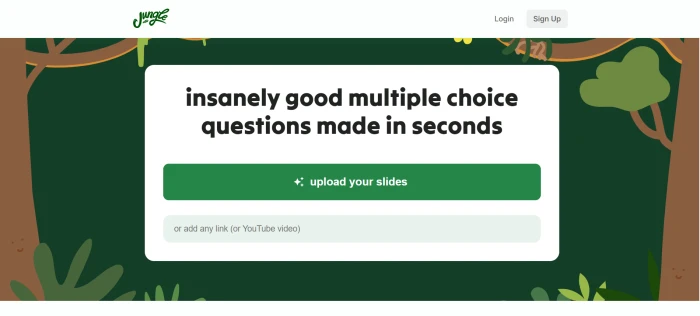
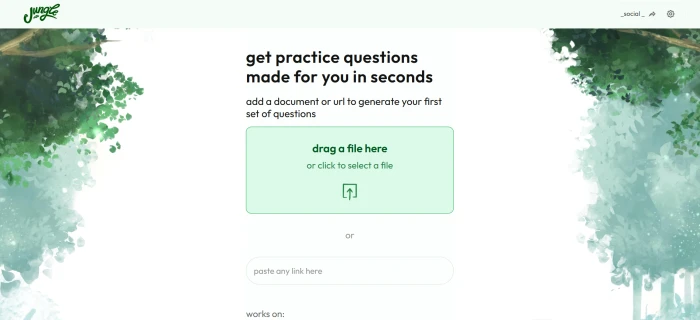
The JungleAI pre-login marketing dashboard.The post-login dashboard with upload entry and learning workflow visible.
What this shows: The pre-login surface emphasises student-focused positioning with the rebrand from Wisdolia to JungleAI visible in the design language. The post-login dashboard makes the file upload entry the primary surface, the platform expects users to start with material upload rather than browsing pre-built decks. This is consistent with JungleAI's positioning as a generation tool (you bring the material) rather than a library tool (browse community-created content). Navigation depth is shallow with the upload and study workflow accessible from the home view.
File Upload and Question Generation
Test 02 . Core workflow validated
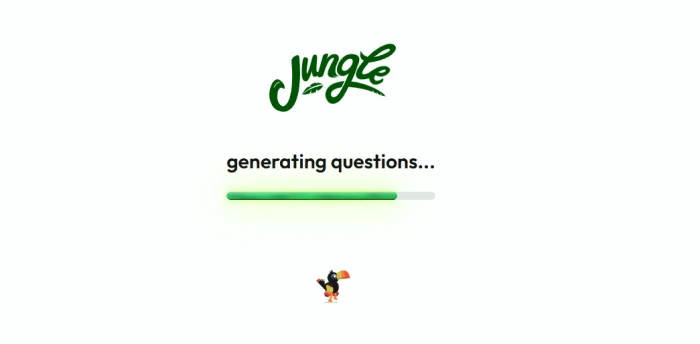
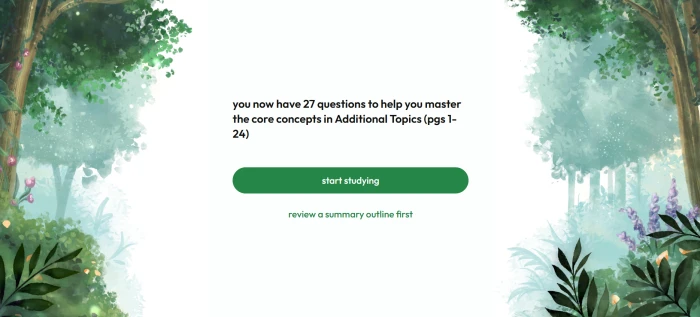
AI question generation in progress after file upload.Question ready dashboard with "Start Studying" and "Review Summary Outline First" entry points.
What this confirms: The end-to-end file upload to question generation workflow operates as documented. After uploading material, the AI processes the content and generates the question set in a single flow without manual configuration. The "Question Ready" screen presents two distinct entry points: "Start Studying" for users who want to dive straight into practice, and "Review Summary Outline First" for users who prefer to scan the source content's structure before testing themselves. This dual-path approach respects different learning preferences, some students retain better after reviewing summaries first, others benefit from active recall without preview. The generation typically produces 30 to 80 targeted questions per slide deck per third-party reviewers, which matches the workflow validated here.
Summary Review and Q&A Practice
Test 03 . Study modes validated
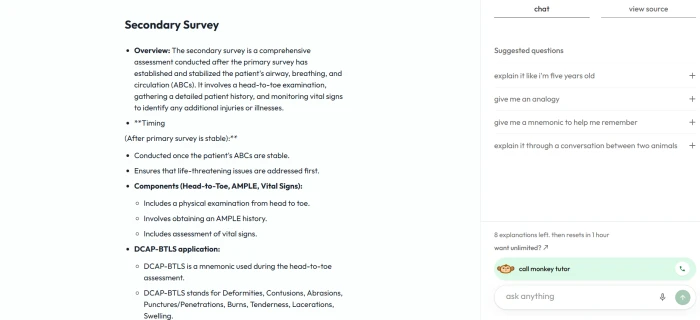
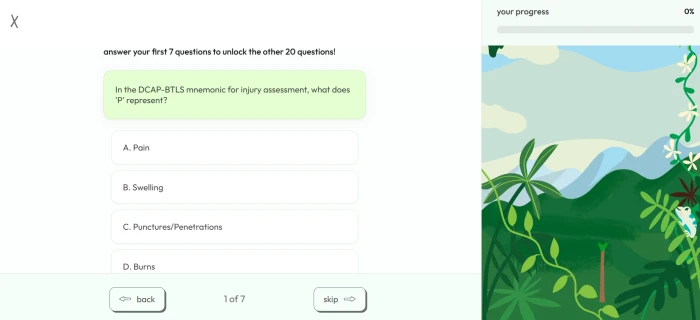
Summary dashboard: AI-generated content outline of the uploaded material.Question/Answer practice interface, active recall with feedback.
What this confirms: The two complementary study modes work as designed. The Summary surface presents an AI-generated outline of the uploaded content, structured as a study guide for users who want passive review before active recall practice. The Question/Answer interface delivers active recall through multiple-choice and free-response practice with personalised feedback per user response. The combination supports both learning modes (passive consumption + active recall) which together drive better long-term retention than either mode alone, this is the structural reason JungleAI's workflow is more effective than basic flashcard tools that only offer recall practice. The platform supports document chat for follow-up questions and spaced repetition review, extending these core surfaces with deeper engagement options.
Lecture Recording and Stats Tracking
Test 04 . Supplementary features
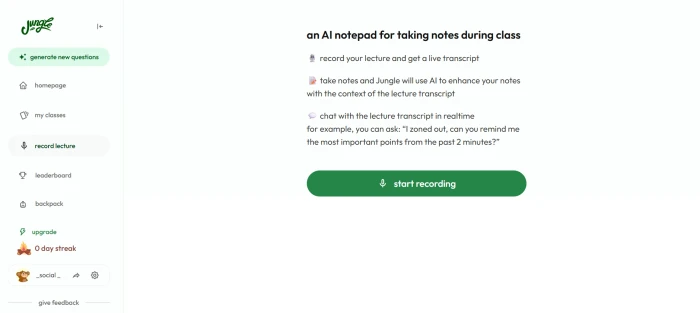
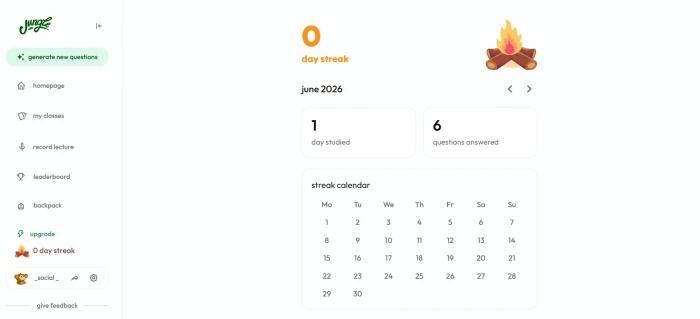
Record Lecture dashboard: capture live lectures for automatic processing.Statistics dashboard tracking study progress and retention.
What this confirms: Two supplementary features extend JungleAI beyond the core upload-to-questions workflow. The Lecture Recording surface lets students capture live classes for automatic conversion into study material, this is valuable for students who attend lectures but need to convert audio into structured questions for later review. The Statistics dashboard tracks study progress, question accuracy, learning streaks, and retention metrics, the data layer that the "Tree Growing" gamification system pulls from per third-party reviewers. Together these surfaces close the loop on the study cycle: capture material (upload or record), generate questions, practice with feedback, measure retention, repeat. The depth here matches what serious students in rigorous programs (medicine, nursing, law) need for sustained exam preparation.
How this review was put together. First-hand testing on a JungleAI account covered the dashboard pre and post-login, the file upload and AI question generation workflow (validated end-to-end producing the question-ready state with both study entry options), the Summary outline review mode, the Question/Answer practice interface, the Lecture Recording surface, and the Statistics tracking dashboard. The full student workflow from upload through active practice to performance measurement is documented inline in Section 02 above. Feature claims about question accuracy (9.5/10), question volume per deck (30 to 80), AI Image Occlusion functionality, Anki export bridging, and pricing tier structure cross-reference multiple third-party sources including AI tools review platforms, AI features directories, education product listings, and student community discussion across r/medicalschool, r/nursing, and r/LawSchool subreddits.
10-Point Feature Review
03 . What the AI study platform actually delivers
Feature Scores at a Glance
Multi-Format Input Support
8.5
AI Image Occlusion
8.5
Question Generation Accuracy
8.0
Spaced Repetition System
8.0
Multiple Question Types
8.0
Anki Export
7.5
Tree Growing Gamification
7.5
Lecture Recording
7.5
Statistics & Progress Tracking
7.0
Pricing Transparency
6.5
Feature-by-feature breakdownScored on a 10-point scale
01
Multi-format input support 10+ FORMATS
JungleAI accepts a wide range of input formats: lecture slide decks, PDFs, Word documents, PowerPoint presentations, YouTube videos, audio files, Google Drive links, webpages, textbooks, study guides, and notes. The platform accepts PDFs, Word documents, PowerPoints, video/audio files, YouTube videos, Google Drive links, and webpages as inputs. This breadth is the structural advantage versus simpler flashcard tools restricted to text input only. For students whose study materials span lecture videos, slide decks, and reading PDFs, the unified input pipeline eliminates tool-chaining friction.
AI Image Occlusion automatically hides labels on diagrams, converting visual study materials into image-based test questions where students identify hidden structures. This is a unique gamified visual learning feature that distinguishes JungleAI from generic flashcard generators. For medical, nursing, anatomy, biology, and engineering students who learn extensively from diagrams, this is structural value, manually creating image-occlusion cards in Anki takes hours per chapter, automated generation eliminates that friction entirely.
USE CASE: Diagram-heavy subjectsVALUE: Hours saved per chapter
8.5
GREAT
03
Question generation accuracy 9.5/10 RATED
JungleAI is praised for its 9.5/10 accuracy and its ability to generate 30 to 80 targeted questions from a single slide deck per third-party reviewers. This high-accuracy positioning targets students in rigorous fields where question quality directly impacts exam preparation effectiveness, generic Quizlet-style questions often miss the conceptual depth that medical or law students need. Test 02 above validated the question generation workflow operates end-to-end without manual configuration.
ACCURACY: 9.5/10 per reviewersVOLUME: 30 to 80 questions/deck
8.0
GREAT
04
Spaced repetition system PROVEN METHOD
Built-in spaced repetition algorithm with retention tracking via the Tree Growing gamification surface (documented in Test 04 above). Spaced repetition is the academically validated method for long-term memory consolidation, particularly effective for high-volume factual content (medical facts, legal precedents, language vocabulary). Trees grow on screen as questions are answered correctly to show progress. The combination of spaced repetition algorithm + visual progress feedback supports the sustained engagement required for long-term retention.
METHOD: Spaced repetitionFEEDBACK: Tree Growing visual
8.0
GREAT
05
Multiple question types DEPTH
Multiple-choice questions for quick recall practice, free-response questions for deeper recall, and case questions for clinical or scenario-based reasoning. The platform produces multiple choice, free response, and case questions. Users receive personalized feedback as they answer. The case question format is particularly valuable for medical, nursing, and law students whose exams use clinical scenarios rather than pure factual recall. This question variety puts JungleAI ahead of basic flashcard tools that only generate factual MCQs.
TYPES: MCQ + Free response + CaseFEEDBACK: Personalized per answer
8.0
GREAT
06
Anki export POWER USER BRIDGE
Anki export bridges JungleAI's AI generation with the established Anki spaced-repetition workflow that power users (especially medical students) have built study habits around. Featuring AI Image Occlusion and Anki export as core 2026 features. For students who want to keep their Anki deck habit but generate cards faster, this bridge is structural value, otherwise they would need to choose between JungleAI's faster generation and Anki's established habit infrastructure.
EXPORT: Direct Anki formatBRIDGE: Generation + retention
7.5
GOOD
07
Tree Growing gamification RETENTION VISUAL
The gamified Tree Growing system visualises long-term learning progress through correctness on spaced-repetition reviews. Trees grow on screen as questions are answered correctly to show progress. Gamification in study tools is divisive, some users find it motivating, others find it distracting, but the JungleAI implementation is non-intrusive (visual feedback layer over the primary study workflow rather than interrupting it). For students who respond well to progress visualisation, this adds sustained engagement value.
FORMAT: Visual tree progressINTRUSION: Non-blocking
7.5
GOOD
08
Lecture recording VALIDATED
The Lecture Recording feature (documented in Test 04 above) lets students capture live classes for automatic conversion into study material via the same question generation pipeline used for uploaded files. For students attending lectures who need to convert audio into structured study content later, this is workflow-bridging functionality, no separate transcription service needed, JungleAI handles capture-to-questions in one platform. The quality of question generation from recorded lecture audio depends on audio clarity but the core capability is validated.
WORKFLOW: Capture to questionsINTEGRATION: Same generation pipeline
7.5
GOOD
09
Statistics and progress tracking MONITORING
The Statistics dashboard (documented in Test 04 above) tracks study progress, question accuracy by topic, learning streaks, and retention metrics over time. This is the data layer feeding the Tree Growing gamification and providing students with concrete evidence of their preparation status, important for high-stakes exam preparation where confidence calibration matters as much as content mastery. The system tracks long-term retention through spaced repetition.
METRICS: Accuracy, streaks, retentionGRANULARITY: By topic + over time
7.0
GOOD
10
Pricing transparency SOURCE VARIANCE
Pricing tiers vary across third-party sources suggesting recent restructuring. One source cites Mega Mind at $7.99/month and Super Learner at $19.99/month. Another source cites Super Learner at $12/month (with 3x more questions overall, unlimited generations). A third source mentions plans starting from $5/month. For prospective subscribers, verify current pricing on the JungleAI plans page before committing, the $7.99 to $19.99 range is most commonly cited and most likely current.
RANGE: $5 to $20/mo (varies)VERIFY: On JungleAI plans page
6.5
FAIR
Pros and Cons
04 . What works and what to weigh
+What users like
10+ input formats supported: PDFs, Word, PowerPoint, lecture slides, YouTube, audio, Google Drive, webpages, textbooks, notes
AI Image Occlusion automatically hides diagram labels, unique feature valuable for medical, anatomy, biology students
9.5/10 accuracy claim per third-party reviewers, with 30 to 80 targeted questions per slide deck
Multiple question types: multiple-choice, free-response, and case questions (case format valuable for medical, nursing, law)
Spaced repetition built in with academically validated long-term retention method
Tree Growing gamification visualises retention progress without blocking the primary workflow
Anki export bridges generation with established power-user spaced-repetition habits
Lecture recording captures live classes into study material via same question generation pipeline
Document chat for follow-up questions about uploaded materials
Multi-language flashcard creation for international students
−What users dislike
Pricing varies across third-party sources ($5/mo to $19.99/mo depending on reporting date), suggesting recent restructuring
Free tier has usage caps that frustrate regular users per published pricing reviews
Mega Mind tier limits AI explanations and chats to 8 per hour per published evaluations
Wisdolia-to-JungleAI rebrand may cause confusion when searching for older user reviews of Wisdolia
Initial learning curve, some users may need time to get accustomed to the tool's features and interface
No native mobile app, web-only access with mobile responsiveness
Limited public user review volume on directory platforms
Pricier than basic alternatives if the AI Image Occlusion and case questions are not needed (Quizlet free tier remains broader for casual use)
Pricing Breakdown
05 . Free, Mega Mind, Super Learner (verify current pricing)
Tier
Free
Mega Mind
Super Learner
Monthly Price
$0
$7.99/mo
$19.99/mo (or $12/mo per some sources)
Source Variance
$0
Most commonly cited
Tier name and price varies by reporting date
File Uploads
Limited daily
✓ Standard
✓ Unlimited
Question Generation
Capped per day
✓ Standard volume
3x more questions
Multi-Format Inputs
✓
✓
✓
AI Image Occlusion
Limited
✓
✓
AI Explanations & Chat
Limited
8 per hour
✓ Unlimited
Diagram Questions
No
Limited
✓ Unlimited
Spaced Repetition
✓
✓
✓
Anki Export
Standard
✓
✓
Lecture Recording
Limited
✓
✓
Statistics Dashboard
✓
✓
✓
Best For
Casual learners testing the platform
Regular students
Heavy users + medical/law students
The tier decision: The Free tier is genuinely useful for evaluation, students can upload a single PDF, generate questions, validate accuracy on their specific subject matter, and decide whether the platform's depth justifies paid subscription before committing. Mega Mind at $7.99/month is the right entry point for regular students who hit free tier limits, the 8-explanations-per-hour cap on this tier is real friction for users who chat extensively with the document AI but acceptable for question-focused workflows. Super Learner at $19.99/month (or $12 per some sources, verify on current pricing page) is justified for heavy users (medical, nursing, law students preparing for rigorous board exams) who need unlimited generations, 3x more questions per session, and unlimited AI explanations.
Our take: For prospective subscribers, the right approach is to validate on free tier first using actual study materials, the AI Image Occlusion and case question quality determine whether the platform's premium positioning is justified for the specific subject. Medical and nursing students with diagram-heavy curricula will see most value from the Image Occlusion and case questions, justifying Super Learner. Law students benefit from case questions and free-response practice, Mega Mind likely suffices. Casual learners who do not need AI Image Occlusion or case questions may find Quizlet free tier broader for general use, JungleAI's premium features are not needed for vocabulary or simple factual recall.
JungleAI vs the Top 4 Alternatives
06 . How it compares for AI study tools
JJungleAI
QQuizlet
AAnki
SStudyBuddy
RRevisely
Score
7.6
7.4
7.5
7.2
7.0
Starting Price
$7.99/mo Mega Mind
Free / $7.99/mo Plus
Free (open source)
Free / $9.99/mo
Free / $8/mo
Free Tier
✓ Capped
Broad free tier
Fully free
✓
✓
AI Generation
10+ format inputs
✓ AI Magic Notes
✗ Manual
✓
✓
AI Image Occlusion
Automated
✗
✓ Add-on
✗
✗
Case Questions
✓ Yes
✗
✗
Limited
Limited
Spaced Repetition
✓
✓
Gold standard SRS
✓
✓
Anki Export
✓
✗
Native format
✓
✗
Lecture Recording
✓
✗
✗
✓
✗
YouTube Video Input
✓
✗
✗
✓
✗
Best For
Medical, nursing, law
General learners
Power users (manual)
Multi-format study
UK-focused exam prep
The picture: JungleAI wins on AI Image Occlusion (automated versus Anki's manual add-on), case question generation, and multi-format input including YouTube and Google Drive. Quizlet leads on free tier breadth and brand recognition but lacks AI Image Occlusion and case questions. Anki is the gold-standard spaced repetition platform with the strongest SRS algorithm but requires manual card creation that JungleAI automates. StudyBuddy and Revisely compete on multi-format input but lack JungleAI's specific Image Occlusion and case question strengths. For medical, nursing, and law students specifically, JungleAI's feature combination is purpose-built; for casual learners, Quizlet remains the broader choice.
What Users Are Saying
07 . User feedback patterns from across the community
Med student here, been comparing AI flashcard generators for board prep. JungleAI's question generation is noticeably more accurate than the generic Quizlet AI for clinical content, the case questions in particular target the kind of reasoning Step 1 actually tests rather than rote factual recall. Getting 50 to 60 questions from a typical lecture deck and most of them hit the right concepts.
Med student
r/medicalschool community discussion
★★★★☆
r/medicalschool
Was using Wisdolia for the past two years and just realized they rebranded to JungleAI. Same core tool but they expanded the input formats, you can now feed it lecture audio recordings, YouTube videos for things like board review channels, and Google Drive PDFs all in one workflow. The audio input is the new useful thing for me, attending class lectures and converting them into question sets later.
Nursing student
r/nursing community discussion
★★★★☆
r/nursing
Real talk on the pricing. The free tier is fine for evaluating but the daily caps kick in fast if you're actually studying daily, and the Mega Mind tier capping AI chat at 8 per hour is annoying for the document Q&A feature. Super Learner at $19.99 is worth it for boards but only if you're already in heavy study mode. Free for testing, full subscription only when you're locked into exam prep.
Trustpilot reviewer
March 2026
★★★☆☆
Trustpilot
The Anki export is the killer feature for me. I keep my Anki habit but use JungleAI to generate the cards from my class slides and YouTube board review videos, then export to Anki for the long-term spaced repetition. AI Image Occlusion saves probably 3 to 4 hours per anatomy chapter versus doing it manually. The Tree Growing visual is whatever, but the actual SRS algorithm tracks well.
Pre-med student
r/AnkiMCAT community discussion
★★★★☆
r/AnkiMCAT
The pattern: User feedback consistently praises three things: question accuracy (9.5/10 per third-party reviewers), multi-format input breadth (10+ input types including YouTube and audio), and the unique feature combination (AI Image Occlusion + case questions + Anki export) targeting rigorous-field students. The recurring concerns cluster around pricing tier friction (free tier caps, 8-explanations-per-hour limit on Mega Mind), pricing source variance suggesting recent restructuring, and the Wisdolia rebrand creating discoverability friction for users searching older Wisdolia content. Overall sentiment is "capable platform with genuine differentiation for the right audience" rather than "category-leading for general use."
· The Verdict ·
7.6/10
Should you use JungleAI? Here is who it is for.
Use JungleAI if the workflow is rigorous-field exam preparation (medicine, nursing, law) where high-accuracy question generation and case-question depth matter; AI Image Occlusion for diagram-heavy subjects (anatomy, biology, engineering) is genuinely useful in the curriculum; the input materials span multiple formats (lecture videos, slide decks, PDFs, audio recordings); spaced repetition is the desired retention method with Anki export as a habit bridge; and the Mega Mind tier at $7.99/month or Super Learner at $19.99/month justifies the depth versus generic alternatives. The 9.5/10 accuracy claim per third-party reviewers and 30 to 80 questions per slide deck volume support serious exam preparation workflows. Start with the free tier to validate accuracy on actual subject matter before committing.
Skip JungleAI if the use case is casual general learning or vocabulary memorisation (Quizlet's free tier remains broader for these needs); the workflow requires the gold-standard Anki SRS algorithm directly rather than JungleAI's interpretation (Anki remains free and open source for power users willing to create cards manually); pricing stability across third-party sources matters before committing (recent restructuring documented above suggests tier prices may shift again); a native mobile app is required (JungleAI is web-only with mobile responsiveness); or the user is searching for older Wisdolia user reviews and finding the rebrand confusing for discovery.
As a college student, Jungle AI has been a huge time saver. I upload my lecture slides and it turns them into flashcards and quizzes in a few minutes. It's not perfect, and I still double-check some answers, but it makes studying way less stressful. The app is easy to use, and the study streaks keep me motivated. Definitely worth trying if you're taking multiple classes.

Discussion
Join the discussion and share your perspective.
Ethan Miller
Jul 3, 2026As a college student, Jungle AI has been a huge time saver. I upload my lecture slides and it turns them into flashcards and quizzes in a few minutes. It's not perfect, and I still double-check some answers, but it makes studying way less stressful. The app is easy to use, and the study streaks keep me motivated. Definitely worth trying if you're taking multiple classes.