Musicful is one of the few AI music tools that hands you a MIDI file rather than only a finished mix. A single prompt returned two completed tracks inside two minutes, with stem separation into as many as 13 parts sitting one menu click away. Underneath sits a credit economy that moves fast: a 42-second music video quoted 1,143 credits, nine times what the same panel had asked moments earlier for a shorter clip. Built for creators who want a whole production chain in one tab and will read the meter before pressing generate.
Musicful turns a written description, a pasted lyric sheet, a hummed melody, or an uploaded reference clip into a finished song with vocals and arrangement. Where most generators stop at a stereo mix, Musicful keeps going. It splits the result into individual stems, exports MIDI for a DAW, renders a lyric video, and builds a full music video from the same track. The whole chain lives on one site alongside a cover generator and a public API.
The audience is content creators rather than working producers. Musicful sells itself on speed and on clearing the licensing question up front, promising royalty-free output for video, podcasts, games, and advertising.
Ownership is worth noting before you subscribe. The Google Play listing names Wheatfield Guard Technology Co., Ltd. of Shenzhen as the developer, while a number of replies on the company's Trustpilot profile are signed by the iMyFone support team. Neither name appears prominently on musicful.ai.
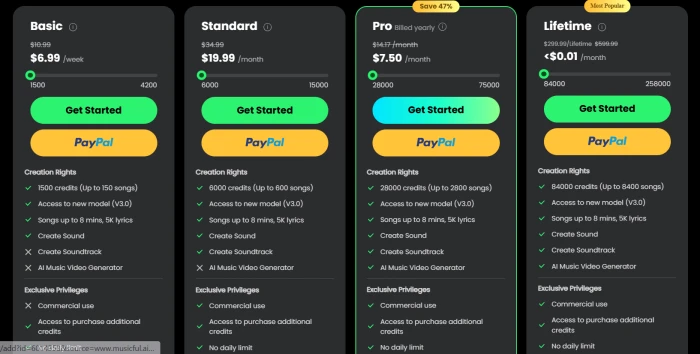
Four paid plans are on sale. Basic bills weekly at $6.99, Standard runs $19.99 a month, Pro is $7.50 a month on annual billing, and a Lifetime licence costs $299.99 once.
What Happened When We Tested It
02 . 9 tests from first prompt to licence terms
One brief went in, deliberately specific, so the output could be measured against instructions rather than vibes. What came back was less interesting than what the interface revealed about the cost of using it. The findings below run in the order they surfaced during a single session.
A 200-character ceiling on a tool sold on prompt detail
Test 01 . Prompt entry
★ Prompt Used
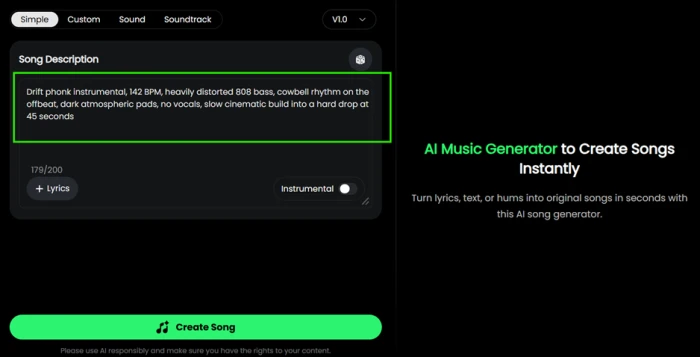
"Drift phonk instrumental, 142 BPM, heavily distorted 808 bass, cowbell rhythm on the offbeat, dark atmospheric pads, no vocals, slow cinematic build into a hard drop at 45 seconds."
The Simple tab, with the V1.0 model selected by default.
First impression: That brief consumed 179 of the 200 characters Simple mode permits. Musicful's own homepage prints example prompts longer than the box accepts, and its paid models advertise a 1,000-character style allowance, which places the ceiling in the interface rather than the model.
A percentage counter with nothing behind it
Test 02 . Wait state
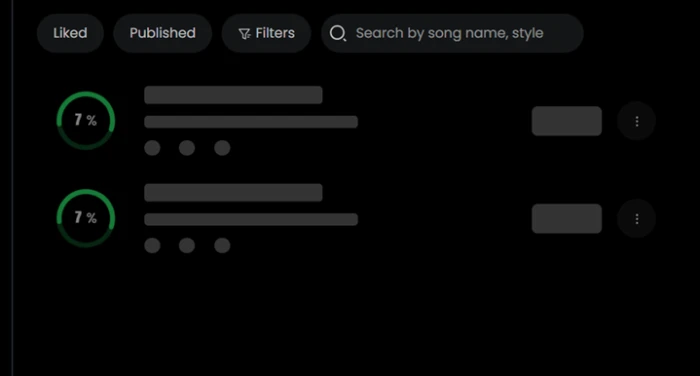
Generation reports a percentage and nothing else.
How it performed: Both tracks finished inside two minutes, which is competitive for this category. The counter never offered a time estimate, so there was no way to judge whether to wait or switch tabs. A small omission that becomes tedious across a working session.
One prompt, two tracks, nearly double the length
Test 03 . Output length
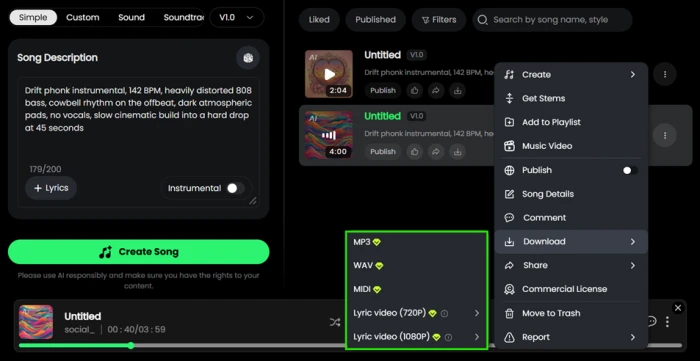
Two variations from a single submission, at 2:04 and 4:00.
What we observed: A single click produced two tracks. One ran 2:04 and the other 4:00, with no duration setting anywhere on my side of the screen. Anyone scoring music to a fixed video slot may find one of their two variations unusable before pressing play on either.
Every paid model costs the same, and it is not the cheapest
Test 04 . Model rates
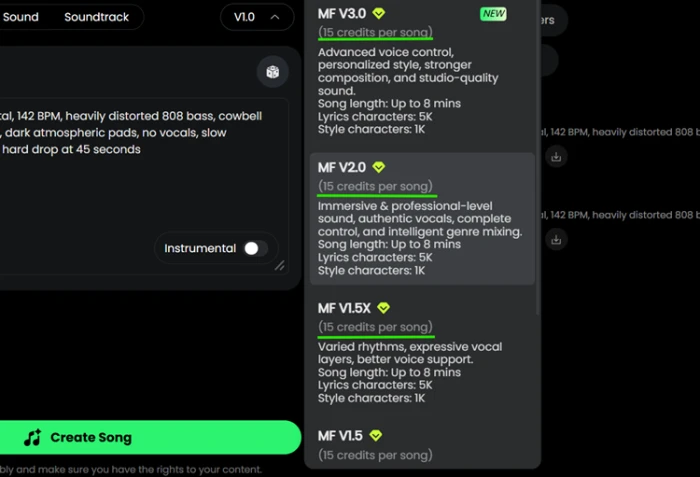
The model selector, with per-song credit costs attached.
The key finding: V1.5, V1.5X, V2.0 and V3.0 all carry the same 15-credit charge per song. There is no price ladder rewarding the older models, which makes the free tier's default worth checking against the credit ledger.
The oldest model bills a third more than the newest
Test 05 . Credit ledger
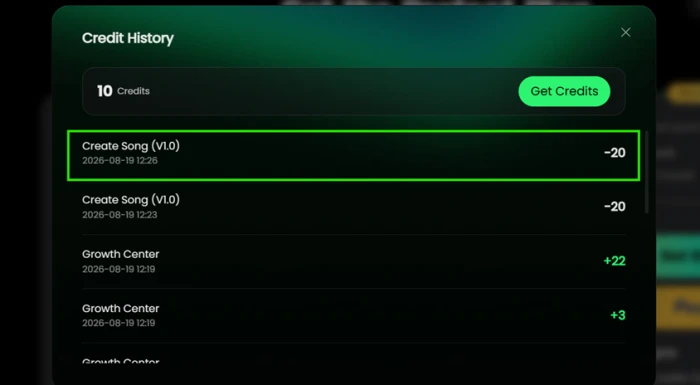
The ledger for the V1.0 generation run in Test 01.
What this confirms: Twenty credits. The model a free account is handed by default charges a third more per generation than any of the four newer ones, while Musicful's own descriptions rank it the weakest of the five. Nothing in the interface explains the inversion, and no technical reading of it holds up.
Thirteen stems, priced as a separate purchase
Test 06 . Stem splitting
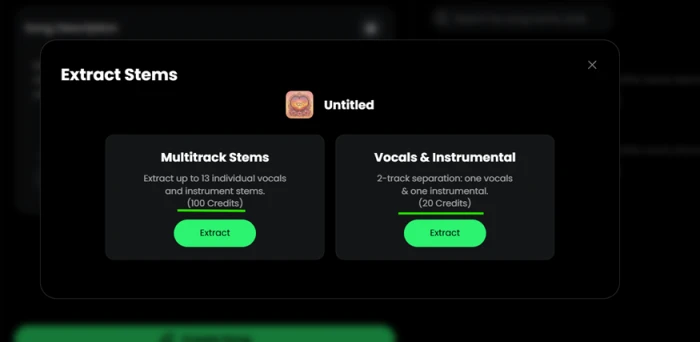
Two stem options, both priced in credits.
Where it lands: Multitrack separation into as many as 13 parts costs 100 credits. A vocal and instrumental split costs 20, the same as one V1.0 song. The depth here is real and few mobile-first rivals match it, though the charge lands on top of a subscription already paid for.
A storyboard preview priced like a finished song
Test 07 . Video quote
The opening quote, with a short default clip selected.
The evidence: On first load the panel asked 127 credits to generate and 28 to preview a storyboard. Paying a song-scale price to look at a draft is unusual, and it sets the expectation that video sits in roughly the same bracket as audio. It does not.
Forty-two seconds, nine times the price
Test 08 . Video scaling
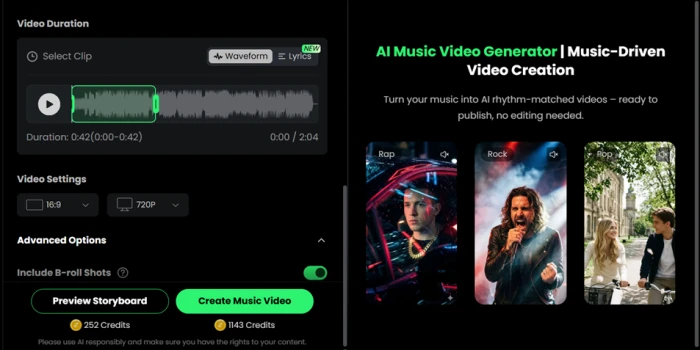
The same panel after extending the clip to 42 seconds.
Under the surface: Selecting 42 seconds of the 2:04 track pushed the quote to 1,143 credits, with the storyboard preview at 252. That is nine times the opening figure for well under half the song. Covering the full track would take roughly three such clips.
Royalty-free on the homepage, licensed further down
Test 09 . Licensing
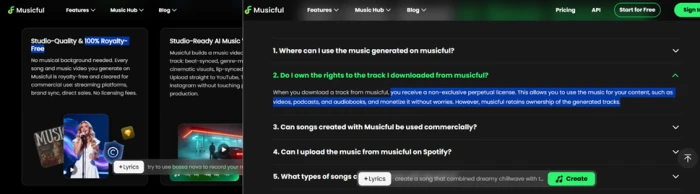
The claim as it appears near the top of the marketing site.
The real story: The homepage promises studio-quality, 100% royalty-free music cleared for commercial use. Further down the same site, the FAQ states that downloading a track grants a non-exclusive perpetual licence while Musicful retains ownership. Both statements hold at once, and the second is standard across this category. Anyone planning to register a track with a distributor or a rights organisation needs the second sentence, and the homepage does not prepare them for it.
★
A full post-production chain behind one generate button
Two finished tracks arrived inside two minutes. From the same result row, the download menu offered MP3, WAV, MIDI, and two lyric video resolutions, while the stem modal offered a split into as many as 13 parts. Rivals that match the audio quality generally hand back a stereo mix and stop there, or reserve stems and MIDI for their top tier.
!
Nothing marks the exit as locked until you try it
The Download submenu lists MP3, WAV, MIDI, and two lyric video resolutions, each with a small green credit diamond beside it. Clicking MP3 neither disabled the option nor explained a restriction. It opened the pricing page. Commercial License, one row below, behaved the same way. Musicful advertises free song creation and that part is accurate, but getting the file off the platform is a separate transaction the interface never announces.
How this review was put together. One drift phonk brief was submitted through Simple mode in August 2026, then followed through the results panel, the download menu, the model selector, the credit ledger, the stem modal, and the music video generator. Every credit figure quoted above was read from the interface during that session rather than taken from documentation. Plan prices and feature gating were verified against the official Musicful pricing page on August 19, 2026. Competitor capabilities were checked against each vendor's own help centre or pricing page on the same day.
10-Point Feature Review
03 . Scored on what the session put on screen
Feature Scores at a Glance
Export format range
9.0
Generation speed
8.5
Stem separation depth
8.5
Model selection breadth
8.0
Feature coverage
8.0
Track length allowance
8.0
Prompt interface ceiling
6.0
Output length control
5.5
Free tier usability
5.5
Music video economics
5.0
Feature-by-feature breakdownWeighted toward song creation over peripheral tools
01
Export format range Best in class
MP3, WAV, MIDI, and two lyric video resolutions from a single submenu. MIDI in particular puts a generated idea inside a DAW as editable notes, which most competitors either omit or reserve for a top tier. It falls short of a perfect mark only because every option in that menu leads to a purchase before it leads to a file.
Formats offered: 5Available without payment: 0
9.0
Excellent
02
Generation speed Strength
Two complete tracks in under two minutes, on the free tier, running the oldest model. That is quick enough to iterate on a brief rather than plan around a wait. It stops at 8.5 because the progress counter reports a percentage with no time remaining, so the speed is only apparent in hindsight.
Tracks per submission: 2Time to completion: Under 2 min
8.5
Strong
03
Stem separation depth Strength
Thirteen stems is deeper than the twelve Suno documents for its Studio tier, and the simpler vocal and instrumental split covers the common case at a fifth of the cost. Held below 9.0 because both options bill separately from the subscription, so a heavy remixing month costs noticeably more than a light one on the same plan.
Maximum stems: 13Split options: 2
8.5
Strong
04
Model selection breadth Strength
Five generations of the model are selectable per song, so an arrangement that suits an older release can be reproduced rather than lost to an upgrade. It sits at 8.0 rather than higher because the selector shows a version number and a price without describing what each model changes, leaving the choice to trial and error.
Models selectable: 5Paid model rate: 15 credits
8.0
Strong
05
Feature coverage Strength
Song generation, cover creation, stem splitting, MIDI export, music video, and a documented API all sit under one login. Buying that range separately would mean two or three subscriptions. It holds at 8.0 because breadth here comes with the credit meter attached to almost every button, so coverage and affordability pull against each other.
Input methods: 4Distinct generators: 3
8.0
Strong
06
Track length allowance Strength
Every paid tier permits songs up to eight minutes with a 5,000-character lyric allowance, which covers a full arrangement rather than a loop. That is generous for the category and does not scale with price, so the entry plan gets the same ceiling as the top one. It stops at 8.0 because the length of any individual result stays outside the user's control.
Maximum song length: 8 minutesLyric allowance: 5,000 characters
8.0
Strong
07
Prompt interface ceiling Limitation
A detailed brief covering tempo, instrumentation, arrangement, and a timed structural change used 179 of the 200 available characters, leaving nothing spare. It earns 6.0 because Custom mode exists as a route around the cap and the paid style allowance is five times larger. It cannot go higher when the default entry point is narrower than the examples on the vendor's own homepage.
The same submission returned durations nearly two minutes apart, with no duration field anywhere on the creation screen. For a platform that markets itself to video creators, delivering a variation at nearly double the length is a coin flip on whether either result fits the edit. It clears 5.0 because both tracks were complete and usable in isolation, and the eight-minute ceiling means nothing was cut short.
Length variance: 2:04 to 4:00Duration controls: None
5.5
Weak
09
Free tier usability Weak point
A free account creates songs it cannot download, publish, or licence, running a default model that bills a third more per generation than the newer ones. It reaches 5.5 rather than lower because the songs themselves are complete and audible in the browser, so the tier works as an audition of output quality. As a way to finish anything, it does not.
Default model cost: 20 creditsNewest model cost: 15 credits
5.5
Weak
10
Music video economics Weak point
A quote that jumps ninefold when a clip is extended to 42 seconds leaves a buyer no way to budget the feature before choosing a plan. Previewing a draft costs more than generating a whole song, which inverts the usual relationship between trying something and committing to it. The floor of 5.0 rather than lower reflects that every quote appears before generation rather than after, so nobody is billed by surprise.
Quote at 42 seconds: 1,143 creditsStoryboard preview: 252 credits
5.0
Weak
Pros and Cons
04 . What lands and what grates
+Worth having
MIDI comes out, not just audio: a generated idea arrives in your DAW as editable notes
Thirteen-way stem splitting: enough separation to rebalance a mix rather than mute a part
Two finished tracks in under two minutes: quick enough to iterate on a brief in one sitting
Five models on tap: an older arrangement style stays reachable after an upgrade lands
Eight-minute songs: room for a full arrangement rather than a loop that needs stitching
Four ways in: type it, paste lyrics, hum it, or upload a reference clip
−What grates
Length is a coin flip: one submission returned durations nearly double one another with no control
The brief box runs out early: Simple mode stops at 200 characters, shorter than the site's own examples
No time estimate while you wait: a percentage climbs with nothing indicating how long remains
You licence the track rather than own it: worth reading before a distributor asks who holds the rights
Pricing Breakdown
05 . Four paid tiers, one of them billed weekly
Feature
Basic$6.99/week
Standard$19.99/month
Pro$7.50/mo, billed yearlySave 47%
Lifetime$299.99 one payment
Credits included
1,500
6,000
28,000
84,000
Credit slider ceiling
4,200
15,000
75,000
258,000
Songs advertised
150
600
2,800
8,400
Songs at the 15-credit rate
100
400
1,866
5,600
Newest model (V3.0)
✓
✓
✓
✓
Songs up to 8 mins, 5K lyrics
✓
✓
✓
✓
Create Soundtrack
✗
✓
✓
✓
AI Music Video Generator
✗
✗
✓
✓
Commercial use
✗
✓
✓
✓
The tier math: Basic is the only plan billed by the week, which changes its shape entirely. Fifty-two payments of $6.99 work out near $30 a month, above Standard's $19.99, for a quarter of the credits and without commercial rights. Read down the column rather than across the row and the cheapest-looking tier becomes the most expensive way to buy a song.
The advertised song counts deserve a second look. Every tier divides cleanly by ten, so 1,500 credits becomes 150 songs and 84,000 becomes 8,400. No model in the selector charges ten credits. The four newest cost fifteen and the free default costs twenty, which puts the real yield around a third below the headline on each plan.
One more gate matters if video is the reason you are here. The AI Music Video Generator is absent from Basic and Standard, so the feature starts at Pro. At the rate quoted for 42 seconds during testing, Pro's allowance covers roughly two dozen such clips, or about eight complete videos for a track of average length.
All four paid tiers with their credit sliders.
Pricing verified August 19, 2026. Musicful runs frequent promotional countdowns, so open the official pricing page before you commit.
Musicful vs the Top 3 Alternatives
06 . Checked against each vendor's own documentation
MMusicful
SSuno
FSoundful
BBeatoven
Stems
Up to 13, priced per split
Up to 12, inside Studio
One stem pack a month
Not offered
MIDI export
In the download menu
Get MIDI, from a stem
Bundled in the stem pack
Not offered
Music video
Built in, credit priced
Not offered
Not offered
Not offered
Licence model
Non-exclusive perpetual, vendor keeps ownership
Commercial rights on paid plans
Exclusive licence available on the top tier
Non-exclusive perpetual, Fairly Trained certified
Best For
Taking one idea through to a finished video
Vocal realism and multitrack editing
Brand and enterprise sonic identity
Background beds where training provenance matters
How to read this table: Musicful is the only entry that carries a track from prompt to music video without a second subscription, and its stem count edges out the field. Suno remains the reference point for vocal realism and the only rival with a full multitrack editor behind it. Pick Soundful when a legal team needs an exclusive licence on the paperwork, and Beatoven when a client asks how the model was trained.
What Users Are Saying
07 . Five accounts across three platforms
Musicful's public reception is split by venue in a way worth noting. Its iOS app sits at 4.4 out of 5 across 176 ratings. Its Trustpilot profile skews far more positive, though Trustpilot has attached its own notice to that profile stating the company may be soliciting reviews in a way the platform does not support. The quotes below cover ground the test session did not reach.
Who benefits from a generator that keeps working after the song is finished?
Use Musicful if your work needs the parts and not only the mix, meaning separated stems and an editable MIDI file, and you want a music video built from the same track without opening a second subscription.
Skip Musicful if vocal realism is the deciding factor or your edit demands a track cut to a fixed length. Suno scores 8.3 on this site and gives you a multitrack editor to finish inside.


Discussion
Join the discussion and share your perspective.