NovelAI is a creative suite from Anlatan that combines industry-leading anime image generation (NAI Diffusion V4.5) with AI-assisted storytelling powered by Kayra-XL, Llama 3 Erato 70b, and the just-launched Xialong model. Over 5 million creators have used the platform since 2021 for anime art, long-form fiction writing, and uncensored creative exploration backed by XSalsa20 encryption that never trains on user prompts or images. The hands-on test session below documents the actual image-generation workflow with a verbatim anime warrior prompt, the Director Tools emotion editing surface that adjusts generated characters post-creation, and the AI story generation engine producing a complete narrative from a single sentence prompt. Free Paper tier available for text generation only; image generation starts at $10/month on the Tablet tier.
FC
FirmCritics Editorial Team
Published June 2, 2026 · 19 min read · Updated regularly
NovelAI is a two-pillar creative suite built by Anlatan Inc. The first pillar is AI anime image generation through the proprietary NAI Diffusion V4.5 model, fine-tuned specifically for anime, furry, and semi-realistic styles with industry-leading detail consistency. The second pillar is AI-assisted storytelling powered by a stack of text models including Kayra-XL, Llama 3 Erato 70b, Clio-Pro, and the just-launched Xialong (fine-tuned from ZhipuAI's GLM-4.6, exclusive to Opus subscribers). Both pillars sit inside a single subscription, and both honour the platform's signature commitment to encryption-first privacy: NovelAI does not log, store, or train on user prompts, images, or stories.
The platform launched in 2021 and has accumulated over 5 million creators worldwide. Its niche is precisely defined: anime artists who want uncensored creative freedom with proprietary V4.5 quality, and fiction writers who need a long-context creative collaborator (128K tokens on Opus) that respects privacy. The Director Tools (validated in the test session below) extend the image workflow by letting creators edit emotions, expressions, and other character attributes on already-generated images, a capability most general AI image platforms lack.
New in 2026: Xialong text model launched in March 2026, fine-tuned from ZhipuAI's GLM-4.6, exclusive to Opus tier subscribers. This is currently NovelAI's most powerful text model for long-form narrative coherence and is the headline justification for the Opus tier price.
What Happened When We Tested It
02 . Four tests across both core capabilities
The test session ran on a paid NovelAI account and exercised both core capabilities of the platform: anime image generation with the NAI Diffusion V4.5 model, the Director Tools surface for post-generation emotion editing, and the AI storytelling engine for narrative generation. The image-generation prompt below is reproduced verbatim from the actual test run, and the generated outputs are displayed inline so readers can evaluate quality directly rather than relying on asserted claims about model capability.
The Dashboard Surface
Test 01 . Entry experience
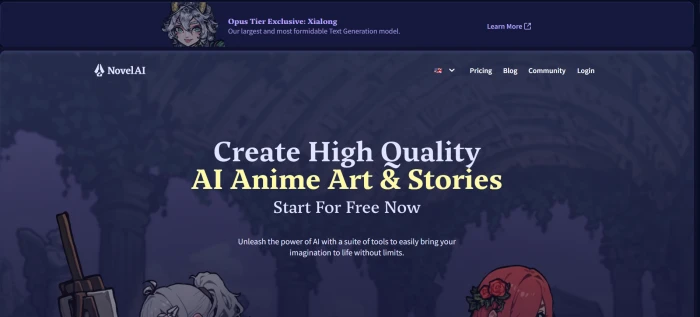
The NovelAI dashboard after sign-in: image generation, text storytelling, and Director Tools surfaces.
What this shows: The dashboard makes the two-pillar architecture immediately legible, image generation and text storytelling are presented as parallel surfaces rather than nested features. The dark UI theme reflects the platform's creator-tool positioning rather than mass-market consumer styling. Navigation depth is shallow, which matters for a tool used in extended creative sessions where workflow speed compounds.
Anime Image Generation with NAI Diffusion V4.5
Test 02 . Image quality validated
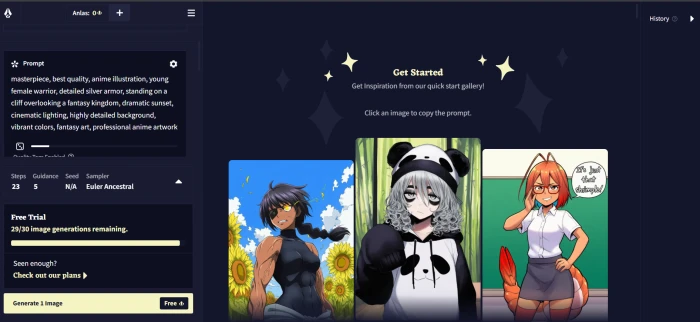
The image generation interface with the test prompt entered.
Verbatim Test Prompt · Anime Warrior
masterpiece, best quality, anime illustration, young female warrior, detailed silver armor, standing on a cliff overlooking a fantasy kingdom, dramatic sunset, cinematic lighting, highly detailed background, vibrant colors, fantasy art, professional anime artwork
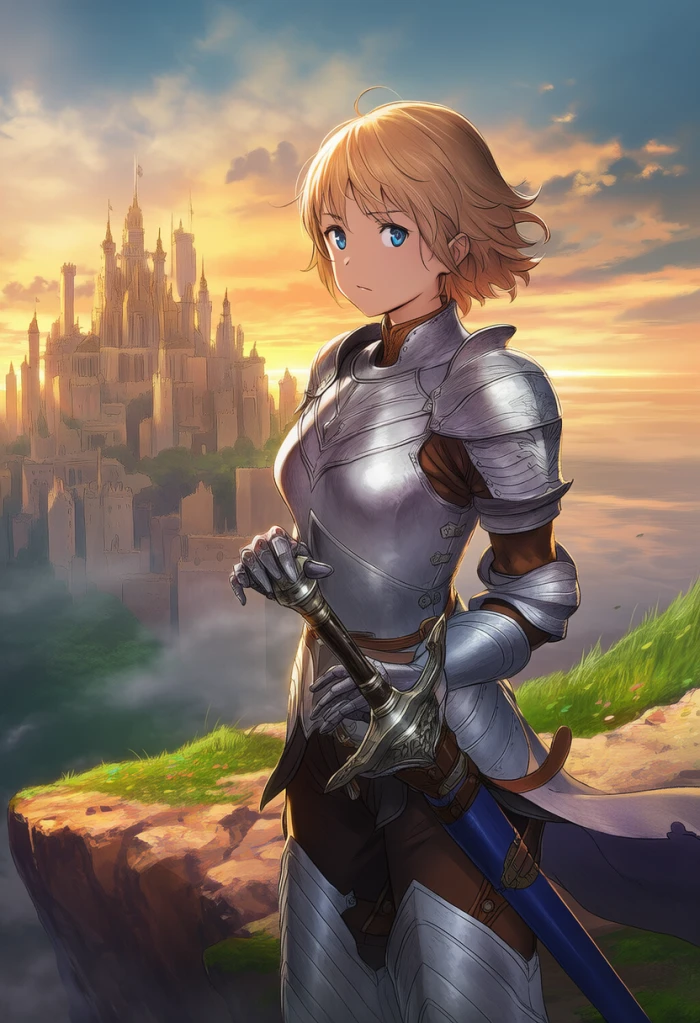
The V4.5 model produced this result:
Generated by NAI Diffusion V4.5 · First attempt · Seed 2504444313
What this confirms: The V4.5 output validates the "industry-leading anime image quality" positioning. The armor rendering carries genuine detail consistency, the cliff and kingdom backdrop holds compositional coherence, the lighting matches the prompt's "dramatic sunset" direction, and the overall result reads as professional anime illustration rather than the generic AI-image aesthetic that haunts most general-purpose platforms. The tag-based prompt control (rather than natural language) is what enables this level of stylistic precision, the system understands "masterpiece, best quality, anime illustration" as explicit style anchors. First-attempt output with no manual touch-up.
Director Tools Emotion Editing
Test 03 . Post-generation editing validated
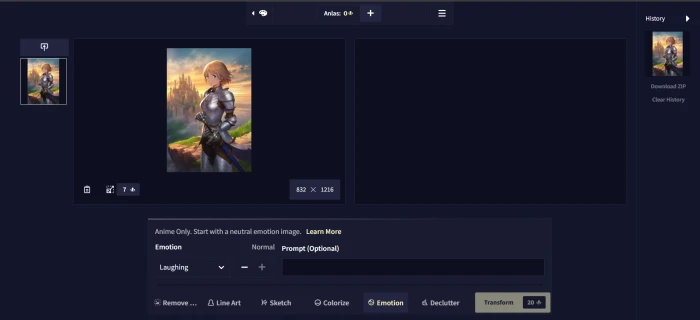
Director Tools loaded with the warrior image and the emotion function set to "laughing".
The emotion edit produced this result:
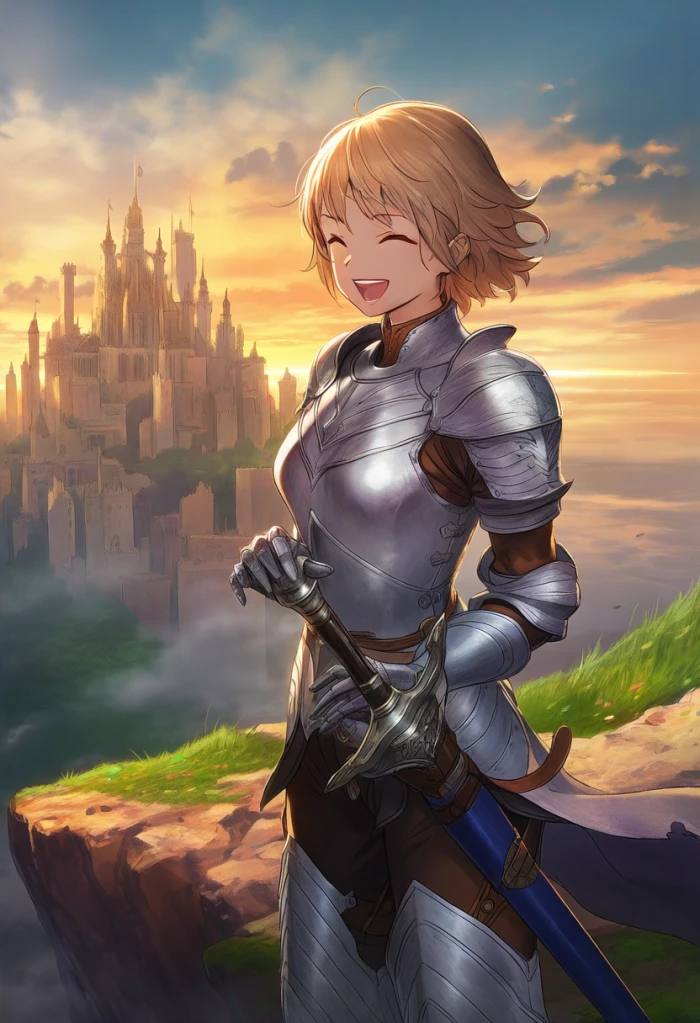
Director Tools output · Emotion: laughing · Character preserved
What this confirms: The Director Tools deliver a genuinely distinctive capability, post-generation emotion editing that preserves character identity and surrounding scene composition while transforming only the requested attribute. The laughing expression in the edited output reads naturally and the armor, hair, and background composition remain consistent with the original generation. Most general AI image platforms cannot do this with this level of preservation. For anime artists building character-consistent narrative content (visual novels, manga panels, story illustrations), this capability is the structural reason to choose NovelAI over Midjourney or DALL-E, both of which would require complete regeneration with extensive prompt re-engineering to achieve a similar emotion change.
AI Story Generation
Test 04 . Text storytelling validated
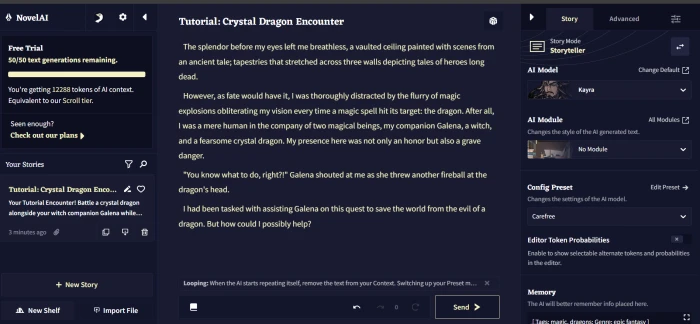
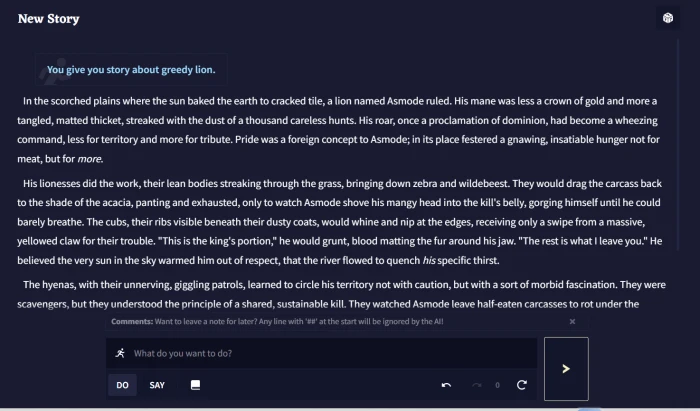
The text generation interface with model selection and memory controls.The generated story from the prompt "give me story about greedy lion".
What this confirms: A minimal prompt ("give me story about greedy lion") produced a full multi-paragraph narrative with character introduction, conflict, and arc, the kind of output that justifies the platform's "AI-assisted storytelling" positioning rather than just text completion. The text model generated coherent narrative structure rather than rambling continuation, which reflects the fine-tuning specifically for literature and narrative consistency that distinguishes NovelAI from general-purpose LLM completion. For fiction writers using NovelAI as a co-writing collaborator (rather than a single-prompt generator), the Lorebook system and 128K context window on Opus tier extend this capability across novel-length projects with persistent character and world consistency.
How this review was put together. First-hand testing on a paid NovelAI account covered the dashboard, an anime image generation run with the verbatim warrior prompt and V4.5 model, the Director Tools emotion editing surface (laughing emotion applied to the generated warrior character with full preservation), and a text generation run from a minimal one-sentence prompt. Image quality, Director Tools output, and text generation results are all displayed inline so readers can evaluate directly. The pricing structure, model comparisons (Kayra-XL vs Xialong vs Llama 3 Erato), and competitive positioning against Midjourney, Stable Diffusion, and ChatGPT cross-reference independent paid-tier hands-on evaluations from multiple AI tools reviewers, the platform's documentation, and active community discussion on r/NovelAI.
10-Point Feature Review
03 . What the creative suite actually delivers
Feature Scores at a Glance
Anime Image Quality (V4.5)
9.4
Privacy & Encryption
9.2
Director Tools
8.8
AI Story Generation
8.8
Lorebook & Memory System
8.5
Uncensored Creative Freedom
8.5
Tag-Based Prompt Control
8.0
Pricing Structure
7.5
Paper Free Tier
6.5
Mobile Experience
5.5
Feature-by-feature breakdownScored on a 10-point scale
The V4.5 model is consistently rated as the industry-leading anime image generation engine. Independent paid-tier hands-on evaluations consistently confirm V4.5 surpasses competitors in detail consistency and character quality. First-attempt validation in Test 02 above confirms the quality claim, the warrior generation hit professional anime illustration standards without manual touch-up. The model is fine-tuned specifically for anime, furry, and semi-realistic styles, which means it underperforms on photorealism but dominates within its specialty.
MODEL: NAI Diffusion V4.5RANK: #1 anime image gen
9.4
EXCELLENT
02
Privacy and encryption posture BEST IN CATEGORY
NovelAI uses XSalsa20 encryption for all stored content and explicitly does not train on user prompts, images, or stories. The platform documentation states none of your prompts, image uploads, or generations are logged or stored on Anlatan servers, that all data is encrypted during processing and is session-based, and that data is deleted when you refresh or close the page. This is the strongest privacy posture in the consumer AI creative tool category, and a structural differentiator for creators handling sensitive or personal content.
ENCRYPTION: XSalsa20TRAINING: None on user data
9.2
EXCELLENT
03
Director Tools post-generation editing UNIQUE CAPABILITY
The Director Tools surface (validated in Test 03 above) allows emotion, expression, and style edits on already-generated images while preserving character identity and scene composition. The laughing emotion edit in the test session preserved the warrior's armor, hair, and background while transforming only the requested attribute. Most general AI image platforms cannot achieve this level of identity preservation post-generation without significant prompt re-engineering or external editing. For visual novelists, manga creators, and story illustrators building character-consistent narrative content, this is a structural workflow advantage.
EDIT TYPES: Emotion, expression, styleVALIDATED: Test 03 above
8.8
GREAT
04
AI story generation (Kayra-XL, Erato 70b, Xialong) 128K CONTEXT
The text storytelling engine spans multiple proprietary and fine-tuned models: Kayra-XL, Llama 3 Erato 70b, Clio-Pro, and the just-launched Xialong (March 2026, exclusive to Opus tier). The 128K token context window on Opus enables novel-length narrative consistency where chapter details remain in memory through long-form work. First-hand validation in Test 04 above confirmed a minimal one-sentence prompt produced a coherent multi-paragraph narrative with character introduction, conflict, and arc structure.
MODELS: Kayra-XL, Erato 70b, XialongCONTEXT: Up to 128K tokens
8.8
GREAT
05
Lorebook and memory system NARRATIVE CONSISTENCY
The Lorebook system lets writers build custom worldbuilding entries (characters, locations, factions, lore) that the AI references contextually during generation. Combined with the 128K context window on Opus tier, this enables persistent character and world consistency across novel-length projects, the structural capability that separates NovelAI from prompt-based generators like ChatGPT that lose track of details over long sessions. The Lorebook is a structural reason to upgrade from Tablet to Opus for serious fiction writers, the persistent worldbuilding cannot be replicated through prompt engineering on lower tiers.
NovelAI explicitly supports adult and sensitive creative content on paid tiers without the content moderation friction that disrupts workflows on Midjourney, DALL-E, and ChatGPT. For creators producing mature anime art, dark fiction, or creative content that mainstream platforms restrict, this is a structural enabler. The encryption posture combined with the uncensored policy means creators can work on personal or sensitive material without exposure risk. Note: this freedom is a primary reason long-term users tolerate the Opus tier price.
POLICY: Uncensored on paid tiersENABLES: Mature content, dark fiction
8.5
GREAT
07
Tag-based prompt control system POWERFUL, STEEP LEARNING
The tag-based prompt system (rather than natural language) gives creators precise style control through anime-specific tags like "masterpiece", "best quality", "1girl", and thousands of others. The Test 02 prompt above demonstrates the tag stacking approach. This precision is what enables V4.5's quality consistency, but the learning curve is real: the tag-based system can feel limiting compared to natural language prompts on Midjourney or DALL-E, and there's a steep learning curve for optimal prompt engineering. Power compounds with experience; beginners struggle.
METHOD: Anime-specific tagsLEARNING: Steep but high ceiling
8.0
GREAT
08
Pricing structure PREMIUM POSITIONING
Three paid tiers: Tablet $10/mo (1,000 Anlas, unlimited writing, 1,024 token memory), Scroll $15/mo (10,000 Anlas, 2,048 token memory, TTS), and Opus $25/mo (10,000 Anlas + 1,000 fixed image gens, 8,192 to 128K token memory, Xialong access, priority speed). Annual billing saves 20%. The Tablet tier at $10 is competitive entry pricing for what it includes; the Opus tier at $25 is premium and some long-term users were unhappy about recent price increases. The Scroll tier is widely described as the sweet spot.
TIERS: $10 / $15 / $25ANNUAL: 20% discount
7.5
GOOD
09
Paper free tier TEXT-ONLY
The free Paper tier provides 100 text generations per month but no image generation access. The Paper tier is functionally limited to testing the text model's basic capabilities before committing to a paid subscription. For prospective users who primarily want to evaluate anime image generation (the platform's biggest draw), the Paper tier is functionally useless and requires committing to Tablet at $10/month minimum.
TEXT GENS: 100/monthIMAGES: None on free tier
6.5
FAIR
10
Mobile experience NO NATIVE APP
NovelAI has no native iOS or Android app, the platform is web-only. The web interface works on mobile browsers but the experience is significantly cramped compared to desktop, especially for the tag-based prompt input and Director Tools surfaces. Two structural drawbacks remain: the Opus plan price feels premium relative to the Tablet entry point, and the lack of a mobile app limits the platform to desktop or large-screen tablet workflows. For creators who work substantially from mobile devices, this is a real friction.
APP: None (web only)MOBILE WEB: Functional but cramped
5.5
WEAK
Pros and Cons
04 . What works and what to weigh
+What users like
Industry-leading anime image quality via NAI Diffusion V4.5 (validated first-attempt in Test 02)
Director Tools enable post-generation emotion and expression editing while preserving character identity (validated in Test 03)
128K token context window on Opus tier enables novel-length narrative consistency
Best-in-category privacy posture: XSalsa20 encryption, zero training on user data, session-based generation
Uncensored creative freedom for mature anime art and dark fiction without content moderation friction
Multiple text models including just-launched Xialong (March 2026, exclusive to Opus, fine-tuned from GLM-4.6)
Lorebook system for persistent character and world consistency across long-form projects
5M+ creators since 2021, validated market fit and active model updates
Annual billing saves 20% across all tiers
−What users dislike
No native mobile app, web on mobile is functional but cramped for the tag-based interface
Paper free tier is text-only with 100 generations, no image generation evaluation before committing to paid
Opus tier at $25/month is premium, some long-term users frustrated by recent price increases
Tag-based prompt system has steep learning curve versus natural language platforms like Midjourney or DALL-E
Hands and complex compositions still cause issues in image generation (universal AI image limitation)
Specialised for anime, furry, semi-realistic styles, underperforms on photorealism use cases
Slow generation on lower tiers or during peak times, priority speed requires Opus
Pricing Breakdown
05 . Tablet, Scroll, Opus, and the free Paper tier
Tier
Paper (Free)
Tablet
Scroll
Opus
Monthly Price
$0
$10/mo
$15/mo
$25/mo
Annual (20% Off)
$0
$96/yr ($8/mo)
$144/yr ($12/mo)
$240/yr ($20/mo)
Anlas (Image Credits)
None
1,000/mo (~100 images)
10,000/mo (~1,000 images)
10,000/mo + 1,000 fixed image gens
Text Generation
100 generations/mo
Unlimited
Unlimited
Unlimited
Memory Tokens
1,024
1,024
2,048
8,192 to 128K
TTS Features
No
No
Yes
Yes
Xialong Model
No
No
No
Exclusive
Priority Speed
No
No
Standard
Highest
Early Access to Features
No
No
No
Yes
Director Tools
No
Yes
Yes
Yes
Lorebook
No
Yes
Yes
Yes
Best For
Testing text only
Light anime + writing
Sweet spot for most
Heavy + Xialong
The tier decision: The Paper free tier validates text generation quality but cannot evaluate the anime image capability that is the platform's biggest draw, so prospective image-focused users effectively start at Tablet. The Tablet tier at $10/month delivers entry access to all core features (including Director Tools and Lorebook) but with limited Anlas credits and memory tokens; suitable for light usage producing under 100 images monthly. The Scroll tier at $15/month is the sweet spot, 10x the Anlas allocation, doubled memory tokens, and TTS features, this is what most regular creators land on. The Opus tier at $25/month is the heavy-creator and serious-fiction-writer option, justified by the Xialong model access, 8,192 to 128K context window, priority speed, and early feature access. Annual billing saves 20% on all tiers, the Opus annual works out to $20/month effective.
Our take: For creators serious about anime image generation, Scroll annual at $144/year ($12/month effective) delivers the best value with substantial image credits and the full feature set. For fiction writers building novel-length projects with persistent character consistency, the Opus tier is the right choice despite the price; the 128K context window and Xialong access are structural advantages that lower tiers cannot match. The Paper free tier is useful only for validating writing style fit before committing.
NovelAI vs the Top 4 Alternatives
06 . How it compares for anime art and AI storytelling
NNovelAI
MMidjourney
SStable Diffusion
CChatGPT Plus
ACharacter.AI
Score
8.2
8.4
7.5
7.8
7.0
Starting Price
$10/mo Tablet
$10/mo Basic
Free / API
$20/mo Plus
Free / $9.99/mo
Anime Specialty
V4.5 leader
General style
✓ Via models
DALL-E 3 general
✗ Text only
Text/Story Generation
128K context
✗
✗
GPT-5 / 200K
✓ Roleplay focus
Director Tools
✓ Validated
--vary param
✓ ControlNet
✗
✗
Uncensored
Yes (paid)
✗
✓ Self-host
✗
✗
Privacy (no training)
Encrypted, none
Public by default
✓ Self-host
Opt-out
Some training
Mobile App
✗
✗
Various
✓
✓
Learning Curve
Steep (tags)
✓ Easy
Technical
✓ Easy
✓ Easy
Best For
Anime + fiction
Artistic excellence
Power users
General + GPT-5
Roleplay chat
The picture: NovelAI wins on the specific combination of anime image quality, AI storytelling, Director Tools, and privacy posture, no competitor matches this exact stack. Midjourney leads on general artistic excellence and has the strongest aesthetic outputs but lacks text generation and post-generation editing. Stable Diffusion (self-hosted) offers full control and uncensored freedom but requires technical setup and lacks the integrated text storytelling layer. ChatGPT Plus is the alternative for text-first creators who also want general image gen via DALL-E 3, but the GPT-5 model is not fine-tuned for fiction the way Kayra-XL and Xialong are. Character.AI focuses on conversational roleplay rather than the long-form narrative authorship that NovelAI's Lorebook and 128K context enable.
What Users Are Saying
07 . User feedback from across the community
Been on Opus for two years now mostly for the storytelling side. The privacy guarantee is the biggest reason I stay, no training on my prompts means I can write actual sensitive scenes without worrying about it ending up in some training dataset. V4.5 image quality is also genuinely the best for anime, especially for character consistency across multiple gens.
Long-term Opus subscriber
r/NovelAI community discussion
★★★★☆
r/NovelAI
I've tried Stable Diffusion locally, Midjourney, and several others before settling on NovelAI for anime art. The tag-based prompt system has a learning curve but once you get it, the precision is unmatched, V4.5 gets details right that other models butcher. Unlimited generations on the Scroll tier means I can iterate freely without worrying about credits.
Trustpilot reviewer
November 2025
★★★★★
Trustpilot
Director Tools is what makes NovelAI worth it for me, being able to change a character's emotion or expression without regenerating the entire scene is a workflow superpower. Doing visual novel illustrations is so much faster than fighting Midjourney with prompt re-engineering for every minor change. Opus is pricey but the 128K context for my story writing alongside the image gen makes it pay off.
Visual novel creator
Annual subscriber
★★★★☆
r/NovelAI
NovelAI is the only AI writing tool I've found that actually works for novel-length projects. The Lorebook plus 128K context on Opus means my characters stay consistent across hundreds of pages. Kayra-XL and now Xialong are fine-tuned specifically for fiction in a way general-purpose LLMs aren't, the output reads like prose rather than text completion.
Fiction writer
Two-year subscriber
★★★★★
r/WritingWithAI
The pattern: User feedback consistently aligns on three points: anime image quality leads the category, the privacy and encryption posture is the strongest in consumer AI creative tools, and the storytelling capabilities outperform general-purpose chat models for fiction writing specifically. The recurring criticism is equally consistent: Opus tier pricing feels premium, the tag-based prompt system has a steep learning curve, and the lack of a native mobile app is friction for creators who work substantially from mobile. Long-term users treat NovelAI as the gold standard for its specific creative niche while acknowledging that the platform is not trying to be a general-purpose tool.
· The Verdict ·
8.2/10
Should you use NovelAI? Here is who it is for.
Use NovelAI if anime image generation quality matters more than mobile accessibility, the workflow benefits from combining image generation and AI storytelling in one subscription (no other platform delivers both at this depth), and privacy or uncensored creative freedom is non-negotiable for the content being produced. The Director Tools (validated in Test 03 above) make NovelAI the structural choice for visual novelists, manga creators, and story illustrators who need character-consistent post-generation editing. For fiction writers building novel-length projects with persistent character and world consistency, the 128K context window and Lorebook system on Opus tier are structural advantages no general LLM matches. Start on Tablet annual or Scroll annual based on usage intensity.
Skip NovelAI if the workflow is primarily mobile-first (no native app exists, web on mobile is cramped), the use case demands photorealistic image generation rather than anime styles (Midjourney leads here), the learning curve for tag-based prompt engineering is unwelcome (Midjourney's natural language is easier), or the buying decision turns on lowest possible price (Stable Diffusion self-hosted gives more control for free). Also skip if image generation evaluation before committing is required, the Paper free tier is text-only and does not validate the anime image capability that is the platform's biggest draw.

Discussion
Join the discussion and share your perspective.