Phrasly bundles an AI humanizer, a detector, a content generator, and a document editor into one cheap subscription aimed at students and content creators. In testing it rewrote a technical passage cleanly, holding on to specialist terms while flipping its own detector from 100% AI to 100% human. The catch showed up on a personal essay, where it added sentences, and even profanity, that were never in the original. It suits budget users who will proofread every line, not anyone pasting output straight into a submission.
Phrasly is an all-in-one AI writing workspace built around two jobs: rewriting AI-generated text so it reads as human, and scoring text for how AI-like it looks. Around that core sit a content generator, a plagiarism checker, a Google-Docs-style editor called Phrasly Pages, and a handful of smaller writing utilities. The pitch is aimed squarely at students and content creators who want to check a draft and clean it up in the same tab, without juggling four separate subscriptions.
The company leans hard on one claim: that its humanizer runs on proprietary in-house models rather than a repackaged general model, and that this lets it clear detectors like Turnitin, GPTZero, and Originality.ai. Usage is framed as unlimited on the paid plan, a deliberate contrast with rivals that meter by the word. A free tier lets newcomers humanize 550 words without a card, and a paid ladder starts with a $2.00 three-day trial before opening into the Unlimited plan at $10.99 per month on annual billing.
What Happened When We Tested It
02 . 6 tests across the humanizer and its detector
We worked from a paid account, feeding the humanizer text whose origin we already knew so every result could be checked against ground truth. The session mixed a technical passage, a personal essay, an AI-written casual essay, and a decade-old academic abstract. Two outside detectors sat alongside Phrasly's own so we could see whether a clean score inside the app meant anything outside it.
Confirming the input was machine written
Test 01 . Baseline
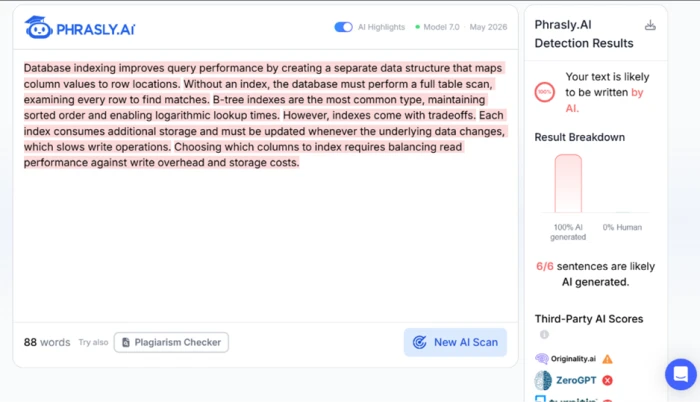
Phrasly's detector on the raw passage: 100% AI, all six sentences flagged.
A clean baseline: before touching the humanizer, we ran an 88-word technical passage through Phrasly's own detector. It returned 100% AI and flagged every sentence, which is the correct call and the starting point every later test measures against.
The technical rewrite, on Aggressive
Test 02 . Humanizer
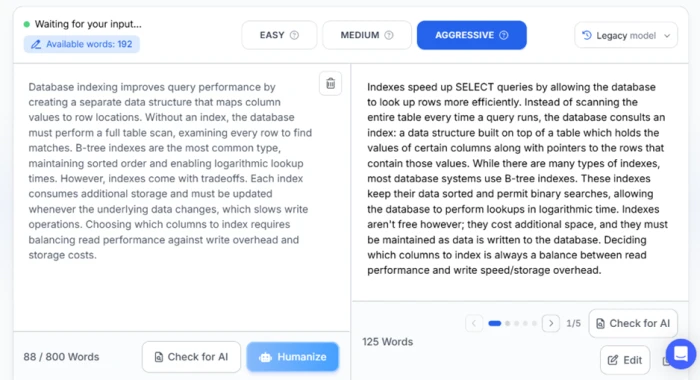
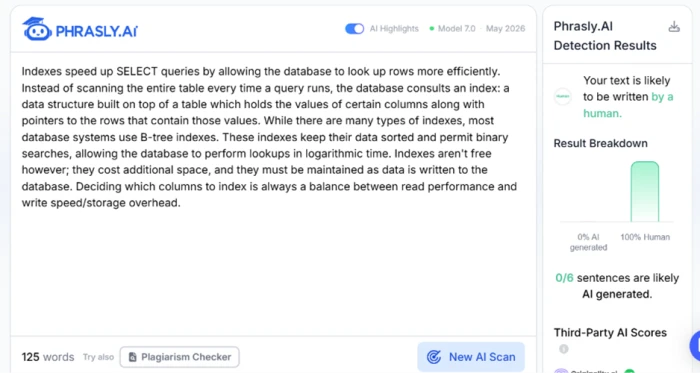
Aggressive mode: 88 words in, 125 words out.The same passage back in Phrasly's detector: 100% human, none flagged.
Where it earned its keep: the rewrite kept the meaning and the terminology intact, with B-tree indexes and logarithmic lookup time both surviving untouched. Read aloud, the output sounded like a person explaining indexes rather than a model reciting a definition, and Phrasly's own detector flipped the passage from 100% AI to 100% human.
The same text, judged by outside detectors
Test 03 . Cross-check
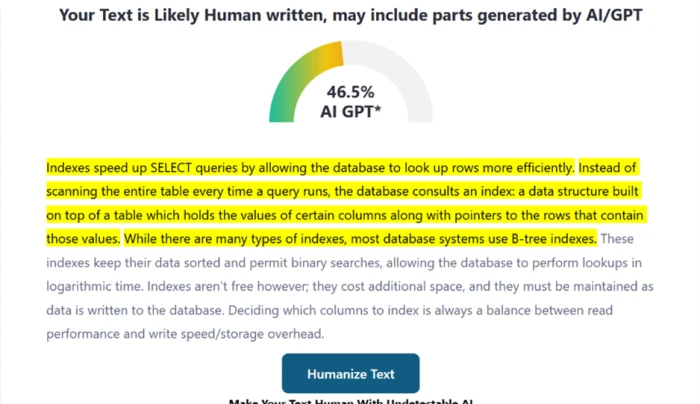
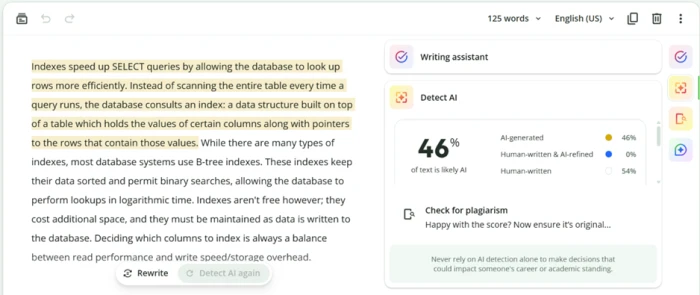
ZeroGPT rated the identical text 46.5% AI.QuillBot landed at 46%, within half a point of ZeroGPT.
The signal here: two independent checkers agreed with each other and disagreed with Phrasly. A 46% reading is an estimate, not a verdict, so it does not prove the text is machine written. What it does prove is narrower and more useful: a clean pass inside Phrasly predicts nothing about what an outside detector will say, which is the whole point if you are rewriting to satisfy someone else's checker.
The personal essay, where it went wrong
Test 04 . Fabrication
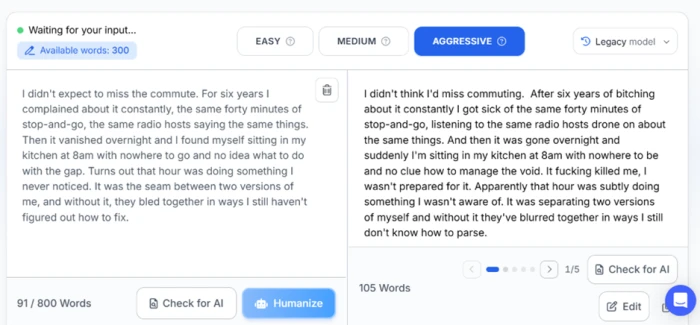
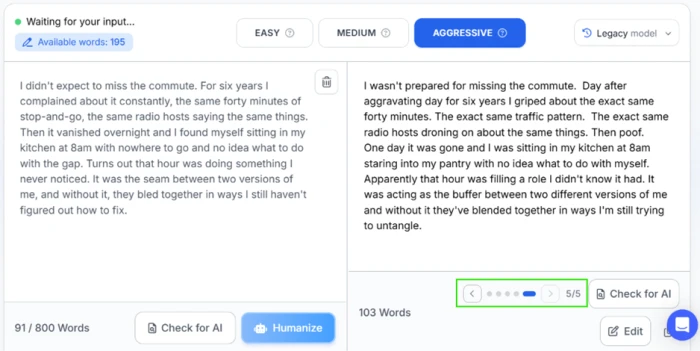
Variation 1 of 5. The profanity and the emotional claim were both added by the tool.Variation 5 of 5. The pantry appears nowhere in the source text.
The key finding: a 91-word personal essay came back as five variations, and two of them invented material. One added a profane line of grief that nothing in the input carried. Another moved the writer from a kitchen to a pantry that never existed. The voice damage was the smaller issue. Fabrication is the serious one, and it is quiet enough that anyone pasting a rewrite into a client draft or a graded assignment could publish claims they never made.
The detector against a casual AI essay
Test 05 . Blind spot
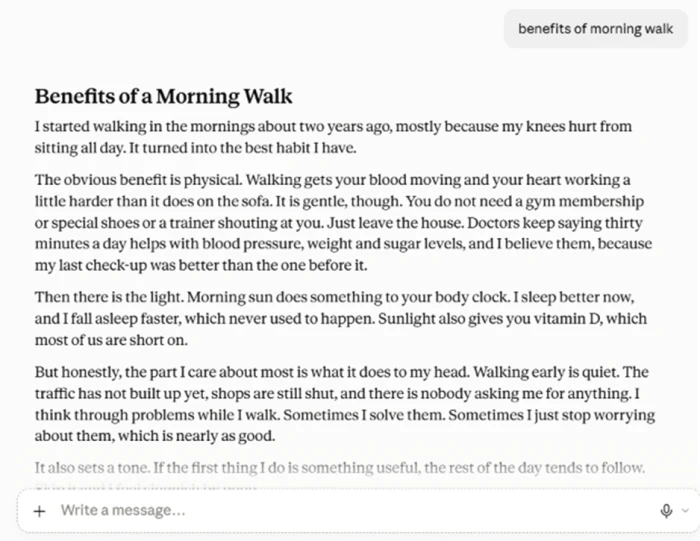
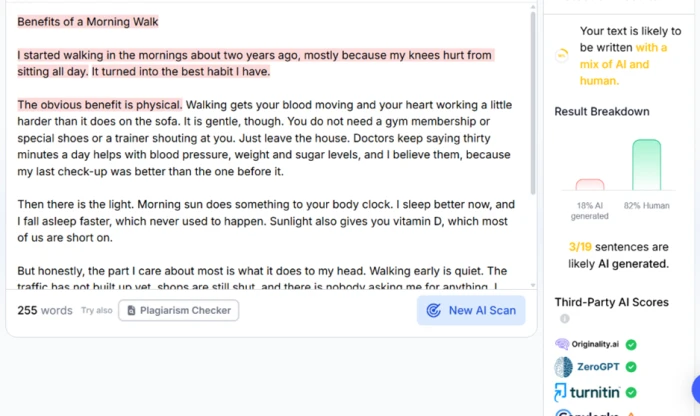
An AI-written essay in a loose, conversational register, with no humanizing applied.Phrasly rated that AI essay 82% human, flagging 3 of 19 sentences.
What stood out: the essay was pure AI, untouched by any rewrite, yet the detector let it through at 82% human and caught only the short declarative openers. It responded to style rather than origin. Formal machine prose gets flagged, loose machine prose walks straight past, and that raises an awkward question about the humanizer next door: if chatty AI output already reads as mostly human, the rewriting is only solving a problem that stiff, formal drafts have.
A control the detector had to get right
Test 06 . Human control
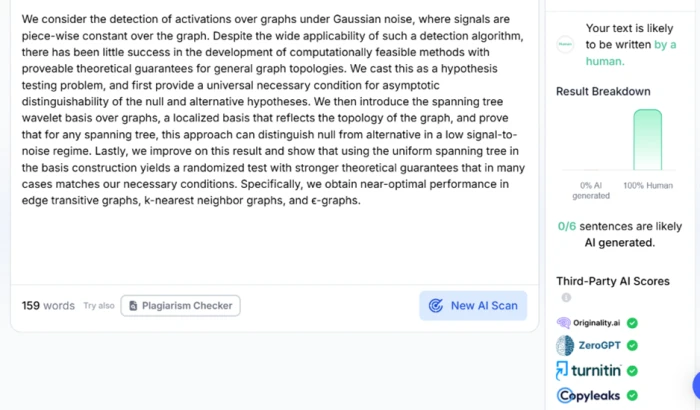
A 2012 arXiv abstract, written years before any large language model, read as 100% human.
A point in its favour: we pasted the abstract of a paper posted to arXiv in 2012, long before a language model could have produced it, and Phrasly called it 100% human. Dense academic writing is exactly where a false positive does the most harm to a real person, so a correct call here matters more than the win looks on paper.
★
Technical rewriting that keeps the terminology
On the factual passage, Aggressive mode held on to precise domain terms and left the meaning where it started, then neutralised Phrasly's own detector completely. For dense, jargon-heavy source text, this is the part of the product that does what the marketing says.
!
It writes sentences you never did
Two of five variations on a personal essay added content that was not in the input, including a physical detail and a profane emotional line. A humanizer that quietly authors new claims is dangerous the moment output goes unread, because the fabrication reads as fluent and confident rather than obviously wrong.
How this review was put together. Testing ran in September 2026 on a paid Phrasly account, using four source texts of known origin so each detector result could be checked against the truth rather than a guess. The humanizer was exercised on Aggressive mode, and its output was rescored both inside Phrasly and in two independent detectors. Pricing was verified the same week on Phrasly's own checkout at phrasly.ai/pricing. No affiliate feed or third-party roundup fed any figure in this article.
10-Point Feature Review
03 . Scored against what the testing showed
Feature Scores at a Glance
Ease of Use
8.5
Value for Money
8.0
Editor and Workflow
7.5
Humanizer Output Quality
6.5
Content Generator
6.5
Word Limits and Quota
6.0
Detector Accuracy
5.5
Meaning and Voice Fidelity
5.5
External Detection Bypass
5.0
Billing Transparency
4.5
Feature-by-feature breakdownScored 5.0 to 9.0 on observed behaviour
01
Humanizer Output Quality Split result
On the technical passage the rewrite was clean and readable, which would justify a higher mark on its own. The personal essay pulls it back down, since the same mode padded and reworded until the writing lost its edges. It sits at 6.5 rather than 7.0 because the good result was confined to factual text, and above 6.0 because that result was genuinely strong.
Technical rewrite: 88 to 125 wordsTerminology: preserved
6.5
Fair
02
External Detection Bypass Weak spot
A rewrite that reads as clean inside Phrasly still drew 46% AI readings from two outside detectors. That gap is the difference between passing your own tool and passing the one a teacher or editor relies on. The 5.0 reflects a real but inconsistent effect: it moved the needle, yet not far enough to trust, and dropping lower would ignore that it did clear Phrasly's own bar.
ZeroGPT: 46.5% AIQuillBot: 46% AI
5.0
Weak
03
Detector Accuracy Blind spot
The detector nailed raw formal AI and a genuine human control, but rated an untouched casual AI essay 82% human. It reads writing style, not authorship, so loose machine text slips through. The score holds at 5.5 rather than lower because it avoided the false positive that hurts real writers, and no higher because the blind spot lands on the most common kind of AI text.
Casual AI essay: 82% humanSentences flagged: 3 of 19
5.5
Weak
04
Meaning and Voice Fidelity Fabrication risk
Factual meaning held up, but the personal rewrite swapped a vivid image for a flat functional phrase and, worse, added details the writer never wrote. Fidelity means the output says what you said and nothing more. Adding invented content is a direct failure of that, so the 5.5 is generous and reflects only that technical meaning survived; the fabrication alone keeps it well under 7.
Invented details: 2 of 5 variationsVoice: flattened
5.5
Weak
05
Content Generator Capped
The generator produces usable drafts and folds into the same workspace, but caps a single request at 500 words and meters output against a monthly word pool. It earns 6.5 for being present and integrated rather than bolted on, and stays under 7 because the per-request ceiling makes long-form drafting a stitch-together job.
Per request: up to 500 wordsTop plan pool: 50,000 words per month
6.5
Fair
06
Word Limits and Quota Opaque
The paid plan lifts the per-process cap to 5,000 words, generous for most work. The wrinkle is how the quota drains: it counts the padded output, not your input, so a 91-word submission cost 105. The counter also shifted between sessions without explanation. That earns 6.0, held up by the roomy cap and pulled down by a meter that is hard to read.
Per process: 800 to 5,000 wordsCharged on: output length
6.0
Fair
07
Ease of Use Best in class
Paste text, pick a mode, read the result. Nothing to install and no setup, with the detector highlights sitting right beside the rewrite. This is the strongest part of the product and the reason the user reviews skew so positive, so it earns 8.5. It stops short of 9 only because the multi-draft output confuses first-timers who expect a single answer.
Setup: noneOutput: 5 variations per run
8.5
Strong
08
Editor and Workflow Well built
Phrasly Pages gives you a real editor with citation support, so the whole loop from first draft to clean copy happens without tab-hopping. It scores 7.5 for depth few rivals bother with. It is not higher because the editor still leans on the same humanizer, which means the fabrication risk rides along into anything you draft there.
The cheap headline hides a trial that rolls into an annual charge, and the pattern shows up repeatedly in user reviews reporting surprise renewals. Combined with a quota counter that resets on an unexplained schedule, the money side is the least trustworthy part of the experience. It sits at 4.5 because the mechanics are legal and disclosed on the checkout, but only just, and buyers keep getting caught.
Trial: $2.00 then annualReviews on billing: recurring
4.5
Poor
10
Value for Money Genuinely cheap
Unlimited humanizations at a low monthly rate undercut most metered rivals, and for a student who mostly rewrites factual coursework that is real value. It earns 8.0 on price alone. It does not reach higher because value assumes the output is usable, and the fabrication and detection gaps mean you pay again in proofreading time.
Model: unlimited humanizationsFree entry: 550 words
8.0
Strong
Pros and Cons
04 . What testing rewarded and punished
+Where it delivers
Clean technical rewrites: factual passages keep their domain terms and their meaning after humanizing
One workspace: humanizer, detector, generator and editor live behind a single login
Zero friction: paste, pick a mode, get output in seconds with nothing to install
Options to choose from: each run returns several variations so you can pick the closest fit
No false alarm on real writing: it cleared a genuine pre-AI academic abstract as human
Forgiving entry: first-timers can try the humanizer without handing over a card
−Where it bites
Invents content: it added sentences and even profanity that were never in the input
Flattens voice: distinctive personal imagery gets swapped for generic phrasing
Internal-only confidence: a clean score in Phrasly does not carry to outside detectors
Blind to loose AI: chatty machine text sails past its own checker
Padding: rewrites run longer than the source and eat into word budgets
Opaque quota: the usage counter shifts and resets with no explanation on the dashboard
Pricing Breakdown
05 . Two paid tiers and a free entry point
Feature
3 Day Access$2.00 trial
Unlimited$10.99 / mo annualBest Value
AI humanizations
Unlimited
Unlimited
Words per process
800
5,000
Content generator words
6,000 total
50,000 per month
Plagiarism check
✗
100,000 words per month
Advanced detection bypass
✓
✓
Beta access to new tools
✗
✓
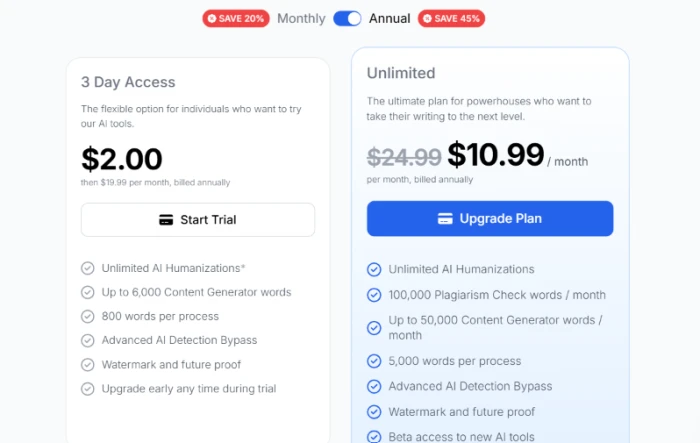
What the numbers mean: the $2.00 entry is a three-day trial, not a plan, and it converts to a recurring charge if you do not cancel first, which is the single most common grievance in Phrasly's user reviews. The Unlimited plan's headline rate is billed a year at a time, so the low monthly number is an annual commitment paid up front. Choosing monthly billing instead carries a smaller discount than the annual view advertises. If all you want is to sample the humanizer, the free tier covers 550 words before any of this applies.
Phrasly's annual pricing view, with the 3 Day Access trial beside the Unlimited plan.
Pricing verified September 9, 2026 on Phrasly's own checkout. Rates shift without notice, so read the current terms on the official pricing page before you commit.
Phrasly vs the Top 3 Alternatives
06 . How it stacks against a humanizer and two detectors
PPhrasly
SStealthWriter
GGPTZero
SScribbr
Score
6.2
5.1
6.8
7.2
Main job
Humanize plus detect
Humanize
Detect
Detect plus plagiarism
Entry price
$2.00 trial, then $19.99/mo
Free, then $20/mo
Free detection
Free detector
Best For
Cheap all-in-one drafting for students
Preset-mode humanizing for volume
Detection accuracy and classroom checks
Students needing plagiarism and detection together
How to choose: if the job is only to check whether writing looks AI, GPTZero and Scribbr both do it for free and score higher on our scale, so paying Phrasly for that alone makes little sense. If the job is to rewrite AI text on a budget, Phrasly undercuts StealthWriter's $20 entry by a wide margin and hands you five variations per run instead of StealthWriter's fixed preset modes. The trade you accept for that price is the fabrication risk and the weak external bypass, neither of which the cheaper option escapes either.
What Users Are Saying
07 . Mostly warm, with one loud complaint
Also, they didn't notify me about renewal and charged me $161.
A cheap all-in-one that needs a careful reader behind it
Use Phrasly if you mostly rewrite factual or technical coursework, you want the detector and the humanizer sitting in one cheap tab, and you will read every line of output before it goes anywhere.
Skip Phrasly if you need trustworthy detection, where GPTZero at 6.8 and Scribbr at 7.2 both score higher and check for free, or if you write personal and creative pieces where an invented sentence is a serious problem.

Discussion
Join the discussion and share your perspective.