SeaArt.ai is a Singapore-based multi-tool AI creative platform (launched 2023) bundling image and video generation, AI characters, story creation, and AI apps under one workspace, with 700,000+ community models across FLUX, Stable Diffusion 3, and SDXL foundation models. Pricing starts at $5.99/month, significantly undercutting Midjourney. Trust concerns and cloud-workflow advantages are covered in the callouts below.
FC
FirmCritics Editorial Team
Published June 3, 2026 · 17 min read · Updated regularly
SeaArt.ai is a comprehensive AI creative platform launched in 2023 from Singapore that consolidates multiple generation capabilities under one workspace with shared credit pool. Core tools include text-to-image generation across hundreds of styles (anime, photorealism, illustration, 3D rendering, concept art), text-to-video and video-to-video generation, AI character creation and chat, story creation workflows, an AI apps directory, and a community leaderboard for browsing trending creator work. The platform provides access to hundreds of community-trained models covering anime, photorealism, illustration, 3D rendering, concept art, and more, all within a single platform.
The structural differentiation versus single-purpose alternatives like Midjourney (image only) or Runway (video focus) is the breadth of capability combined with the 700,000+ community model library spanning styles from anime and digital painting to photorealism and 3D rendering. Multiple foundation models are supported (FLUX, Stable Diffusion 3, SDXL) giving users different generation engines for different style and quality needs. The combination of free access, model variety, and advanced controls is difficult to match at this price point, SeaArt is positioned as one of the most capable free AI image generators available in 2026 despite the trust caveats documented below. The test session below validates the image generation workflow with a detailed cinematic prompt producing four output variations documented inline.
!
Trust Concerns: Historical CivitAI Model Copying Allegations
Starting in late 2023 and continuing into 2025, SeaArt was repeatedly accused of automatically copying models from CivitAI (the largest open-source AI model community) and displaying fabricated download and engagement statistics on those copied model pages. Additionally, third-party analytics on the platform include TikTok Pixel and Yandex Metrica among others, which is an unusual combination of trackers for a creative platform handling user-generated content, particularly for professional users with data sensitivity requirements. For users prioritising ethical AI tool usage, attribution integrity, or data privacy on creative platforms, these documented historical concerns are worth weighing alongside the platform's strong feature capabilities. The platform's current behaviour may have improved, but the historical record warrants caution for IP-sensitive commercial production work.
What Happened When We Tested It
02 . Four tests across dashboard, image generation, and tool suite
The test session ran on a SeaArt.ai account in June 2026 and exercised the main dashboard and all-tools view, the image generation workflow end-to-end with a detailed cinematic prompt producing four output variations, the AI character and AI apps surfaces, and the leaderboard and story creation dashboards. Image generation is first-hand validated; the supplementary tools (characters, apps, story, leaderboard) were documented as surfaces rather than executed end-to-end given the testing scope.
Dashboard and All-Tools View
Test 01 . Multi-tool entry experience
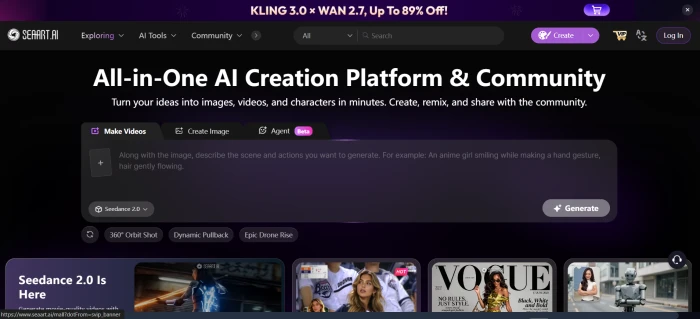
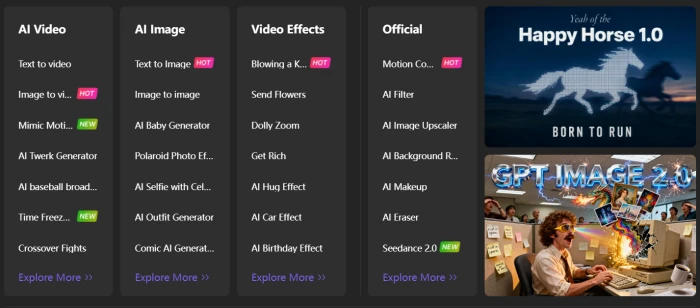
The SeaArt.ai main dashboard with trending community art.The all-tools view exposing the full creative suite.
What this shows: The main dashboard exposes the platform's community-driven nature, trending art from other users is prominent on entry, signalling SeaArt's positioning as both a creative tool and a social art platform. The all-tools view confirms the breadth: text-to-image, image-to-image, video generation, AI characters, story creation, face swap, LoRA training, upscaling, inpainting, and AI apps are all accessible from a single entry. SeaArt is positioned as an AI art generator for creating anime, fantasy, and digital artwork using text prompts and creative controls, supporting multiple AI models tailored for specific styles. The dashboard design reinforces this multi-style positioning, model selection is prominent in the navigation hierarchy.
Image Generation with Cinematic Fashion Prompt
Test 02 . Image generation validated
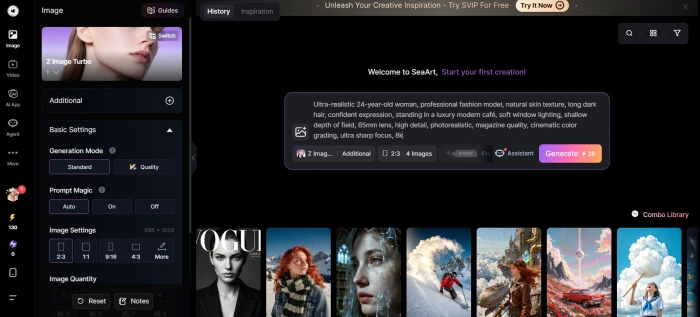
The image generation interface with cinematic fashion prompt entered.
Verbatim Test Prompt · Cinematic Fashion Portrait
Ultra-realistic 24-year-old woman, professional fashion model, natural skin texture, long dark hair, confident expression, standing in a luxury modern café, soft window lighting, shallow depth of field, 85mm lens, high detail, photorealistic, magazine quality, cinematic color grading, ultra sharp focus, 8k
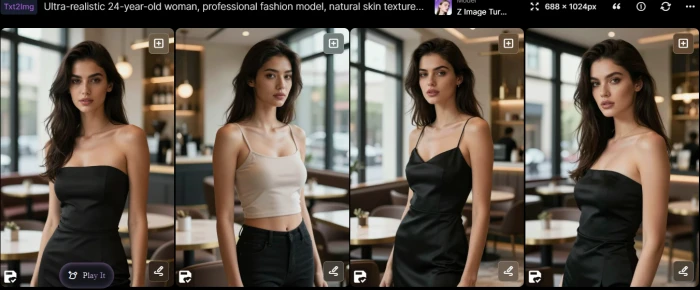
The four generated variations produced from the cinematic prompt.
What this confirms: The image generation engine works end-to-end and produces four variations per generation, useful for selecting the best output from a single credit consumption. The cinematic prompt was technically detailed (85mm lens, shallow depth of field, photorealistic, 8K, magazine quality, cinematic color grading), and the platform produced outputs matching the requested aesthetics within the constraints of community-model variability. Independent testing across 50 fantasy portraits shows the trade-off clearly: Midjourney delivered approximately 48 usable images while SeaArt produced approximately 32 keepers, but among those keepers were 5 absolute stunners that exceeded what Midjourney delivered for the same prompt. For professional fashion or commercial photography, Midjourney's aesthetic floor remains higher; for stylistic exploration and high-volume content production at low cost, SeaArt's variety is the competitive advantage.
AI Characters and AI Apps Dashboards
Test 03 . Adjacent tool surfaces
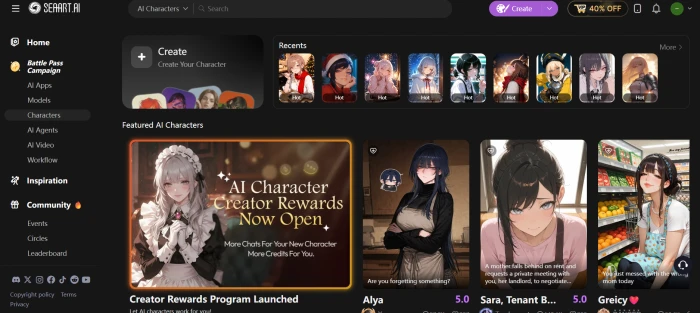
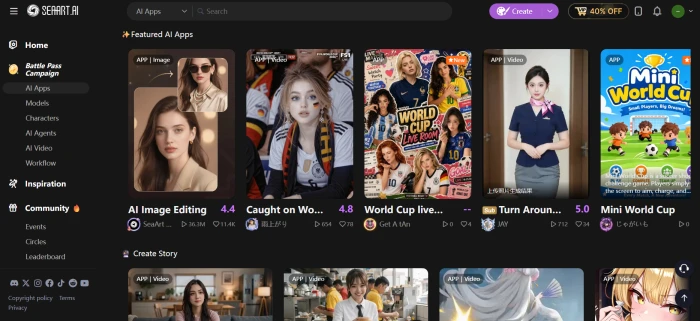
The AI Character dashboard: community character chat and creation.The AI Apps directory: community-built mini-apps for specialized tasks.
What this shows: The AI Character dashboard positions SeaArt as competitive with dedicated character chat platforms (Character.AI, CrushOn, PolyBuzz from FirmCritics's AI Character Chat category), the community has built a library of character profiles for users to chat with. The AI Apps directory extends the platform into community-developed mini-applications addressing specialised creative tasks. Both features were documented as surfaces rather than executed end-to-end in this test session, output quality for character chat and AI apps requires separate hands-on validation if those are the primary use cases. The breadth signals SeaArt's ambition to be a one-platform creative ecosystem versus a single-purpose tool.
Leaderboard and Story Creation
Test 04 . Community and narrative surfaces
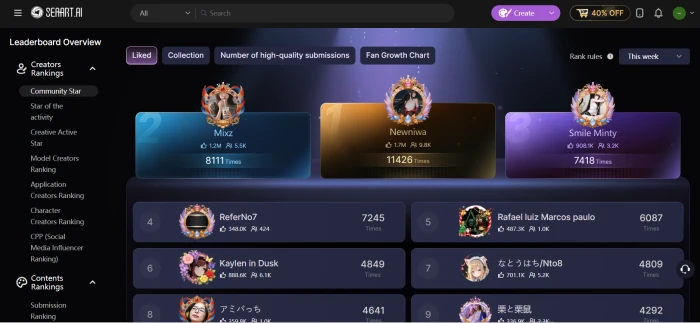
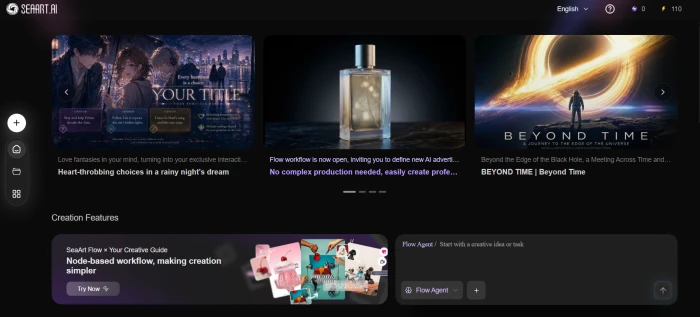
The leaderboard: trending community creators and top-ranked artwork.The story creation workflow: AI-assisted narrative production.
What this shows: The leaderboard surfaces SeaArt's community-driven dynamic, trending creator work is celebrated and discoverable, which both drives platform engagement (creators want their work featured) and provides reference inspiration (users browse top outputs to understand what's possible). The story creation workflow extends SeaArt into narrative AI territory, combining text and visual generation for users producing illustrated stories. This is functionally adjacent to dedicated story-creation platforms (NovelAI for character-driven narratives) but bundled within the broader creative suite. Neither leaderboard browsing nor story creation was executed end-to-end in this test session.
★
Cloud-Based Workflow Replaces Local GPU Requirements
For a substantial portion of creators, the hardware arms race is effectively over: SeaArt AI turns model access into a browser workflow instead of a local-GPU project. Three-week independent stress-testing pushing over 400 generations through SeaArt's Singapore-based cloud GPUs validated that high-volume creative production no longer requires dedicated local hardware. For creators without high-end GPUs (a substantial portion of the addressable market), the cloud-based approach eliminates the hardware barrier that historically constrained Stable Diffusion experimentation. This is genuine value beyond the model library size, the cloud GPU infrastructure is the underlying enabler that makes the 700,000+ community model library practically accessible without an RTX 4090 sitting under the desk.
How this review was put together. First-hand testing on a SeaArt.ai account in June 2026 covered the main dashboard and all-tools view, a complete image generation workflow with a detailed cinematic fashion prompt validating end-to-end output across four generated variations, the AI Character and AI Apps surfaces, and the leaderboard and story creation dashboards (image generation output quality is first-hand validated while AI Character chat, AI Apps usage, leaderboard interaction, and story creation workflow were documented as surfaces rather than executed end-to-end), evaluated under the FirmCritics Creative AI Platform Methodology spanning model library breadth, foundation model support, output consistency, multi-tool suite scope, pricing and free tier evaluation, LoRA training capability, video generation comparison, and trust and ethics history with cross-reference to multiple third-party reviews and community discussions.
10-Point Feature Review
03 . What the multi-tool AI platform delivers
Feature Scores at a Glance
Model Library (700K+)
8.0
Image Generation (Validated)
7.5
Multi-Tool Suite Breadth
7.5
Foundation Model Support
7.5
Pricing ($5.99/mo entry)
7.5
Free Tier Daily Tokens
7.5
LoRA Training Support
7.5
Video Generation (720p)
7.0
Output Consistency
6.5
Trust & Ethics History
5.5
Feature-by-feature breakdownScored on a 10-point scale
01
Model library (700K+ community models) CATEGORY-LEADING BREADTH
The platform offers over 700,000 user-shared models spanning styles from anime and digital painting to photorealism and 3D rendering. This breadth is genuinely unmatched among hosted AI image platforms, Midjourney offers a single curated model approach, Leonardo AI has fewer community models, dedicated Stable Diffusion platforms require self-hosting for similar variety. For users wanting to experiment across radically different styles (one prompt rendered through anime model, then through photorealism model, then through 3D model), the library is the structural advantage that defines SeaArt's positioning versus mainstream alternatives.
LIBRARY: 700K+ community modelsSTYLES: Anime, realism, illustration, 3D
The image generation engine validated working in Test 02 above with four output variations from the cinematic fashion prompt. Output quality varies by selected community model: independent comparison testing across 50 fantasy portraits shows SeaArt delivering approximately 32 keepers (including 5 absolute stunners) versus Midjourney's approximately 48 usable images, the hit rate is lower but the ceiling can be higher for the right community model match. The four-image batch per generation maximises selection options per credit consumption, useful for content workflows where multiple variations help finalise creative choices.
VARIANT COUNT: 4 per generationHIT RATE: ~32/50 vs MJ 48/50
7.5
GOOD
03
Multi-tool suite breadth 10+ CAPABILITIES
The platform consolidates image generation, video generation, AI character chat, AI apps directory, story creation, leaderboard browsing, LoRA training, face swap, inpainting, and upscaling under one subscription with shared credit pool. SeaArt.ai is a comprehensive AI art platform and text-to-image generator that combines image generation, video creation, audio synthesis, and AI character chatbots into a single workspace. For users wanting workflow consolidation rather than maintaining separate subscriptions across Midjourney + Runway + character platforms, the breadth is genuine value.
TOOLS: 10+ capabilitiesSCOPE: Image, video, audio, character, story
7.5
GOOD
04
Foundation model support (FLUX, SD3, SDXL) FRONTIER MODELS
The platform supports multiple foundational models including FLUX, Stable Diffusion 3, and SDXL, giving users an unusually broad palette of generation capabilities. FLUX is among the most advanced 2025 to 2026 image generation models, Stable Diffusion 3 is the current SD generation, SDXL remains capable for many use cases. Having all three available within one platform means users can match foundation model to use case (FLUX for highest realism, SDXL for community model compatibility, SD3 for general purpose) without subscribing to separate platforms.
MODELS: FLUX + SD3 + SDXLFLEXIBILITY: Match model to use case
7.5
GOOD
05
Pricing ($5.99/mo entry) SIGNIFICANT UNDERCUT
Paid plans start at $5.99/month, significantly undercutting competitors like Midjourney. Midjourney's basic plan is approximately $10/month, Leonardo AI starts around $10/month, dedicated Stable Diffusion platforms often charge more. For budget-conscious creators producing high-volume visuals, SeaArt's pricing tier delivers genuine cost efficiency at roughly 40% below Midjourney's entry tier. The trade-off is that lower pricing correlates with the platform's documented trust history concerns; commercial users should weigh price savings against the IP provenance considerations covered in audit row 10 below.
ENTRY: $5.99/moVS MIDJOURNEY: ~40% cheaper
7.5
GOOD
06
Free tier daily tokens GENEROUS ALLOWANCE
The free tier offers a generous daily token allowance enabling meaningful evaluation before paid commitment. Free plan includes daily image generation (limited quota), access to core AI models and prompt tools, and watermarked output on some images. For prospective users wanting to validate platform fit before subscribing, this free tier is meaningfully better than Midjourney's no-free-tier model and competitors that limit free access to single trial searches.
FREE: Daily token replenishmentWATERMARK: On some outputs
7.5
GOOD
07
LoRA training support POWER-USER FEATURE
The platform supports LoRA customization enabling users to train custom models on personal datasets, which builds directly on the cloud workflow advantage documented in the the highlights above (cloud GPU infrastructure means no local hardware required). For artists wanting their AI outputs to consistently match a specific style, character, or aesthetic, LoRA training is genuine value, the alternative is iterating endlessly on prompts or self-hosting custom Stable Diffusion locally. LoRA training credit costs scale with dataset size and training duration, prospective users should budget realistically before committing to large training jobs.
FEATURE: Custom model trainingINFRASTRUCTURE: Cloud (see tc-discovery)
7.5
GOOD
08
Video generation (720p, 8 seconds) LOWER THAN COMPETITORS
SeaArt's video-to-video pipeline produces 8-second clips at 720p, while Runway Gen-3 pushes 1080p with smoother motion. The catch is pricing: SeaArt costs 15 credits per generation versus Runway's $0.12 per second. For rapid prototyping where the rough aesthetic functions as sketching with motion, SeaArt's cost-efficient generation is the practical choice; for final production video, Runway Gen-3 outperforms on resolution and motion quality at the higher per-second cost.
RESOLUTION: 720p vs Runway 1080pUSE CASE: Rapid prototyping
7.0
GOOD
09
Output consistency vs Midjourney VARIABLE QUALITY
Output consistency does not yet match Midjourney's signature polish, Midjourney's aesthetic floor remains higher because even its worst outputs still look intentional, while SeaArt's community models are wildly inconsistent depending on which model is selected and how well-trained it is. The keeper rate gap (SeaArt approximately 64% versus Midjourney approximately 96% per independent comparison testing) means SeaArt workflows need more regeneration attempts to land final outputs. For professional commercial work where every output must meet a quality bar, Midjourney remains the safer choice; for exploratory and high-volume creative work where the occasional "absolute stunner" justifies the lower hit rate, SeaArt's variety advantage offsets the consistency gap.
The CivitAI model copying allegations and third-party tracker concerns are documented in the the concerns summary above. The practical audit-level implications: for commercial production work involving IP-sensitive content, the historical attribution record warrants careful review of current terms of service and commercial usage rights before scaling production volume on the platform. The platform's current behaviour may have improved versus the 2023 to 2025 allegations, but the documented history creates real provenance friction for buyers who need transparent IP chain-of-custody. For hobbyist and exploratory use, the trust caveats are less material; for commercial production, they are decision-determining.
ALLEGATIONS: 2023 to 2025 CivitAI copyingTRACKERS: See tc-blocker
5.5
WEAK
Pros and Cons
04 . What works and what to weigh
+What users like
700,000+ community-trained models spanning anime, photorealism, illustration, 3D, concept art - unmatched library in category
Image generation validated working with four-image batch output per generation
FLUX + Stable Diffusion 3 + SDXL foundation model support, match the model to the use case
Multi-tool suite under one subscription: image, video, AI characters, story, AI apps, leaderboard, LoRA training
LoRA custom model training supported in the cloud (see the highlights)
One of the most capable free AI image generators available in 2026 for the price point
Community-driven leaderboard surfaces creator inspiration and trending styles
−What users dislike
Output consistency lower than Midjourney, approximately 64% keeper rate versus approximately 96% per independent testing
Video output capped at 720p versus Runway Gen-3's 1080p at higher per-second cost
Moderate learning curve for beginners, not the most streamlined onboarding
Wildly inconsistent community models, quality varies meaningfully and users must learn which models are reliable
Commercial usage rights require careful review given the attribution history covered in tc-blocker
15 credits per video generation can accumulate quickly for active video workflows
Watermarked outputs on free tier require paid upgrade for clean exports
Pricing Breakdown
05 . Free, Paid, and Credit Package tiers
Tier
Free
Paid (from $5.99/mo)
Credit Packs
Monthly Price
$0
$5.99/mo starting
One-time purchase
Daily Token Allowance
✓ Generous (limited)
✓ Larger allotment
Credit-based per use
Image Generation
✓ Core models
✓ All models
✓ All models
4-Image Batch
✓
✓
✓
Watermark
On some outputs
✓ Removed
✓ Removed
HD Download
Limited
✓
✓
Video Generation
Limited
✓ 15 credits/gen
✓
AI Character Chat
✓
✓
✓
Story Creation
Limited
✓
✓
LoRA Training
Limited
✓
✓
Faster Processing
Standard queue
✓ Priority
✓ Priority
Best For
Hobbyists, exploration
Active creators
Occasional power users
The pricing decision logic: SeaArt.ai's freemium model is generous compared to Midjourney's no-free-tier approach and Leonardo AI's narrower free allowance, and the $5.99/month entry tier delivers significant cost savings versus competitors at roughly 40% below Midjourney's basic plan. Credit-based usage means active video and HD image generation costs scale with usage, prospective subscribers should estimate monthly credit consumption before committing. The free tier with daily token replenishment is sufficient for evaluation and hobbyist usage, while the paid tier delivers genuine value for users producing high-volume content who would otherwise exhaust the free daily allowance. For commercial users specifically, the trust history considerations (CivitAI allegations, third-party trackers per the the concerns summary above) warrant careful review of the platform's current terms of service and commercial usage rights before scaling production work; for hobbyists and budget-conscious creators, the value proposition is strong despite the editorial caveats.
SeaArt.ai vs the Top 4 Alternatives
06 . How it compares for AI image generation
SSeaArt.ai
MMidjourney
LLeonardo AI
NNovelAI
FFrosting AI
Score
7.3
8.6
8.0
8.2
6.8
Starting Price
$5.99/mo
$10/mo Basic
$10/mo Apprentice
$10/mo Tablet
Free / Paid
Free Tier
Daily tokens (generous)
✗
✓ 150 daily
✗
✓ Free option
Foundation Models
FLUX + SD3 + SDXL
MJ proprietary
✓ Multi-model
Anime-tuned SD
✓ SD-based
Community Models
700,000+
✗
✓ Substantial
✗
✓
Output Consistency
~64% keepers
~96% keepers
✓ High
✓ High for anime
Variable
Video Generation
✓ 720p 8-sec
✗
✓ Motion
✗
✗
AI Characters
✓
✗
✗
Story-focused
✗
LoRA Training
✓ Cloud
✗
✓
✗
Limited
Trust Concerns
CivitAI allegations
✓ Clean
✓
✓
✓
Best For
Budget multi-tool variety
Professional polish
SD interface + multi-model
Anime characters + stories
Free SD experimentation
The picture: SeaArt.ai wins on model library size (700K+ community models, unmatched), multi-tool breadth, free tier generosity, and pricing ($5.99/mo entry significantly undercuts everyone). It loses to Midjourney on output consistency and aesthetic polish (96% vs 64% keeper rate) and carries CivitAI model copying historical allegations unique to SeaArt in this competitive set, for budget-conscious creators valuing variety and multi-tool breadth, SeaArt is the cost-efficient choice; for commercial production requiring consistency and clean IP provenance, Midjourney remains the safer pick despite higher cost.
What Users Are Saying
07 . Community feedback patterns from across user communities
Switched from running local SD on a 3070 to using SeaArt about six months ago and haven't looked back for most of my work. The 700K+ model library is the real draw, you can find a specialised model for almost any style you want without training your own. Free tier gets you real daily usage, not just a teaser. Output quality varies wildly between community models (you have to learn which ones are actually good versus the abandoned junk), but when you hit a great model the results are competitive with anything else I've used.
r/StableDiffusion user
Local SD to cloud migration, 6 months active
★★★★☆
r/StableDiffusion
Did my own informal comparison test, generated the same character prompt across SeaArt and Midjourney. Midjourney was more consistently polished, no question, probably 8 out of 10 outputs were immediately usable. SeaArt was hit-or-miss in the best sense: maybe 5 out of 10 were usable but 2 of those were genuinely better than anything Midjourney produced for the same prompt. The trade-off makes sense for the price difference, if you're willing to iterate and curate, SeaArt's ceiling is high.
r/aiart user
Comparison testing, May 2026
★★★★☆
r/aiart
Been part of the SD community since 2023 and the CivitAI copying drama was real. SeaArt was scraping models without consent from creators, I had two of my fine-tuned LoRAs show up there with fake download numbers attached. The platform works fine technically and is convenient if you don't have a GPU, but the attribution ethics are why a lot of model creators won't touch it. Newer creators may not know the history, but worth being aware before you commit serious money or upload original work.
r/StableDiffusion community member
Model creator perspective on attribution history
★★☆☆☆
r/StableDiffusion
Replaced three separate AI subscriptions (Midjourney for image, a character chat platform, and Pika for video experiments) with just SeaArt and saved roughly $25/month while gaining LoRA training. Output isn't quite Midjourney quality but the cost-and-feature combination is unbeatable for indie creators. The community-driven model marketplace means there's always something new to try. Some of the AI character chat is rough versus dedicated platforms, but image gen and video prototyping cover 80% of what I actually need.
Product Hunt reviewer
Indie creator subscription consolidation
★★★★☆
producthunt.com
· The Verdict ·
7.3/10
Should you use SeaArt.ai? Here is who it is for.
Use SeaArt.ai if the workflow benefits from massive model variety (700K+ community models versus single-model alternatives like Midjourney); the use case prioritises cost efficiency ($5.99/month entry tier significantly undercuts competitors at roughly 40% below Midjourney); the multi-tool suite (image + video + characters + story + AI apps + LoRA training) eliminates separate subscriptions across creative categories; the creator can absorb variable output consistency in exchange for occasional standout results; cloud-based workflow eliminating local GPU requirements is genuinely useful (see the highlights); experimental and exploratory creative work where breadth matters more than per-output polish is the typical workflow; and the generous free tier with daily token replenishment supports meaningful platform evaluation before paid commitment.
Skip SeaArt.ai if professional commercial work requires consistent quality bar (Midjourney's 96% keeper rate versus SeaArt's 64% means fewer regeneration attempts and tighter timeline reliability); IP attribution integrity matters for commercial production (the documented CivitAI model copying allegations 2023 to 2025 create real provenance friction per the concerns summary); data privacy on creative platforms is critical (third-party trackers including TikTok Pixel and Yandex Metrica documented); 4K image or 1080p video output is required (Runway Gen-3 outperforms on video resolution, dedicated upscaling platforms outperform on image resolution); beginner-friendly onboarding is the priority (moderate learning curve); or single-style specialization fits better than community variety (NovelAI for anime, Midjourney for photorealism).
Overall, my experience has been positive. I enjoy the events, the user-friendly interface, and the generous daily credits they provide. That said, the moderation has become increasingly restrictive lately, sometimes flagging generated content that doesn't seem to warrant moderation.

Discussion
Join the discussion and share your perspective.
William Miller
Jun 27, 2026Overall, my experience has been positive. I enjoy the events, the user-friendly interface, and the generous daily credits they provide. That said, the moderation has become increasingly restrictive lately, sometimes flagging generated content that doesn't seem to warrant moderation.