
Home / Reviews / AI Writing Tools / Songtell AI
Lyric Analysis AI Web Tool

Songtell Review

songtell.com · AI song-meaning analysis

Most lyric sites hand you a wall of crowd comments and let you sort it out yourself. Songtell instead writes a short critical essay for each song, and in testing it flagged the surveillance undertone that most listeners miss in "Every Breath You Take." The catch is everything wrapped around the writing: album credits pulled from a third-party lyrics database come back wrong, and songs outside that database return nothing at all. It suits curious listeners who want a fast, structured read of a song's subtext and are willing to check the facts themselves.

Reviewer Score
7.1
/10
Capable Pick
Sharp on meaning.
Weak on the facts around it.
Subtext & Misread Songs9.0
Mainstream Readings8.5
Emotional Arc Mapping8.5
Metadata Accuracy5.0
Confidence Signals5.0
Platform
Web no mobile app
Catalog
~17,000 curated songs
Lyrics Data
LRCLIB third-party
Price
Free no paid tier
Sign-In
Optional Google
Launched
2022 rebuilt 2026

What Songtell Does

01 . Overview

Songtell exists to answer one question: what does a song mean? You type a title and choose the right track; what comes back is an AI-written analysis laid out like a short critical essay, with the themes, a spotlight lyric, a mapped emotional arc, and even a deliberately contrarian second reading. A metadata panel sits alongside listing the genre, key, tempo, year, and album.

The project began in December 2022 as a solo developer's experiment. It went briefly viral, then went quiet, running on autopilot until a 2026 rebuild reset it: the catalog was cut to roughly 17,000 songs the team judged worth covering, and every analysis was rewritten from scratch. On positioning, Songtell sells depth over breadth and interpretation over annotation, aiming at listeners who want a considered read rather than a crowd-sourced comment thread. It is free to use, with an optional Google sign-in that adds saving and community features.

What Happened When We Tested It

02 . 6 tests on accuracy, freshness, coverage, and metadata

The account was the default one: no login, just the search box. Al Qasimi pushed songs through four buckets to find the edges of the tool, from tracks whose meaning is obvious, to songs most people misread, to music almost nobody has written about, to a single released only weeks earlier. The question was less whether Songtell could paraphrase a lyric than whether it understood one, and where it would break.

A song whose meaning is on the surface

Test 01 . Baseline read
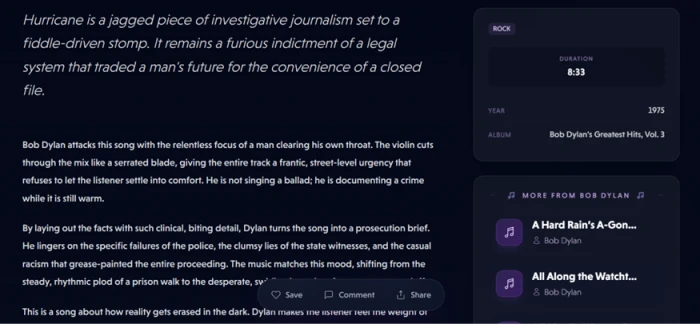
Songtell's analysis page for Bob Dylan's Hurricane, reading the lyric as investigative journalism about a wrongful conviction
The reading of Bob Dylan's "Hurricane."
First impression: Songtell followed the song as reported journalism about a wrongful conviction, matching the documented case behind the lyric. On material this direct, it had nothing to trip over.

The song everyone mistakes for a love letter

Test 02 . Misread lyric
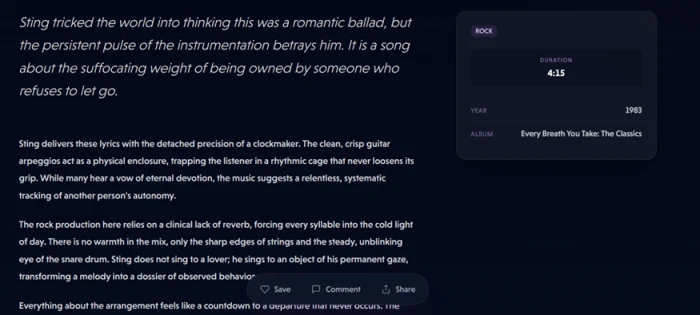
Songtell's reading of The Police's Every Breath You Take, describing surveillance and obsession beneath the melody rather than romance
The tool flags the controlling, watchful core rather than romance.
What stood out: Rather than the wedding-ballad reading, it opened on the idea that the melody disguises possession and constant watching, close to how Sting has described the track for years. It refused the obvious take.

When the music argues with the words

Test 03 . Sound versus meaning
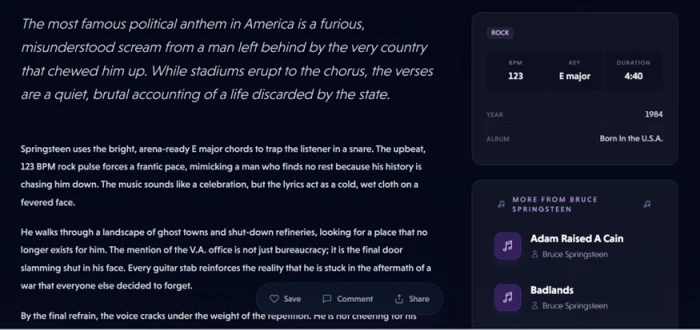
Songtell's analysis of Bruce Springsteen's Born in the U.S.A., connecting the bitter veteran lyric to the upbeat arena arrangement
Songtell links the triumphant production to the bitter lyric underneath.
The key finding: It went past the discarded-veteran lyric to explain how the bright, arena-ready arrangement hides the message. Reading sound against words in one pass is harder than decoding a verse, and it managed both.

A single only weeks old

Test 04 . Freshness
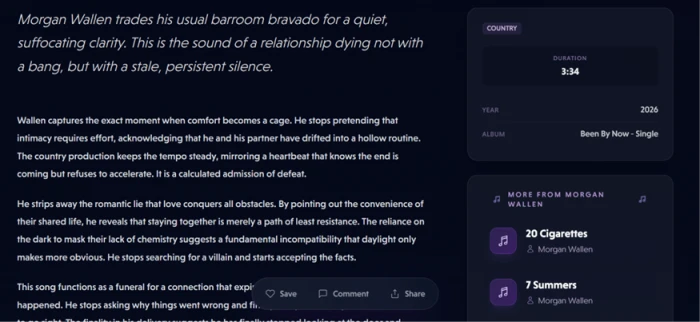
Songtell's interpretation of Morgan Wallen's 2026 single Been By Now, reading it as a relationship ending in quiet acceptance
An accurate reading of a track just weeks old at testing.
Worth noting: A search that looked built to draw a blank instead produced a coherent reading about a relationship ending in quiet acceptance, resting on the same wordplay the song uses. Recency was not the wall it looked like.

Right analysis, wrong facts

Test 05 . Metadata check
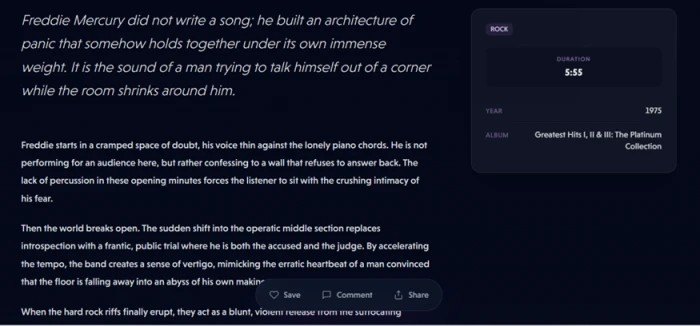
Songtell's metadata panel for Queen's Bohemian Rhapsody showing the correct 1975 year but crediting a later compilation album instead of A Night at the Opera
Correct year, wrong album: the panel names a later compilation.
Where it lands: The interpretation read fine, but the panel credited the song to a later greatest-hits box set instead of its 1975 original. A second famous track showed the identical slip, both tracing back to whatever album the underlying lyrics database happened to store.

A track off the beaten path

Test 06 . Coverage limit
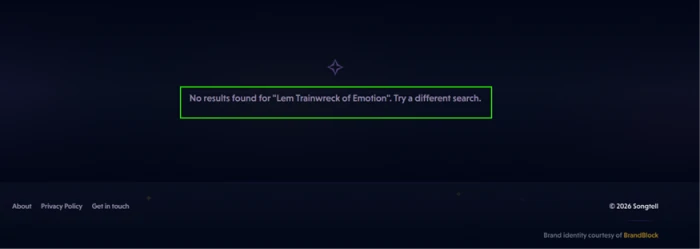
Songtell returning an empty no-results-found screen for an obscure song not present in its lyrics database
Songs outside the catalog return an empty result, not an interpretation.
The takeaway: An obscure search returned a flat no-results screen. When the writing engine has nothing to read, it does not improvise; it simply stops, which is honest but leaves niche and self-released music unreachable.
It reads the gap between music and words

The strongest thing the testing surfaced was not paraphrase but interpretation. On the Springsteen test it decoded the discarded-veteran lyric and then tied it to the triumphant arrangement that disguises it, doing the harder job of reading sound against meaning in a single pass.

!
The facts around the analysis are unreliable

The metadata panel inherits whatever a third-party lyrics database lists, so a landmark record can be filed under the wrong album even when the year is right, with no hint to the reader that the detail is off. Worse for coverage, anything the database does not hold returns a blank screen instead of a best attempt.

How this review was put together. Al Qasimi ran Songtell in August 2026 across four kinds of songs: ones whose meaning is plain, ones listeners routinely misread, obscure tracks, and a release only weeks earlier. Each search was checked against the documented backstory and against the song's own metadata panel. Pricing and the free-access model were confirmed on Songtell's own site, including the About page at songtell.com/about. No account was used for the core reading tests.

10-Point Feature Review

03 . Scored on hands-on results, not the marketing
Feature Scores at a Glance
Mainstream Interpretation
8.5
Subtext & Misread Songs
9.0
Emotional Arc Mapping
8.5
Contrarian Second Reading
8.0
Freshness on New Releases
7.5
Source Transparency
7.0
Community Contributions
6.0
Catalog Coverage
5.5
Metadata Accuracy
5.0
Confidence Signaling
5.0
Feature-by-feature breakdown9.0 is the ceiling here
01
Mainstream Interpretation Strength
On catalog songs the readings are substantive rather than generic, tracking a track's documented meaning in clean, essay-style prose. What keeps this off a 9.0 is the occasional literary flourish the lyric does not earn; what holds it well above a 7 is how reliably it finds the central idea.
Hurricane read: accurateFormat: multi-paragraph essay
8.5
Strong
02
Subtext & Misread Songs Strength
This is where Songtell separates from a plain summary tool. It turned down the popular misreading and, in one test, read a song's arrangement against its lyric in the same pass. A perfect mark would also require it to flag its own confidence, which never happens, so 9.0 is the number it reaches.
Misread-song tests: both correctMusic vs lyric: caught
9.0
Standout
03
Emotional Arc Mapping Strength
Each analysis charts how a song's feeling moves from open to close, a framing most lyric sites skip and a useful one to have on the page. The half-point below a 9 reflects that these stage labels are interpretive and cannot be checked against anything outside the tool.
Arc: labeled stage by stageCoverage: every analysis
8.5
Strong
04
Contrarian Second Reading Strength
A deliberate alternate interpretation runs under every reading, arguing against the obvious take, and it is often the more interesting one. The 8.0 rather than more comes from second takes that occasionally read as a writing exercise instead of a supported claim.
Second reading: on every pageDepth: variable
8.0
Strong
05
Metadata Accuracy Weak spot
The panel beside each reading is the least trustworthy thing on the page. Two hit songs landed under the wrong album, both inheriting whatever a third-party lyrics database stores. Correct release years hold the score at 5.0; mislabeled landmark records stop it climbing any higher.
Album errors: 2 of the hits testedSource: third-party database
5.0
Weak
06
Catalog Coverage Weak spot
Mainstream pop, rock, hip-hop, and folk are handled well, but the catalog was pruned to a curated core and stays tied to what the lyrics database holds. A deep covered center earns the 5.5; the thin edges beyond it keep the number from rising.
Catalog: ~17,000 songsFocus: mainstream genres
5.5
Fair
07
Freshness on New Releases
A single only weeks old returned a coherent reading, which plenty of analysis tools cannot manage on brand-new material. The 7.5 rather than higher reflects a dependency: that outcome hangs on the lyrics database ingesting the track first, so it is no guarantee for every release.
2026 single: accurateDepends on: database ingestion
7.5
Solid
08
Source Transparency
Song pages cite their sources and separate artist quotes from historical background, more openness than most lyric sites bother with. Holding it to 7.0 are two things: the main essay carries no inline sourcing, and several cited references are fan wikis of mixed reliability.
Sources shown: per pageMix: encyclopedias and fan wikis
7.0
Solid
09
Confidence Signaling Weak spot
A rock-solid reading and a flimsy one arrive in the same assured literary voice, with no cue to tell them apart. Clear, readable prose keeps this from dropping below 5.0; the fact that verifying every claim falls back on the reader keeps it from rising.
Certainty cues: noneTone: uniform
5.0
Weak
10
Community Contributions
Readers can submit insights that get folded into the analysis, a real point of difference on paper. The 6.0 reflects a layer that stayed sparse after the rebuild and is easy to overlook, with a merge-and-check process the reader never sees.
Contribution: Google sign-inVolume: sparse
6.0
Fair

Pros and Cons

04 . What you notice in an hour of use
+What Works
  • Reads subtext, not just surface: it catches irony and controlling undertones that a plain summary would smooth over.
  • Emotional arc timeline: every page maps how a song's feeling shifts from opening to close.
  • A built-in counter-argument: each analysis includes a second reading that pushes back on the obvious one.
  • It cites its sources: song pages link the encyclopedias and interviews behind each claim.
  • Essay, not a comment pile: you get a structured critical read rather than a thread to sift.
  • Quick on new songs: it pulled a coherent reading of a track that was barely out.
What Grates
  • Metadata you cannot trust: album credits are often wrong, pulled straight from a third-party lyrics database.
  • Narrow catalog: it covers a curated core, so many niche and brand-new tracks are simply not there.
  • One confident voice for everything: a shaky reading sounds exactly as certain as a rock-solid one.
  • Thin community layer: the crowd-contribution feature is sparse and easy to miss.

Pricing Breakdown

05 . Free, with an optional sign-in
Feature No AccountFree /forever Signed InFree /GoogleOptional
Read full analyses
Arc map, quiz, second reading
Browse the full catalog
Save songs to collections
Track reading history
Post community insights

Pricing in plain terms: you pay nothing. There is no paid plan and no in-app purchase, and the core analysis, the arc map, the quiz, and the contrarian reading all load without an account. A free Google sign-in unlocks saving and history, along with the ability to post insights, and that is the only gate on the site. Two things are worth flagging for anyone arriving from an older writeup. Several of those still describe a pay-per-credit system, but that model predates the 2026 rebuild and no longer appears anywhere on the site. And there is no visible monetization now, no ads and no upgrade prompt waiting behind a feature, so the current free status reads as a small, self-funded project rather than a permanent promise.

Pricing verified August 24, 2026. Songtell lists no paid plan, and the free, no-account model is described on its official About page.

Songtell vs the Top 3 Alternatives

06 . How it stacks up against the usual shortlist
SSongtell GGenius SMSongMeanings SSSongStory
MethodAI critical essay, arc and quizCrowd annotations, artist notesFan discussion threadsAI reading, multilingual
CoverageCurated coreMillions of songsLarge crowd archiveBroad, AI-generated
Human or AIAI plus light communityHuman plus artistHuman communityAI
Best ForStructured AI reads with an arc mapLine-by-line annotations and artist notesTwo decades of fan interpretationAI readings in dozens of languages

Where each one wins: reach for Genius when a song is popular enough to carry real annotations and you want the artist's own notes, since it will beat an AI summary on documented fact every time. Songtell earns its place on songs where you want a fast, structured read of the subtext and a sense of the emotional shape, without scrolling a comment thread to get there. SongStory is the pick when your song is in another language. SongMeanings still holds the deepest well of pure fan debate, if you have the patience to dig for it.

What Users Are Saying

07 . A quiet footprint

Here the trail runs cold, and that is worth reporting plainly. Songtell has almost no organized user-review presence. It runs only in a browser, so there are no App Store or Google Play ratings. It carries no Trustpilot or G2 profile. The software directories that list it show zero user reviews at all.

What discussion exists is scattered and anecdotal, mostly people in music-fan communities reacting to one reading of one song. The reactions split about how you would expect: some listeners find the AI's take illuminating on abstract tracks, while others write it off as over-poetic or too loose to lean on. None of it adds up to the kind of sustained, linkable feedback a buyer can weigh.

Read the silence as a signal in itself. A tool this niche tends to get quietly used or quietly dropped rather than argued over, and Songtell has gathered neither a fanbase nor a backlash worth citing. Until that changes, the most reliable read on the product is a hands-on one, which is why the testing above is doing the heavy lifting in this review.

· The Verdict ·
7.1/10
A sharp interpreter you still have to fact-check

Use Songtell if you want a fast, structured read of what a mainstream song means, especially the ones people routinely misread, and you value an emotional-arc map and a contrarian second reading over scrolling crowd comments. Its interpretations are the strongest part of the product and the reason to visit.

Skip Songtell if you need dependable album and release metadata, or coverage of niche and self-released tracks that fall outside its catalog. For crowd-verified annotations on popular songs, Genius is the better call, and for lyrics in another language, SongStory fits the job.

Category RankCapable Pick
Compared To3 Alternatives
Entry PriceFree
Free TierFull access

Discussion

Join the discussion and share your perspective.