StealthWriter puts an AI humanizer and two built-in detectors on a single screen, so you can rewrite a draft and re-scan it without leaving the page. That convenience ran into a wall in testing: the two scanners returned opposite verdicts on the same 300 words, and two outside detectors sided against the optimistic one. It fits light users who want a quick rewrite-and-check loop and can treat the built-in score as a rough hint rather than proof.
StealthWriter is an AI content humanizer built around one loop: paste text written by ChatGPT, Claude, or Gemini, rewrite it to read more like a person wrote it, then scan the result against a built-in detector in the same window. The audience is anyone who drafts with a chatbot and wants the result to read less like a machine wrote it, students and marketing teams most of all.
Operated by AiVantage LLC, the tool leans on a family of rewrite engines it calls Ghost, paired with a numeric intensity dial and a Deep Scan that colour-codes AI probability sentence by sentence. It positions itself as the lean option in a crowded field, an AI Humanizer and an AI Detector without the sprawl of features its rivals pile on. The service runs on a free plan plus five paid tiers, from Starter at $20 a month up to Scale at $400 a month.
What Happened When We Tested It
02 . 6 tests on detection accuracy and output
I ran the free plan in August 2026 with a clean sample rather than anything lifted from an existing page. For the input I asked ChatGPT for a 300-word encyclopedia-style explanation of how noise-cancelling headphones work, in a formal tone, with brand names and decibel figures baked into the text and a few negation-heavy sentences dropped in. Negation is where rewriting tools tend to flip meaning without anyone noticing, so it made a useful stress point. One setup note for anyone repeating this: ChatGPT's citation chips paste in as raw JSON metadata, so route the text through a plain-text editor before it reaches StealthWriter.
Establishing the baseline
Test 01 . Raw AI scan
★ Prompt Used
"Write a 300-word encyclopedia-style explanation of how noise-cancelling headphones work. Formal tone, flowing paragraphs, no citations. Include brand names and decibel figures in the text."
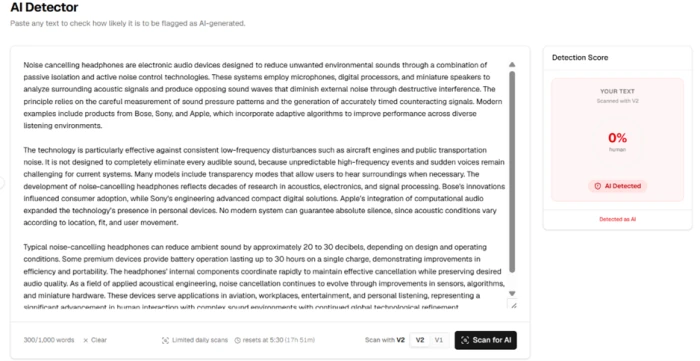
Baseline: the raw AI draft, read by the built-in V2 detector before any rewrite.
What we observed: Before humanizing anything, I pasted the clean 300 words into StealthWriter's own detector on the V2 setting. It came back 0% human. That is exactly right. Untouched machine output, correctly identified, which sets an honest starting line for everything that follows.
The humanizer, on its heaviest setting
Test 02 . V1 verdict
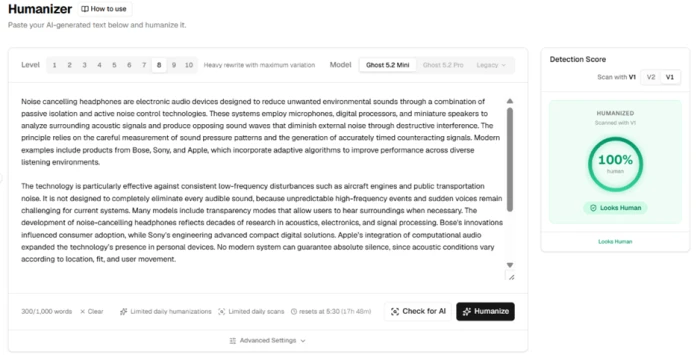
Right after the rewrite, the V1 scanner returns a perfect human score.
The signal here: I set the engine to Ghost 5.2 Mini and the level to 8 of 10, which the interface labels a heavy rewrite with maximum variation. Ghost 5.2 Pro sits greyed out on the free plan. The rewrite finished in a few seconds, and the scanner built into the humanizer panel, set to V1, reported the result as 100% human with a green Looks Human badge. Stop there and you would walk away certain the job was done.
Switching the detector to V2
Test 03 . Scanner conflict
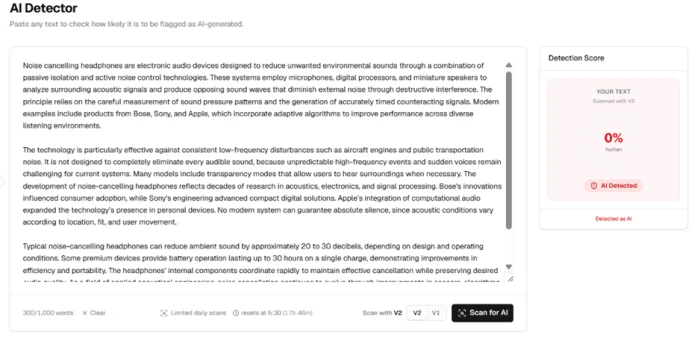
Minutes later, V2 reads the same passage as fully AI.
The key finding: StealthWriter ships two detector versions behind a small toggle. I ran the humanized text through V2. Zero percent human, red badge, AI Detected. Same 300 words, same session, minutes apart, opposite verdicts from two scanners inside one product. The word counter reads 300 in both screenshots and only the version toggle changed between readings. V1 is the number shown right after a rewrite, so it is the first one a user sees. Both scanners cannot be right.
Checking against QuillBot
Test 04 . Outside detector
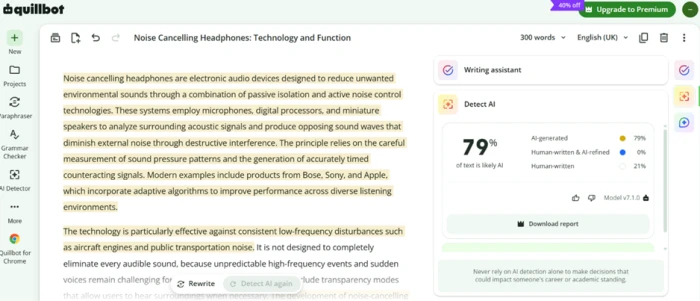
QuillBot's read on the humanized output.
Where it lands: To settle which internal scanner to believe, I took the humanized text to two detectors StealthWriter does not control. QuillBot rated it 79% likely AI generated, with sentence-level highlighting spread across the opening paragraphs. That lines up with V2, not with the badge the tool showed me first.
Checking against GPTZero
Test 05 . Outside detector
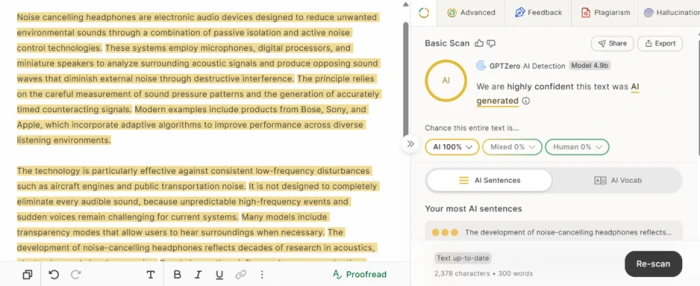
GPTZero puts the same passage at 100% AI.
What this confirms: GPTZero was blunter still, reporting high confidence that the passage was machine generated and putting the figure at 100%. Two independent detectors landed on the same conclusion. V1 is the outlier, and it happens to sit exactly where a student who saw the green badge after a rewrite and submitted the result would trust it without a second look.
Hitting the free plan ceiling
Test 06 . Input limit
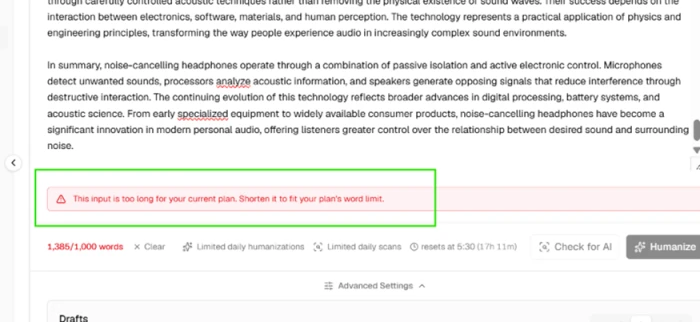
The free tier stops a 1,385-word paste before it starts.
Worth noting: Input on the free tier caps at 1,000 words. A 1,385-word draft turned the counter red and greyed out the Humanize button behind a warning. That is an ordinary length for a blog post. Split it in two and each half gets rewritten on its own, with no promise the tone matches across the seam. The free tier also allows 10 humanizations a day against a visible countdown, so a single afternoon of real testing burns through the allowance.
★
The plumbing is quick and the baseline scanner is honest
A level-8 heavy rewrite of 300 words returned in a few seconds, and the built-in V2 detector called the untouched ChatGPT text 0% human before any rewriting happened. Speed and the raw-input reading are the parts that held up cleanly under testing.
!
The two built-in scanners contradict each other
The same 300 words scored 100% human on V1, the version shown right after you humanize, and 0% human on V2 minutes later in the same session. The number a buyer is most likely to trust is the one QuillBot and GPTZero also rejected.
How this review was put together. Testing ran on StealthWriter's free plan in August 2026, using Ghost 5.2 Mini at the level-8 rewrite setting. The input was a single 300-word AI-generated sample, humanized once and then scanned with the tool's own V1 and V2 detectors before being re-checked in QuillBot and GPTZero. Pricing was verified against the plan details published at stealthwriter.ai. I concentrated on the free tier because that is where a first-time user starts.
10-Point Feature Review
03 . Scored against what the session showed
Feature Scores at a Glance
AI Detection Evasion
4.0
Built-in Detector Reliability
3.5
Rewrite Coherence
6.5
Feature and Claim Accuracy
4.0
Interface and Workflow
7.5
Freeze Keywords Control
7.0
Model Selection
6.0
Processing Speed
7.5
Input Length Limits
5.0
Free Plan Utility
4.5
Feature-by-feature breakdownScores tie to the August 2026 session, weighted toward the job the tool sells
01
AI Detection Evasion Core weakness
This is the whole point of the product, and the humanized output did not clear the two most common free detectors. A 4.0 rather than 3.5 gives credit for prose that stayed readable and might slip past weaker checkers. It cannot reach 4.5 when QuillBot and GPTZero both flagged the same passage with room to spare.
QuillBot: 79% AIGPTZero: 100% AI
4.0
Weak
02
Built-in Detector Reliability Contradiction
One product, two scanners, opposite readings on identical text in the same session. The score stays above 3.0 because the detectors do run and V2 matched the outside tools. It cannot climb to 4.0 when the panel puts a 100% human badge in front of users that its own second scanner flatly rejects.
V1 reading: 100% humanV2 reading: 0% human
3.5
Poor
03
Rewrite Coherence
Meaning survived. The heavy rewrite kept the negation intact and carried brand names and decibel figures through without scrambling the sense. A 6.5 reflects clean readability on one sample; it stops short of 7.0 because a single 300-word test limits confidence and detectability blunts the payoff.
Rewrite level: 8 of 10Sample: ~300 words
6.5
Fair
04
Feature and Claim Accuracy Overstated
Several published write-ups describe detector strictness modes and a library of eight writing styles. The August 2026 build has neither, only a Drafts slider and Freeze Keywords in its Advanced Settings. The controls that do exist match their descriptions, which keeps this off the floor, but the gap between what is advertised elsewhere and what shipped is wide.
Styles advertised: 8Styles present: 0
4.0
Weak
05
Interface and Workflow Clean
Paste, choose a model and level, humanize, scan, all on one screen. The layout earns a 7.5 for being easy to move through with no manual required. It misses 8.0 because the useful controls hide in a collapsed panel and the ChatGPT citation-chip snag greets you at the door.
Screens to result: 1Detector versions: 2
7.5
Strong
06
Freeze Keywords Control Useful
List a product name or a technical term and it survives the rewrite intact, which matters for anyone pushing marketing copy through the tool. A 7.0 recognises a real lever most rivals bury. It does not go higher because it is the only meaningful control beyond how many draft alternatives you want.
Drafts range: 1 to 5Term locking: Yes
7.0
Strong
07
Model Selection
Three engine families are on offer, Ghost 5.2 Mini, Ghost 5.2 Pro, and a Legacy set. The middle score reflects real choice, held back by the fact that Pro is greyed out for free users, so the account most people start on cannot touch the stronger rewriter.
Engine families: 3Free access to Pro: No
6.0
Fair
08
Processing Speed Fast
A heavy rewrite came back in a few seconds, quick enough to keep a rewrite-and-check rhythm going. It earns 7.5 on observed speed. Top marks are off the table because the pricing screen itself lists free-tier response times as below standard, so the experience slows for the tier most people test on.
Rewrite time: Under 10sFree response: De-prioritised
7.5
Strong
09
Input Length Limits
Free tops out at 1,000 words, and every paid tier caps a single submission at 5,000, the $400 Scale plan included. The midpoint score fits: 5,000 words covers most single articles, so it is not a floor, but paying twenty times more from Starter to Scale buys not one extra word per paste.
Free cap: 1,000 wordsPaid cap: 5,000 words
5.0
Mixed
10
Free Plan Utility Thin
Ten rewrites a day, a 1,000-word ceiling, and, per the pricing screen, natural human-like output listed as excluded from the free tier. It clears 4.0 because you can still run real tests with the detectors included. It cannot reach 5.0 when the tier withholds the output quality the product is built to sell.
Daily rewrites: 10Human output: Excluded
4.5
Weak
Pros and Cons
04 . What stands out in daily use
+What works
Fast rewrites: a heavy rewrite lands in a few seconds rather than minutes
One-screen loop: humanize and scan without ever leaving the page
Freeze Keywords: product names and technical terms stay untouched through a rewrite
Honest on raw input: the built-in detector correctly flags untouched machine text
Meaning holds: negation and figures came through a heavy rewrite without breaking
−What frustrates
Contradictory scanners: V1 and V2 return opposite verdicts on the same words
Weak against outside detectors: QuillBot and GPTZero both caught the humanized output
Misleading human badge: the score shown first is the optimistic outlier
Feature drift: strictness modes and a style library other reviews cite are not in the build
Model gating: free users are locked out of the stronger Ghost engine
Opaque usage counter: users report the daily allowance is hard to track mid-session
Pricing Breakdown
05 . Six tiers, one input ceiling
Feature
Free$0/mo
Starter$20/mo
Plus$50/moMost Popular
Humanizations per day
10
50
150
Words per input
1,000
5,000
5,000
Natural human-like output
✗
✓
✓
Ghost 5.2 Pro model
✗
✓
✓
Ghost Legacy models
✗
✓
✓
Fastest response times
✗
✗
✓
Priority support
✗
✗
✓
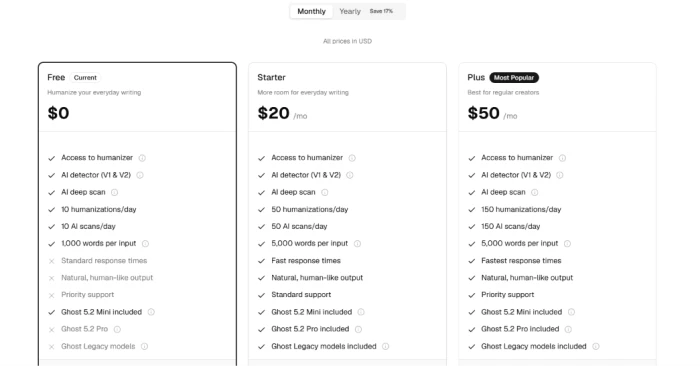
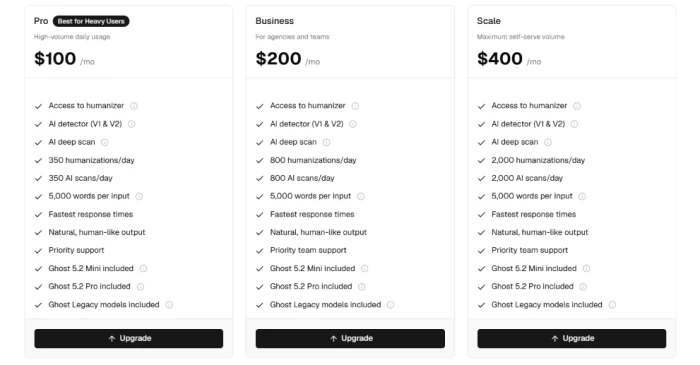
Where the value sits: The real cliff is the step from Free to Starter. Twenty dollars unlocks the qualitative stuff the free tier holds back at once: 5,000-word inputs, the faster rewrite engines, natural human-like output, and access to every Ghost model. Climb past Starter and you are buying volume, nothing else. Plus, Pro, Business, and Scale all share the same 5,000-word input ceiling and the same model list; the only figure that moves is the daily humanization count, which runs 50, 150, 350, 800, then 2,000 at the top. Scale asks $400 a month for forty times Starter's daily rewrites and not a single extra word per submission. Annual billing shaves close to 17% across the board, so Starter lands at $200 a year and Scale at $4,000. The one tier the public cards skip is Business at $200 a month, which the plan comparison lists between Pro and Scale.
The first three monthly tiers, Free through Plus.The upper tiers, Pro through Scale.
Pricing verified August 27, 2026 against the plan details published by AiVantage LLC. Rates and limits move around, so confirm the current numbers on the official pricing page before you subscribe.
StealthWriter vs the Top 3 Alternatives
06 . How it stacks up against the shortlist
SStealthWriter
UUndetectable AI
WWriteHuman
HHumbot
Free access
10/day, 1,000 words
250-word trial
250-word trial
Limited free plan
Input per request
5,000 words
5,000 words
600 to 3,000 words
500 words to unlimited
Built-in detector
Yes, V1 and V2
Yes
Yes
Yes
Pricing model
Daily rewrite quota
Monthly word quota
Monthly request quota
Monthly word quota
Best For
One-screen rewrite and check
GPTZero-focused bypass
Multiple rewrite variations
High word volume on a budget
How to choose: It comes down to what you are optimising for. If the priority is processing volume cheaply, StealthWriter's daily cap works against you, because a quiet week is capacity you paid for and never get back; Undetectable AI at $9.99 a month and WriteHuman at $12 a month meter by the month instead. If output honesty matters most, remember that every tool here markets a bypass none can guarantee, and StealthWriter is the only one whose own two scanners openly disagree. WriteHuman's edge is the several rewrite variations it hands you per pass, while Humbot trades polish for raw word count at volume. None of them cleared the toughest external detectors in independent 2026 testing, so none is a safe bet for graded academic work.
What Users Are Saying
07 . Verbatim from Trustpilot
non transparent company u can humanize 150 time a day for 50 usd but how many time u humanize how many time u left and sometime its say overload hence humanizer failed
Not recommended, It's output is 100% a spun/AI-rewritten article. I rewrite the subheadings to make them "unique," but it didn't understand the context of the article.
Use StealthWriter if you want a quick, single-screen rewrite-and-check loop for low-stakes content, you read the built-in human score as a rough hint, and you always re-run the output through an independent detector before it counts for anything.
Skip StealthWriter if your work passes through Turnitin or Originality.ai, or you need dependable evasion. Undetectable AI and WriteHuman meter by the month instead of the day and posted stronger independent bypass numbers, though neither is safe for graded submissions either.

Discussion
Join the discussion and share your perspective.