Studley takes almost any source, a PDF, a YouTube lecture, an audio file, or a class you record live, and turns it into structured notes with a matched quiz bank. The input range is the real hook: few study apps swallow a recorded lecture and hand back organised notes, a time-stamped transcript, and mastery-tracked questions in one place. It fits students who learn by testing themselves and want the whole loop in a single workspace.
Studley is an AI study workspace that converts source material into a complete study set. You feed it a document, an image, an audio or video file, a YouTube link, a web page, raw text, or a lecture you record on the spot, and it returns organised notes beside the original source, plus a bank of quiz questions and flashcards built from the same material.
It positions itself as the whole study loop in one tab rather than a single-trick generator. The workspace keeps notes, the source, a chat, quizzes, and a few extra tools like a problem solver and a paper grader together, so a student is not stitching a flashcard app to a note app to a tutor. The pitch targets exam-focused learners who revise by self-testing, and it runs on the web with a companion iOS app for studying on a phone.
What Happened When We Tested It
02 . 4 tests covering sign-in, inputs, output, and the quiz engine
I took a Studley account from sign-up through a full study set built from a computer-science source, then put the generated quizzes through their paces. The aim was to see how much structure the engine adds on its own and where the free experience stops.
Getting Through the Front Door
Test 01 . Sign-in
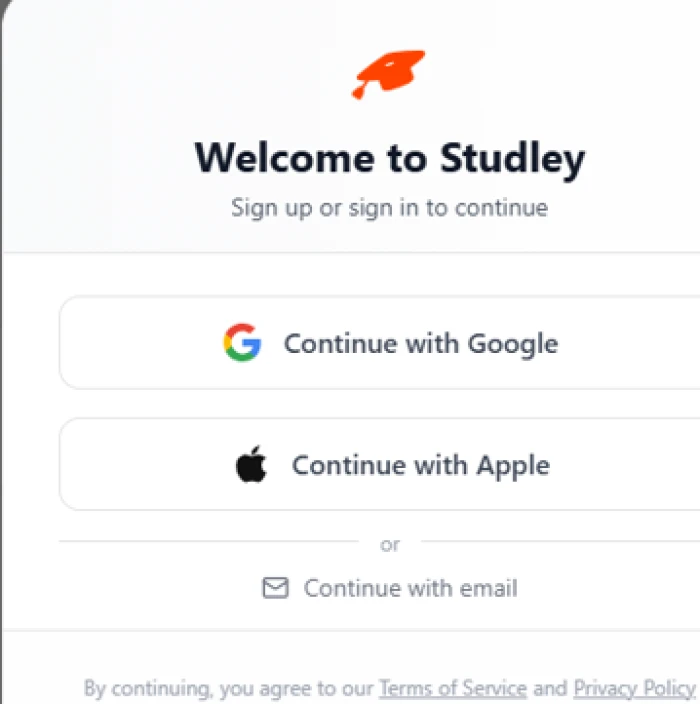
The sign-in card: Google, Apple or email, and nothing else to fill in.
First impression: The entry point is about as light as it gets. One card, three choices: a Google or Apple account, or a plain email address. No long form, no card details, no verification loop before you can look around. You are inside in a few seconds, which is what you want from a tool you have not decided to trust with your notes yet.
Starting a Study Set
Test 02 . Inputs
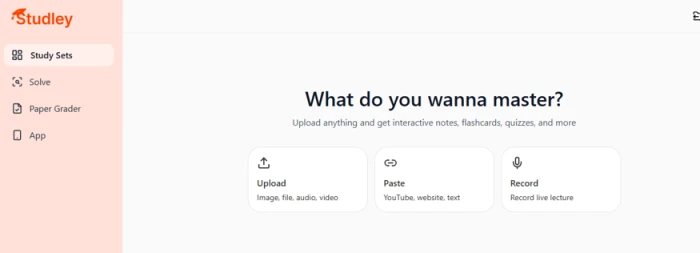
The home screen, with Upload, Paste and Record as the three ways to start.
What stood out: The home screen asks one plain question, "What do you wanna master?", and offers three routes: upload an image, file, audio or video; paste a YouTube link, a website or raw text; or record a live lecture. That last route is the separator. Pointing it at a YouTube lecture or recording a class and getting structured material back is the feature a plain flashcard app cannot match.
What Comes Back
Test 03 . Study-set output
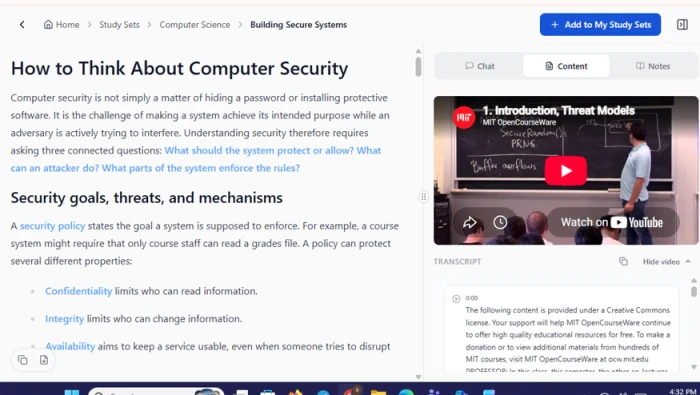
A study set: AI notes on the left, the source video and transcript on the right.
The evidence: I ran a computer-science source through it and got a study set titled "Building Secure Systems." The organisation is the strong part. The left pane holds clean, readable notes with key terms picked out in colour, such as confidentiality, integrity and availability. The right pane keeps the original alongside: the embedded video with a time-stamped transcript you can scroll while you read. Tabs for Chat, Content and Notes mean the material and the study aids live together instead of scattered across windows.
The Quiz and Flashcard Engine
Test 04 . Study aids
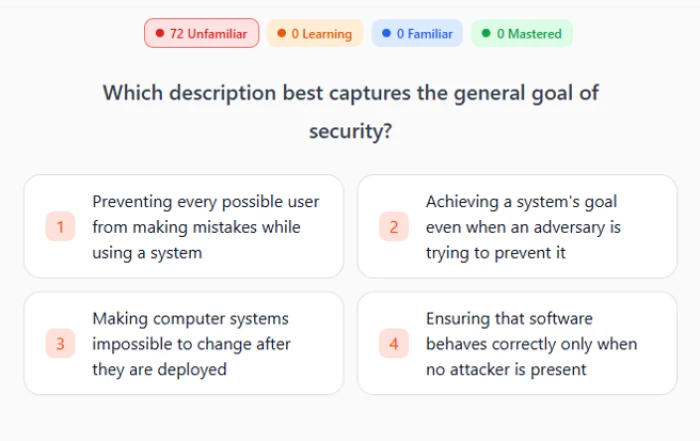
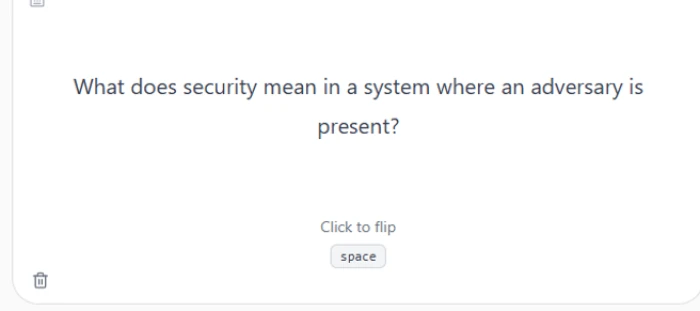
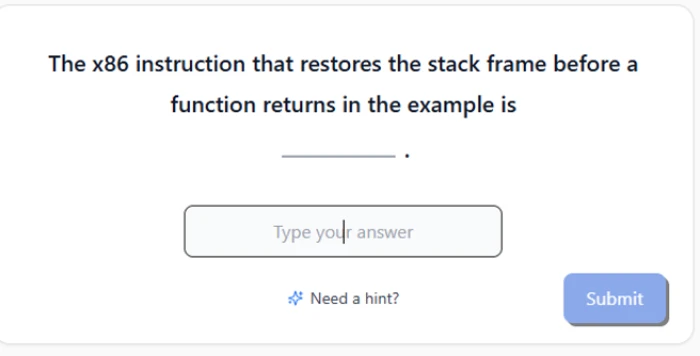
Multiple choice, with distractors close enough to make you think.A click-to-flip flashcard for active recall.Fill-in-the-blank, with an optional hint for the tougher ones.
What this confirms: This is where Studley earns its keep. From one source it built a large question bank and tracks each item through four stages, from Unfamiliar to Learning to Familiar to Mastered, so review shows progress rather than endless grinding. The formats vary and read well: multiple choice with plausible wrong answers, click-to-flip cards, and fill-in-the-blank with a "Need a hint?" option on the harder ones. The questions tracked the source closely and tested understanding, not keyword matching, which is where a lot of AI quiz tools fall apart.
★
Any source in, a usable study set out
The combination I could confirm hands-on is the real draw: a recorded lecture or a YouTube link becomes structured notes, a scrollable transcript synced to the source, and a varied quiz bank with mastery tracking. Almost nothing else in this space accepts that range of inputs and returns material this organised from a single pass.
!
The free account stops almost immediately
The free tier builds a single study set and then asks you to pay, and the interface does not show the price until you reach the upgrade flow. The generated notes also need a human check: they read well, but anything auto-made should be verified against the source before an exam rather than trusted on sight.
How this review was put together. Testing ran on October 12, 2026 across a sign-up, one full study set built from a computer-science source, and the multiple-choice, flashcard and fill-in-the-blank formats the engine produced. Pricing and plan limits were confirmed from Studley's own in-app upgrade copy and its published FAQ, with App Store figures taken from the official listing by Studley AI Inc. The generated notes were judged against the source material they came from.
10-Point Feature Review
03 . Scored against what the study set actually delivered
Feature Scores at a Glance
Input Versatility
9.0
Quiz & Flashcard Quality
8.5
Onboarding & Access
8.5
Study Set Organization
8.0
Mobile Experience
7.5
Study Aids & Chat
7.0
Extras: Solve & Grader
6.0
Note Accuracy & Reliability
5.5
Value for Money
5.5
Pricing Transparency
5.0
Feature-by-feature breakdownScored 5.0 to 9.0, weighted toward core study functions
01
Input Versatility Standout
The highest mark on the page, and it earns a 9.0 rather than an 8.5 because the input range is the product's real edge. Files, images, audio, video, YouTube links, websites, raw text and live recordings all become a study set. Recording a lecture in the room and getting structured output back is something almost nothing else in this category does. It stops short of a perfect score only because I tested a single source type end to end.
Routes: upload, paste, recordLive capture: yes
9.0
Standout
02
Quiz & Flashcard Quality Standout
An 8.5. The questions tested understanding rather than surface keyword matching, the distractors were close enough to require thought, and the four-stage mastery tracking turns review into visible progress. Held under 9.0 because a single source produced an overwhelming bank with no obvious way to start from a smaller, prioritised set.
Formats: MCQ, flip, fill-inTracking: 4 stages
8.5
Standout
03
Onboarding & Access Strong
An 8.5 for sign-in with Google, Apple or email, with no setup chore and no verification wall before you can explore. It does not reach 9.0 because the price stays hidden until the upgrade flow, so the smooth start quietly funnels toward a paywall you cannot size up in advance.
Methods: Google, Apple, emailCard needed: no
8.5
Strong
04
Study Set Organization Strong
An 8.0. The notes sit beside the original source and a synced transcript, with key terms colour-coded, so you can check the AI against the material instead of trusting it blind. It lands below 8.5 because the layout quality depends on the notes underneath it, and those were not flawless in sustained use reported elsewhere.
Layout: notes + sourceTranscript: time-stamped
8.0
Strong
05
Mobile Experience Capable
A 7.5, carried by a native iOS app that holds a 4.68 rating across thousands of ratings, which is a genuine signal of broad satisfaction. Kept under 8.0 because specific app-side features draw complaints, including an audio recap that users say runs too fast to follow comfortably.
iOS rating: 4.68Ratings: 4,461
7.5
Capable
06
Study Aids & Chat Capable
A 7.0. The Chat, Content and Notes tabs keep the aids attached to the source, which is the right design. It cannot climb higher because paid users have reported the chat capping how many questions they can ask, so the feature that should be the always-on tutor runs into limits.
Tabs: chat, content, notesChat limits: reported
7.0
Capable
07
Extras: Solve & Grader Unproven
A 6.0. The sidebar carries a problem Solver and a Paper Grader, which round out the one-workspace pitch. The score sits at the midpoint because I did not lean on them in testing, so they are promising additions rather than confirmed reasons to choose Studley.
Solver: presentPaper grader: present
6.0
Unproven
08
Note Accuracy & Reliability Mixed
A 5.5. In my test the notes were accurate, but reliability is the sharpest split in the public record: users report notes that stop halfway through a chapter, cut off mid-table, or thin a long source down to a minimal summary. It avoids a lower mark because my own run held up, yet the pattern of incomplete output is too common to wave away.
My test: accurateReported: cut-off notes
5.5
Mixed
09
Value for Money Mixed
A 5.5. The annual rate works out cheap per week, and heavy users who commit get real value. It is dragged down by a hard free-tier cap and by recurring complaints that the paid product did not deliver what buyers expected, so the value depends heavily on your output actually landing complete.
Free: 1 study setAnnual: $1.88/wk
5.5
Mixed
10
Pricing Transparency Weak
The lowest mark, a 5.0. The product does not show what is free versus paid, or what the plan costs, until you hit the upgrade flow, and the headline figure is quoted per week while billing happens monthly or yearly. The weekly framing makes the commitment look smaller than the amount that actually leaves your account.
Price up front: noQuoted as: per week
5.0
Weak
Pros and Cons
04 . What holds up and what does not
+What Works
Accepts almost any source: files, images, audio, video, YouTube links, websites and live recordings all become a study set
Lecture recording stands out: capturing a class in the room and getting structured material back is rare in this category
Output is organised, not dumped: notes, the source and a scrollable transcript sit together so you can check the AI against the material
High-quality questions: varied formats, fair distractors and hints, with Unfamiliar-to-Mastered tracking that shows real progress
Everything in one workspace: notes, chat, quizzes, a solver and a paper grader instead of three stitched-together apps
Frictionless sign-in: Google, Apple or email, and you are studying within seconds
−What Falls Short
Notes can arrive incomplete: users report material that stops mid-chapter or cuts off partway through a table
Output needs a human check: auto-generated notes should be verified against the source before an exam, not taken on faith
Overwhelming question banks: a single source can produce more cards than is comfortable to start on, with no small prioritised set
Extras are unproven: the Solver and Paper Grader are promising but need real testing before they count as reasons to choose it
Pricing Breakdown
05 . What the plans cost and where the catch hides
Plan
Free$0
Unlimited$1.88 /wk annualFull Access
Study sets
1 total
Unlimited
Upload, paste, record
Limited
Unlimited
Flashcards & quizzes
Limited
Unlimited
Monthly billing option
n/a
$3.74 / wk
Mobile app access
✓
✓
What you are actually paying: Studley runs two tiers. Free lets you build exactly one study set, enough to see the output quality and no more. Everything past that sits behind Unlimited, which the company quotes at $1.88 per week billed annually or $3.74 per week billed monthly, so committing to a year roughly halves the weekly rate. Two things are worth knowing before you buy. The price is quoted per week while your card is charged in a single monthly or yearly amount, which makes the commitment read smaller than the figure at checkout. And because the plan is sold through the app stores, the exact billed total appears in the purchase sheet rather than on a public pricing page, so there is no plain web table to compare against before you reach the upgrade flow.
Pricing verified October 12, 2026 from Studley's in-app upgrade copy and published FAQ. Rates and promotions change, so confirm the billed total in the purchase sheet on the official site before you subscribe.
Studley vs the Top 2 Alternatives
06 . How it compares to the study tools a buyer would shortlist
SStudley
QQuizlet
TTurbo AI
Entry Price
$1.88/wk annual
Plus from $19.99/yr
Free, paid not public
Free Tier
1 study set
Yes, limited
Yes, generous
Record Live Lecture
Yes
No
Yes
Source to Notes
Files, video, YouTube
Manual plus import
Lectures, PDFs
Platforms
Web, iOS
Web, iOS, Android
Web, iOS, Android
Best For
Widest input range in one place
Large shared card libraries
Fast lecture-to-notes capture
Picking between them: Choose Studley when your material lives in lectures, videos and PDFs and you want notes, a transcript and a quiz bank generated together. Quizlet is the pick if you mainly want flashcards and value its enormous library of existing study sets, at a flat and openly published annual price. Turbo AI overlaps most directly on lecture capture and offers a more generous free tier, so it is the natural first comparison if the recording feature is your main reason for looking. Studley's advantage is breadth of input in a single workspace; its risk is output that occasionally arrives incomplete.
What Users Are Saying
07 . Where the public verdict splits
Studley's public feedback pulls in two directions. Its iOS app holds a 4.68 rating across more than four thousand ratings, a broadly happy mass-market audience. Its Trustpilot profile tells a harsher story, averaging well below the middle across a small sample, where the written complaints cluster around incomplete output and billing. The quotes below come from Trustpilot, the one approved platform carrying written reviews, and they surface angles my own testing did not reach.
"Notes are incomplete or cut off mid-chapter, including sections stopping halfway through tables or explanations."
The most flexible input engine in the category, let down by uneven output
Use Studley if you learn from lectures, videos and PDFs and want notes, a transcript and a strong quiz bank built together in one workspace. The input range and the quiz quality are the best reasons to pick it, and the frictionless sign-in makes it easy to try.
Skip Studley if you need output you can trust unverified, or you want to know the full price before signing in. Treat the AI notes as a strong first draft to check against the source. If flashcards alone are the goal at a published flat price, Quizlet Plus is the simpler buy.


Discussion
Join the discussion and share your perspective.