

What Suno AI Is and What Changed in 2026
Suno is the most-used AI music generator in the world, founded in 2022. From a single prompt it builds a full track, with lead vocals, harmonies, drums, bass, and a finished mix, and its V5 model, released in September 2025, pushed output close to studio quality, with vocals that rarely sound synthetic and arrangements rivals still struggle to match.
Two developments reshaped the platform in 2026. On the legal side, Warner Music settled its copyright suit with Suno in late 2025 and signed a licensing deal for new models, while Sony is still in court, so the rules around AI music rights are being written in real time. On the business side, a $250 million raise valued Suno at $2.45 billion and turned it from an industry outsider into a licensed partner. Both threads run through the pricing, feature, and legal sections below.
What Happened When We Generated a Song
The testing for this review centred on one question: how close does Suno V5 actually get to a finished, releasable song from a single prompt? A pop song brief was entered into the platform, the system generated a complete song with lyrics in under a minute, and the resulting track is publicly listenable at the link below. The full lyrics output and prompt are documented in this section so readers can hear the result and read the underlying lyrics simultaneously.
The Homepage and Workflow
Onboarding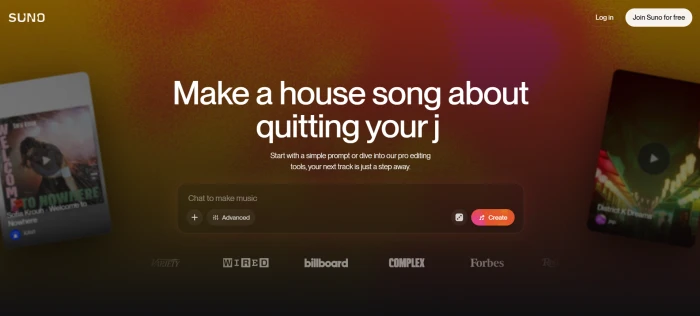
The Prompt and Generation
Test 01 · Pop song from scratch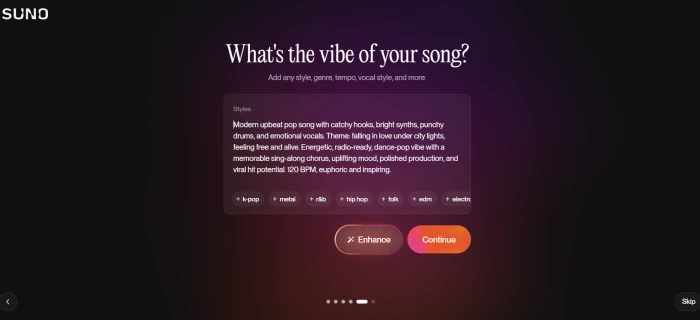
The song generated is publicly listenable at the link above. The vocal performance carries the chorus with no obvious AI artifacts, the production is genuinely radio-ready, and the energy matches the brief. What stands out about the output is not just the audio quality but the structural completeness: the song has a proper intro, verses, pre-choruses, choruses with hooks, a bridge, and an outro, all built around a coherent musical idea rather than just looping a chord progression.
Neon on the windshield, midnight in your eyes
We were two small sparks in a river full of lights
Crossing every line we were scared to cross before
Now the whole street's spinning when you open up the door
Your laugh cuts through the traffic, my heart starts to race
Every empty corner turns electric in your place
I was moving through the city, but I never felt this high
Till you pulled me in and made the skyline come alive
We're falling in love under city lights
Lost in the glow, but it feels so right
Hands in the air and we're flying free
You and me, you and me
We're singing loud to the beat tonight
Burning like gold in the neon sky
No fear, no sleep, just you and me
You and me, you and me
Coffee on a Monday, dancing in the rain
Every little ordinary moment feels changed
Sidewalk conversations, secrets in the dark
You make a masterpiece out of a broken-hearted start
Now the bassline's shaking every window on the block
We don't need forever, just this second on the clock
I was looking for a reason, now I know what I need
When you take my hand, the whole world starts to breathe
If the night runs out, we'll make our own sunrise
If the world gets loud, I'll still hear your voice inside
Every flashing sign says we were meant to be
In the heartbeat of the city, you're the rush in me
[Chorus repeats with full instrumentation]
Under city lights, we come alive
Under city lights, we come alive
Two things stand out about the lyrics. First, the specific imagery: "neon on the windshield," "burning like gold in the neon sky," "the bassline's shaking every window on the block." These are concrete sensory details, not generic AI filler. Second, the structural sophistication: two distinct verses with different scenes, two pre-choruses that bridge into the same chorus differently, a proper bridge that adds emotional escalation, and an outro that distills the hook. Suno V5 generated this from a single prompt with no manual editing.
The Listen-to-Earn Credits Economy
One of Suno's quieter innovations is the Listen-to-Earn dashboard: a system that gives users free credits in exchange for listening to and rating other creators' songs. The feature is visible on every account, prominently surfaced after the free daily 50 credits are spent, and provides a path for free-tier users to extend their generation budget without paying.
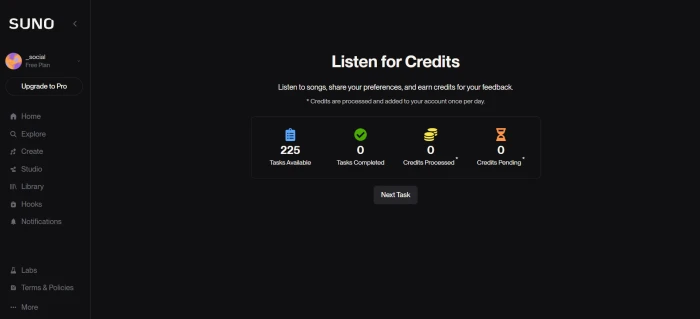
Why this mechanic actually matters
For a generative platform, attention is the scarce resource. Suno needs creators to discover community-generated music to drive engagement and retention; users need credits to keep creating without paying. The Listen-to-Earn dashboard solves both problems at once by tying credit rewards to community attention. It is the only mechanic in any major AI creative platform that turns the platform itself into a credit-earning engine, which materially changes the economics of free-tier use.
For a casual user generating 10 songs a day on the free tier, Listen-to-Earn can effectively double or triple that allowance during active listening sessions. For Suno, it builds a community feed with engagement that pure-feed platforms struggle to manufacture. The trade-off is the time cost: earning credits this way means actually listening to other creators' songs, which is fine for a discovery-minded user and irrelevant for someone who just wants their own music made faster.
Seven Features, Scored
Pricing
Suno's pricing structure stayed consistent through the V5 launch. The free tier remains useful for casual experimentation, Pro at $10 per month unlocks commercial rights and V5 access, and Premier at $30 per month adds Suno Studio and the highest credit allocation. Annual billing knocks 20 percent off both paid tiers.
| Plan | Price | Credits | What It Includes |
|---|---|---|---|
| Free | $0 | 50 daily (~10 songs) | V4.5 model only, personal use only, shared queue, no WAV download, no commercial rights |
| Pro (monthly) | $10/mo | 2,500 monthly (~500 songs) | V5 access, commercial rights, WAV download, ad-free, full speed |
| Pro (annual) | $8/mo equivalent | 2,500 monthly | Same features as monthly Pro, 20% saving locked in |
| Premier (monthly) | $30/mo | 10,000 monthly (~2,000 songs) | Everything in Pro plus Suno Studio, stems export, MIDI export, batch generation, priority queue |
| Premier (annual) | $24/mo equivalent | 10,000 monthly | Same features as monthly Premier, 20% saving locked in |
| Credit top-ups | $8 or $24 | 2,500 or 10,000 one-time | Add credits without upgrading tier, requires active subscription to spend |
How to read it. Pro at $10 monthly is the practical entry point and the recommended tier for any creator using Suno songs in monetised content. The annual discount drops it to roughly $8 per month, which is below most music streaming subscriptions. Premier becomes worthwhile only for users who actually use Suno Studio for multi-track production or need batch generation for high-volume content workflows. Credit top-ups exist as a safety valve for power users running out before the month resets, but they require an active subscription, so they cannot be used to extend free-tier usage.
Pros and Cons
- V5 is the best AI music model on the market, with studio-grade audio that no rival platform matches in 2026
- Lyric generation produces specific imagery and proper song structure, not generic AI rhyming filler
- Suno Studio brings genuine DAW features to AI music for the first time, including stems, MIDI export, and multi-track editing
- Credits do not roll over between billing cycles on subscription plans, so unused monthly allocation is lost
- Copyright vesting is uncertain under current US Copyright Office rules requiring human authorship
- Download caps are being introduced in 2026 alongside the licensed models, with exact limits not yet published
Suno vs the Alternatives
| SSuno | UUdio | MMubert | AAIVA | SSoundraw | |
|---|---|---|---|---|---|
| Score | 8.3 | 7.8 | 7.5 | 7.6 | 7.4 |
| Starting Price | Free / $10 | Free / $10 | Free / $14 | Free / $15 | $16.99/mo |
| Latest Model | V5 (studio-grade) | V1.5 | Generative | Symphonic | Royalty-free engine |
| Vocals + Lyrics | ✓ Full songs | ✓ Full songs | ✗ | ✗ | ✗ |
| Stems + DAW Export | ✓ Premier | ✓ | ✗ | ✓ | ✗ |
| Commercial Rights | Pro+ (contested) | Paid (contested) | Cleared royalty-free | Cleared royalty-free | Cleared royalty-free |
| Free Tier | 50 credits/day | 10 songs/day | 25 tracks/mo | 3 downloads/mo | Limited preview |
| Best For | Full songs, V5 quality | Voice cloning | Streaming BGM | Classical, film scores | Safe royalty-free |
Three useful comparisons drop out of the table. Udio is Suno's closest direct rival on output quality, and is the right pick specifically for voice cloning workflows where Udio is stronger. Mubert, AIVA, and Soundraw all sit in a different category: royalty-free generative music with fully cleared licensing, designed for users who need legal certainty more than vocal songs. For pure vocal AI music with full structure and lyrics, Suno's V5 is materially ahead of every alternative in 2026, and that lead is the basis for the higher score.
Discussion
Join the discussion and share your perspective.
Mason Calloway
Sep 30, 2026Version 5.5 was excellent, but V6 feels like a major downgrade. I recreated the same song with identical lyrics and prompts, but it lost the energy, vocal character, and depth of the original. Please bring back access to V5.5.
Eliana Brooks
Sep 29, 2026I got an incredible track with Suno! The whole process was fun, easy, and creative. I loved experimenting with different ideas and hearing them turn into actual music. Really impressed with the final result!
Thomas Cook
Sep 25, 2026I've tried several AI music tools, but Suno stands out. The music quality and prompt accuracy are excellent, and it consistently delivers impressive results. Definitely my go-to AI music platform.
Cameron Russell
Sep 24, 2026The new update is really disappointing. Song generations feel much less accurate, and the overall quality has dropped a lot.
Daniel Davis
Sep 23, 2026Loved Suno for a long time, but V6 feels like a downgrade. Songs start strong and quickly lose quality. Please listen to longtime users and bring back the older models that actually worked. It should be about the music, not just the next update.
Jessica Wilson
Jun 27, 2026After testing several AI music generators, including Producer.ai, I found Suno.com, especially its V5.0 model, to deliver the best overall experience. The music quality is excellent, and the price-to-performance ratio is difficult to match. I've used it to create and release multiple songs on major streaming platforms like Spotify, Apple Music, and YouTube Music, and the results have been very satisfying. For anyone interested in AI-powered music creation, Suno V5.0 is one of the strongest options available and an easy recommendation.