udio.com · Uncharted Labs, in partnership with Universal Music Group
Udio gives you finer control over where a new musical section lands than any competitor at this price, and then refuses to let you take the result anywhere. Downloads are switched off across the entire platform, stems included, as a consequence of the October 2025 Universal Music Group settlement, and the Share dialog routes every listener back to udio.com. Our fusion prompt for Carnatic violin over drum and bass came back tagged as House on one variation and Dream pop on the other. Worth a look if you want to sketch and listen inside one platform, and worth avoiding entirely if anything you make needs to reach Spotify or a video timeline.
Udio turns a written description into a finished song with vocals and instrumentation. You describe a style in a Describe field and either supply your own lyrics or let the model write them. Every action returns two variations. Built by Uncharted Labs, a company founded by former Google DeepMind researchers, it launched in April 2024 and spent its first eighteen months as the connoisseur's pick against Suno, favoured by people who cared about production polish over sheer output speed.
The positioning changed in October 2025. Udio settled copyright litigation with Universal Music Group and signed a separate deal with Warner Music, and the current service is explicitly a transition period ahead of a relicensed platform. Udio's own help centre states that downloading of audio, video and stems has been disabled. The company describes what comes next as a place where you stream your creations rather than export them.
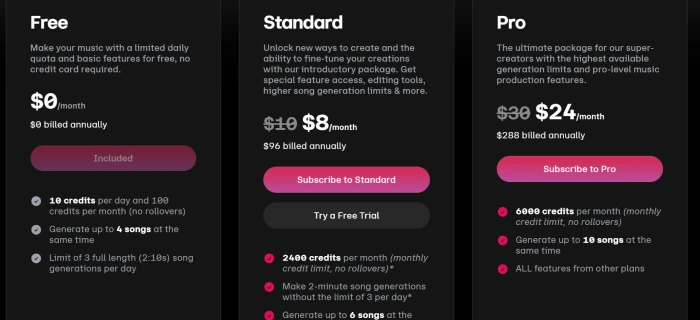
Three plans are on offer. Free costs nothing, Standard is listed at $10 a month, and Pro at $30, with lower effective rates on annual billing.
What Happened When We Tested It
02 . 8 tests run on a free account
Everything below came from a free account, which turned out to be the right lens. The free tier is what a prospective subscriber sees before deciding, and its limits reveal how the whole credit model is structured. I ran a deliberately awkward fusion prompt, tested the extend mechanics, went looking for the download button, and finished with a multilingual test that failed for reasons that had nothing to do with the model.
Three credit pools, none of them announced
Test 01 . Free tier
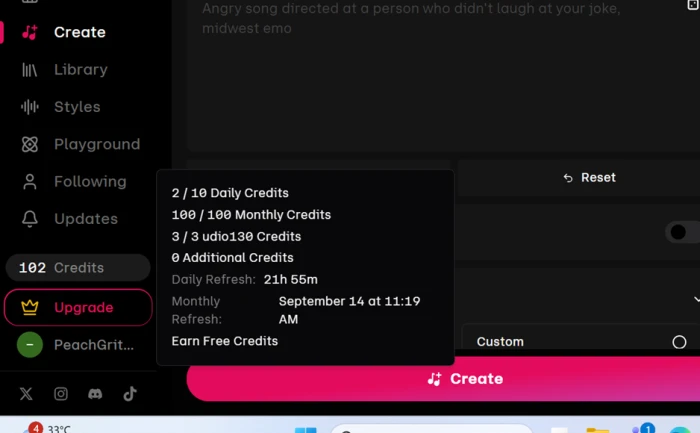
Hovering the counter reveals the daily allowance sitting against a separate monthly pool.
What this shows: The number on screen is not the whole story. Hovering reveals a daily allowance of 10 running against a monthly limit of 100. They refresh on different schedules and neither accumulates. One full-length generation drew 8 credits off my counter and returned two variations, which puts the free month at roughly twelve attempts before the larger pool is gone.
A fusion prompt the model could not template
Test 02 . Prompt adherence
★ Prompt Used
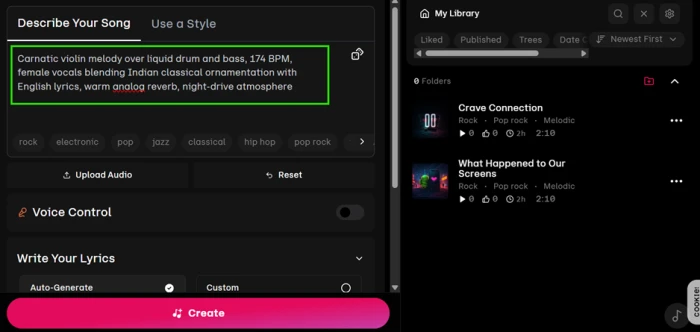
"Carnatic violin over liquid drum and bass at 174 BPM, female vocals carrying Indian classical ornamentation"
The fusion prompt as entered in the Describe field.
The real story: This prompt was chosen because no genre template answers it. Carnatic ornamentation over liquid drum and bass is a combination the training data has almost certainly never seen, which makes it a clean test of whether the model reads a description or pattern-matches to the nearest familiar thing.
The model labels its own output, and disagrees with itself
Test 03 . Genre tagging
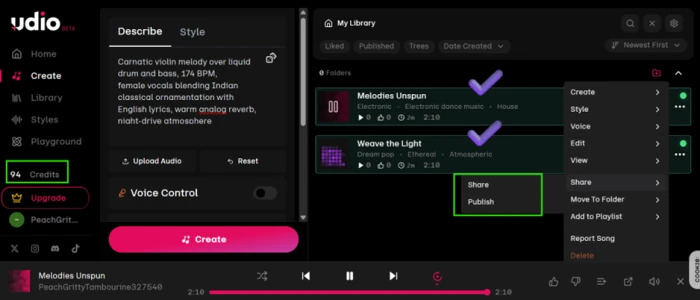
Udio's own tags on the two returned variations.
What matters here: One variation came back tagged House, a genre that lives nearer 120 BPM than the 174 requested. The other was tagged Dream pop. Neither goes anywhere near Carnatic, and more revealing still, the two variations from a single prompt landed in genres unrelated to each other. That split repeated across every test I ran. A later Spanish-language request was tagged Latin pop correctly, so mainstream handling is accurate and the failure is specific to prompts that ask the model to combine traditions.
Extend moves the track forward 33 seconds
Test 04 . Track length
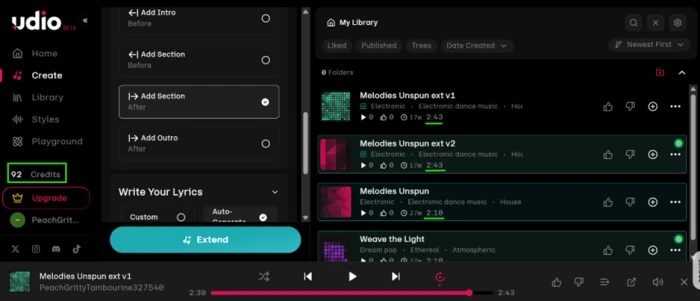
A 2:10 track extends to 2:43, with the counter falling by two.
The takeaway: A single extend is capped at roughly 33 seconds and cost 2 credits for two variations. Getting to a conventional three and a half minute runtime therefore means three separate extends, and each one is a fresh roll on whether the model holds the key and the vocal timbre it established earlier. The controls themselves are the best part of the product. You choose where the new material goes instead of accepting whatever gets appended.
There is no download button anywhere
Test 05 . Export
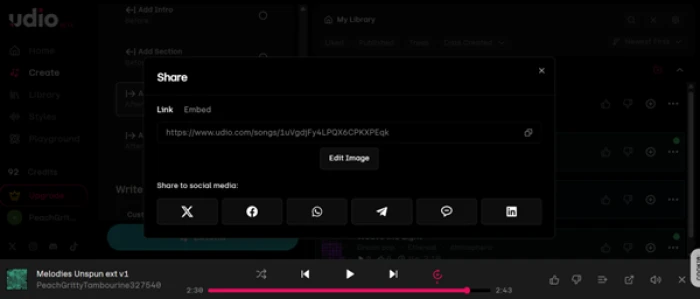
The Share dialog, offering a link and an embed code.
Where it breaks: I went through the track menu twice looking for the export option. What exists instead is a Share dialog offering a link and an embed code, with the social buttons resolving to udio.com. Every path routes a listener into Udio rather than handing you a file. The walled garden Universal negotiated is not an abstraction here. It is the interface.
The best feature is visible and locked
Test 06 . Editor access
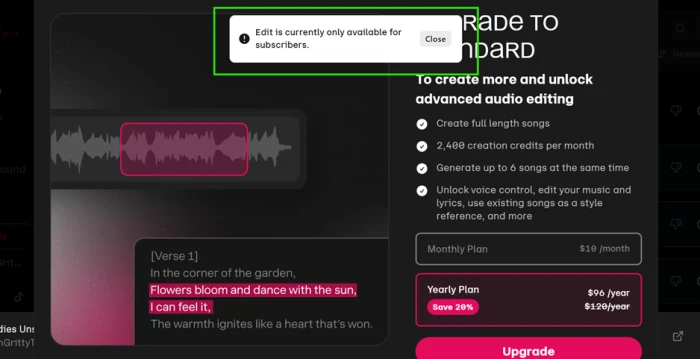
Selecting a waveform region surfaces the lyric line that belongs to it.
The signal here: Select a region of the waveform and the corresponding lyric line appears. This is the section-level control that genuinely separates Udio from its competitors, and it is the clearest argument for paying. Free users get to look at it through the glass.
An interface trap that invalidates a whole test
Test 07 . Lyric handling
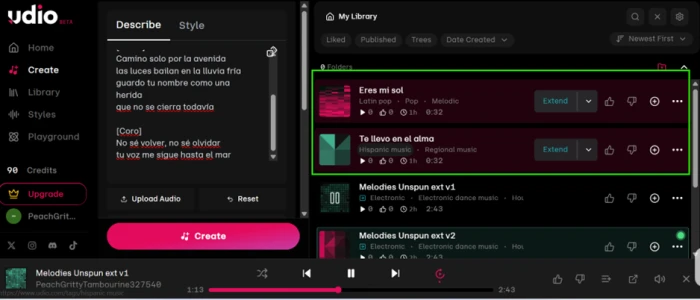
Lyrics pasted into the wrong field, and the invented titles that gave it away.
What clicked: My first multilingual attempt failed because of me, not the model. I pasted Spanish lyrics into the Describe box rather than the Write Your Lyrics section further down the panel, so Udio read my verse as a mood description. The returned titles are what exposed it. Neither phrase appears anywhere in what I submitted, which makes the title a free integrity check on whether your lyrics registered at all.
Correct Spanish words, unmistakably English mouth
Test 08 . Multilingual vocals
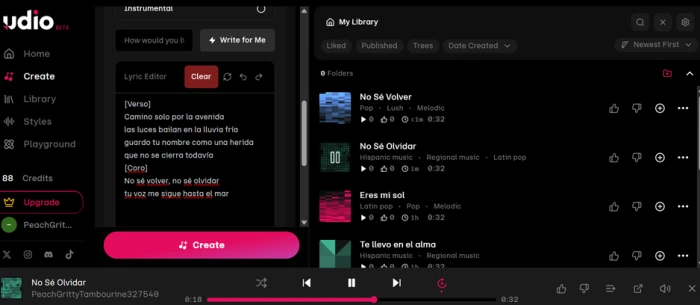
With lyrics in the right field, the returned titles come straight from the submitted chorus.
The validation: The corrected run confirmed itself the same way, returning titles lifted from the chorus I wrote. The model sang the right words. Delivery is where it slips: vowels arrive diphthongised in the English manner, so "solo" leans toward two gliding sounds rather than two pure ones, and the rolled r in "cierra" lands closer to an English retroflex. Spanish is syllable-timed and English is stress-timed, and the phrasing follows the English pattern throughout. A native speaker would place the singer as non-native within a line.
★
Section-level placement paired with titles that audit your own input
Two things held up under testing. The extend controls let you decide where new material is inserted rather than appending blindly to the end, and the waveform selection maps cleanly onto the lyric line it belongs to, which is a real compositional workflow rather than a reroll button. Alongside that, the auto-generated title turns out to be a reliable tell: if it contains a phrase you never wrote, your lyrics went into the wrong field. Anyone benchmarking lyric handling should check returned titles against their input before drawing conclusions about the model.
!
Nothing you make can leave the platform
Downloading is disabled service-wide, stems as well as finished audio, confirmed in Udio's own help centre and visible in the product as a Share dialog sitting where the export option used to be. This is not a free-tier restriction that paying lifts. A subscriber sees the same dialog. Anyone planning to release AI tracks commercially or hand a finished file to a client should treat the platform in its current state as disqualifying rather than merely limited.
How this review was put together. Testing ran in August 2026 on a free Udio account created for this review, with no vendor contact and no complimentary access. The session covered a deliberately difficult fusion prompt, mainstream genre handling, extend mechanics, the sharing menu, the section editor and a two-part multilingual lyric test, with the credit counter recorded before and after each action. Plan prices were checked against the in-app subscription screen and Udio's official iOS App Store listing. Credit limits and the current download status were verified in the Udio help centre.
10-Point Feature Review
03 . Scored on observed behaviour from a free account
Feature Scores at a Glance
Section placement on extend
8.0
Mainstream genre handling
8.0
Lyric-to-waveform editor
7.5
Extend length per action
6.5
Free tier evaluation value
6.0
Multilingual vocal delivery
6.0
Credit transparency
5.5
Variation consistency
5.5
Fusion prompt adherence
5.0
Export and portability
5.0
Feature-by-feature breakdownScored 5.0 to 9.0, weighted toward output and portability
01
Section placement on extend Best feature
You nominate where a new section goes rather than accepting an append to the end, which is compositional thinking rather than slot-machine thinking. It falls short of 8.5 because holding musical continuity across the join is still unreliable, and a 33 second ceiling per action means the control gets exercised three times to finish one track. Nothing observed justified dropping to 7.5.
Placement control: Before or afterCost per action: 2 credits
8.0
Strong
02
Mainstream genre handling Reliable
A Spanish-language request came back correctly identified as Latin pop, and the arrangement matched. Where a prompt sits inside a well-populated genre, the model does what it is told. This sits at 8.0 rather than higher because the sample here is narrow, covering conventional requests only, and the same session showed how quickly accuracy collapses once a prompt steps outside familiar territory.
Selecting a waveform region reveals the lyric line attached to it, which makes targeted revision possible instead of regenerating a whole track to fix eight words. The design earns a high mark on its own terms. It cannot reach 8.0 from this session because free access is view-only, so the mapping was assessed as an interface rather than exercised on a real edit.
Mapping accuracy: Region to lyric lineFree access: View only
7.5
Solid
04
Extend length per action Restrictive
A 2:10 track reached 2:43, so the ceiling is around 33 seconds of new material per extend. Three extends stand between a first generation and a standard radio runtime, and each is an independent gamble on key and vocal continuity. It clears 6.0 because the additions are placeable and cheap in credits. It misses 7.0 because the ceiling turns one creative decision into a sequence of them.
Added per extend: 33 secondsExtends to reach 3:30: 3
6.5
Middling
05
Free tier evaluation value Thin
Roughly twelve full-length attempts a month, capped at three per day, is enough to form a judgement about the model and nowhere near enough to finish anything. That is a defensible trial rather than a generous one, which puts it at 6.0. It would rate lower if generation were blocked outright, and higher if the daily cap did not sit on top of the credit ceiling as a second independent limit.
Full-length attempts: ~12 per monthDaily cap: 3 songs
6.0
Middling
06
Multilingual vocal delivery Accented
Spanish lyrics were sung accurately word for word, which is the harder half of the problem and rules out anything below 5.5. What holds it to 6.0 is phonetics: diphthongised vowels where Spanish wants pure ones, a rolled r rendered closer to an English retroflex, and stress-timed phrasing applied to a syllable-timed language. Fine for a demo, wrong for anything a native audience will hear.
Lyric accuracy: CorrectAccent: Non-native
6.0
Middling
07
Credit transparency Opaque
Two pools on different refresh cycles, neither visible until you hover the counter, and a documented cost that did not match the meter. Udio's help centre puts a pair of full-length songs at four credits. My counter fell by eight. It avoids a lower mark because the counter updates immediately and the help centre does publish the rules. It cannot reach 6.0 while the published figure and the observed deduction disagree by a factor of two.
Every action returns two songs, and across this session the pair routinely landed in genres unrelated to each other. Useful if you are fishing for a direction. Actively unhelpful if you had a direction and wanted two takes on it. Rated 5.5 rather than 5.0 because the divergence is at least wide enough to be informative, and no higher because two variations that share no musical premise are effectively one attempt plus a distraction.
Songs per action: 2Genre agreement: Inconsistent
5.5
Weak
09
Fusion prompt adherence Collapses
A prompt specifying Carnatic violin, liquid drum and bass, 174 BPM and classical ornamentation produced output the model itself tagged House and Dream pop. The tempo was missed and the tradition never appeared. Ornamentation was absent throughout. The score does not fall further because the material returned was competently produced and the failure is confined to cross-tradition requests rather than being general. It cannot rise because none of the four specified attributes survived.
Attributes specified: 4Attributes honoured: 0
5.0
Weak
10
Export and portability Absent
No download exists anywhere in the product, in any format, for free or paying users. The Share dialog offers a link and an embed, and both keep the listener on udio.com. This is the floor of our scale, and it applies because the surrounding platform still functions: tracks play, save to a library and can be sent to someone. What cannot happen is a file arriving on your machine.
Download formats: NoneSharing routes: udio.com only
5.0
Weak
Pros and Cons
04 . What holds up and what does not
+What Works
You place the section: new material goes where you point it rather than being appended to the end
Waveform maps to lyric: selecting a region surfaces the words that belong to it, making targeted revision possible
Conventional prompts land: requests inside a well-populated genre come back arranged the way you asked
Titles audit your input: an invented title is an instant signal that your lyrics never reached the model
Two takes per action: every generation returns a pair, so a weak result rarely costs a second attempt
−What Frustrates
Fusion requests get flattened: cross-tradition prompts snap to the nearest mainstream genre and lose the tempo with it
The pair disagrees: two variations from one prompt frequently share no musical premise
Extend is short: reaching a normal runtime takes three separate attempts, each risking continuity
Nothing exports: no audio, video or stem file can be taken off the platform
Two fields, one mistake: pasting lyrics into the description box is easy to do and easy to miss
Spanish carries an English mouth: correct words, gliding vowels and stress-timed phrasing a native listener catches immediately
Pricing Breakdown
05 . What each tier actually includes
Feature
Free$0/mo
Standard$10/moEntry Paid
Pro$30/mo
Monthly credit limit
100
2,400
6,000
Daily credits
10
Not applicable
Not applicable
Full-length songs per day
3
Uncapped
Uncapped
Songs at the same time
4
6
10
Editing tools
✗
✓
✓
Downloads
✗
✗
✗
What you're actually paying: The subscription screen leads with the annual rate, so the $10 headline is rarely the number at checkout. Committing to a year brings Standard to $8 a month at $96 up front, and Pro to $24 a month at $288. Two details deserve more weight than the prices. First, these are credit limits rather than balances, and they reset without rolling over, so an unused month is simply gone. Second, a subscription trial does not lift the free-tier ceilings, which means a trial account still runs on 10 daily credits and still stops at three full-length songs a day. Anyone trialling Standard to evaluate the editing tools should know they are evaluating them on free-tier generation volume.
One number did not reconcile. Udio's help centre documents a pair of full-length songs at four credits, and my counter dropped by eight for a single generation. Both figures come from official sources, they disagree, and I have reported them as found rather than picking one.
The plan lineup as it appears inside the account.
Pricing verified August 14, 2026 against the in-app subscription screen. Terms are moving quickly during the licensing transition, so check the current plan page before you subscribe.
Udio vs the Top 3 Alternatives
06 . Every figure taken from each vendor's own pages
UUdio
SSuno
11ElevenLabs
MMureka
Entry paid plan
$10 per month
$8 per month billed annually
$6 per month
$8 per month billed annually
Monthly allowance
2,400 credits
2,500 credits
30,000 credits
Up to 400 songs
Taking files off the platform
Disabled entirely
20 song downloads per month on the entry plan
MP3, MP4, WAV and separated stems
MP3 on entry, WAV and stems above it
Best For
Sketching and refining structure inside one platform
Publishing on a schedule with files that leave
Music sitting alongside voiceover in one account
High song volume on a small budget
How to choose between them: Price is almost irrelevant here, because the four sit within a few dollars of each other at the entry tier. The row that decides it is the third one. Udio is the only platform on this list where a finished track cannot become a file, which removes it from consideration for anyone whose work ends in a release, a client handoff or a video edit. Suno introduces its own monthly download caps rather than unlimited exports, so heavy publishers should count their releases against that ceiling before committing. What Udio still has, and what none of the others match at this price, is the ability to decide where a section goes and revise it against its own lyric line. That is worth paying for the day the files can leave.
What Users Are Saying
07 . Five reviews from Trustpilot and the App Store
"I subscribed specifically because the platform advertised that I could DOWNLOAD my creations"
Who should pay for a music tool that will not give you the music?
Use Udio if your work ends inside the platform, meaning you write and listen for your own satisfaction, or you are testing structural ideas you intend to rebuild elsewhere. The section placement and the lyric-to-waveform mapping are better than anything at this price.
Skip Udio if anything you make has to end up somewhere else, because no file leaves the platform on any tier. Suno and Mureka both still export, and ElevenLabs covers music alongside voiceover if you want one account for both.

Discussion
Join the discussion and share your perspective.