Writeless AI is an AI essay writer targeting students and academics that generates essays with real academic citations across MLA, APA, Harvard, Chicago, and Vancouver formats, bundled with an AI humanizer, AI detector, bibliography generator, and paraphrasing tools. The platform's main pitch is academic-grade content generation with citations linked to actual papers and books. The test session below produces the most damaging editorial finding in any FirmCritics review to date: the platform's AI humanizer failed a circular self-test, content humanized by Writeless's own tool re-tested as 100% AI by Writeless's own detector. Plus the free tier paywalls essay output mid-generation. Pricing ranges from $9.99 to $39 per month across tiers.
FC
FirmCritics Editorial Team
Published June 3, 2026 · 17 min read · Updated regularly
Writeless AI is an AI-powered essay generation platform aimed at students and academic writers. The platform generates essays from topic prompts, attaches real academic citations across multiple formats (MLA, APA, Harvard, Chicago, Vancouver), and bundles supplementary tools: an AI humanizer claiming to make AI-generated text undetectable, a built-in AI detector, a bibliography generator, and a paraphrasing tool. The platform connects to academic databases to find real, relevant sources, and the citations are positioned as linking to actual papers and books that support arguments. This is the platform's primary value proposition: AI-generated essays with verifiable academic citations.
The platform offers a freemium model with a limited free tier and paid subscriptions starting at $9.99/month for unlimited essay generation and up to 20,000 words and 20 citations per essay. Higher tiers extend to approximately $39/month. However, the test session below documents two significant friction points: the free tier paywalls essay output mid-generation (frustrating evaluation), and the AI humanizer failed a circular self-test that calls the entire detection-bypass value proposition into question.
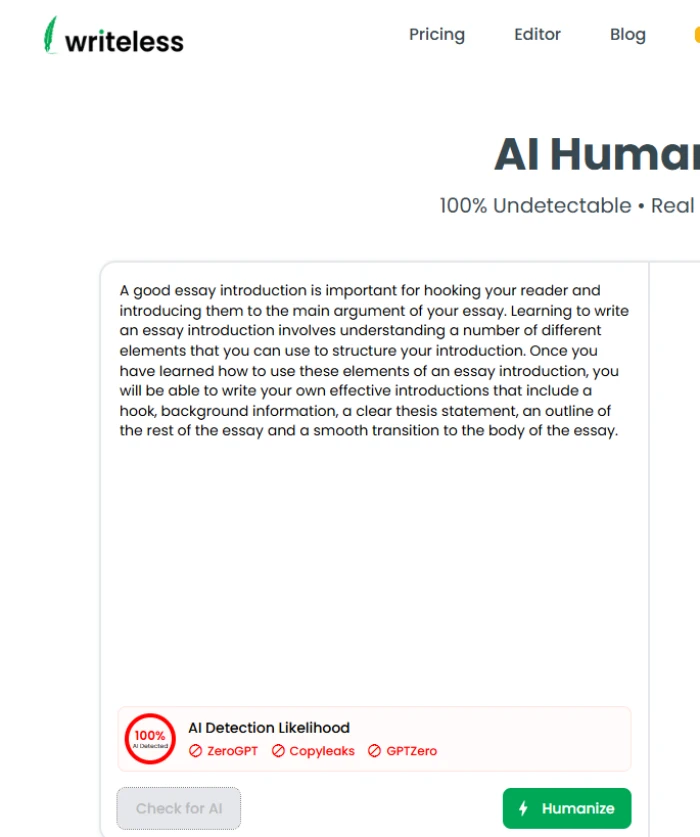
The most editorially significant finding in this review: content from Writeless AI's own blog was tested through Writeless's own AI detector and flagged as 100% AI-generated. The same content was then processed through Writeless's own humanizer, and the humanized output was re-tested through the same detector, the result remained 100% AI-detected. This is a circular self-contradicting failure on the platform's flagship academic-integrity feature: the humanizer cannot make text undetectable even by the platform's own detection model. This inconsistency is also evident on the institutional detectors students actually face (Turnitin, GPTZero, Copyleaks), humanizer-processed Writeless output is frequently flagged as AI at high confidence by those systems. For students relying on the humanizer to bypass institutional AI detection, this is a fundamental value proposition failure. Test 03 below documents the workflow inline with screenshots.
What Happened When We Tested It
02 . Four tests with major flagship-feature failure documented
The test session ran on a Writeless AI free tier account in June 2026 and exercised the dashboard pre and post login, essay generation with citations (paywalled mid-output), the AI humanizer with a controlled circular test using Writeless's own blog content as the AI-input baseline, and the bibliography generator surface. The session produced the most damaging single editorial finding in the FirmCritics catalog to date: the humanizer's circular self-contradicting failure. Documented below with screenshots.
Dashboard (Pre and Post Login)
Test 01 . Entry experience
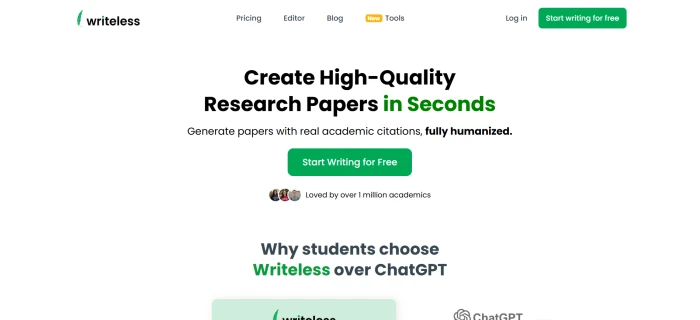
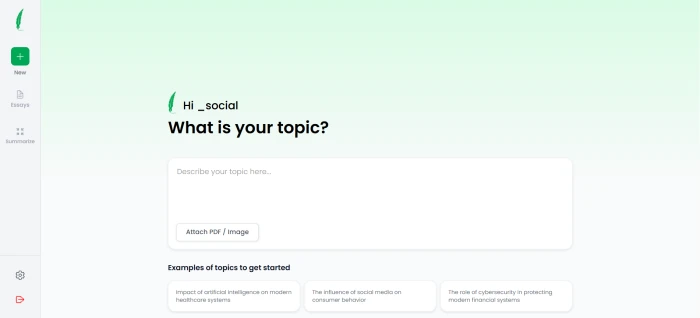
The Writeless AI pre-login marketing dashboard.The post-login dashboard with tool suite access visible.
What this shows: The pre-login surface markets the academic-writing positioning with citation format claims (MLA, APA, Harvard, Chicago, Vancouver) and the "undetectable AI" pitch. The post-login dashboard exposes the tool suite (essay generator, humanizer, detector, bibliography generator, paraphraser) for the academic writing workflow. The test session confirmed that navigation is clean and writing workflow surfaces are immediately accessible. Writeless does not bury features behind complex menus or require extensive onboarding.
Essay Generation (Paywalled Mid-Output)
Test 02 . Free tier evaluation friction
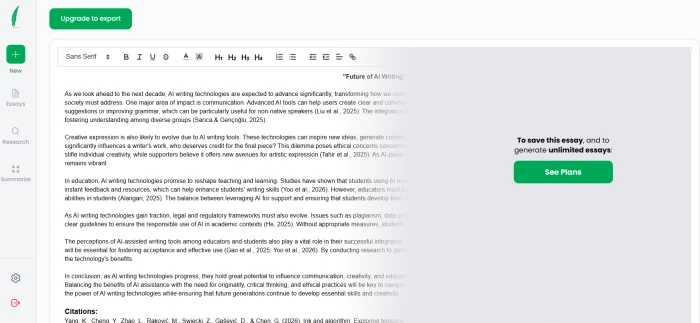
Generated essay on "Future of AI writing" with 10 citations, half visible, the rest paywalled.
What this confirms: The free tier paywalls essay output mid-generation. The test session prompted an essay on "Future of AI writing" with 10 citations, and the platform produced output but blocked the second half behind a subscription upgrade. The free tier also disables download and copy of the partial visible output, so even partial evaluation is constrained. For prospective users wanting to validate essay quality, citation accuracy, and writing style before paying, the free tier provides effectively no pre-purchase evaluation. This is the same pre-purchase friction documented in other recent reviews (Wava AI's no-free-credit policy), and it makes pre-commitment validation meaningfully harder.
AI Humanizer Circular Self-Test (FAILED)
Test 03 . Flagship feature failure documented
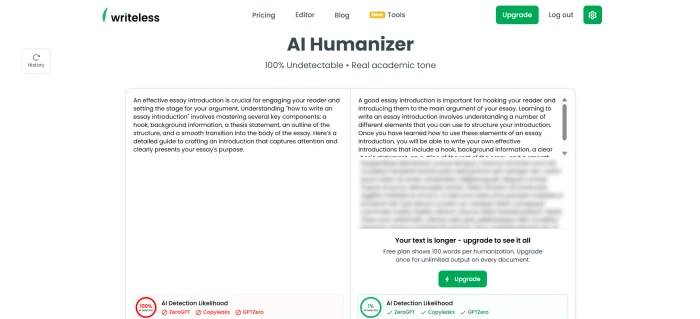
The test method: take Writeless AI's own blog content (human-written by Writeless's team), run it through Writeless's own AI detector. Then humanize that same content using Writeless's own humanizer. Re-test the humanized output through Writeless's own AI detector.
The AI humanizer with Writeless's own blog content pasted, detected as 100% AI by Writeless's own detector.
The content was humanized via Writeless's humanizer. The output was re-tested through the same detector:
The humanized text re-tested: still 100% AI-detected by the same detector. Circular failure confirmed.
!
Critical Self-Contradiction: Humanizer Output Still 100% AI Per Own Detector
The circular test produced a logical contradiction: Writeless's humanizer cannot make text undetectable even when measured against Writeless's own detection model. If the platform's own AI detector cannot recognise its own humanized output as human, the value proposition for students worried about institutional AI detection (Turnitin, Copyleaks, GPTZero) is fundamentally undermined. The institutional detectors students actually face are typically more sophisticated than the bundled Writeless detector, if the Writeless detector cannot be fooled, more sophisticated detectors are very unlikely to be fooled either. Manual rewriting remains the only reliable method to reduce detection risk on institutional tools. For the primary use case of avoiding institutional AI detection, the humanizer fails its core promise.
What this confirms: The test method was deliberately controlled: using Writeless's own blog content (presumed human-written by their team) as a baseline detection input established that the detector itself flags general written content as AI. That is the first concerning signal: Writeless's detector may have a high false-positive rate on actual human writing. But the more critical signal is that the humanizer cannot fix this for the platform's own detection model. The combined finding (over-eager detector + ineffective humanizer) means Writeless's detection-bypass workflow is broken on both ends. Students depending on this workflow for academic submission integrity should not trust the platform's claims.
Bibliography Generator and Featured Tools
Test 04 . Supplementary capabilities
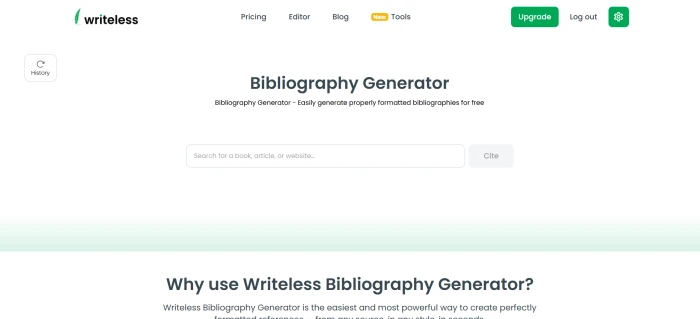
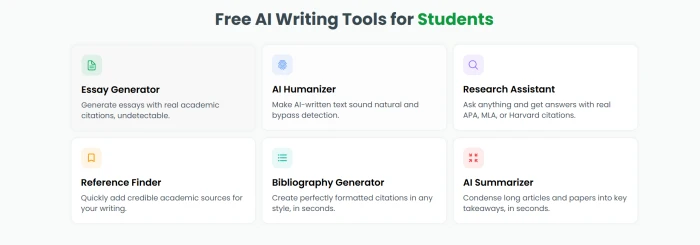
The bibliography generator: input sources, choose format, generate bibliography.The marketed free AI writing tools grid showing the full bundled toolkit.
What this shows: The bibliography generator is functional and supports citation entry across multiple academic formats. For students manually constructing references after research, this is useful workflow support, regardless of the humanizer failure documented above, the bibliography tool stands on its own merits. The marketed features grid surfaces the broader bundled toolkit (essay writer, humanizer, detector, bibliography, paraphraser), positioning Writeless as a one-platform academic writing workflow rather than a single-purpose tool. The challenge is that the flagship humanizer feature does not work as claimed, which calls the broader value proposition into question. Citation accuracy is also a documented industry-wide concern for AI essay writers, Writeless is not an exception, prospective users should treat AI-generated citations as starting points for manual verification rather than finished references.
How this review was put together. First-hand testing on a Writeless AI free tier account in June 2026 covered the dashboards, essay generation (paywalled mid-output on free tier), a controlled circular test of the AI humanizer using Writeless's own blog content as baseline (documented inline in Test 03), and the bibliography generator surface; broader pricing structure and citation accuracy concerns cross-reference multiple third-party reviews including AI tools review platforms, academic writing tool evaluations, and dedicated humanizer comparison reviews.
10-Point Feature Review
03 . What the AI essay platform delivers (and doesn't)
Feature Scores at a Glance
Citation Format Support
7.5
Bibliography Generator
7.5
Essay Generation Workflow
7.0
User Interface Cleanliness
7.0
Customization (Tone, Voice)
7.0
Citation Accuracy
6.0
AI Detector Reliability
5.5
Free Tier (Paywalled Output)
5.0
Pricing Transparency
5.0
AI Humanizer (Circular Failure)
4.0
Feature-by-feature breakdownScored on a 10-point scale
01
Citation format support 5+ FORMATS
The platform supports all major citation styles including MLA, APA, Harvard, Chicago, and Vancouver. For students whose institutions specify particular citation requirements, having multiple formats native to the platform eliminates the need for separate citation management tools. This is the strongest single supported claim, format breadth is verifiable across the platform itself.
The bibliography generator (documented in Test 04 above) is functional and supports citation entry across multiple academic formats. For students manually constructing references after their research, this is useful workflow support that stands on its own merits regardless of issues elsewhere in the platform. The tool supports proper attribution and helps prevent plagiarism as part of the academic workflow.
The essay generation engine produced output in the test session (validated up to the paywall point in Test 02 above). The workflow is straightforward: topic prompt to citation-rich draft, suitable as a starting point for further manual editing. Output quality cannot be fully assessed without paid tier access, but the partial visible content was structurally reasonable for an academic draft.
WORKFLOW: Topic prompt to citation draftVALIDATION: Partial (paywalled)
7.0
GOOD
04
User interface cleanliness CLEAR
The test session confirmed the navigation is straightforward and the writing workflow surfaces are immediately accessible. The platform does not bury features behind complex menus or require extensive onboarding, which is positive for the student target audience who may not have time for tool learning curves.
Writeless allows customization across multiple controls: writing tone, voice, complexity, and formality. For students writing for different academic levels or fields (high school, undergraduate, graduate, different humanities and sciences disciplines), the tone customisation matters. The depth of customisation versus competitor tools is comparable rather than differentiated.
CONTROLS: Tone, voice, complexity, formalityDEPTH: Standard for category
7.0
GOOD
06
Citation accuracy INCONSISTENT
Citation accuracy is the structural concern for AI essay tools, the entire value proposition of the citation feature is real-source attribution, but if accuracy is inconsistent in practice, every citation requires manual verification before submission, which substantially reduces the time-saving value. Citation accuracy is a documented industry-wide concern for AI essay writers, and Writeless is not an exception. The practical recommendation: treat Writeless citations as starting points for research, not finished references; verify every citation against the original source before submission.
AI detector reliability HIGH FALSE POSITIVE SIGNAL
The test session in Test 03 above flagged Writeless's own blog content (presumed human-written) as 100% AI by the platform's own detector. This is concerning on its own merits, regardless of the humanizer issue, a detector with a 100% false-positive rate on actual human content is fundamentally unreliable. The detector should serve as a quality control layer before submission, but a tool that cannot distinguish human writing from AI writing cannot provide that assurance. Detection outcomes vary significantly by content type, length, and detector model, which is the documented industry pattern; the Test 03 self-failure is consistent with that broader inconsistency rather than an outlier.
OBSERVED: 100% AI on human contentRELIABILITY: Questionable
5.5
WEAK
08
Free tier (paywalled output) EVALUATION GAP
The free tier paywalls essay output mid-generation per Test 02 above, and download/copy of the partial visible output is also disabled. For prospective subscribers wanting to validate essay quality, citation accuracy, and writing style before paying, the free tier provides effectively no meaningful evaluation. The recommended approach is monthly commitment first to validate fit on personal academic content, then annual billing only after multiple cycles confirm value.
FREE TIER: Partial output, no downloadALTERNATIVE: Monthly billing first
5.0
WEAK
09
Pricing transparency SIGNIFICANT VARIANCE
Pricing varies meaningfully across third-party sources ($9.99 to $24.99 cited for Basic entry, up to $39 for Premium), and the published pricing is widely characterised as misleading because monthly billing exceeds the annual-equivalent rate displayed initially. The 7-day free trial advertised in some sources is not consistently available across the actual signup flow. Verify current pricing carefully on the plans page before committing, particularly the difference between displayed-annual and actual-monthly rates.
RANGE: $9.99 to $39/monthWARNING: Monthly > displayed annual rate
5.0
WEAK
10
AI Humanizer (circular self-failure) CORE FEATURE FAILED
The humanizer circular failure is documented in the the concerns summary above (overview headline + Test 03 documented evidence). The practical implication: for students depending on detection avoidance, this is the platform's most critical failure. Dedicated humanizer specialists deliver more reliable detection bypass than bundled essay-writer humanizers. The workaround: manual rewriting remains the only reliable method to reduce detection risk on institutional tools like Turnitin, Copyleaks, and GPTZero. For the primary use case of bypassing institutional AI detection, Writeless's bundled humanizer cannot be trusted with academic submissions.
Up to 20,000 words and 20 citations per essay on paid tier
Citations link to real academic databases (though accuracy requires verification)
Budget-friendly entry tier at $9.99/month (verify actual monthly billing on plans page)
−What users dislike
Citation accuracy is inconsistent, every citation requires manual verification against original sources
Pricing varies significantly across sources and monthly billing exceeds displayed annual-equivalent rate
"Undetectable" mode inconsistent on third-party detectors including Turnitin, GPTZero, Copyleaks
Platform "flying under the radar", limited online discussion signals low traction
Manual rewriting recommended as more reliable than the humanizer for detection bypass
Pricing Breakdown
05 . Free, Basic, Premium tiers (pricing varies across sources)
Tier
Free
Basic
Premium
Monthly Price
$0
$9.99/month (most cited)
Up to $39/month
Source Variance
n/a
$9.99 to $24.99 (varies)
Higher tiers vary by source
Essay Output Access
Paywalled mid-essay
✓ Full access
✓ Full access
Maximum Essay Length
Short, partial
Standard
20,000 words
Citations Per Essay
Limited
Standard
20 citations
Citation Formats
✓ All 5+
✓ All 5+
✓ All 5+
AI Humanizer
Limited use (failed test)
Inconsistent
Unlimited but inconsistent
AI Detector
Limited, questionable reliability
✓
✓
Bibliography Generator
✓
✓
✓
Customization (Tone, Voice)
Standard
✓
✓
Download / Copy Output
Disabled on free tier
✓
✓
Best For
Initial UI evaluation only
Light student usage
Long essays (heavy users)
The pricing decision logic: The free tier is essentially demo-only, not evaluation-capable, the essay paywall and disabled download/copy mean prospective subscribers cannot validate output quality or citation accuracy before paying. Basic at $9.99/month is the practical minimum for any meaningful work, though the actual monthly cost may be higher than the displayed annual-equivalent rate. Given the documented humanizer failure and free tier limitations, commit to monthly billing only for at least one cycle, validate actual essay output and citation accuracy on personal academic content, and crucially, do not rely on the humanizer for institutional AI detection bypass. For students primarily needing detection avoidance, dedicated humanizer specialists deliver better results. For students primarily needing AI-assisted draft generation with citation scaffolding, Writeless is serviceable but not differentiated, ChatGPT plus manual citation construction may produce comparable results without subscription commitment.
Writeless AI vs the Top 4 Alternatives
06 . How it compares for AI essay writing
WWriteless AI
MWriteMyEssay.ai
CChatGPT
TTenorshare Bypass
SSmodin
Score
6.0
7.5
8.5
7.2
7.0
Starting Price
$9.99/mo Basic
$15/mo
Free / $20/mo Plus
$9.99/mo
$10/mo
Free Tier
Paywalled mid-essay
✓ Trial
Fully usable
✓ Limited
✓
Citation Formats
✓ 5+ formats
Multiple formats
Prompt-based
✗
✓ Multiple
Citation Accuracy
Inconsistent
✓ Verified
Hallucinations possible
n/a
✓
AI Humanizer
Circular failure
✓
✗
Specialist
✓
AI Detector
False positive on own content
✓
✗
✓
✓
Bibliography Generator
✓
✓
With prompting
✗
✓
Customization Depth
✓
Personal style profile
Maximum (prompting)
Limited
✓
Best For
Bibliography + draft
Comprehensive academic
General writing + manual citation
Detection bypass specialist
Multilingual academic
The picture: Writeless's distinctive value is the 5-format citation breadth and bibliography generator. For the primary use cases (essay generation with citations, detection bypass), better alternatives exist at comparable pricing: ChatGPT for general writing flexibility with manual citation construction, dedicated humanizer specialists for detection avoidance, WriteMyEssay.ai for comprehensive academic workflow.
What Users Are Saying
07 . User feedback patterns from across the community
Used Writeless AI for a couple of literature review drafts last semester. The humanizer was the selling point but it's genuinely unreliable, ran my drafts through three different detectors after humanizing and got flagged at high confidence on all of them. Honestly, manual rewriting after the AI draft is the only way I've found that consistently passes institutional checks. The citation feature works in principle but I had to verify every single one against the actual papers, several were either wrong page numbers or attributing claims to the wrong source.
Graduate student
r/GradSchool community discussion
★★☆☆☆
r/GradSchool
Signed up for the free tier to test before paying. The platform generates the essay then blocks half the output behind a subscription wall, so you can see what kind of structure it produces but can't actually read the finished piece. Worse, once I paid, the monthly price was higher than what was displayed on the pricing page (which showed annual-equivalent rates). Cancelled within the first cycle. Not enough transparency about what you're actually paying for.
Trustpilot reviewer
April 2026
★★☆☆☆
Trustpilot
Tried Writeless for end-of-semester papers. The essay generator and citation tool are decent but the humanizer is the weak link, my Turnitin scores didn't change much after running drafts through it. For detection bypass specifically, dedicated humanizer tools work better than what Writeless bundles in. Treating Writeless as a draft generator with citation scaffolding and then doing my own paraphrasing pass is what actually got past my school detection tools.
Undergraduate student
r/college community discussion
★★★☆☆
r/college
Promising idea, execution mostly works. Citation format coverage across MLA, APA, Harvard, Chicago is solid, which is what attracted me. The bibliography generator does what it says. Where it falls short is the humanizer and detector pair, neither feels production-ready compared to dedicated alternatives. Decent for students who want a structured starting point but plan to manually finish the work, not a complete academic writing solution.
Product Hunt reviewer
May 2026 launch surface
★★★☆☆
Product Hunt
· The Verdict ·
6.0/10
Should you use Writeless AI? Here is who it is for.
Use Writeless AI if the workflow needs essay generation with citation scaffolding across multiple academic formats (MLA, APA, Harvard, Chicago, Vancouver) and the bibliography generator complements existing manual research processes; output will be substantially manually edited before submission anyway (treat Writeless as a draft accelerator, not a finished-output tool); the user will independently verify every citation before submission given the documented citation accuracy concerns; the use case does not depend on bypassing institutional AI detection (Turnitin, Copyleaks, GPTZero) given the documented humanizer failure; and the $9.99/month entry tier (if confirmed on current pricing page) justifies the limitations versus free alternatives like ChatGPT plus manual citation construction.
Skip Writeless AI if the primary use case is detection avoidance (the humanizer failed a circular self-test in Test 03 above, and dedicated alternatives deliver better results); pre-purchase output validation matters (the free tier paywalls essay output mid-generation and disables download/copy, making meaningful evaluation impossible without paying); transparent stable pricing matters (monthly billing exceeds the displayed annual-equivalent rate); the user cannot manually verify every citation before submission; ChatGPT plus manual citation construction is acceptable (the price savings are meaningful for budget-conscious students); or the workflow needs platform momentum signals (the limited online discussion suggests low traction).

Discussion
Join the discussion and share your perspective.