
Quick Answer
| Category | Winner |
|---|---|
| Best overall | Eleven Music (ElevenLabs) |
| Best free | Google Flow Music (formerly Riffusion) |
| Best for composers and instrumentals | AIVA |
| Best for YouTube creators | Soundraw |
| Best on a budget | Beatoven.ai |
| Best vocals, with a serious catch | Udio |
I built a shortlist of twelve tools, started verifying pricing against vendor pages, and found that three of them no longer did what every other roundup claimed they did. One had been quietly acquired and renamed. One had a shutdown date on the calendar. One had removed the download button entirely, which means you can make music on it and never hold the file.
That last discovery reframed the whole piece. Choosing an AI music generator in 2026 is mostly a legal decision wearing a creative costume. The copyright settlements between the major record labels and the AI companies have already changed what these platforms are permitted to hand you, and the differences show up in the export menu long before they show up in the marketing.
Below are ten alternatives worth your time, scored on output quality, licensing clarity, editing control, and value. I have flagged exactly where each one will disappoint you.
How I Scored These Tools
Every tool here was assessed against the same four criteria:
- Output quality: 30%
- Licensing clarity and commercial safety: 30%
- Control and editing: 20%
- Value for money: 20%
Licensing carries as much weight as sound. A track you cannot legally release is worth nothing, however good it sounds. That single decision is why one tool below has arguably the best vocals in the category and still finishes last.
Prices were checked against each vendor's public pricing page in early July 2026, with euro figures converted at prevailing rates. AI music pricing moves fast enough that a number can go stale inside a quarter. Nothing on this page is sponsored, and no vendor was contacted for input.
Why Creators Look for a Suno Alternative
Suno is the market leader by a distance. It reported around two million paying subscribers and roughly $300M in annual recurring revenue in early 2026, and raised $400M in June at a $5.4B valuation. Leaders attract people looking for the exit anyway. The common reasons:
- The free tier is deliberately weak. Free users are held on the older v4.5 model and get no commercial rights, which is a nudge toward the $10/month Pro plan rather than a product.
- Credit anxiety. Every serious generation burns credits, and heavy users hit the ceiling fast.
- No stems, no MIDI. Suno hands you a finished mix. If you want to rebuild the arrangement, you are stuck.
- Genre ceiling. Suno is tuned for pop and other vocal-led material. Orchestral and cinematic work lands flat.
- Unresolved legal exposure, which deserves its own section.
The Lawsuits Have Already Rewritten This List
The scoring weights above put licensing on equal footing with sound. Here is the reason.
In June 2024 the RIAA filed coordinated copyright suits on behalf of all three major labels against Suno in the District of Massachusetts and against Udio in the Southern District of New York. The allegation was that both companies trained their models on copyrighted recordings without a licence. Then the coalition fractured.
- 29 October 2025: Universal settled with Udio and announced a joint licensed platform. The next day, Udio disabled all downloads, including stems. Paying subscribers got a 48-hour recovery window running 3 to 5 November before the walls went up.
- 25 November 2025: Warner settled with Suno and signed a licensing partnership. Suno acquired Warner's Songkick ticketing platform as part of the arrangement. Critically, Suno kept downloads and commercial rights intact.
- Warner settled with Udio in November 2025. Merlin followed in December, Kobalt in January 2026.
- Sony has settled with neither company. A summary judgment hearing on the fair use question was scheduled for July 2026.
- Independent artists filed separate class actions from late 2025, arguing that major-label settlements do nothing for musicians distributing through DistroKid or TuneCore.
Two consequences you can act on today. First, Universal insisted on a "walled garden" where AI creations cannot leave the platform, and Warner did not, which is the entire reason Suno users can still download and Udio users cannot. Second, a small group of vendors licensed their training data before shipping rather than after being sued, and those vendors are now the safest place to build a commercial workflow.
That splits the field into four legal postures. Vendors that licensed before launching, or trained only on catalogue they own, sit at one end. Eleven Music and Soundraw are the clearest examples. Suno settled and stayed open. Udio settled and closed. Open-source models sit outside the argument entirely. Every review below states which camp the tool falls into.
Quick Comparison
| Tool | Vocals | Free plan | Commercial use (paid) | Can you export? | Best for |
|---|---|---|---|---|---|
| Eleven Music | Yes | 7 songs/day | Yes, sector limits | Yes | Commercial release and client work |
| AIVA | No | 3 downloads/mo | Full copyright on Pro only | Yes, MIDI + WAV | Film, game, and trailer scoring |
| Soundraw | No | Not advertised | Yes | Yes | YouTube and short-form video |
| Google Flow Music | Yes | Yes | Verify current terms | Yes, watermarked | Free experimentation |
| Loudly | Limited | Limited | Yes | Yes, stems | Producers finishing in a DAW |
| Beatoven.ai | No | Limited | Yes | Yes | Podcasts and budget video |
| Stable Audio | No | Non-commercial | Yes, hosted tiers | Yes | Sound design and self-hosting |
| Mubert | No | 25 tracks/mo | Yes | Yes | Streams, ambient, and APIs |
| ACE-Step (OSS) | Yes (YuE) | Weights free | Model-dependent | Yes | Developers at scale |
| Udio | Yes, best | Yes | Granted on paper | No | On-platform listening only |
The 10 Best Suno AI Alternatives
Ordered by score, highest first. The tool most roundups put at number one sits at number ten, and the reason is the export menu rather than the audio.
1. Eleven Music (4.6 / 5)
Overview. ElevenLabs built its music model the opposite way round from Suno. It signed licensing agreements with Merlin (which represents 30,000 independent labels and distributors) and with Kobalt (the largest independent publisher in the world) before shipping, rather than after being sued. In March 2026 it layered a Music Marketplace on top of the generation engine and relaunched as a consumer platform.
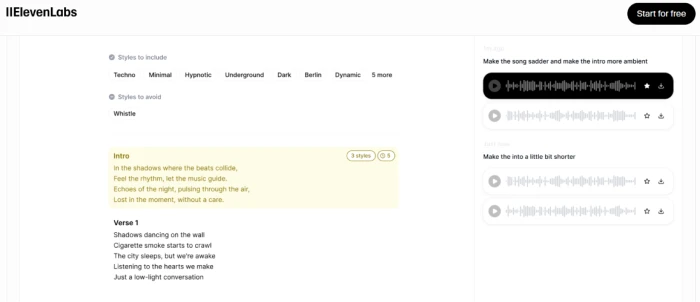
Best for: anyone releasing music commercially, plus agencies and brands who need indemnifiable audio.
Standouts:
- Outputs cleared for broad commercial use, backed by upstream licences rather than a promise
- Vocals and instrumentals across many languages from plain-English prompts
- The Kobalt deal establishes a 50/50 split between compositions and recordings, which is better parity than streaming offers
- A free tier of seven songs per day
Where it falls short:
- Usage terms carve out several sectors: arms, tobacco, pharmaceutical, adult entertainment, religious, political
- You cannot use it to build a competing commercial production-music library
- Vocal realism still trails Suno's v5 line by a small margin
Pricing. Free tier at seven songs per day. Pro at $9.99/month for up to 500 tracks monthly.
Commercial licence. Broad commercial use on paid plans, subject to the sector restrictions above.
Why choose it over Suno. Legal cleanliness. Suno's exposure to Universal and Sony was unresolved as of July 2026. Eleven Music licensed its training data up front, which is the only structural defence against the ruling discussed in the previous section.
2. AIVA (4.3 / 5)
Overview. A Luxembourg company, and the first AI registered as a composer with SACEM. AIVA is parameter-driven rather than prompt-driven, offering more than 250 styles and dropping you into a piano-roll editor once the track exists.
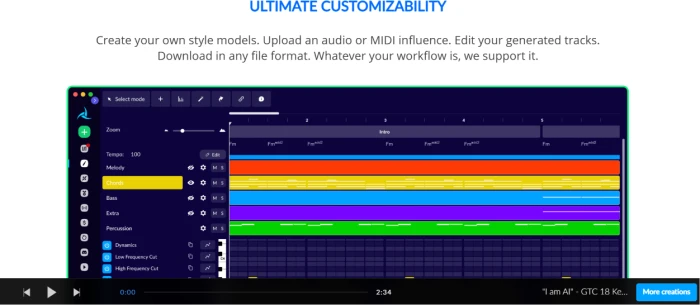
Best for: scoring film, games, trailers, and ads, or anyone who needs to edit individual notes.
Standouts:
- MIDI export, which almost nobody else offers
- WAV and stems on the Pro plan
- Pro transfers full copyright to you with no attribution required
- Custom style training from your own reference audio or MIDI
Where it falls short:
- No vocals whatsoever
- Free and Standard plans leave copyright with AIVA, which is a trap for anyone publishing library music
- Download caps are tight: 3 per month on free, 15 on Standard, 300 on Pro
- The rendered preview uses stock samples, so the MIDI needs a real orchestral library in your DAW before it sounds finished
- No public developer API as of mid-2026
Pricing. Free plan. Standard around €11/month billed annually. Pro around €33/month billed annually, and noticeably higher on monthly billing.
Commercial licence. Free is non-commercial with mandatory attribution. Standard permits monetisation on YouTube, Twitch, TikTok, and Instagram while AIVA retains copyright. Only Pro transfers full copyright.
Why choose it over Suno. You get the underlying parts instead of a bounced file, and the licence is the cleanest in its class once you reach Pro.
3. Soundraw (4.1 / 5)
Overview. A Tokyo company whose model was trained exclusively on original compositions written by in-house producers. That single fact sidesteps the training-data question described in the licensing section above.
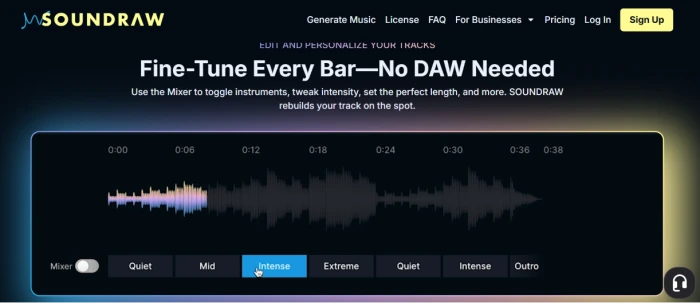
Best for: video creators who need copyright-safe instrumental beds and predictable output.
Standouts:
- Bar-level energy editing, so you can duck under dialogue and peak at the emotional climax rather than laying a flat track across the whole video
- Unlimited generation on paid plans
- A public API
- The cleanest training-data story of any vendor here
Where it falls short:
- Instrumentals only
- The parameter interface is fast but caps how strange your ideas can get
- Niche genres come out generic. Ask for lo-fi hip hop with a specific vinyl crackle texture and you will get generic lo-fi hip hop
- No free tier is advertised on the public pricing page
Pricing. Roughly $5.99 to $11.04 per month depending on plan and billing cycle, with custom enterprise plans available.
Commercial licence. Royalty-free commercial use with retained monetisation rights.
Why choose it over Suno. The vendor owns its training data, so a Content ID claim or an adverse court ruling is not your problem.
4. Google Flow Music, formerly Riffusion (4.0 / 5)
Overview. This is the tool that killed my first draft. Riffusion began as an open-source spectrogram experiment in December 2022, rebranded to Producer.ai in July 2025, was acquired by Google on 24 February 2026, and became Google Flow Music in April 2026. It now runs on Lyria 3 inside Google Labs.
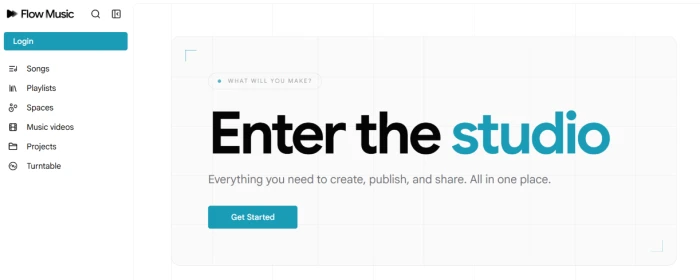
Best for: hobbyists and anyone who wants a conversational studio rather than a prompt box.
Standouts:
- A usable free tier, which is rare now that the leaders have tightened their limits
- A conversational agent that workshops lyrics and melodies across multiple turns instead of rolling a slot machine
- Replace and Extend, which let you turn a lo-fi piano intro into a dubstep drop or rewrite several choruses in one pass
- Tracks up to three minutes
Where it falls short:
- When the models switched on 20 February 2026, all past generations, sessions, models, and media became inaccessible. Users were emailed a warning to download first
- Every output carries an inaudible SynthID watermark that survives MP3 conversion, compression, EQ, and normal mastering. There is no opt-out, and Google runs a public detector
- It is a Google Labs experiment, and Google closes experiments
- Community reports say prompt precision got worse after the model change
Pricing. Free tier. Paid tiers historically ran from about $6 to $48 per month. Confirm the current ladder, since it changed at acquisition.
Commercial licence. Verify before you publish. Labs framing has historically meant weaker commercial guarantees than a paid product carries.
Why choose it over Suno. Cost, plus an iterative editing loop Suno does not offer.
5. Loudly (3.9 / 5)
Overview. Built around production assets rather than finished songs, which makes it a handoff tool rather than a destination.
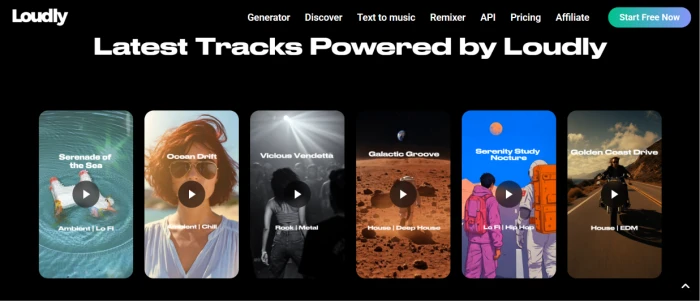
Best for: producers who intend to rearrange and mix the output themselves.
Standouts:
- Stem export as a first-class feature
- Strong customisation controls
- One of the lowest entry prices on this list
- Almost no learning curve
Where it falls short:
- Stem quality is uneven. Drums and bass separate cleanly, while piano and synth stems bleed into each other and need extra mixing
- No weekly plan, so short projects subsidise months you do not use
- Vocal capability is limited
Pricing. Around $5.99/month on annual billing.
Commercial licence. Royalty-free commercial use on paid plans.
Why choose it over Suno. Suno hands you a mix. Loudly hands you the parts.
6. Beatoven.ai (3.8 / 5)
Overview. Purpose-built for scoring video and podcasts, and priced accordingly.
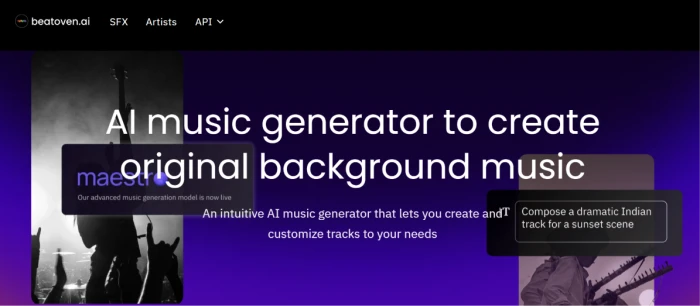
Best for: podcasters and YouTubers who need background beds at exact durations.
Standouts:
- Generate to an exact length, anywhere from 30 seconds to 15 minutes
- Mood and tempo controls tuned to video workflows
- Integrations with Premiere Pro and DaVinci Resolve
- The cheapest plan on this list that includes commercial rights
Where it falls short:
- Instrumental only
- Adaptive scoring struggles across abrupt scene changes. Cut from quiet dialogue into an action beat and the music arrives at the wrong energy
- Output is functional rather than memorable
Pricing. Roughly $2.50/month on annual billing.
Commercial licence. Royalty-free commercial use on paid plans.
Why choose it over Suno. Price, and length control Suno simply does not give you.
7. Stable Audio (3.7 / 5)
Overview. Two products sharing one name. There is a hosted web app with full-length generation, and there are open-weights models you can run on your own hardware. Knowing which one you are using is the first step to setting expectations.
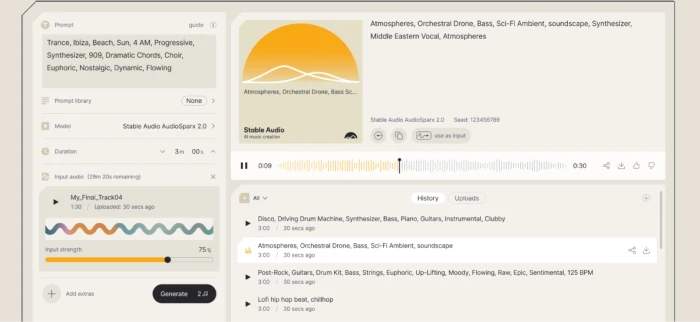
Best for: sound designers, electronic producers, ambient composers, and teams who want a model they control.
Standouts:
- Audio-to-audio transformation driven by a reference track, which gives more control than text alone
- Open weights you can fine-tune, unusual among the major vendors
- Excellent textures and cinematic material
- Full-length generation up to roughly three minutes on the hosted model
Where it falls short:
- The open weights and the hosted model are not equivalent. Stable Audio Open 1.5 caps at about 47 seconds per sample and wants around 12GB of VRAM
- Vocals are not the point here
- The free tier is non-commercial
Pricing. A freemium ladder on the hosted app. Stability adjusts tiers and credit allotments periodically, so read the live pricing page rather than a number in an article.
Commercial licence. Commercial use on paid hosted tiers. Stable Audio Open falls under the Stability AI Community Licence, which is not the same thing as Apache 2.0.
Why choose it over Suno. Reference-driven control, and the option to run the model offline.
8. Mubert (3.5 / 5)
Overview. Generates continuous, evolving streams instead of discrete tracks, so the music adapts rather than loops.
Best for: lo-fi channels, meditation apps, focus streams, and product experiences that need music which never repeats.
Standouts:
- The only purpose-built real-time API in this roundup
- 25 free tracks per month
- Genuine adaptivity rather than a four-bar loop
- Priced between Soundraw's tiers
Where it falls short:
- Narrow range. Electronic, ambient, lo-fi, and downtempo are where it lives, and it shows outside those
- A poor fit if you want a song with a beginning and an ending
Pricing. Creator plan around $14/month.
Commercial licence. Royalty-free on paid plans.
Why choose it over Suno. Suno makes songs. Mubert makes soundtracks that keep going.
9. ACE-Step and the Open-Source Route (3.4 / 5)
Overview. Not one product but a category. ACE-Step 3.5B, YuE 7B, MusicGen, and Stable Audio Open can all be self-hosted on rented or owned GPUs.

Best for: engineering teams generating at catalogue scale, and anyone who needs a training-data licence they can read in full.
Standouts:
- ACE-Step and YuE ship under Apache 2.0, so commercial use is unambiguous
- No monthly cap and no vendor who can revoke your access
- ACE-Step runs on about 8GB of VRAM. YuE needs 16GB and produces full songs with lyrics
- No subscription, and no walled garden risk
Where it falls short:
- Nothing is free. On rented L40S spot instances, ACE-Step costs roughly $0.011 per 30-second generation and YuE about $0.027 per song, against Suno Pro at roughly $0.016 per song
- Below a few hundred songs a month, subscribing is cheaper
- MusicGen is CC BY-NC 4.0, which means no commercial use at all. Check the Hugging Face page for every model before you ship
- Quality trails the hosted leaders
Pricing. GPU rental only.
Commercial licence. Model-dependent, and this is the one place where the licence does vary file by file.
Why choose it over Suno. No subscription, no monthly cap, a licence you can read in full, and no settlement that can change the rules underneath you.
10. Udio (3.2 / 5)
Overview. Most roundups still rank Udio first for vocal realism, and on sound alone it earns that. It sits last here because of what happened on 30 October 2025, the day after it settled with Universal.
Udio disabled all downloads, including stems. Subscribers were given a 48-hour window from 3 to 5 November 2025 to retrieve existing songs under the old terms. Everything created since lives inside the platform. Warner signed a comparable deal that November. Merlin followed in December and Kobalt in January 2026. As of mid-2026 the licensed relaunch had not shipped and downloads had not returned.
Best for: listening to what you made, on Udio.
Standouts:
- Studio-grade 48kHz instrumentals
- The most human-sounding singing in the category, according to most 2026 blind comparisons
- Pro subscribers received 1,200 bonus credits and a one-time grant of 1,000 non-expiring credits as compensation
- A future licensed platform where artists opt in and get paid, which is the most ethically defensible model in the industry
Where it falls short:
- You cannot export. Not to Spotify, not to your DAW, not to a client, not anywhere
- The CEO publicly acknowledged the company hated shipping it that way, which tells you it was a settlement condition rather than a product decision
- A $30/month plan that grants commercial rights on paper and produces no file in practice is a strange thing to sell
Pricing. Free tier. Pro at $30/month.
Commercial licence. Commercial rights granted, export disabled. Read that sentence twice before subscribing.
Why choose it over Suno. Nothing, right now, unless you want a vocal demo you will never distribute. Revisit after the licensed relaunch ships.
Pricing at a Glance
Suno is included as a reference row so the comparison means something.
| Tool | Free plan | Entry paid plan | Commercial rights |
|---|---|---|---|
| Eleven Music | 7 songs/day | $9.99/mo Pro | Yes, with sector restrictions |
| AIVA | 3 downloads/mo | ~€11/mo Standard | Full copyright only on Pro (~€33/mo) |
| Soundraw | Not advertised | ~$5.99/mo | Yes, royalty-free |
| Google Flow Music | Yes | ~$6/mo historically | Verify current terms |
| Loudly | Limited | ~$5.99/mo annual | Yes, royalty-free |
| Beatoven.ai | Limited | ~$2.50/mo annual | Yes, royalty-free |
| Stable Audio | Non-commercial | Varies, check live page | Yes, on hosted paid tiers |
| Mubert | 25 tracks/mo | ~$14/mo Creator | Yes, royalty-free |
| Open source | Weights free | GPU cost only | Model-dependent |
| Udio | Yes | $30/mo Pro | Granted, but export disabled |
| Suno (reference) | 50 credits/day, older model | $10/mo Pro | Yes, downloads intact |
The headline prices hide the real gap. Udio and Suno both top out at $30/month. One of them gives you a downloadable, commercially licensed WAV and the other gives you a stream.
Which One Should You Actually Choose?
The ratings above assume a general-purpose creator. Your situation probably narrows the field to one or two.
- Releasing to Spotify, or selling to clients: Eleven Music. The licensed training data is the whole argument.
- Scoring film, games, trailers, and ads: AIVA Pro. Nothing else exports MIDI.
- YouTube and short-form video: Soundraw. Beatoven.ai if the budget is tight.
- Zero budget: Google Flow Music, with the caveat that you should download everything you care about the day you make it.
- Finishing in a DAW: Loudly for stems, Stable Audio for texture and sound design.
- Building a product, or generating at scale: Mubert's real-time API, or self-hosted ACE-Step under Apache 2.0.
What to Check Before You Commit
Each item below maps to a specific failure I ran into while researching the ten reviews above.
- Can you download the file at all? Udio proves this question is not rhetorical.
- Does the plan you can afford include commercial rights, or only the tier above it? AIVA's Standard plan monetises but does not transfer copyright.
- Who owns the copyright after you download? Ownership and permission to monetise are different things.
- Is the output watermarked, and can distributors detect it? SynthID survives compression, and there is no opt-out.
- Is the training data licensed, or is the vendor mid-litigation? This determines whether the terms you sign today survive next quarter.
- What happens to your back catalogue if the vendor is acquired or pivots? Producer.ai users lost their sessions with an email's notice.
- Do you get stems and MIDI, or only a bounced mix?
Two Tools That Almost Made This List
Google MusicFX. It was on my original shortlist. Google Labs then announced that MusicFX and MusicFX DJ shut down on 31 July 2026, with resources redirected to Google Flow Music. Do not build a workflow on it. If you have unreleased clips sitting there, export them now.
Boomy. The most generous free tier in the category, with unlimited generation and a built-in distribution pipeline to Spotify and Apple Music. Entry paid plan sits around $2.99/month. It stayed off the list on output quality, and because a distribution pipeline bolted onto a generator becomes a liability rather than a feature if the July ruling goes against AI training.
When Suno Is Still the Right Call
An alternatives article that never concedes the incumbent has a point is marketing.
Suno remains the strongest tool available for one specific job: a finished, vocal-led song you can download and release. Warner's November 2025 settlement left downloads and commercial rights intact for paying users, which is exactly what Udio surrendered. At $10/month, Suno Pro undercuts Udio's $30 tier and hands you a WAV at the end of it.
The exposure is real, and worth stating plainly. Universal and Sony remained in active litigation as of mid-2026, settlement talks were reported to have reached an impasse in April, and a summary judgment hearing on fair use was set for July. Discovery had already established that Suno's training data contained millions of recordings owned by those two labels.
A ruling against Suno would not retroactively criminalise tracks you have already released. The claims target how Suno trained its models, not what you did with the output. It would reshape what future models can be trained on, and how much a licence costs everyone downstream.
So the honest position looks like this. If you are releasing this quarter and you want vocals, Suno is defensible, and Eleven Music is the safer trade if legal cleanliness matters more to you than the last ten percent of vocal realism. If you are building a catalogue you intend to own in five years, watch what the court does in July before you commit a workflow to any single platform, because the tool that looks best today is the one most likely to have its terms rewritten by a judge.
Comments
Join the discussion and share your perspective.