
Short answer: I scored Akool 7.8 and PixVerse 7.3. Both hit 8.0 on image-to-video with almost the same prompt, so the tie broke on everything surrounding it. Akool wins on translation, face swap, live avatars, and enterprise proof. PixVerse wins on voice synthesis inside the same subscription, and on free credits that refill daily.
In June I sat a woman at a cafe table and put a warm cup of coffee in her hand. Then I asked for a slow cinematic push-in with shallow depth of field. Steam rising. A soft blink. Morning light through the window. Ultra-realistic skin.
Then I ran nearly that same prompt through the other platform.
The two outputs came back close enough that I scored the feature identically on both, 8.0 out of 10. That result was not what I expected, and working out why it happened took me somewhere the marketing pages of both companies would rather I did not go. It starts with a dropdown menu.
Both generated videos are embedded below and hosted publicly, so you can judge the frames yourself instead of taking my word for it.
The Quick Verdict
These numbers come from the two full reviews on this site. Every one is defended below.
| You are | Pick | Deciding evidence |
|---|---|---|
| Localising video for global markets | Akool | Translation with lip sync across 155 plus languages, scored 8.5 |
| Scaling ad creative variants | Akool | Face swap with no blurry artifacts, scored 8.0 |
| Presenting live on calls | Akool | Live Camera runs under one frame of visible delay |
| Adding narration without a second bill | PixVerse | Voice synthesis included, scored 7.0 |
| Evaluating before you pay | PixVerse | Free credits refill daily, plus referral and achievement credits |
| Animating a single image cinematically | Either | Both scored 8.0, validated with public output URLs |
| Working to a tight budget | PixVerse | Entry tier undercuts Akool’s $30 Pro plan |
Overall, Akool finished at 7.8 and PixVerse at 7.3. The gap is narrower than that sounds, and it is not made of pixels.
The Test: One Cafe, Two Platforms
Controlled comparison needs controlled inputs, so both tests shared a scene, a camera move, and a set of physical details chosen to punish weak motion models.
- A young woman seated in a cafe, blinking naturally.
- Steam rising from a coffee cup, which forces the model to render fine moving particles.
- A slow cinematic push-in with shallow depth of field and background bokeh.
- An explicit 4K quality directive with ultra-realistic skin detail requested.
Akool received the source image plus the motion prompt. PixVerse generated its own source image from a text prompt first, then animated it, which is worth holding in mind because that extra step is a capability difference rather than a handicap.
Phase 1: Akool
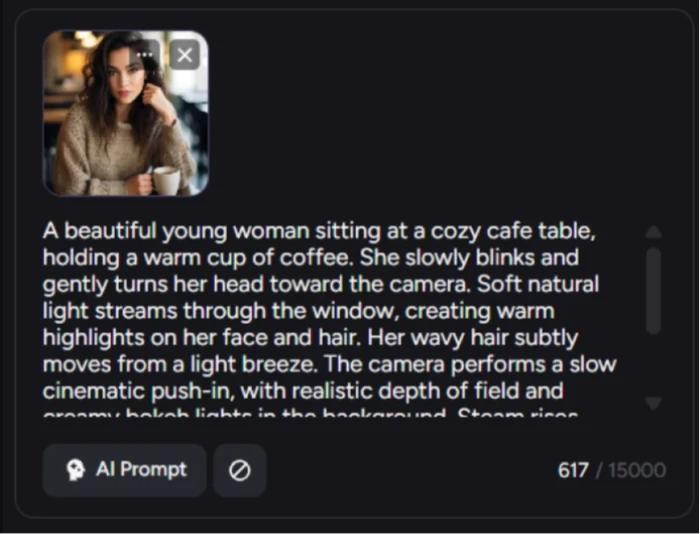
The engine honoured the complex directives. Camera push-in tracked as specified and depth of field held. The steam behaved like steam, and skin detail survived the motion.
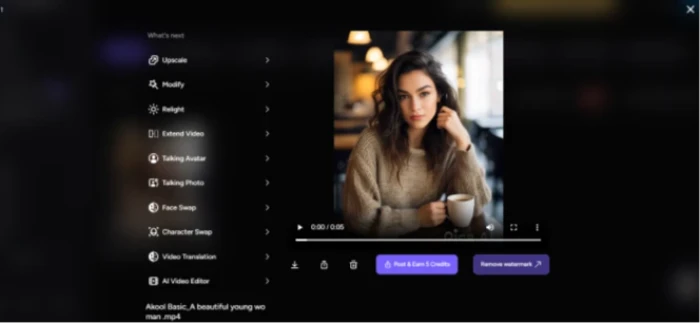
Generated video - click here to see generated video.
Phase 2: PixVerse
PixVerse started a step earlier. A text prompt produced the character, a red-haired woman reading in a cozy cafe, and that generated image became the source for animation.

The animation prompt then asked for a page turn, a brief smile, morning light, coffee steam, blurred cafe guests in motion behind her, and the same slow push-in with shallow depth of field.
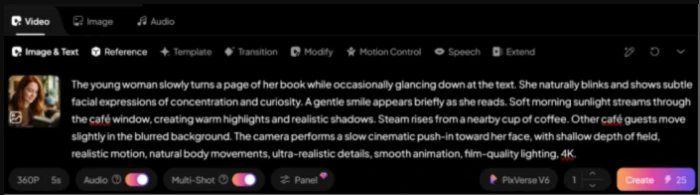
Motion timing matched the prompt cadence. Camera direction was respected. Depth of field aligned with the specification.
Generated result: click here to see generated video.
The result
8.0 for Akool. 8.0 for PixVerse.
Neither clip embarrassed itself. Neither is indistinguishable from a camera. If image-to-video is the only thing you need, this comparison ends here in a draw and you should choose on price. Most readers need more than one thing, which is why the article continues.
Four Things Akool Does That PixVerse Does Not
Akool’s advantages sit in the workflow layer, above the model. They survive whichever engine is selected in that dropdown, and that is precisely why they are durable.
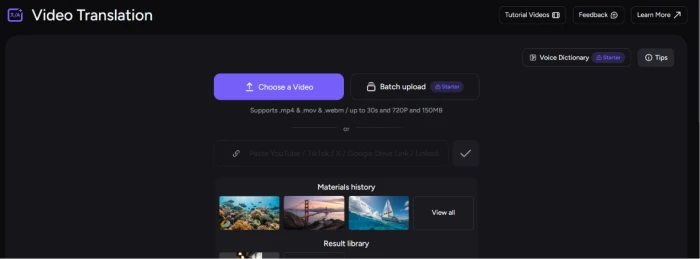
Video translation across 155 plus languages
This scored 8.5, the highest single number across both reviews. Lip-sync precision means the dubbed output does not read as obviously dubbed, which is where most competing tools fall over. PixVerse does not attempt this.
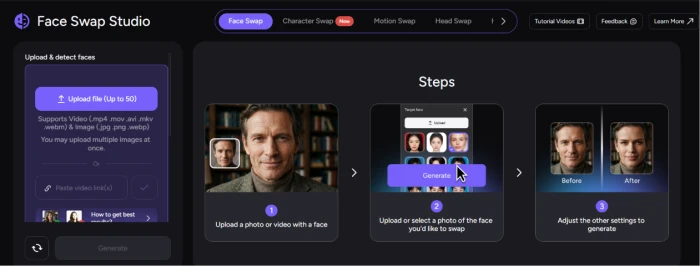
Studio-grade face swap
No blurry artifacts, with facial expression and shadow preserved through the swap. A PPC media buyer described the working pattern in our review comments: shoot one hero video with a model, then generate fifteen to twenty face-swapped variants for cohort testing, shipping them without a manual cleanup pass.
That is a production process, not a novelty. It scored 8.0.
Live Camera
Real-time face transformation on a video call, mirroring expression and gesture with less than one frame of visible delay in Zoom session testing. No competing avatar platform I have tested offers it. Scored 8.0.
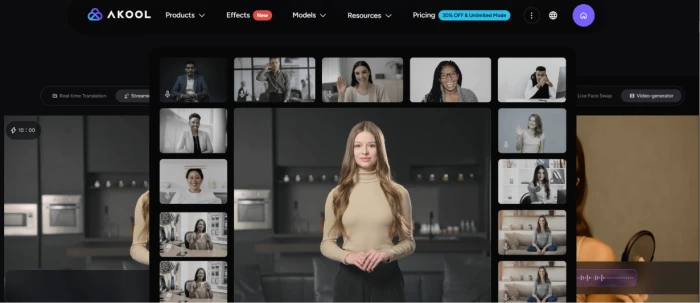
Avatar video and a public avatar library
Studio-grade avatar output at a $30 entry price, with a library of pre-made presenters covering a wide demographic range for teams who do not want to build custom avatars per campaign.

Behind these features sits commercial evidence that matters to a procurement team. Akool was founded in Palo Alto in 2022, reports $40M ARR, took the number one spot on the 2025 Inc. 5000, and counts Coca-Cola and Qatar Airways as customers.
Three Things PixVerse Does That Akool Does Not
PixVerse answers with consolidation rather than depth.
Voice synthesis under the same subscription
The same account that generated the image and animated it also narrated it. Our test fed a short narrative passage into the voice generator and got back narration-quality audio with natural cadence, hosted at a public URL.
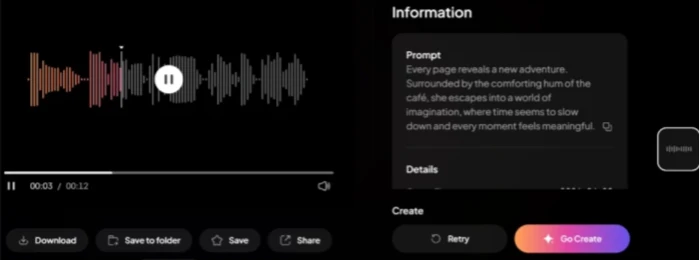
Score: 7.0. Competent rather than category-leading against a voice specialist. The point is the bill. A creator chaining separate services pays one subscription for images, a second for video, a third for voice, and a fourth for upscaling. PixVerse collapses that into a single line item, which is the strongest structural argument in its favour.
Free credits that keep arriving
Three accumulation paths run in parallel. Daily login rewards arrive for showing up. One-time achievement rewards land at platform milestones. Refer-and-earn credits pay both sides of an invitation. This scored 7.5.

Most platforms in this category treat paid subscription as the only route to credits. PixVerse does not, and for a user with a network to refer, the offset is material.
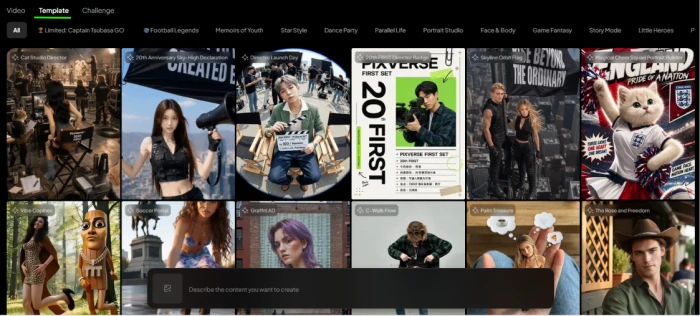
A templates library
Pre-built prompt templates across every modality, scored 7.0. They will not replace the detailed cinematic prompt used in the test above. They lower the entry cost for anyone who has never written one.
One correction to a claim you will read elsewhere. Both platforms expose public share URLs for finished output, as the two embedded links in this article demonstrate. That is not a PixVerse exclusive.
What You Will Actually Pay
Neither company sells videos. Both sell credits, which means you are buying attempts, and attempts fail.
This is the single largest complaint in both review threads. Akool’s credit system scored 6.5 for transparency, PixVerse’s scored 6.0. They are the two lowest scores either platform recorded on a shared category.
Akool
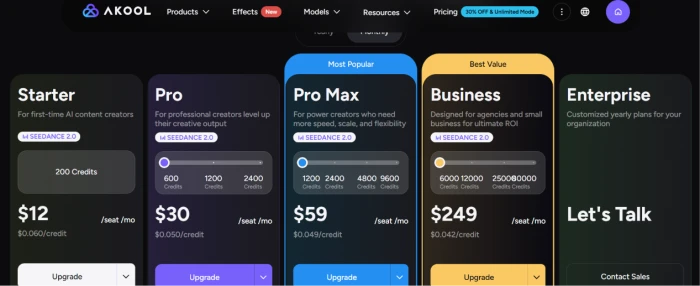
| Tier | Price | What changes |
|---|---|---|
| Free | $0 | 720p ceiling, watermark, ten minute maximum |
| Pro | $30 a month | Watermark removed, up to 4K, limited Live Camera |
| Pro Max | Mid tier | Full API access, unrestricted Live Camera, longer durations |
| Business | Up to $500 a month | Studio avatars, maximum processing speed, full API |
Published credit rates run at roughly 10 credits per 10 seconds of 1080p output and 40 credits per 10 seconds at 4K. Premium engines such as Sora 2 or Google Veo 3.1 draw more per generation, and Akool does not publish every per-model rate in one place. You discover the cost by spending it.
The seat charge
Akool’s own pricing page states that every admin or editor invited into a workspace is billed at the owner’s rate. An owner on the $30 Pro plan who adds two editors pays $90 a month.
Price the seats before you price anything else. A four person team is looking at a $120 product.
PixVerse
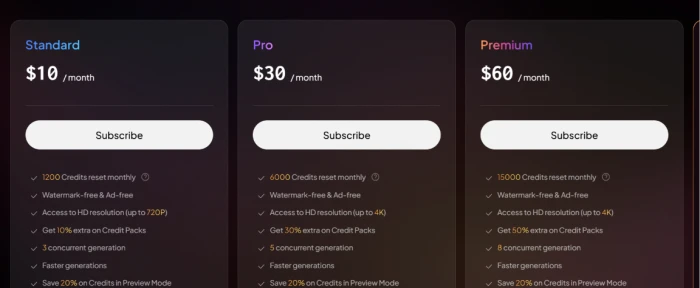
| Tier | Price | What changes |
|---|---|---|
| Basic | $0 | 90 starting credits plus 60 that refill daily, watermarked |
| Standard | About $10 a month | Caps at 720p, three concurrent generations |
| Pro | About $30 a month | 1080p output, higher concurrency |
| Premium and Ultra | Higher tiers | Off-peak savings, batch creation, priority processing |
The credit arithmetic is public. A 1080p five second clip costs 120 credits, or 130 with audio. Video generations consume heavily. Voice sits in the middle, and image generation is the lightest draw. Assume two to five attempts before a clip is publishable, then divide.
Verify both tables against the live pricing pages on the day you buy. Both companies revise tiers, and PixVerse ships a model update every two to three months.
The Free Plans Are Not Equal
Akool’s free tier scored 7.0. It watermarks output and caps at 720p with a ten minute limit, which is enough to test whether the avatar quality suits your face and your brand before you spend.
PixVerse’s free tier scored 5.5, the weakest number in either review. The daily refill is genuinely generous for slow experimentation, and yet it runs dry before you can validate a full end-to-end workflow. Video generations eat the allowance fastest.
An awkward result follows. PixVerse gives you more days of free access. Akool gives you a more useful single evaluation. If you have one afternoon, spend it on Akool. If you have a fortnight, PixVerse teaches you more.
Credits, Refunds, and the Face Problem
The section most comparison articles skip, and the one where money and legal exposure live.
- Credits expire at the end of the billing cycle on both platforms. Nothing rolls over.
- PixVerse daily credits die the same day. Unused free credits are not banked.
- Akool bills in US dollars only and states a no-refund policy.
- Both watermark free output, so neither free tier produces anything publishable.
The face problem
Akool’s two strongest features are its most legally loaded. Swapping an identifiable person’s face, or cloning a voice, without documented written permission exposes you to likeness and publicity claims across most jurisdictions, and to criminal liability under synthetic media statutes now on the books in several US states.
Get a signed release. Keep it. The same applies to an avatar trained on an employee who later resigns, which is a scenario that has already reached litigation elsewhere in this category.
PixVerse restricts explicit content through moderation filters. That frustrates some creative work and forecloses a category of misuse. Neither company is wrong here. They are defending different risks.
The Scorecard
Scored on the same ten-point methodology in June 2026. Start with the categories both platforms compete in.
| Shared category | Akool | PixVerse |
|---|---|---|
| Image-to-video, validated with public URL | 8.0 | 8.0 |
| Free tier usefulness | 7.0 | 5.5 |
| Credit system transparency | 6.5 | 6.0 |
| Overall | 7.8 | 7.3 |
Now the categories where only one competes. This table, rather than the one above, is the actual decision.
| Category | Platform | Score |
|---|---|---|
| Video translation, 155 plus languages | Akool | 8.5 |
| Face swap, studio-grade | Akool | 8.0 |
| Avatar video quality | Akool | 8.0 |
| Live streaming avatars | Akool | 8.0 |
| API access | Akool | 7.5 |
| Multi-modal workflow under one bill | PixVerse | 8.0 |
| Refer-and-earn plus rewards | PixVerse | 7.5 |
| Text-to-image generation | PixVerse | 7.0 |
| Voice generation | PixVerse | 7.0 |
| Templates library | PixVerse | 7.0 |
Read the second table honestly and Akool’s exclusive column carries the heavier numbers. Read it again with your own job in mind and that stops mattering, because an 8.5 on video translation is worth zero to a creator who never leaves English.
Alternatives Worth Twenty Minutes
- HeyGen, scored 8.7 in our testing, leads Akool on avatar depth and starts at $24 a month.
- Synthesia, at 8.5, remains the corporate training specialist.
- Runway and Kling both beat PixVerse on our video generator scoring, at 7.6 and 7.5.
- Morph Studio routes to Sora, Veo, Kling, and other frontier engines openly, which is the same architecture Akool uses without announcing it.
That final bullet deserves a second read. If your Akool testing shows one engine consistently winning, price that engine on its native platform before you subscribe. You are paying Akool for workflow, and workflow you never use is a tax.
The Verdict, as Decision Rules
Naming an outright winner would misrepresent a 0.5 point gap built almost entirely from features one platform does not attempt.
- Buy Akool if a human face in your video has to speak, translate, appear live on a call, or be swapped for another face. The 8.5 translation score and the sub-frame Live Camera latency have no equivalent on the other side.
- Buy PixVerse if you are producing narrated visual content alone and one bill matters more than category-leading depth in any single modality.
- Buy neither on the strength of image-to-video. They tied at 8.0, and I have embedded both outputs above so you can confirm that yourself.
- Buy the underlying engine directly if your own testing shows a specific model winning inside Akool.
One number to settle before a card touches either checkout. Akool’s seat charge, covered in the pricing section above, means a small team pays a multiple of the advertised price. Price the seats first, then the credits, then your real failure rate per usable clip, and only then argue about which model renders prettier steam. Most people work that list backwards and meet the true cost in month two.
Comments
Join the discussion and share your perspective.