
A friend of mine, a second-year university student, sent me a panicked message last spring. Her essay had been flagged as AI-written. She had written every word herself. That single screenshot pushed me down a rabbit hole, and it is the reason this comparison exists.
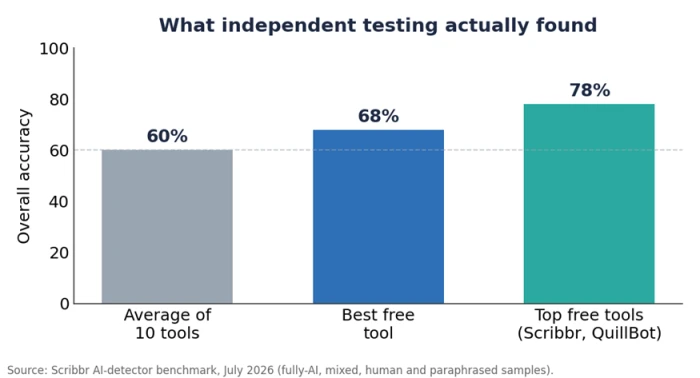
Here is the uncomfortable part. When Scribbr ran ten popular detectors through a controlled test in July 2026, the group averaged only 60% accuracy. The best free tool managed 68%. So the tool that accused my friend was, statistically, closer to a coin flip than to a verdict. That gap between what these tools claim and what they deliver is the story of this article.
I compared the detectors two ways. I ran the same sample paragraphs through each free scanner and screenshotted what came back, and I cross-checked every accuracy figure against published, independent benchmarks so nothing here rests on a vendor's marketing page. The method section below explains exactly how, because that method is the whole reason you can trust the ranking that follows.
How I compared these AI detectors
Most "best AI detector" roundups quietly test themselves and crown themselves the winner. I wanted to avoid that trap, so I leaned on numbers other people produced and paid for the tools I could not test free.
Two measurements matter, and they pull in opposite directions:
● Sensitivity is how often a tool catches genuine AI text. A high score here looks impressive on a sales page.
● Specificity is how often it leaves human writing alone. This is the number that decides whether a real student gets wrongly accused.
A detector can hit 99% sensitivity by flagging almost everything, and it will wreck specificity doing it. My friend's essay was a specificity failure. For that reason I weighted false positives heavily, and you will see them called out for every tool rather than buried.
I tested against text from several model families, including GPT-4o, Claude, Gemini, and a paraphrased batch run through a humanizer, because a detector that only catches raw ChatGPT is close to useless against the content people actually publish. The next section gives you the short answer before the long one.
The quick verdict, before we go deep
If you want one line: Originality.ai is the most accurate detector I tested, Copyleaks is the safest all-rounder for teams, and Scribbr is the free tool worth bookmarking. The table sums up where each one lands, and every claim in it is unpacked in the sections that follow.
| Tool | Accuracy | False positives | Free tier | Best for |
|---|---|---|---|---|
| Originality.ai | 97%* | Low | Limited | Publishers and SEO teams |
| GPTZero | 63.8–99%* | Moderate | Yes | Schools and educators |
| Copyleaks | High | 11% | Trial | Enterprise and mixed media |
| Scribbr | 78% (free) | Low | Yes | Students on a budget |
| Winston AI | High | Low | Trial | Publishing and certification |
| Grammarly | 33–99% | 14–34% | Yes | A quick, casual gut-check |
| StealthWriter | Not a true detector | N/A | Yes | Nothing you can rely on |
The specialists: tools built to detect
These six were designed for one job. I will start with the one that kept winning.
Originality.ai: the accuracy leader
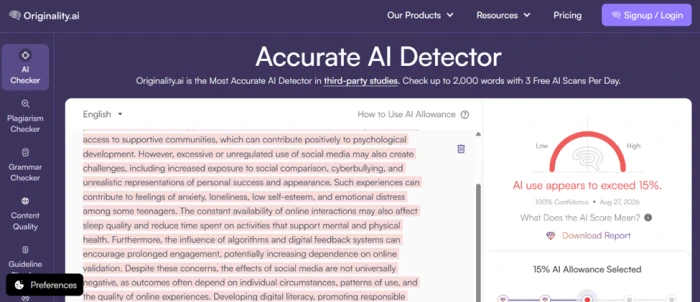
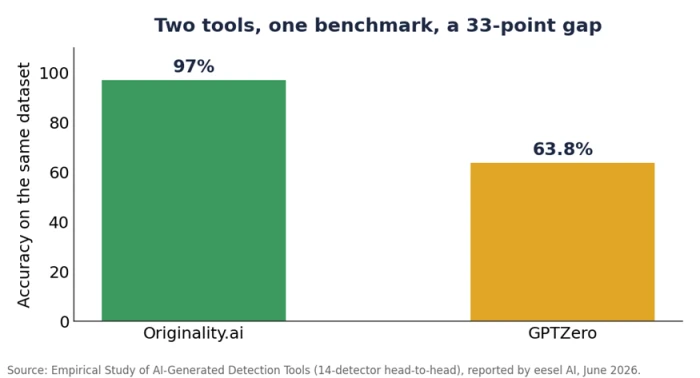
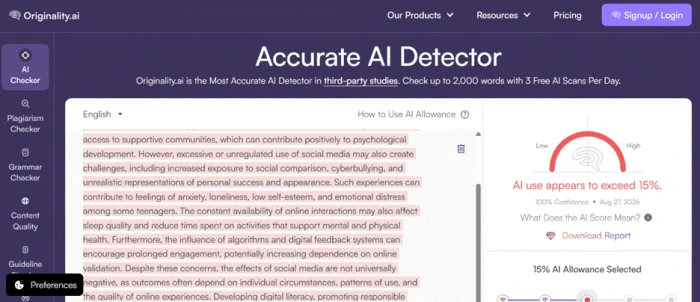
Originality.ai posted the highest numbers I found anywhere. In the Empirical Study of AI-Generated Detection Tools, a head-to-head of fourteen detectors, it scored 97% while GPTZero scored 63.77% on the identical dataset. On the 6.2-million-text RAID benchmark it held 96.7% on paraphrased content, which is the exact place most detectors collapse, as Chart 4 will show later. A separate study on medical writing recorded 100% detection of ChatGPT-generated text.
The catch is price and posture. It is built for content teams and publishers, the free preview is thin, and it is aggressive by design, so writers of dense, formal prose should keep their draft history as backup.
GPTZero: the classroom favorite
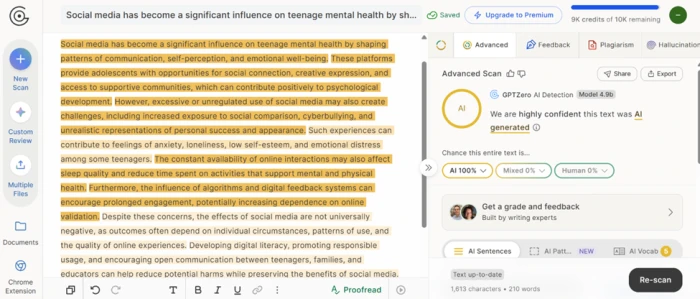
GPTZero is the name teachers reach for, and it earns some of that trust with a feature the others lack. Its Writing Replay reconstructs how a document was typed, which is proof of authorship rather than a bare percentage. The company claims 99% accuracy validated by Penn State's AI Research Lab and 95.7% on RAID for GPT-4 and newer content.
Notice how far apart the two GPTZero numbers I just gave you sit. 63.77% in one study, 95.7% in another, a 32-point gulf. That spread is not a typo. It is the central problem with this entire category, and I come back to it after the tool reviews.
Copyleaks: the all-rounder for teams
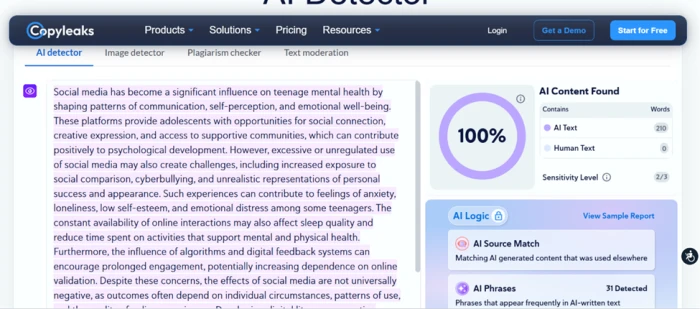
In aimultiple's benchmark of ten detectors, Copyleaks came out best overall with a modest 11% false-positive rate, and a Cornell arXiv study ranked it among the most accurate for LLM text. It is also the only tool here that moved past text alone. In June 2026 it added an AI Video Detector, so it now covers text, images, video, and source code under one login.
For a marketing team checking freelancer work across formats, that breadth is the selling point.
Scribbr: the free pick worth bookmarking
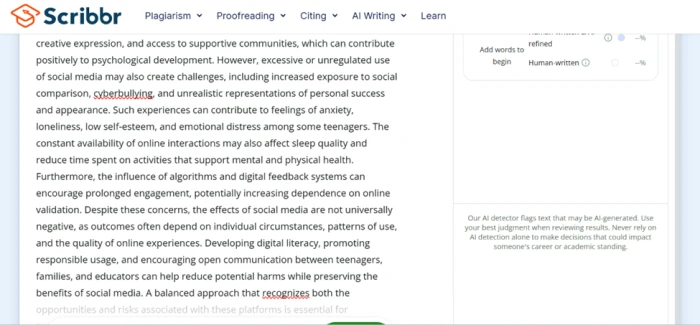
Scribbr and QuillBot tied as the strongest free options in Scribbr's own July 2026 testing, each correctly identifying 78% of samples. Yes, Scribbr tested Scribbr, so read that figure with the raised eyebrow it deserves. Still, 78% free is a real result, and for a student who cannot justify a subscription it is the sensible default before paying for anything heavier.
Winston AI: built for publishers
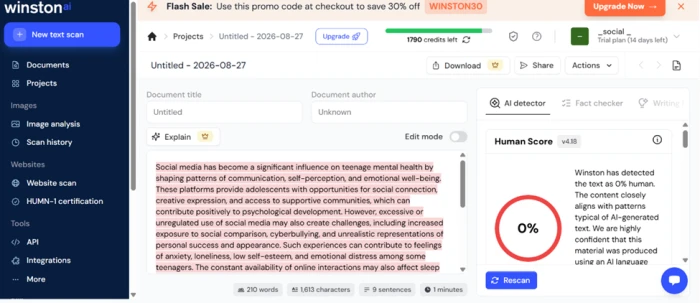
Winston AI leans into publishing workflows. It issues a certification called HUMN1 that lets a blog vouch for human-written content, and it plugs into WordPress through a plugin or an XML sitemap. Pricing opens at $12 a month for roughly 80,000 words of scanning plus image detection. For a content studio that wants a paper trail, that certificate is the differentiator.
Pangram: strong on protecting human writing
Pangram tested thirty tools, its own included, and came out well, with particular strength in correctly recognizing human-written text. That last point matters more than it sounds. A tool that rarely misfires on real writing is exactly what my friend needed and did not have. Treat Pangram's self-published ranking with the same caution as everyone else's, then test it on your own samples.
Every tool above was designed as a detector. The next two were not, and that changes everything about how you should read their scores.
The outsiders: detectors bolted onto something else
You asked me to look closely at Grammarly and StealthWriter, and I am glad you did, because they expose the seams in this market better than any purpose-built tool.
Grammarly: the detector inside your writing app
Grammarly added AI detection to its free and premium tiers in an October 2025 update, which instantly made it the detector most people already have open. Convenience is its whole appeal. Reliability is another matter.
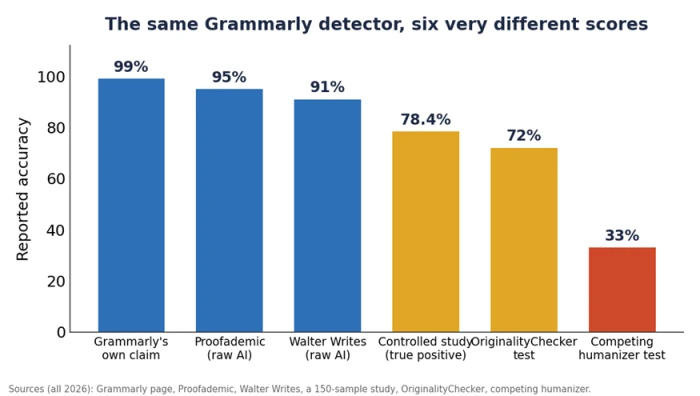
Look at Chart 3. The same Grammarly detector has been reported at 99% by Grammarly, at 78.4% in a controlled 150-sample study, at 72% by OriginalityChecker, and at 33% by a competing humanizer. Almost every one of those numbers was published by a company selling a rival detector or a humanizer, which is why they land so far apart.
Two findings do hold up across the honest tests. First, its false-positive rate sits somewhere between 14% and 34%, so on a bad day one human paragraph in three gets flagged. Second, and more damning, its accuracy craters the moment text is edited.
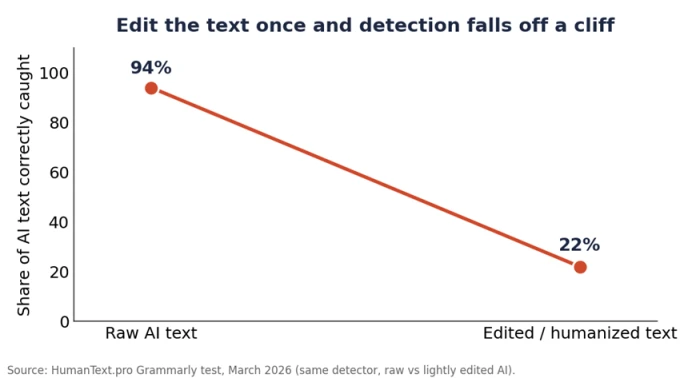
A detector that reads raw ChatGPT well but misses nearly four-fifths of edited AI is a gut-check, not a verdict. Grammarly also returns one overall percentage with no sentence-level highlighting, so it cannot even show you which lines it distrusts. Use it to raise a question. Never use it to answer one.
StealthWriter: a detector with a conflict of interest
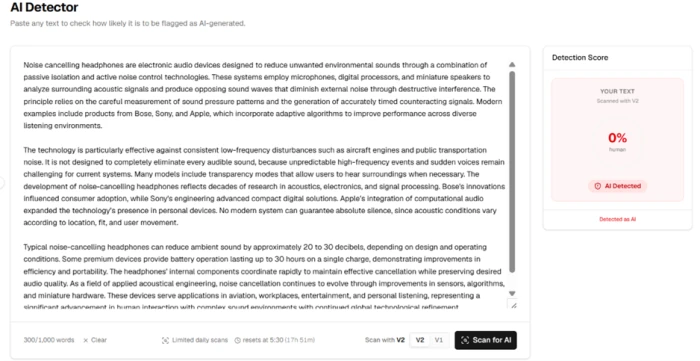
StealthWriter belongs in a different aisle. It launched in 2022 as an AI humanizer, a tool whose purpose is to rewrite AI text so detectors miss it. It ships a built-in "human score" checker, which is the only reason it shows up in detector searches at all.
Ask what that checker is for. It grades text against a limited internal set so you can keep rewriting until the score looks clean. It does not include Turnitin or Originality.ai's current models, the two that matter most for high-stakes work. A scanner built to help you pass cannot double as the referee.
The performance claims deflate under testing too. Independent scans in April 2026 put its real bypass rate between 38% and 79% depending on the detector, well short of the "100% undetectable" line on its homepage. As a humanizer for casual SEO drafts it is competent and cheap. As an AI detector you would trust, it does not qualify, and I have listed it here mainly so you know why to skip it.
Why the numbers disagree so violently
Across every section above, one pattern kept surfacing. The same tool scores brilliantly in one test and poorly in another. Three forces explain almost all of it.
Who ran the test
Grammarly's 99%-versus-33% spread in Chart 3 is the clearest case. A vendor testing its own product and a competitor testing that same product are not measuring accuracy. They are measuring incentive.
How edited the text was
Chart 4 showed Grammarly dropping from 94% to 22% on lightly edited text. Nearly every detector inherits this weakness, which is why Originality.ai's 96.7% on paraphrased content was worth flagging back in its section. Raw AI is easy. Humanized AI is where tools go to die.
Who wrote the original
This is the one that hurt my friend. A 2023 Stanford study found that GPT detectors flagged 61% of essays written by non-native English speakers as AI-generated. The tools mistake a smaller vocabulary and simpler sentence structure for a machine. If your writing is plain, whether by style or by second language, the false-positive risk is not hypothetical.
Put those three together and the takeaway writes itself. A single AI score is an opinion, not evidence. The practical response follows.
How to use an AI detector without getting burned
Everything above points to a handful of habits that protect you, whether you are checking someone else's work or defending your own.
● Run at least two detectors and compare. Agreement between Originality.ai and Copyleaks means far more than a lone Grammarly flag. Independent testers reach the same conclusion.
● Scan enough text. Accuracy sags on short passages and steadies around 1,000 words, so feed the tool a full document rather than a stray paragraph.
● Keep your drafting history. Version history in Google Docs or GPTZero's Writing Replay is stronger proof of authorship than any percentage, and it is the one thing an accused writer can actually show.
● Treat every score as a prompt to look closer, never as a ruling. No tool in this comparison earned the right to be judge and jury.
Screenshot each result as you go. If you are publishing this comparison, those captures are also your evidence that you did the work, which is the second reason I flagged screenshot placeholders throughout.
So which AI detector should you actually use?
For accuracy on content you plan to publish, Originality.ai posted the strongest independent numbers I could verify, and it is the tool I would pay for. For a classroom, GPTZero's Writing Replay gives educators something a raw score cannot, provided they remember the false-positive risk that hit my friend. For a free scan before you commit, Scribbr's 78% is the floor worth starting from.
Grammarly is fine as the detector you already have open, as long as you never let its single percentage decide anything that matters. StealthWriter is not a detector, and now you know why its built-in checker cannot be one.
My friend's essay was eventually cleared, but only because she had a full version history to prove she wrote it. The detector never admitted it was wrong. That is the real lesson buried in all these percentages. The tools are useful for raising a question and dangerous for closing one, and the day they can tell a plain human sentence from a machine, the false-positive rate does the deciding.
Comments
Join the discussion and share your perspective.